










Mussaenda: The Tropical Wonder with Ornamental Bracts
Introduction to Mussaenda
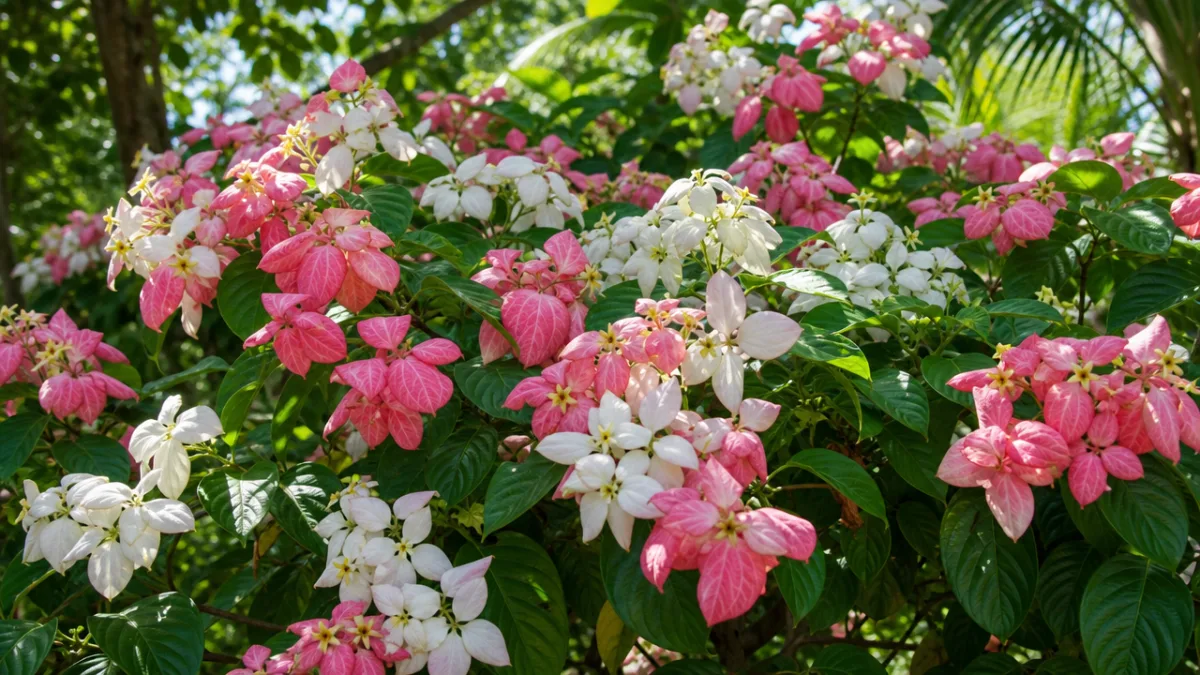
Mussaenda is a genus of flowering plants in the family Rubiaceae — the same family that gives us coffee and gardenia. Native to tropical and subtropical parts of Africa, Asia, and the Pacific Islands, these beautiful shrubs and small trees have won over gardeners and plant lovers all over the world. What makes them so special isn’t actually their flowers, which are small and easy to miss, but their dramatically enlarged, colorful sepals — usually called bracts — that steal the whole show. These bracts come in white, pink, red, yellow, and orange, which is why Mussaenda tends to be one of the most eye-catching plants you’ll find in any tropical garden.
The name Mussaenda actually comes from a Sinhalese word used in Sri Lanka, which hints at just how deeply rooted this plant is in Asian botanical tradition. For centuries, people have been cultivating these plants in tropical gardens from the Philippines to India and all across Southeast Asia. They love warm, humid conditions and you’ll commonly spot them in public parks, home gardens, and along roadsides in countries like Thailand, Malaysia, and India. Because they can bloom for much of the year in tropical climates, landscapers especially love them for providing long-lasting color and visual drama.
What really sets Mussaenda apart from other ornamental shrubs is what happens to its calyx. In most flowering plants, sepals are just little green coverings that protect the developing bud — nothing exciting. But in Mussaenda, one or more of those sepals blows up into a large, colorful, leaf-like structure that completely upstages the actual flower. This is thought to work as a kind of natural billboard for pollinators, drawing in insects and birds from far away. The effect is a plant that looks like it’s perpetually blooming, with soft, pastel-toned bracts floating around clusters of tiny star-shaped flowers.
Species and Varieties of Mussaenda
There are roughly 200 species in the Mussaenda genus, though most of what you’ll find in gardens are hybrids developed through careful breeding programs over the years. One of the most beloved species is Mussaenda erythrophylla, commonly known as Ashanti blood or Red flag bush, which originally comes from tropical West Africa. It produces deep, vivid red bracts that look almost flame-like against its dark green leaves. It’s also a vigorous grower — left unpruned, it can easily reach two to three meters tall — which makes it great as a bold specimen plant or an informal hedge.
Mussaenda philippica is probably the most widely grown species in tropical Asia, and it’s something of an unofficial garden icon in the Philippines. In its natural form it produces white bracts, but hybridizers have used it to create a wide range of cultivars in pink, salmon, peach, and creamy yellow. One of the most celebrated is ‘Aurorae’, named after Aurora Aragon Quezon, wife of the first President of the Philippine Commonwealth. Its large, overlapping white bracts give it an almost snow-dusted appearance even in the height of summer. Then there’s ‘Dona Trining’, another famous Philippine cultivar, with vivid pink bracts that deepen toward the center for a rich, romantic look.
Modern hybridization has produced a remarkable range of Mussaenda varieties suited to different spaces and climates. Compact varieties work beautifully in containers and smaller urban gardens, while more vigorous hybrids are perfect as large landscape shrubs or trained into small trees. Some standout hybrids include ‘Queen Sirikit’, a Thai cultivar with deep, rich pink bracts, and ‘Dona Evangelina’, which comes in soft oranges and peachy tones. These hybrids tend to be especially popular because they bloom more freely and consistently than many pure species, and they often carry more enlarged bracts per flower cluster, which only adds to the visual impact.
Growing Conditions and Climate Requirements
At heart, Mussaenda is a tropical plant, and it does best in conditions that echo where it came from — warm temperatures, high humidity, and reliable rainfall. It’s happiest in USDA hardiness zones 10 through 12, where frost isn’t a concern and temperatures rarely dip below 10 degrees Celsius. In those zones, you can grow Mussaenda outdoors year-round as a permanent garden plant. In cooler climates, it’s commonly kept in containers and brought indoors or into a heated greenhouse over winter, where it can still grow and occasionally bloom as long as it has enough light and warmth.
Mussaenda really loves a spot with full sun to partial shade. It can handle some shade, but if you want the most vibrant, abundant bract displays, aim for at least six hours of direct sun a day. That said, in places with punishing afternoon heat, a little light shade in the afternoons can actually help prevent leaf scorch and keep the bracts looking their best — too much intense UV can wash out the colors over time. Good air circulation also matters, since Mussaenda can be prone to fungal problems when the air around it stays still and humid, especially if plants are crowded together without much breathing room.
Soil quality makes a real difference with Mussaenda. These plants do best in well-draining, fertile soil with a slightly acidic to neutral pH somewhere between 5.5 and 7.0. Heavy clay that holds too much water is bad news — it can lead to root rot, which can take down even a well-established shrub surprisingly fast. Working plenty of organic matter into the planting area, whether that’s compost, well-rotted manure, or coconut coir, improves both drainage and nutrition. For container growing, a good-quality potting mix blended with perlite or coarse sand gives you the drainage these plants need to thrive without sitting in soggy soil.
Planting, Pruning, and General Care
The best time to plant Mussaenda is at the start of the warm season, when the soil is warming up and there’s no more risk of cold stress. When going in-ground, dig your hole roughly twice as wide as the root ball and the same depth, so the plant sits at the same level it was in its nursery pot. Fill back in with enriched soil, water it well to settle everything, and then lay down a layer of organic mulch around the base — just keep it away from the stem itself. That mulch will help hold moisture, keep the soil temperature steady, and keep weeds from competing with the plant while it’s getting established.
Pruning is genuinely one of the most important things you can do for a Mussaenda. Because these shrubs bloom on new growth, regular pruning directly drives more flowering — trim the plant, it pushes out fresh shoots, and fresh shoots mean more flowers and bracts. Light tip pruning throughout the growing season keeps the shape compact and bushy and encourages the plant to branch out nicely. Then, once or twice a year after the main bloom flush winds down, a harder prune will rejuvenate the whole plant, spark vigorous new growth, and prevent the open, leggy look that unpruned older plants tend to develop.
Watering and fertilizing are the other two big pillars of keeping Mussaenda happy. During the growing season, water deeply and regularly so the soil stays consistently moist but never waterlogged. In drier climates or during dry spells, you may need to water more often to prevent wilting and bract drop. For fertilizing, a balanced slow-release fertilizer in spring followed by a phosphorus-rich formula mid-season does a great job of supporting both growth and blooming. If you want to push things further — especially with container plants that have limited access to nutrients — supplementing with a liquid fertilizer every two to three weeks during the active growing period can make a noticeable difference.
Propagation Methods
Mussaenda can be propagated a few different ways, and the best method usually comes down to what you have available and how many plants you’re trying to grow. Stem cuttings are by far the most popular choice for home gardeners and nursery growers alike because they’re reliable and fairly straightforward. Softwood cuttings from healthy, actively growing tips in spring or early summer root well when treated with rooting hormone and kept in a warm, humid environment. Aim for cuttings about 10 to 15 centimeters long, strip the lower leaves, dip the cut end in rooting powder or gel, and then push them into a well-draining propagation medium like perlite or a 50/50 mix of coarse sand and peat.
Air layering is another solid option, especially if you want a larger, more established plant sooner than cuttings can provide. The idea is to wound a section of healthy stem by removing a ring of bark and cambium, pack the wound with moist sphagnum moss, and wrap the whole thing tightly in clear plastic film. Over the following weeks, roots form right there on the parent plant, fed by the continuous flow of water and nutrients from the main stem. Once you’ve got a good root system — usually after six to ten weeks — you cut the rooted section off and pot it up. You’re essentially starting with a well-rooted specimen right from the beginning.
Seed propagation is possible with Mussaenda, but it’s less commonly used, and for good reason. Most popular garden varieties are hybrids, and seeds from hybrid plants won’t reliably reproduce the parent’s characteristics — the seedlings can be quite unpredictable. That can be fun if you’re in an experimental mindset, but it’s not great if you’re trying to reproduce a specific cultivar. With pure species, though, seed propagation can be quite rewarding. Fresh seeds germinate reasonably well when sown in a warm, moist medium at temperatures above 22 degrees Celsius. Soaking the seeds in warm water for 24 hours before sowing tends to speed things up, and seedlings usually reach a transplantable size within eight to twelve weeks under good conditions.
Pests, Diseases, and Troubleshooting
Like most ornamental shrubs, Mussaenda has its share of pest and disease challenges that can cause real problems if you let them go unchecked. The most common insect pests are aphids, mealybugs, and spider mites — all sap-feeders that can distort new growth, cause leaves to yellow, and generally wear the plant down over time. Aphids and mealybugs especially love warm, sheltered spots where their natural predators aren’t around to keep them in check. The good news is that if you catch an infestation early — which means regularly checking the undersides of leaves and the growing tips — you can often deal with it using a strong blast of water, some insecticidal soap, or a few applications of neem oil.
Fungal diseases are another real concern, particularly in humid climates where air doesn’t circulate freely around the plants. Powdery mildew can show up on the foliage when you get warm days and cool nights combined with high humidity, leaving a white, powdery film on the leaf surface. Root rot from Phytophthora and similar water mold pathogens is a more serious issue in waterlogged soil and can kill a plant quickly once it takes hold. The best approach is preventive: give plants enough space for good airflow, avoid watering from overhead, amend soil for proper drainage, and use fungicide treatments when conditions are particularly high-risk.
Nutrient deficiencies are something a lot of Mussaenda growers run into, especially in containers or naturally poor soils. Iron chlorosis — where the leaves turn yellow but the veins stay green — is a common one, and it often comes down to high soil pH locking up the available iron. You can fix this by lowering the pH with sulfur or treating the plant with chelated iron. Nitrogen deficiency looks a bit different: the whole leaf goes pale and yellowish and growth slows noticeably, but it responds quickly to a balanced or nitrogen-rich fertilizer. Staying on top of a regular fertilization schedule and keeping an eye on how your plant looks are really your best defenses against nutritional problems snowballing into something harder to fix.

Cultural Significance and Uses
Mussaenda is more than just a pretty garden plant — it carries real cultural weight in many of the regions where it’s traditionally grown. In the Philippines especially, there’s a lovely tradition of naming Mussaenda cultivars after prominent Filipino women and public figures, a practice that became popular in the twentieth century through the work of horticulturists at the Bureau of Plant Industry. This has turned certain cultivars into living tributes to historical and cultural figures, and the tradition continues today with new hybrids still being named in honor of notable individuals, weaving together botanical culture and national heritage in a genuinely touching way.
In traditional medicine, various parts of the Mussaenda plant have been used in folk remedies across parts of Asia and Africa for things like fever, inflammation, and skin conditions. Scientific research into these potential therapeutic properties is still fairly early-stage, but some preliminary studies have found compounds with antioxidant, anti-inflammatory, and antimicrobial activity in Mussaenda extracts, which has sparked growing academic interest in the genus as a possible source of bioactive compounds. That said, it’s worth emphasizing that self-treating with plant-based remedies is always something to approach carefully, ideally with professional guidance.
From a landscaping and ecological standpoint, Mussaenda brings benefits that go well beyond looking good. Its flowers and bracts are a magnet for pollinators — butterflies, bees, and sunbirds all love them — making it a genuinely valuable addition to any wildlife-friendly garden. In tropical cities, where green cover plays a real role in managing heat island effects and supporting biodiversity, Mussaenda is a practical and beautiful choice. Its relatively fast growth, tolerance for urban conditions, and long blooming season make it a natural fit for public landscaping, streetscaping, and community garden projects that want to add beauty to urban spaces while doing something good for local ecosystems at the same time.








What do you think?
It is nice to know your opinion. Leave a comment.