










Malvaceae: A Complete Guide to the Mallow Family
Introduction to the Mallow Family
If you’ve ever grown hibiscus in your garden, eaten okra in a stew, or unwrapped a chocolate bar, you’ve already had a close encounter with Malvaceae — the mallow family. With over 4,000 species spread across roughly 244 genera, this is one of the most diverse and far-reaching plant families on the planet, found on every continent except Antarctica. We’re talking about everything from towering tropical rainforest trees to the delicate little wildflowers you might spot growing along a country lane. Very few plant families can match that kind of range.
This family also has deep roots in human history — literally thousands of years of it. Ancient Egyptians were growing marsh mallow for its medicinal properties. Indigenous peoples across the Americas were using mallow family plants for food, fiber, and medicine long before Europeans arrived. And today, some of the most important crops and garden plants in the world — cotton, okra, hibiscus, cacao — all belong here. Getting to know Malvaceae isn’t just an exercise in botany; it’s a way of understanding how plants have shaped human civilization.
One thing worth knowing is that the family looks quite different today than it did a few decades ago. Advances in DNA analysis and molecular phylogenetics have led botanists to fold several formerly separate families — including Bombacaceae, Tiliaceae, and Sterculiaceae — into the broader Malvaceae. This wasn’t a bureaucratic reshuffling; it reflects genuine shared evolutionary history. The result is a family that’s bigger, messier, and honestly more interesting than the old version, and one that continues to reward anyone willing to spend time with it.
Key Identifying Features of Malvaceae Plants
Once you know what to look for, identifying mallow family plants becomes surprisingly intuitive. The single most reliable feature is the staminal column — a distinctive structure where all the stamens are fused together around the central style, forming a kind of tube or column right in the middle of the flower. You’ll see this in a common garden hollyhock and in a tropical kapok tree alike. If you spot that column, you’re almost certainly looking at a Malvaceae.
The flowers offer plenty of other clues too. The five petals are often twisted or contorted in the bud, giving them a pinwheel look before they open, and they tend to be large and silky, covering a wide color range from white and soft pink all the way through to deep crimson, orange, yellow, and purple. Many species also have an epicalyx — a ring of leaf-like bracts sitting just below the true sepals that can look, at first glance, like an extra row of petals.
Away from the flowers, there are still useful clues to hunt for. The leaves are typically alternate and simple, often palmately veined with a lobed, heart-shaped, or rounded form. If you have a hand lens handy, look closely at the stems and leaves — many Malvaceae species are covered in tiny star-shaped hairs, called stellate hairs, that are another reliable family-wide trait. And if you snap a stem and notice a slimy, gel-like sap, that’s mucilage, the same substance that gave the marsh mallow plant its fame and eventually gave us the word “marshmallow.”
- Staminal column: fused stamens forming a central tube around the style
- Five petals, often twisted in bud, with a silky or papery texture
- Epicalyx: a ring of bracts below the true calyx
- Alternate, palmately lobed or veined leaves, often with heart-shaped base
- Stellate (star-shaped) hairs on stems and leaves
- Mucilaginous sap in stems, leaves, and roots
- Diverse fruit types including schizocarps, capsules, and berries
Flowers of the Mallow Family: From Wildflowers to Ornamentals
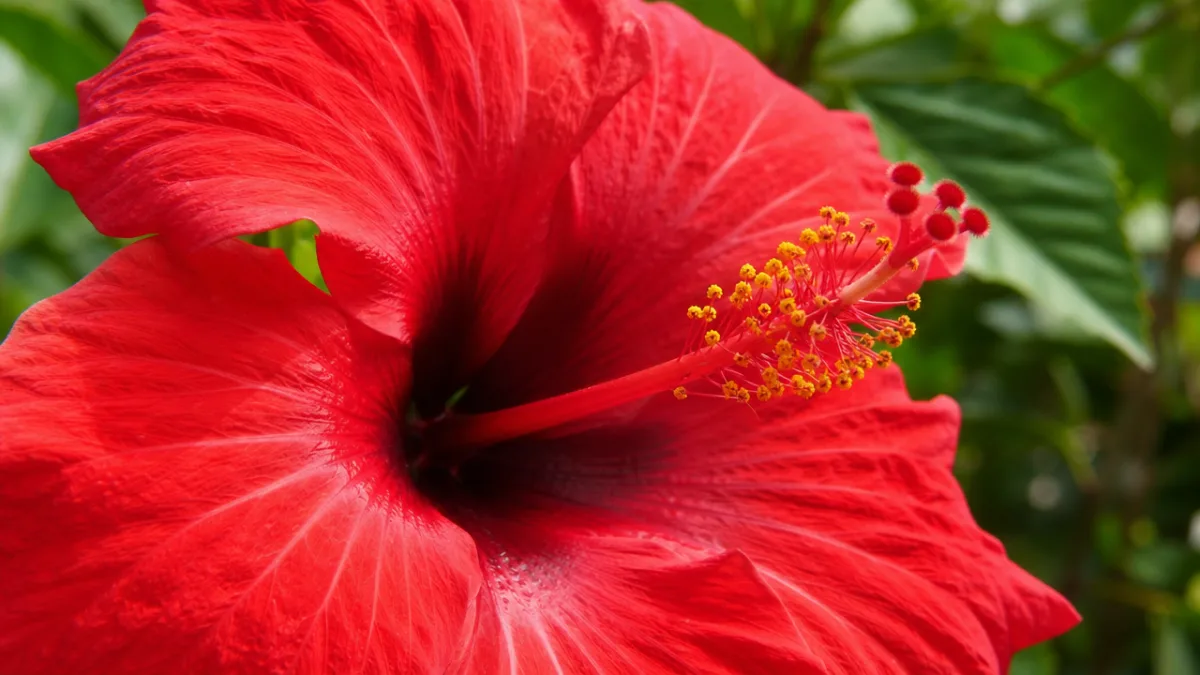
Gardeners have been obsessed with mallow family flowers for centuries, and it’s not hard to see why. Hibiscus alone gives you hundreds of species and thousands of cultivated varieties, spanning nearly every warm color you can imagine. Hardy species like Hibiscus moscheutos produce blooms the size of dinner plates in temperate gardens, while the tropical Hibiscus rosa-sinensis — the national flower of Malaysia — is one of the defining images of tropical landscaping worldwide. When a hibiscus opens fully, petals fanning out from that prominent staminal column like a sunburst, it’s genuinely one of the more arresting sights in the plant world.
Hollyhocks (Alcea rosea) have a different kind of appeal — steeped in history rather than drama. They’ve been growing in European cottage gardens for hundreds of years and turn up in medieval manuscripts and herbal texts with surprising frequency. They send up tall spires — sometimes two to three meters high — and produce flowers along the full length of the stem in a slow upward progression that can stretch the display over weeks. Single and double-flowered forms come in colors from near-black burgundy to pale lemon yellow. There’s something undeniably nostalgic about them, which is exactly why they remain a staple of informal and heritage-style garden designs.
It would be easy to overlook the wild mallows in favor of their showier cultivated relatives, but that would be a mistake. Common mallow (Malva sylvestris) pops up along roadsides and on disturbed ground across Europe, Asia, and North America, and its small five-petaled flowers — pink-purple with beautiful darker veining — are exquisite up close. Checker mallow (Sidalcea) and prairie mallow (Sphaeralcea) bring the same charm to North American meadows, while sea hollyhock (Kosteletzkya) thrives in coastal marshes. These wildflowers may be modest in size, but they show the same elegant floral architecture as their cultivated cousins, and they’re far more important to native bees and butterflies than most showy garden varieties ever will be.
Shrubs and Trees Within Malvaceae
The mallow family isn’t just about flowers — it also contains some seriously impressive woody plants. Rose of Sharon (Hibiscus syriacus) is a great example: a deciduous shrub that earns its keep in temperate gardens by flowering well into autumn, long after most other shrubs have called it a season. It grows to around three meters, produces funnel-shaped flowers in white, pink, purple, or blue, and is genuinely unfussy about soil. Its cold hardiness compared to other hibiscus species makes it one of those plants that experienced gardeners keep coming back to.
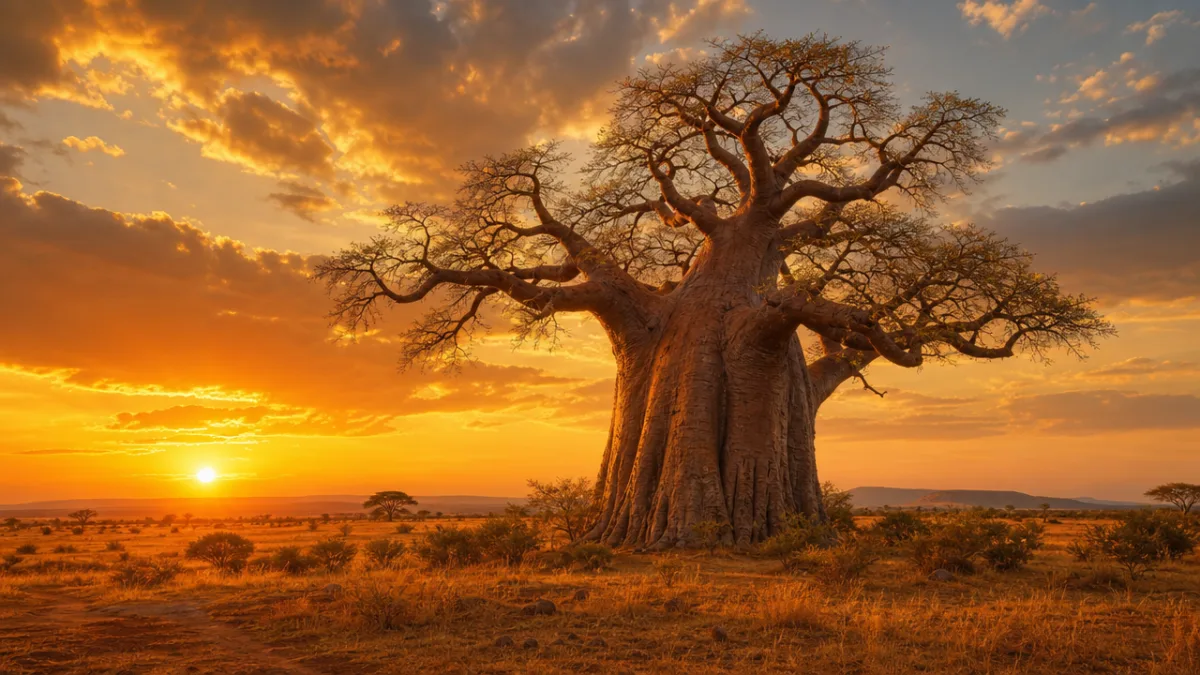
If you want something truly awe-inspiring, look to the baobabs (Adansonia) of Africa and Madagascar. These ancient trees have massively swollen trunks capable of storing thousands of liters of water, can live for thousands of years, and sometimes reach diameters of ten meters or more. Their sparse, almost comically top-heavy crown is what earned them the nickname “the upside-down tree,” as if someone had planted them roots-up. They bloom at night with large white flowers pollinated by bats and bush babies, and for millennia their fruits, leaves, and bark have helped sustain both human and animal communities in some of the driest landscapes on earth.
Then there’s the kapok tree (Ceiba pentandra), now part of Malvaceae after the absorption of Bombacaceae, and a genuine giant of the tropical rainforest. Reaching up to 70 meters, with dramatic spreading buttress roots at the base, the kapok produces seed pods filled with a silky, water-resistant fiber that has been harvested for centuries for use in pillows, life jackets, and insulation. Like the baobab, it blooms at night and relies on bats for pollination. In Maya cosmology, the kapok was the sacred world tree — which gives you a sense of how deeply this plant has been woven into human culture, well beyond its obvious practical uses.
- Hibiscus syriacus — Rose of Sharon; deciduous shrub, temperate gardens, late-season bloomer
- Adansonia — Baobab; iconic African tree, water-storing trunk, bat-pollinated flowers
- Ceiba pentandra — Kapok tree; tropical rainforest giant, fiber-producing seed pods
- Tilia — Linden or lime tree; large deciduous tree, fragrant flowers, major nectar source
- Thespesia populnea — Portia tree; coastal tropical tree, yellow hibiscus-like flowers
- Ochroma pyramidale — Balsa wood tree; fastest-growing wood in the world, bat-pollinated
Economic and Culinary Importance of Malvaceae
When you consider the full modern scope of Malvaceae, it’s hard to think of another plant family that has touched human material culture more broadly. Cotton — grown from several species of Gossypium — is arguably the most important natural fiber in human history, and it still underpins a global textile industry worth hundreds of billions of dollars every year. People have been cultivating it for at least 7,000 years. The fluffy fiber that comes from the seed hairs inside the plant’s boll has shaped trade routes, driven colonialism, restructured entire economies, and changed the social fabric of every inhabited continent. That’s a lot of weight for a plant to carry.
Okra (Abelmoschus esculentus) has a quieter but no less impressive story. Originally from West Africa, it has become a dietary staple across the American South, the Caribbean, South Asia, and the Middle East, valued for its fiber content, its vitamins C and K, and the mucilaginous texture that makes it such an effective natural thickener in dishes like gumbo. What often surprises people is how beautiful okra plants actually are — the flowers, yellow with a dark red center, are as pretty as many ornamental hibiscus varieties. It’s a useful reminder that the line between food plant and garden plant is fairly arbitrary in this family.
And then there’s cacao (Theobroma cacao) — whose scientific name, “food of the gods,” may actually be underselling it. Native to the tropical Americas and cultivated for at least 3,500 years, cacao is the source of chocolate, a commodity of extraordinary global significance. The tree produces its distinctive ribbed pods directly from the trunk and main branches — a phenomenon called cauliflory — and inside those pods are the fermented, roasted seeds that yield cocoa solids and cocoa butter. The fact that cacao now sits within Malvaceae, following the absorption of Sterculiaceae, is one of the more delightful surprises modern botanical science has thrown up. Cotton, okra, and chocolate, all in the same family. It’s a remarkable club to belong to.
Ecological Roles and Conservation Considerations
Malvaceae plants show up as important ecological players in almost every terrestrial biome on earth. Their flowers feed a remarkably wide range of pollinators — bees, butterflies, hummingbirds, and bats among them — and many species have co-evolved with specific partners over millions of years in ways that ecologists are still working to fully map. In tropical forests, the night-blooming flowers of baobabs and kapoks are critical food sources for bats, which in turn provide pollination and seed dispersal services for many other plant species. Remove one of these keystone trees and you can unravel a whole web of ecological relationships.
Several mallow family members are in serious trouble. Kokia drynarioides, a small tree endemic to Hawaii’s dry forests, is critically endangered — only a handful of wild individuals remain, and the species depends entirely on human intervention to survive. Various Hibiscus species native to Pacific and Indian Ocean islands are under heavy pressure from introduced browsing animals, herbicide use, and urban sprawl. These losses aren’t just sad for biodiversity’s sake; they destabilize the ecological networks these plants anchor and sever connections to the traditional cultures that have relied on them for generations.
On the flip side, some Malvaceae species have become genuine nuisances outside their native range. Velvetleaf (Abutilon theophrasti), originally from South Asia, has spread aggressively through North American agricultural land where it competes fiercely with crops and resists eradication. Tree mallow (Malva arborea) has colonized disturbed coastal habitats across Australia and New Zealand. It’s a good reminder that knowing whether a plant is native or introduced matters — even a beautiful, ecologically valuable species can cause real problems when it’s been removed from the natural checks and balances of its home ecosystem.

Growing and Gardening with Malvaceae
For gardeners, the mallow family is something close to a gift that keeps giving. Hardy options like hollyhocks, lavatera, and Hibiscus syriacus will thrive in temperate gardens with minimal fuss, delivering weeks of spectacular bloom through summer and into autumn. More tender species — Hibiscus rosa-sinensis, various Abutilon — can be grown in containers and brought indoors over winter, effectively bringing tropical color to climates they’d never naturally reach. Whatever your situation, there are almost certainly several Malvaceae species that will do well in your garden.
Most members of the family are happiest in well-drained soil with a spot in full sun or very light shade, and most are not fans of sitting in waterlogged ground — though swamp rose mallow (Hibiscus moscheutos) is a notable exception, naturally at home in moist or seasonally flooded habitats. A balanced fertilizer during the growing season will encourage stronger growth and more generous flowering, and deadheading repeat-flowering species like lavatera and Hibiscus will meaningfully extend the display. Pruning needs vary: shrubby deciduous hibiscus generally benefits from being cut back hard in spring, while hollyhocks are best treated as biennials or short-lived perennials and refreshed regularly from seed.
One of the nicest things about this family from a gardener’s perspective is how easy most of them are to propagate. The majority grow readily from seed, and plenty will self-seed freely if conditions suit them — whether that’s a bonus or a headache depends on your garden and your temperament. Softwood or semi-ripe cuttings root well across many species during the growing season, which is invaluable for multiplying named varieties that don’t come true from seed. Layering works for some of the larger shrubby types. However you go about it, the ease of propagation in this family has always made it easy to share plants between gardeners — a tradition as old as cultivation itself, and one that continues to spread the remarkable diversity of Malvaceae through gardens all over the world.








What do you think?
It is nice to know your opinion. Leave a comment.