










Mahonia ‘Soft Caress’ – Oregon Grape Holly: A Complete Growing Guide
Introduction to Mahonia ‘Soft Caress’
If you’ve ever wished you could grow Oregon Grape Holly without the battle scars, Mahonia ‘Soft Caress’ is probably the plant you’ve been waiting for. This cultivar was bred specifically to keep everything that makes mahonias worth growing — the toughness, the elegance, the year-round appeal — while ditching the razor-sharp leaf margins that make traditional varieties such a pain to work with, quite literally. What you’re left with is a shrub with long, arching fronds of feathery, fine-textured foliage that moves in the breeze and catches light in a way that very few plants can match.
It was developed by Piroche Plants in British Columbia and introduced to the market around 2012, quickly picking up the Royal Horticultural Society’s Award of Garden Merit — a reliable sign that a plant actually performs well across a wide range of conditions rather than just looking good in a show garden. Botanically, it belongs to the Berberidaceae family and sometimes gets lumped in with Berberis, but most nurseries still sell it under the Mahonia name. Since then, it’s become a firm favorite with landscape designers and home gardeners who want something a little more refined than the usual run of border shrubs.
The common name “Oregon Grape Holly” gives away its roots. Related species grow wild as understory plants in forests stretching from British Columbia down to Northern California, and ‘Soft Caress’ has inherited their natural shade tolerance and hardiness. But where those wild plants can be a bit rough around the edges, this cultivar channels that same toughness into a form that sits beautifully in a modern garden. Grow it as a specimen, tuck it into a border, or plant it in a container on a sheltered patio — it earns its keep in every situation.
Distinctive Features and Ornamental Appeal
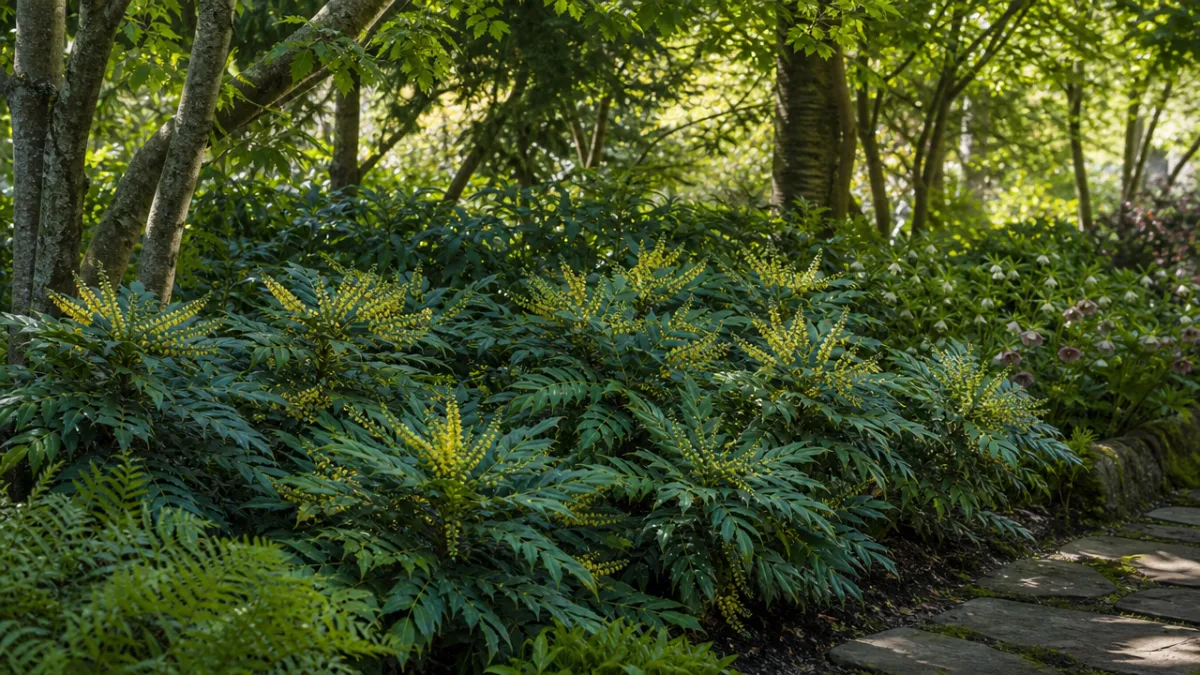
The thing that stops people in their tracks with ‘Soft Caress’ is the foliage. Each frond is pinnately compound — basically a long central stem lined with small, narrow, lance-shaped leaflets, almost like a fern or bamboo. They’re soft and gently pointed without a spine in sight, and each one can reach up to 60 centimeters long, layering up into a cascading, almost fountain-like shape that adds real textural depth to a planting.
The color is just as good. For most of the year the leaves are a rich, glossy green that reflects light beautifully, but as the temperatures drop in autumn and winter, things get even more interesting. The foliage shifts into warm shades of bronze, copper, and reddish-purple — genuinely some of the best winter color you’ll find on any shrub. It’s not stress, just a natural response to the cold, and come spring it greens right back up again.
Then in late summer through autumn, upright clusters of small, bright yellow flowers appear at the tips of the fronds. They’re intensely fragrant and a genuinely valuable nectar source for bumblebees and other native bees that are still on the wing when most of the garden has already shut down for the year. After the flowers come clusters of small, grape-like berries that ripen to a deep blue-black and attract birds into the bargain. It really is a plant that earns its space in every season.

Ideal Growing Conditions and Site Selection
One of the most practical things about ‘Soft Caress’ is how adaptable it is. It genuinely thrives in partial to full shade, which makes it one of the better answers to those tricky north-facing borders or the dry, gloomy patch beneath a large tree where most plants simply give up. That said, it’s equally happy in full sun as long as the soil holds onto a bit of moisture and it’s not getting hammered by drying winds. In hotter climates, some afternoon shade is a smart move to avoid leaf scorch.
For soil, it’s fairly forgiving but does best in well-drained, humus-rich ground with a slightly acidic to neutral pH. Heavy clay should be broken up with plenty of organic matter before planting, and sandy soils will benefit from added compost to hold onto moisture. Like others in its family, it can handle reasonably dry conditions once it’s settled in, but during that first growing season consistent watering is really important.
Hardiness-wise, it’s rated for USDA zones 7 through 9, though it can push into zone 6 with a bit of winter protection. In the UK it copes well across most of the country, tolerating temperatures down to around -10°C (14°F). A sheltered spot near a wall or fence in colder areas can make a real difference. And if you happen to garden in a mild, maritime climate with cool summers and decent rainfall, you’re in luck — that’s where this plant really hits its stride, growing into a full, lush specimen with minimal fuss.
Planting and Establishment
Getting ‘Soft Caress’ off to a good start comes down to a little bit of preparation before the plant even goes in the ground. It’s worth clearing the area properly first, especially if there are any perennial weeds lurking — they’ll compete hard with a newly planted shrub. Dig in a generous amount of well-rotted compost or leaf mold, which improves soil structure and gives those young roots something good to grow into. The planting hole itself should be at least twice as wide as the root ball, and roughly the same depth.
Timing matters too, though container-grown plants — which is what you’ll find at virtually any nursery — can go in at almost any point in the year. Autumn is often the sweet spot, since the soil is still warm from summer and there’s usually decent rainfall to help roots get going before any summer heat arrives. Spring planting works well too, giving the plant a full season to establish ahead of its first winter, which is especially worth thinking about in colder parts of the country.
Once it’s in the ground, watering through that first growing season is the single most important thing you can do. Deep, thorough watering once or twice a week during dry spells beats frequent light splashes every time — it encourages roots to chase moisture downward rather than staying near the surface where they’re at the mercy of the weather. A thick layer of organic mulch around the base of the plant, kept away from the stems, will help hold moisture in, keep weeds down, and slowly improve the soil as it breaks down.
Here are some key planting tips to keep in mind:
- Dig a planting hole at least twice the width of the container to allow roots to spread freely into the surrounding soil.
- Incorporate generous amounts of organic matter such as well-rotted compost or leaf mold to improve soil structure and moisture retention.
- Water deeply and consistently throughout the first full growing season, particularly during dry spells lasting more than a week.
- Apply a 5–8 cm layer of organic mulch around the base of the plant to conserve moisture and reduce weed competition.
- Avoid planting in frost pockets or very exposed positions in colder regions, as young plants are particularly vulnerable to hard late-spring frosts.
Pruning, Maintenance, and Long-Term Care
One of the genuinely great things about ‘Soft Caress’ is how little it asks of you once it’s settled in. It naturally stays compact and well-proportioned, usually topping out at around 90 centimeters to 1.2 meters in height and spread under typical garden conditions. There’s no need for the kind of annual pruning routine that some shrubs demand just to keep them in check — which makes it a really appealing option if you want structure and seasonal interest without a lot of ongoing effort.
When you do pick up the pruners, keep it light. The most useful thing you can do is remove spent flower spikes after blooming, which tidies the plant up and encourages it to put energy into foliage and roots rather than seed production. Occasionally an older stem might get a bit leggy or wander in the wrong direction, in which case cutting it back to a healthy side branch or just above a good bud is perfectly fine. What you want to avoid is hard rejuvenation pruning — cutting the whole plant back near the ground — because ‘Soft Caress’ tends to be slow to bounce back from that kind of treatment compared to more vigorous mahonia species.
Feeding needs are similarly modest. An annual top-dress of well-rotted compost or bark in spring, along with a slow-release general fertilizer, is genuinely all most plants will need. Go easy on high-nitrogen feeds — they push out soft, sappy growth that’s more prone to problems. If your soil is on the acidic side, an ericaceous fertilizer can help keep the foliage looking its best and support good overall vigor.
Pests, Diseases, and Common Problems
‘Soft Caress’ is a tough, largely trouble-free plant, but it’s not completely immune to the occasional problem. The one that comes up most often is mahonia rust, a fungal disease caused by Cumminsiella mirabilissima that shows up as orange-yellow pustules on the undersides of leaves with pale spots on the upper surface. It’s rarely life-threatening but a bad infection can make the plant look pretty sorry for itself. Good air circulation and avoiding overhead watering are your best preventive tools; if you do spot it, remove affected leaves and bin them rather than composting them.
Mahonia looper caterpillars are another occasional visitor worth knowing about. These are the larvae of the geometrid moth Macaria wauaria, and they can defoliate a plant surprisingly quickly if numbers build up. In most gardens, birds and parasitic wasps keep them in check naturally. If you’re seeing real damage, picking them off by hand or using a biological control based on Bacillus thuringiensis works well. Chemical insecticides are best avoided — not least because you’d be harming the same bees that rely on those flowers in autumn.
Leaf scorch — brown, papery patches developing along the leaf margins — is something you might see during hot, dry spells or in exposed spots. It’s not a disease, just the plant telling you it’s either too hot, too dry, or both. For container-grown plants, moving them somewhere more sheltered during a heat wave helps; for garden plants, keeping the soil moist during drought is the main thing. The plant usually bounces back with fresh new growth once conditions ease off.
Common issues to watch for include:
- Mahonia rust – orange pustules on leaf undersides caused by fungal infection; improve air circulation and remove affected leaves promptly.
- Looper caterpillars – rapid defoliation by geometrid moth larvae; monitor carefully and use biological controls if necessary.
- Leaf scorch – brown, papery leaf margins caused by sun exposure and drought stress; ensure adequate moisture and provide afternoon shade in hot climates.
- Root rot – caused by poorly drained, waterlogged soils; prevent by planting in well-drained conditions and avoiding overwatering.
- Powdery mildew – occasional white powdery coating on foliage in humid conditions; improve air circulation and avoid wetting foliage when watering.

Landscape Uses and Design Applications
Not many shrubs are as genuinely versatile as ‘Soft Caress’ when it comes to how you can use them in a design. Given room to develop on its own terms, it makes a superb specimen plant — the kind that anchors a shaded courtyard or holds down a corner of a mixed border with effortless elegance through all four seasons. And because it stays relatively compact, it fits into smaller gardens where the larger mahonia species would quickly take over and become a real headache.
In contemporary and minimalist designs, it tends to get called upon for its bamboo-like texture, which brings an architectural, vaguely exotic quality without any of the invasive tendencies of actual bamboo. It pairs well with ornamental grasses, ferns, and other fine-textured plants that enjoy similar conditions. In Japanese-inspired gardens it sits naturally alongside mosses, hostas, and stone, contributing to that quality of calm and subtle refinement. Designers working in the naturalistic planting tradition have also found it useful as a textural foil against bolder companions like hostas and bergenias.
In containers it’s excellent too — exactly the kind of plant that lifts a patio or entrance area without demanding constant attention. Use a large, well-draining pot with a mix of loam-based compost and fine bark, and find it a spot with morning sun and afternoon shade. Container plants will need more regular watering and feeding than those in the ground, and repotting into fresh compost every couple of years will keep things going strong. In colder areas, move containers somewhere sheltered during hard frosts, or wrap the pot in horticultural fleece to protect the roots.
Here are some outstanding companion plants that work beautifully alongside Mahonia ‘Soft Caress’:
- Hakonechloa macra – Japanese forest grass whose golden, cascading foliage creates a complementary textural contrast.
- Hosta sieboldiana – Large, bold leaves provide a dramatic counterpoint to the delicate fronds of the mahonia.
- Dryopteris erythrosora – Autumn fern whose coppery new fronds echo the seasonal bronze tones of ‘Soft Caress.’
- Helleborus x hybridus – Nodding winter flowers complement the mahonia’s late-season blooms perfectly.
- Carex morrowii ‘Ice Dance’ – Variegated sedge that provides year-round ground-level interest and tolerates similar conditions.
Beyond aesthetics, it’s worth mentioning what ‘Soft Caress’ actually does for the garden ecologically. Those late-season flowers are a lifeline for pollinators that are still active when almost everything else has stopped blooming. The berries get hoovered up by thrushes, blackbirds, and other fruit-eating birds. The dense, layered foliage provides shelter for small birds and beneficial insects through the colder months. At a time when garden biodiversity genuinely matters, this is a plant that pulls its weight well beyond just looking good.








What do you think?
It is nice to know your opinion. Leave a comment.