










Koelreuteria paniculata: The Pride of India and Golden Rain Tree
Introduction and Overview
If you’ve ever walked past a tree dripping with golden-yellow flowers in the middle of summer and stopped dead in your tracks, there’s a good chance you were looking at Koelreuteria paniculata — better known as the Golden Rain Tree or Pride of India. Originally from eastern Asia, particularly China and Korea, this deciduous tree has been winning over gardeners and landscape designers worldwide for centuries, and it’s not hard to see why. Between the cascading yellow blooms, the quirky ornamental seed pods, and its willingness to grow in almost any condition you throw at it, this tree is genuinely hard to beat.
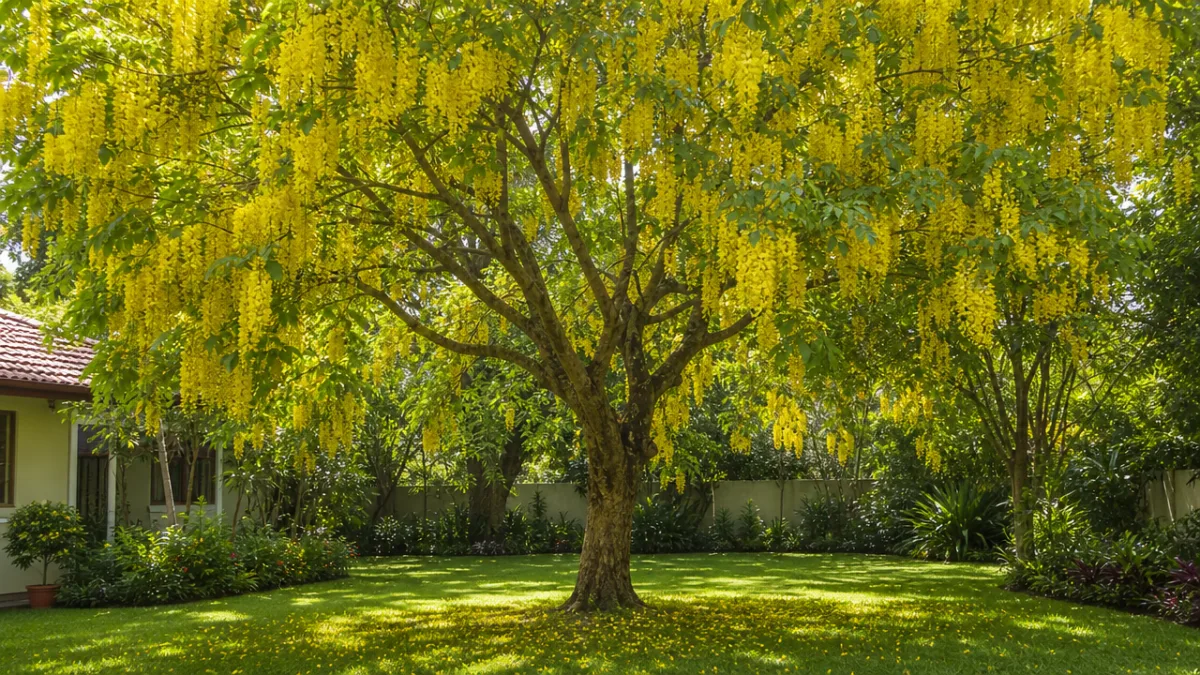
The name “Golden Rain Tree” comes from its most showstopping feature: those big, upright clusters of golden-yellow flowers that can reach up to 30 centimeters long and seem to pour down from the canopy all summer. What makes this even better is the timing — the blooms arrive in midsummer, when most other flowering trees have long since finished their show. If you’ve got a gap in your garden’s seasonal calendar around July and August, this tree was practically made to fill it.
As for its shape and size, the Golden Rain Tree grows into a broadly rounded, spreading form, typically maturing somewhere between 7 and 12 meters tall, though it can push a bit higher in ideal conditions. The canopy is open and graceful rather than dense, which means you get pleasant dappled shade without losing all the light underneath — a real bonus in smaller gardens or spots where you still want things growing below. It works just as well lining a boulevard as it does standing alone as a focal point in a lawn or courtyard.
Botanical Characteristics and Identification
Botanically speaking, Koelreuteria paniculata sits in the family Sapindaceae — the same family as maples, lychees, and horse chestnuts, which is a fun bit of trivia. The genus name honors Joseph Gottlieb Kölreuter, an 18th-century German botanist who did groundbreaking work on plant hybridization, while paniculata refers to the branched, paniculate arrangement of the flower clusters — one of the tree’s most reliable identification features if you’re trying to tell it apart from something else in the field.
The leaves are pinnately or bipinnately compound, usually somewhere between 30 and 45 centimeters long, with seven to fifteen irregularly lobed or toothed leaflets that give the whole thing a lacy, ferny look. It’s the kind of foliage that adds texture to a planting rather than just bulk. In spring, the new leaves often flush out with a lovely reddish-bronze or purplish tint before settling into a solid mid-green for summer. Then in autumn, they turn a warm golden-yellow before dropping — so even without the flowers, you’re getting a solid seasonal performance.
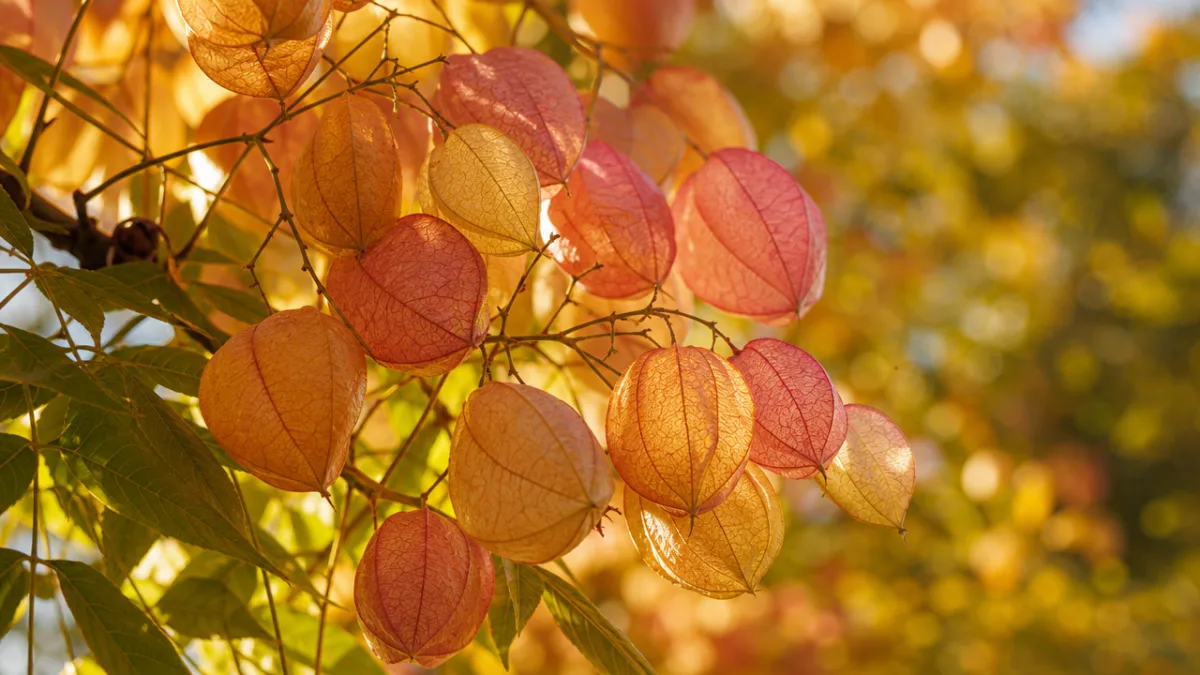
But honestly, the seed pods might be the most charming thing about this tree after the flowers themselves. Once blooming wraps up, the branches fill with papery, lantern-shaped capsules that look remarkably like miniature Chinese lanterns. They start out pale green, blush through shades of pink and salmon, and eventually dry to a warm tan or brown. Inside each one are three small, hard black seeds. The pods hang on well into winter, giving the tree continued presence in the garden long after the leaves are gone, and they’re a favorite of floral designers for dried arrangements too.
Growing Conditions and Climate Tolerance
One of the biggest reasons this tree has become so popular is simply how easy it is to please. Koelreuteria paniculata genuinely doesn’t ask much. It grows well in clay, loam, or sandy soil, handles both alkaline and mildly acidic pH, and — perhaps most usefully — tolerates poor, compacted ground that would make many ornamental trees struggle. That last quality makes it a go-to choice for urban planting situations where the soil conditions are rarely anything close to ideal.
Drought tolerance is another standout trait. Once established, the Golden Rain Tree is remarkably self-sufficient, relying mostly on natural rainfall rather than regular watering. In an era when water-conscious gardening is increasingly important — whether because of restrictions, climate, or just a desire to garden more sustainably — that’s a genuinely valuable quality. Established trees have been known to thrive for decades with very little attention, which is about as low-maintenance as ornamental trees get.
For hardiness, it performs reliably from USDA zones 5 through 9, handling winter lows down to around minus 20 degrees Celsius when dormant and coping equally well with the heat of warmer climates, as long as it gets enough moisture while it’s getting established. The one non-negotiable is sun — it really does need a full sun position, at least six hours a day, to flower well. Shade-grown specimens tend to bloom sparsely and develop a looser, leggier form. Get the sun right, though, and this tree is one of the most rewarding and genuinely trouble-free ornamentals you can grow in a temperate garden.
Landscape Uses and Design Applications
Few trees offer as much versatility in a landscape as Koelreuteria paniculata. It works as a specimen tree, a street tree, a lawn anchor, or a garden focal point — and because it has something interesting going on in every season, it earns its space even in carefully planned gardens where every plant needs to pull its weight year-round. Think about it: bronze new growth in spring, golden flowers in summer, warm leaf color and ripening pods in autumn, and an elegant bare silhouette in winter. That’s a lot of value from one tree.
Cities across North America, Europe, Australia, and New Zealand have taken note of the Golden Rain Tree as a street tree, and it’s easy to understand the appeal. Its root system is compact relative to its canopy, so it’s much less likely to lift pavement than some other species, and its tolerance of pollution and compacted soil means it actually holds up in tough urban conditions. It’s also become a popular replacement for ash trees in areas devastated by the emerald ash borer, and its midsummer flowering season means it livens up city streets precisely when most other flowering trees have already finished.
In home gardens, it makes a fantastic shade tree on the south or west side of a house, moderating summer heat while letting winter sun through once the leaves drop. It also plays well with a wide range of companion plants. Some particularly effective combinations include:
- Ornamental grasses such as Miscanthus or Panicum for textural contrast beneath the canopy
- Late-summer perennials like Rudbeckia and Echinacea that echo the golden tones of the flowers
- Purple-leaved shrubs such as Cotinus coggygria to create a complementary color contrast
- Groundcovers like Liriope or Pachysandra to manage bare soil beneath the canopy
- Spring bulbs that can bloom in the dappled shade before the tree leafs out fully
Planting, Care, and Maintenance
Getting a Golden Rain Tree off to a good start is mostly about choosing the right spot from the beginning. You want full sun, well-drained soil, and enough room for the tree to eventually reach its mature spread without feeling cramped. Container-grown specimens can go in the ground almost any time during the growing season, though spring and autumn are generally the kindest times for the tree since they reduce transplant stress. When you plant, make sure the root flare sits at or just slightly above the surrounding soil — burying it too deep is one of the most common mistakes with young trees and can cause long-term problems.
For the first year or two, keep the soil consistently moist while the roots settle in and spread out. Once established, the tree’s natural drought tolerance kicks in and you can ease off considerably. Feeding requirements are modest — a balanced slow-release fertilizer in early spring can give it a helpful boost, but established trees in decent soil often do fine without any supplemental feeding at all. If anything, be cautious about over-fertilizing with high-nitrogen products, which tends to push leafy growth at the expense of flowers.
Pruning is best done in late winter or early spring while the tree is still dormant, and the good news is that it doesn’t need a lot of it once the basic structure is established. The main things to stay on top of are removing any crossing or rubbing branches, clearing out any damaged wood, and gradually lifting the canopy by removing low branches as the tree matures. Avoid pruning in late summer or autumn — the new growth it would trigger can be caught by early frosts. When you do prune, use clean, sharp tools and make cuts cleanly to help the tree heal well.
Ecological Considerations and Potential Concerns
As much as this tree deserves its reputation as an outstanding ornamental, there’s an important caveat for gardeners in certain parts of the US. In the southeastern and south-central states — Florida, Texas, and parts of the Carolinas in particular — Koelreuteria paniculata has shown invasive behavior. It produces seeds prolifically, those seeds can stay viable in the soil for several years, and the tree has a tolerance for disturbed habitats that lets it spread into native plant communities if left unchecked. This isn’t a concern everywhere, but it’s something worth taking seriously if you’re in one of those regions.
If you’re gardening in an area where invasiveness is a documented issue, it’s worth checking your local invasive species list before planting. Some good native alternatives that offer similar ornamental appeal include Oxydendrum arboreum (sourwood), Chionanthus virginicus (fringe tree), and Cladrastis kentukea (yellowwood) — all beautiful trees without the ecological baggage. If you’re committed to growing Koelreuteria paniculata in a higher-risk area, one practical step is to deadhead the spent flower clusters before the seed pods get a chance to mature and drop.
On the brighter side, in regions where it isn’t a problem, the tree genuinely contributes to garden biodiversity. The flowers are a great nectar source for bees and other pollinators, filling an important gap in the midsummer calendar when many spring-blooming plants have finished. The seed pods feed birds over winter, and the open canopy structure provides decent nesting cover too. Plant it in the right place and you’ve got a tree that earns its keep ecologically as well as aesthetically.
Cultivars and Related Species
If the species itself isn’t quite what you’re after, there are a handful of cultivars worth knowing about. ‘Fastigiata’ is probably the most useful departure from the standard form — it grows in a narrow, columnar habit that’s ideal when space is tight, whether you’re working with a confined urban planting or want a more formal avenue effect. It still flowers and fruits just as well as the straight species; it just takes up a fraction of the horizontal space.
‘September’ was selected specifically for a later flowering period, pushing the golden rain effect into late summer or even early autumn depending on your climate — a real bonus if you’re trying to keep interest going through the tail end of the season. Then there’s ‘Rose Lantern’, which is grown for the particularly vivid pink coloration of its immature seed pods, adding an extra layer of ornamental value in that window between flowering and full fruit maturity. These cultivars aren’t always easy to track down, but specialist nurseries and larger garden centers in regions where the species is commonly grown tend to carry at least a few options.
It’s also worth knowing about the two closely related species within the genus. Koelreuteria bipinnata, the Chinese Flame Tree, is larger, faster-growing, and puts on a similar yellow flower display, but it’s much less cold-hardy — best suited to zones 7 through 9 rather than the wider range of paniculata. Koelreuteria elegans, the Flamegold Tree, is a subtropical species grown mainly in warm coastal climates, known for its autumn flowering season and vivid pink seed pods. Between the three of them, there’s a Koelreuteria for a pretty wide range of climates, with paniculata remaining the most versatile and cold-tolerant of the group by a comfortable margin.
Historical and Cultural Significance
The Golden Rain Tree has a long and genuinely interesting history behind it. In China, where it has been cultivated for over a thousand years, the tree held an honored place in classical garden design — particularly near temples and graves, where it symbolized virtue and dignity. It was considered especially appropriate for planting around Confucian temples and scholars’ gardens, connecting it symbolically with learning, refinement, and philosophical contemplation. For a tree, that’s a pretty distinguished cultural résumé.
Its introduction to the West came in the late 18th century, with one of the earliest recorded arrivals in Europe credited to Pierre d’Incarville, a French Jesuit missionary and botanist who sent seeds from Beijing to Paris around 1747. From there it spread quickly through European gardens, then made its way to Britain and North America, where it caused quite a stir as an ornamental novelty unlike anything Western gardeners had seen before. Thomas Jefferson himself is said to have grown it at Monticello, which gives you a sense of the prestige it carried among serious horticulturists of the era.
As for the name “Pride of India” — that’s actually a bit of a historical mix-up. The tree isn’t native to India at all; it comes from China and Korea. The misnomer most likely stems from the habit in earlier centuries of loosely labeling exotic Asian plants as coming from “the East Indies” or “India,” which was a fairly elastic geographical category in European thinking of the time. The name has stuck around in older horticultural literature and some gardening communities despite the botanical inaccuracy, and there’s something rather charming about it — a small reminder of the wonderfully chaotic history of plant exploration and how plants made their way around the world.








What do you think?
It is nice to know your opinion. Leave a comment.