










Green Art, Green Earth: How Creativity and Conservation Are Shaping a Sustainable Future
The Deep Roots of Nature-Inspired Art
Long before the modern environmental movement took shape, artists were drawing profound inspiration from the natural world around them. From the sweeping Hudson River School landscapes of the nineteenth century to the delicate botanical illustrations of earlier eras, humans have always felt a compulsion to capture nature’s beauty on canvas, paper, and stone. This enduring relationship between artistic expression and the living Earth is not merely aesthetic — it reflects a deep psychological and spiritual bond that connects us to rivers, forests, mountains, and every creature that shares this planet with us.
Throughout history, indigenous cultures around the world developed artistic traditions that were inseparable from their ecological understanding. Cave paintings depicting herds of bison and migrating birds were not simply decorative — they were expressions of reverence, observation, and reciprocal relationship with the environment. Aboriginal Australians encoded detailed ecological knowledge into their visual art, while Native American traditions wove environmental storytelling into textiles, pottery, and ceremonial objects. These ancient practices remind us that art and environmental stewardship have always been intertwined at the deepest cultural levels.
Today, that ancient connection is experiencing a powerful renaissance. As climate change, habitat destruction, and biodiversity loss become increasingly urgent crises, artists across every medium are reclaiming their ancestral role as chroniclers and defenders of the natural world. Green art — art that celebrates, examines, or advocates for the environment — has become one of the most dynamic and meaningful movements in contemporary creative culture. It bridges the gap between scientific data and human emotion, transforming abstract environmental statistics into visceral, moving experiences that can shift perspectives and inspire real change.
What Is Green Art? Defining an Evolving Movement
Green art, sometimes called eco-art or environmental art, is a broad and wonderfully diverse creative movement that uses artistic practice as a vehicle for environmental awareness, advocacy, and healing. It encompasses an enormous range of approaches: painters who document vanishing ecosystems, sculptors who build installations from reclaimed ocean plastic, photographers who bear witness to melting glaciers, muralists who transform urban walls into celebrations of biodiversity, and performance artists who stage interventions in polluted landscapes. What unites these varied practices is a commitment to making the invisible visible — to translating environmental crisis and ecological beauty into forms that the human heart can feel.
Within the broader umbrella of green art, several distinct approaches have emerged with particular vitality. Some artists work primarily in documentation and witness, creating careful, painstaking records of ecosystems and species under threat. Their work functions almost like an extended elegy — a testament to what exists and a warning about what could be lost. Others take a more activist stance, creating provocative installations or public interventions designed to disrupt complacency and demand political action. Still others focus on regeneration and healing, using art-making processes that actually restore damaged environments or engage communities in environmental repair.
It is also worth noting the important distinction between art that is about the environment and art that is environmentally responsible in its production. A truly comprehensive green art practice considers not just its subject matter but also its materials and methods. Artists in this space often experiment with natural pigments derived from plants and minerals, create works on recycled or sustainably sourced materials, minimize carbon footprints in the display and transport of their work, and find ways to give back to the ecosystems that inspire them. This integration of ethics and aesthetics is one of the most exciting and demanding aspects of the contemporary green art movement.

Materials That Tell an Environmental Story
One of the most compelling dimensions of green art is the way in which material choices become a form of storytelling and advocacy in themselves. When the artist Chris Jordan created his monumental photographic series documenting albatross chicks killed by ingested plastic debris in the remote Midway Atoll, the subject matter was devastating enough. But when artists go further and actually incorporate recovered ocean plastic, fallen timber from logged forests, or soil from contaminated industrial sites into their work, the material itself becomes a form of direct testimony. The medium literally embodies the message, collapsing the distance between viewer and environmental reality.
A growing community of artists has developed remarkable innovations in sustainable and natural materials. Natural earth pigments — ochres, umbers, siennas, and clay-based colors — are experiencing a renaissance as painters seek to reduce their reliance on petroleum-derived synthetic pigments. Plant-based dyes and inks made from walnuts, indigo, weld, and madder are being rediscovered and refined by textile artists and printmakers. Even the binders and mediums used to hold pigments together are being reconsidered, with artists turning to egg tempera, casein, plant-based oils, and naturally occurring resins in place of synthetic alternatives.
Beyond individual studio practice, some of the most striking green art involves large-scale land and environmental intervention using only natural and sustainable materials. The late Andy Goldsworthy became world-famous for his intricate, ephemeral sculptures made entirely from whatever he found in a given landscape — ice, leaves, stones, twigs, and mud — arranged with extraordinary delicacy and then left to dissolve back into nature. These works exist primarily as photographs, but the photographic documentation itself becomes a meditation on impermanence, cycles, and the breathtaking intelligence embedded in natural forms. Such practices invite us to see the Earth not as raw material but as a living collaborator in the creative process.
- Natural earth pigments: Ochre, sienna, umber, and chalk-based colors sourced directly from the ground, free of synthetic processing.
- Reclaimed and recycled materials: Ocean plastic, salvaged wood, industrial scrap, and found objects transformed into meaningful artistic statements.
- Living materials: Moss, lichen, living soil, and even microbial cultures used in bio-art and environmental installation.
- Plant-based dyes and inks: Traditional botanical dyeing methods revived for contemporary textile, print, and painting practices.
- Biodegradable binders and varnishes: Egg tempera, linseed oil, pine resin, and beeswax replacing synthetic polymer mediums.
The choice of sustainable materials also reflects a deeper philosophical stance about the relationship between art, economy, and ecology. Every material a studio artist purchases exists within a supply chain that has environmental consequences — from the mining of mineral pigments to the petroleum refinement behind many synthetic colors and mediums. By making conscious, thoughtful choices about materials, green artists participate in a form of consumer activism that, multiplied across thousands of practitioners and amplified by their public visibility, can genuinely shift industry practices and cultural norms around sustainability in the arts.
Public Art, Murals, and the Urban Environmental Imagination
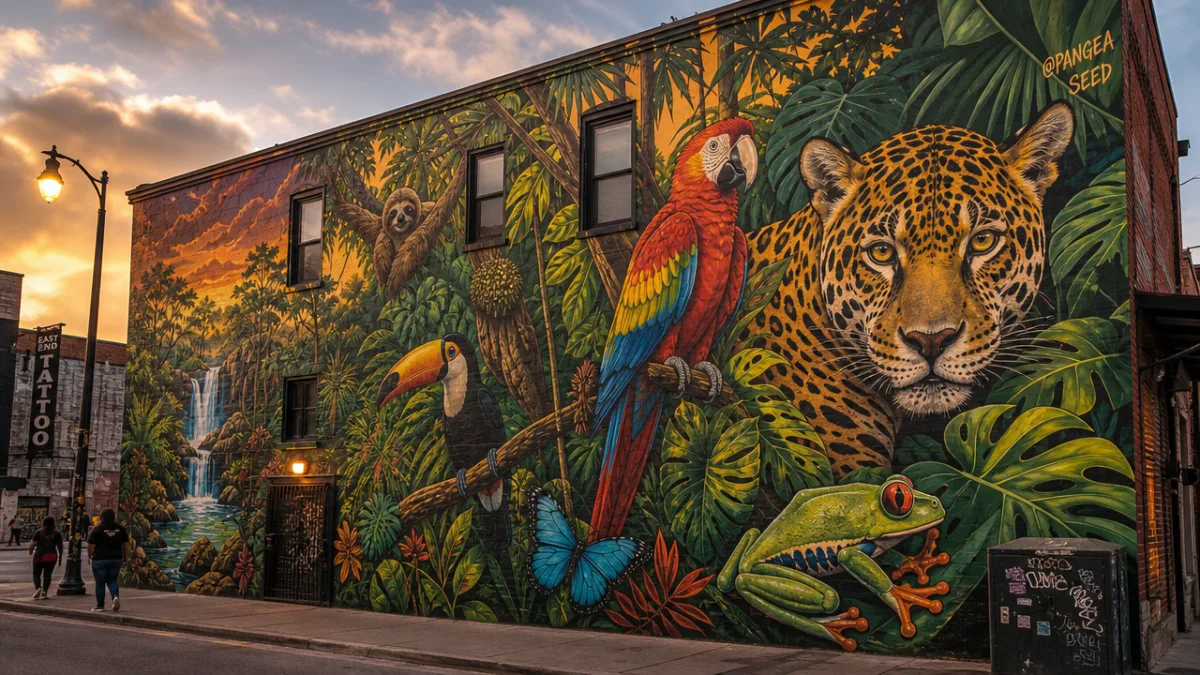
Some of the most democratically powerful expressions of green art happen not in galleries but on the walls of cities, where massive environmental murals transform concrete jungles into celebrations of biodiversity and calls to ecological conscience. Urban muralism has a long tradition as a medium for social justice messaging, and in recent decades environmental advocacy has become one of its most vibrant strands. In cities from Los Angeles to London, São Paulo to Seoul, towering paintings of endangered species, thriving ecosystems, and climate-affected landscapes command attention from thousands of daily passersby who would never set foot in a contemporary art gallery.
The power of environmental street art lies partly in its accessibility and partly in the remarkable contrast it creates with its urban surroundings. A five-story painting of a coral reef in full color, installed on the side of a glass-and-steel office building, creates a visual juxtaposition that is simultaneously beautiful and confrontational. It asks questions without needing to state them explicitly: What have we traded for these structures? What do we owe to the living world we have displaced? Public environmental art operates in the space between beauty and discomfort, using aesthetic pleasure as a gateway to more challenging reflections about the choices embedded in modern urban life.
Community-based environmental mural projects have also proven to be powerful tools for local environmental organizing and education. When young people in a neighborhood collaborate with professional muralists to design and paint a massive image celebrating the native plants and animals of their local watershed, they undergo a transformation in their relationship to place. Research in environmental education consistently shows that children who develop a sense of connection and responsibility to specific local ecosystems are more likely to become engaged environmental citizens as adults. Public art can be one of the most effective and lasting tools for building that connection, embedding ecological literacy into the visual fabric of a community’s shared space.
Photography and Film: Bearing Witness to a Changing Planet
Among all the artistic mediums engaged in environmental advocacy, photography and documentary filmmaking hold a uniquely powerful position. The camera’s apparent objectivity — its capacity to say “this is real, this actually exists or existed” — gives photographic environmental art an evidentiary weight that other mediums sometimes lack. When Ansel Adams photographed the American West in luminous black and white, his images helped build the political will for the National Park system. When contemporary photographers document the collapsing ice shelves of Greenland or the last known individuals of a critically endangered species, they are creating a visual archive of urgent significance for both current advocacy and future historical reckoning.
Documentary filmmaking has similarly produced some of the most transformative environmental advocacy of the past several decades. From Jacques Cousteau’s pioneering ocean documentaries to David Attenborough’s landmark BBC series, from Josh Fox’s examination of fracking in Gasland to the global phenomenon of Our Planet, environmental documentary has repeatedly demonstrated its capacity to reach mass audiences and shift public understanding of ecological issues. The combination of stunning natural imagery, scientific rigor, and emotional storytelling creates an immersive experience that can be genuinely life-changing for viewers, translating abstract environmental data into encounters with specific creatures, specific places, and specific human communities.
Emerging technologies are dramatically expanding the possibilities of environmental documentary and photographic art. Drone photography has made it possible to document landscapes and ecosystems from perspectives that were previously available only to satellites or aircraft, revealing patterns and scales of environmental change that ground-level observation cannot capture. Underwater photographic technology continues to improve, bringing viewers into contact with deep-sea ecosystems that have only recently become accessible to human exploration. Virtual reality documentaries offer the extraordinary possibility of placing viewers inside an Amazon rainforest or on a dying coral reef, creating an empathetic identification with those environments that conventional screen-based viewing cannot achieve.
- Landscape and wilderness photography documenting the sublime beauty of wild places and the visible signs of environmental change.
- Species and biodiversity portraiture creating intimate, dignified images of threatened and endangered wildlife.
- Aerial and drone documentation revealing large-scale patterns of deforestation, habitat fragmentation, and landscape transformation.
- Community and human impact storytelling centering the experiences of people on the front lines of environmental change and injustice.
- Underwater and marine photography bearing witness to the extraordinary and increasingly threatened life of the ocean.
Education, Activism, and the Transformative Power of Green Creativity
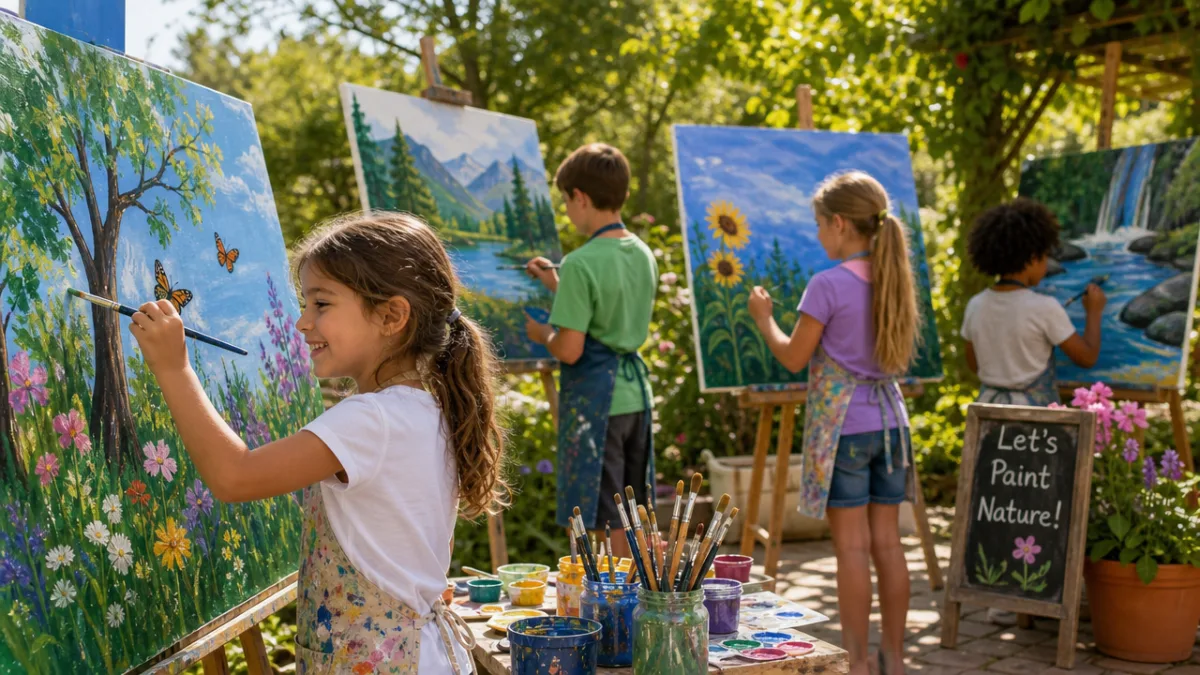
Green art is most powerful when it refuses to remain a passive aesthetic object and instead becomes an engine of education, dialogue, and collective action. Across the world, environmental arts organizations, community studios, school programs, and public festivals are using creative practice as a gateway to environmental literacy and civic engagement. The act of making art about nature — whether it is a child painting a portrait of a local wildflower or a professional installation artist transforming a brownfield site into a living garden — generates a quality of attention, care, and knowledge that few other educational approaches can replicate.
The relationship between green art and environmental activism has grown particularly dynamic in the context of the global climate movement. Extinction Rebellion, Fridays for Future, and other climate advocacy movements have embraced visual art, performance, and creative spectacle as central tools of their organizing strategies. Giant papier-mâché sea turtles in protest marches, die-ins staged in the lobbies of fossil fuel companies, and spectacular visual installations at international climate conferences all reflect an understanding that emotional and aesthetic impact is essential to political mobilization. These artistic interventions are not decorations added to political organizing — they are themselves a form of political communication, designed to break through the numbness and despair that can prevent people from engaging with the scale of the climate crisis.
At the educational level, art-based approaches to environmental learning have shown particular promise with young people. When students are invited to create art that responds to environmental themes — designing a garden, composing music inspired by a local river, writing poetry about an ecosystem they have visited — they develop forms of environmental knowledge that are personal, embodied, and emotionally resonant. This kind of learning tends to be more durable and more motivating than purely information-based environmental education, because it connects intellectual understanding to aesthetic experience and creative agency. Children who have painted a bee or sculpted a mushroom are more likely to notice and care about the living world around them than those who have only read about biodiversity in a textbook.
The future of green art lies not only in the studios of individual artists or the halls of galleries and museums but in the communities, schools, public spaces, and digital networks where creative environmental culture is being built from the ground up. As the ecological crises of our time intensify, the need for art that helps people see, feel, and respond to environmental reality becomes ever more urgent. Green art at its finest does not offer false comfort or easy answers. Instead, it holds open the difficult, necessary space between grief and hope, between witnessing what is being lost and imagining what could be created in its place. In that generative tension, something essential to the human spirit finds expression — and perhaps finds the courage and vision needed to build a genuinely sustainable relationship with the living Earth we all share.
Building a Green Creative Practice: How Anyone Can Participate
One of the most liberating truths about the green art movement is that it does not belong exclusively to professional artists or credentialed environmental scientists. Every person who picks up a brush, a camera, a pencil, or a lump of clay and directs their attention toward the natural world becomes a participant in a tradition of environmental witness and celebration that is as old as human culture itself. The barriers to entry are genuinely low, and the rewards — in terms of personal wellbeing, deepened environmental connection, and contribution to a collective cultural conversation — are genuinely high. Building a green creative practice is within reach for anyone willing to pay attention to the world outside their window.
Beginning a personal green art practice can start with something as simple and immediate as keeping a nature journal. This ancient practice, beloved by naturalists from Gilbert White to Charles Darwin, involves regular, attentive observation of a specific place or set of species, combined with written notes and visual sketches. The discipline of sitting with a plant, an insect, a bird, or a landscape and trying to render it truthfully on paper is one of the most effective ways of developing genuine ecological knowledge. You cannot sketch a leaf without noticing the pattern of its veins; you cannot draw a bird without observing the precise way it holds its body and moves through space. This quality of attention is itself a form of environmental practice, cultivating the sensitivity and care that sustainable living requires.
For those whose creative interests extend into community and public practice, there are a growing number of ways to connect individual artistic energy with collective environmental efforts. Community gardens that double as living artworks, neighborhood mural projects that celebrate local biodiversity, environmental film festivals that bring important documentary work to local audiences, craft circles that focus on natural dyes and sustainable materials — all of these represent points of entry into a broader movement of creative environmental engagement. The green art movement is enriched by every voice and every medium that joins it, from the most intimate personal sketchbook practice to the most ambitious large-scale public installation. What matters is not technical sophistication but genuine attention, authentic response, and the willingness to let the living world speak through your creative work.
- Start a nature journal: Regular sketching and writing about a local place or set of species builds deep ecological attention and knowledge over time.
- Experiment with natural materials: Try making ink from walnut husks, painting with local clay, or dyeing fabric with plant materials found nearby.
- Engage with community art projects: Join or initiate local mural projects, community gardens, or environmental film screenings that build shared ecological culture.
- Document your local environment: Use photography or video to create an ongoing record of the natural history of your immediate surroundings, noticing seasonal changes and signs of environmental stress or health.
- Connect with eco-art networks: Organizations and online communities dedicated to green art can provide inspiration, resources, collaboration opportunities, and a sense of participation in a meaningful global movement.
Ultimately, the invitation that green art extends to all of us is an invitation back into relationship — with the more-than-human world, with our own deepest sources of meaning and beauty, and with each other as members of a community that depends on the health of the living systems that sustain us. In making art that honors, mourns, celebrates, and advocates for the natural world, we participate in one of the most ancient and most necessary of human activities. We declare, in the most direct way we know, that this Earth matters, that its beauty is worth preserving, and that we are willing to pay attention, to bear witness, and to create something worthy of the extraordinary living world we have been given.








What do you think?
It is nice to know your opinion. Leave a comment.