










Baptisia australis: The Native Blue Wild Indigo
Introduction to Baptisia australis
Baptisia australis — you might know it as Blue Wild Indigo or Blue False Indigo — is one of the most stunning native wildflowers North America has to offer. This tough, long-lived perennial belongs to the legume family Fabaceae, and it’s been a fixture across eastern and central North America for thousands of years. Between the deep blue-purple flower spikes, the soft blue-green foliage, and its almost legendary resilience, it has earned a loyal following among both wild prairie ecosystems and everyday gardeners.
Its native range stretches across a broad swath of the eastern United States — from Nebraska to the Atlantic coast, and from the Great Lakes down to Georgia and Texas — where it pops up in open woodlands, meadows, stream banks, and prairies. Indigenous peoples were onto its value long before European settlers arrived, using the plant for medicinal purposes and as a source of blue dye. That’s where the name “False Indigo” comes from: it served as a stand-in for true indigo (Indigofera tinctoria) when the real thing wasn’t available.
What really makes Baptisia australis stand out for today’s gardeners and ecologists is the combination it brings to the table: genuine beauty, serious toughness, and real ecological value, all in one plant. Once it’s settled in, you can essentially leave it alone — no supplemental watering, no fertilizing, no babying required. Deer tend to skip it, it shrugs off drought, it’s happy in poor soil, and it comes back reliably every spring for decades. Some plants have been known to thrive in the same spot for fifty years or more. That’s a pretty hard deal to beat.
Physical Characteristics and Seasonal Interest
One of the things gardeners love most about Baptisia australis is that it earns its keep all season long, not just during the few weeks it’s in bloom. In early spring, the new growth pushes up through the soil looking a bit like clusters of asparagus tips — a distinctive blue-green or silvery-blue color that’s immediately recognizable. Those shoots develop quickly into full, rounded clumps that typically reach three to four feet tall and just as wide. The foliage itself is attractive: trifoliate leaves made up of three oval leaflets in a soft blue-green that holds up well throughout the summer heat.
The main event happens in late spring, usually sometime between April and June depending on where you live. Tall, upright flower spikes shoot up from the mounding foliage, each one lined with rows of pea-like blooms in a rich blue-purple that really stops you in your tracks. Each individual flower has that classic legume structure — a broad upper petal, two side petals, and a lower keel — and they’re produced in generous numbers along stems that run twelve to twenty-four inches long. The whole flowering show typically lasts three to four weeks.
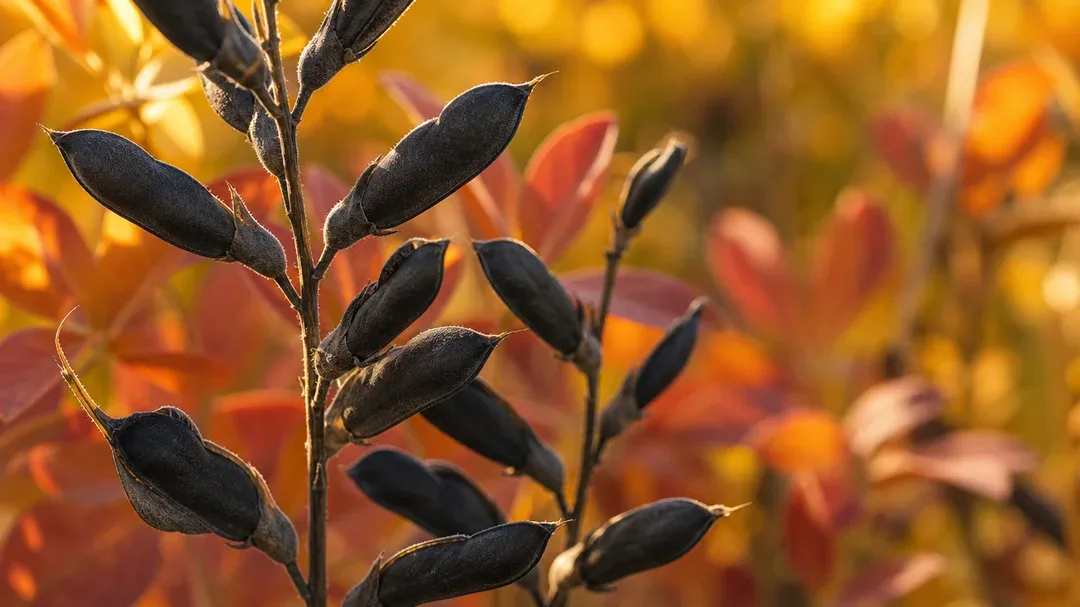
Once the flowers are done, the plant shifts into its next act. The spent flowers give way to inflated, papery seed pods that gradually turn a deep charcoal black as they mature. They actually rattle when the wind blows through them — which is how the plant picked up the nickname “Rattleweed.” Those blackened pods and stems hang around well into winter, adding a sculptural quality to the dormant garden and serving as a food source and shelter for birds and beneficial insects. Many gardeners deliberately leave them standing through the cold months because they look so striking against snow or frost.
Growing Conditions and Soil Requirements
If you want to grow Baptisia australis well, it helps to think about where it actually comes from. In the wild, it grows in open, sunny prairies, meadow edges, and the margins of open woodlands — places that get plenty of direct sun and often have well-drained to dry soils that are rocky, nutrient-poor, or clay-heavy. That evolutionary background is exactly what makes it such an adaptable, low-fuss plant in the garden. It’s built for conditions that would stress most other perennials.
Sun is the one requirement that’s truly non-negotiable. Baptisia australis needs at least six hours of direct sunlight per day to perform well, and it’s even happier with eight or more. When it doesn’t get enough sun, it tends to sprawl open in the middle and lose that nice rounded shape. You might get away with partial shade in a particularly hot climate, but expect reduced flowering and less vigorous growth overall compared to plants in full sun.
Drainage is the other big one. This plant is genuinely well-adapted to dry, infertile soils, and it can actually struggle in the kind of rich, consistently moist garden beds where many conventional perennials thrive. Heavy clay that holds water through wet winters is a real risk for root rot. If that’s what you’re working with, mixing in some coarse grit or planting on a gentle slope can make a meaningful difference. On the flip side, Baptisia is an ideal candidate for those tricky spots most plants hate — dry slopes, rocky outcroppings, the rain shadow beside a building — places where you’d otherwise be fighting a losing battle.
As a legume, Baptisia australis has a helpful trick up its sleeve: it forms a symbiotic relationship with soil bacteria (rhizobia) that pull nitrogen from the air and convert it into a form the plant — and its neighbors — can use. In other words, it actively improves the soil around it over time. This also means you should skip the nitrogen-rich fertilizer. Adding it tends to produce lush, floppy growth at the expense of flowers, which is exactly the opposite of what you want.
Planting and Establishment
The most important thing to know going in is that Baptisia australis asks you to be patient during establishment. The plant puts most of its early energy into building a deep, substantial root system rather than putting on a show above ground. In its first year or two, it might look a bit underwhelming — a modest clump, maybe a light flower display. By years three to four, though, it really starts to hit its stride. By year five, it’s typically the showstopper that drew you to it in the first place. That slow start is absolutely worth it, because once established, this plant will reward you for decades.
Because Baptisia develops a deep taproot, transplanting an established plant is extremely difficult and usually ends badly — for the plant, anyway. So think carefully before you put it in the ground, because that’s where it’s going to live. Young container-grown plants transplant reasonably well in spring or fall as long as you’re gentle with the roots. Fall planting is often ideal since it gives the root system time to get comfortable before the demands of spring growth and flowering kick in. Water new transplants consistently through their first growing season, then gradually back off the irrigation as the plant settles in.
Growing Baptisia from seed takes commitment, but it’s genuinely rewarding. The seeds have a hard coat that needs scarification first — either a quick roughing up with sandpaper or a soak in warm water — followed by four to eight weeks of cold stratification to break dormancy. An easy approach is to sow scarified seeds outdoors in fall and just let them overwinter naturally. Germination can be variable, and seedlings are slow growers, usually needing two to three years before they flower for the first time. The upside is that seed-grown plants often develop the deepest, most robust taproots and tend to be the most vigorous performers over the long haul.
Wildlife and Ecological Value
Baptisia australis is a lot more than a pretty face in the garden. It’s an ecological powerhouse that supports a genuinely impressive range of wildlife. As a plant with a long evolutionary history in North American ecosystems, it has built deep relationships with dozens of insect species that actually depend on it to survive. That’s something non-native ornamentals — however lovely they might be — simply can’t replicate. If supporting local biodiversity is on your radar, Baptisia belongs in your garden.
The flowers are especially important to pollinators. Bumblebees are the main pollinators here, since they’re among the very few insects strong enough to force open the keel petals and reach the pollen and nectar inside. This relationship runs so deep that declining bumblebee populations are actually starting to affect wild Baptisia reproduction in some areas. Native bees, butterflies, and hoverflies also make regular visits during bloom time. The timing matters too: Baptisia flowers in late spring, right when many native bee species are in the critical early stages of colony establishment and most in need of reliable food sources.
Baptisia australis also serves as a host plant for the caterpillars of several specialist butterfly species, most notably the Wild Indigo Duskywing (Erynnis baptisiae) and the Frosted Elfin (Callophrys irus) — which is federally threatened across parts of its range. These caterpillars eat Baptisia foliage exclusively and simply cannot complete their life cycle without it. If you find chewed leaves on your plant, that’s not a problem — that’s the whole point. The seed pods attract birds too, including the Northern Bobwhite, which feeds on the seeds.
The ecological contributions don’t stop with insects and birds. Baptisia’s nitrogen-fixing ability gradually builds soil fertility, and its deep root system helps break up compacted soil, improves water infiltration, and creates pathways that benefit soil microorganisms and earthworms. In prairie restoration projects, it’s commonly included as a structural species that stabilizes soils and sets the stage for other prairie plants to get established. That same deep-rooting drought tolerance also makes it a smart choice for stormwater management plantings and bioswales.
Landscape Uses and Design Applications
Baptisia australis has a bold, architectural presence that makes it genuinely useful across a wide range of garden styles and contexts. At three to four feet tall and equally wide, it has the heft of a small shrub, which means it can serve as a structural anchor in perennial borders, native plant gardens, meadow plantings, and naturalistic landscapes. Unlike a lot of perennials that more or less disappear when they’re not blooming, Baptisia holds its own throughout the season thanks to its attractive foliage and strong, rounded form.
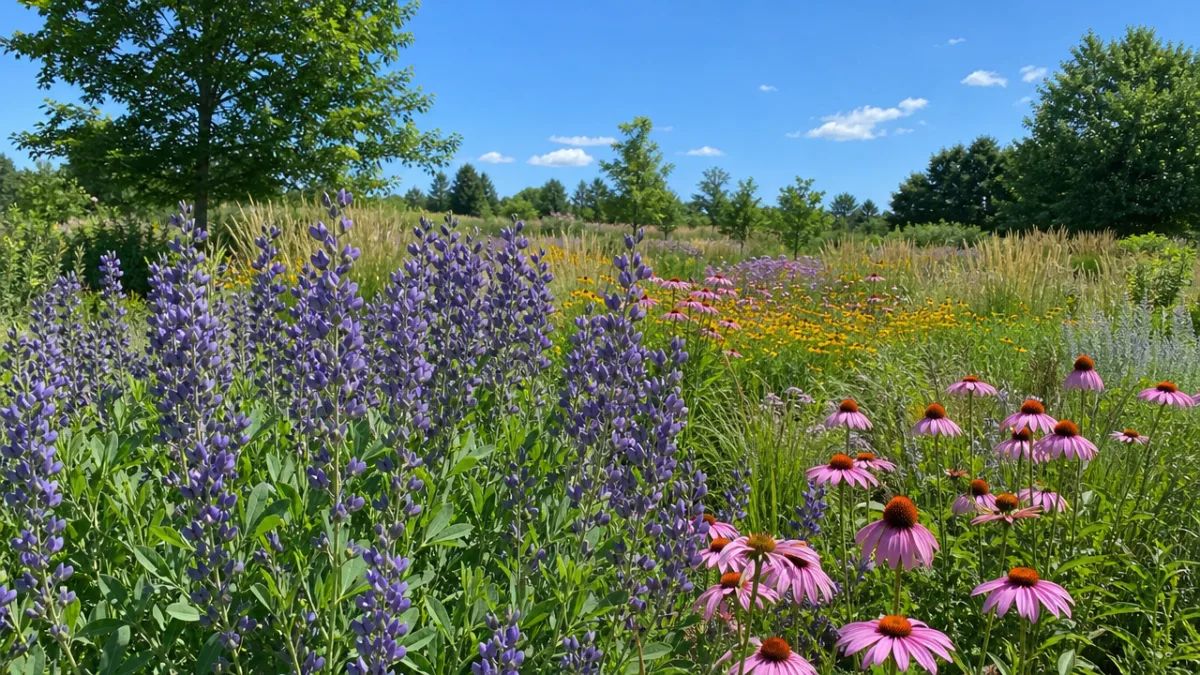
In a mixed border, it works beautifully as a mid-border anchor that provides a reliable backdrop for smaller companions. It pairs especially well with other native prairie plants that like the same sun and well-drained conditions. Some excellent companions include:
- Penstemon digitalis (Foxglove Beardtongue) — blooms at the same time with white to pale pink spikes
- Echinacea purpurea (Purple Coneflower) — takes over the show after Baptisia’s bloom fades
- Rudbeckia fulgida (Orange Coneflower) — brings warm late-summer contrast
- Sporobolus heterolepis (Prairie Dropseed) — a fine-textured native grass that softens Baptisia’s bolder form
- Asclepias tuberosa (Butterfly Weed) — complementary orange blooms with similar growing requirements
- Salvia nemorosa (Woodland Sage) — purple spikes that pick up Baptisia’s color palette in early summer
In naturalistic or meadow settings, Baptisia makes a fantastic foundational species. Plant it in drifts of three to five or more for a bold, landscape-scale statement, or use a single specimen as a focal point in a smaller space. Its tolerance for poor soils makes it a go-to for difficult sites — erosion-prone slopes, compacted or rocky ground, low-maintenance public landscapes where extensive soil prep and regular upkeep just aren’t realistic. And because it lives so long, a well-placed grouping of Baptisia is a genuinely lasting investment in your landscape.
There are also some interesting cultivated varieties worth knowing about. ‘Purple Smoke’ is a hybrid with moody smoky-purple flowers, ‘Twilite Prairieblues’ offers striking bicolor blue and yellow blooms, and ‘Lemon Meringue’ brings soft yellow flowers to the palette. That said, the straight species remains one of the most vigorous and ecologically valuable options, and if supporting local wildlife is a priority, many native plant gardeners and ecologists recommend it over the hybrids. Whatever you choose, Baptisia as a genus rarely disappoints in the right conditions.
Care, Maintenance, and Common Issues
Here’s the good news about Baptisia australis: once it’s established, it genuinely doesn’t want much from you. In fact, too much attention can work against it. Overwatering, fertilizing, and fussing with the soil can encourage the floppy, overgrown growth that’s pretty much the opposite of its naturally tidy, rounded form. The best approach with this plant is deliberate restraint — give it great drainage, full sun, and then mostly leave it alone to do its thing.
During the first growing season, water regularly to help the roots get established. After that, ease off gradually. By year three, a Baptisia in a suitable spot should need no supplemental irrigation at all, even through extended dry stretches. In climates with especially hot, brutal summers, an occasional deep soak during severe drought won’t hurt and may help it look its best — but established plants have come through prolonged droughts without irrigation and without lasting damage. Overwatering in poorly drained soil is a far more common problem than underwatering.
Pruning needs are pretty minimal. The main decision most gardeners face is whether to cut down the blackened stems and seed pods in fall or let them stand for winter interest and wildlife value. Leaving the structure up through winter and cutting back in late winter or early spring — just before new growth starts — is a perfectly sensible approach that many gardeners prefer. Cutting everything back to the ground in spring is completely fine and won’t set the plant back; new growth comes up vigorously from the root crown. If you prefer a tighter, more compact form, shearing the plant back by about a third right after flowering can help — just know you’ll be giving up those ornamental seed pods in the process.
Pest and disease problems are generally pretty rare with Baptisia australis, which is another point in its favor. Deer largely avoid it — the foliage contains alkaloids that make it unpalatable to deer, rabbits, and most other mammalian browsers. Powdery mildew can occasionally show up in conditions of poor air circulation and high humidity, but it typically comes on late in the season after the main show is over and rarely causes any lasting harm. As for butterfly caterpillars feeding on the foliage — that’s not a problem to solve. That’s your ecological garden working exactly as it should.








What do you think?
It is nice to know your opinion. Leave a comment.