










Armeria maritima: The Complete Guide to Sea Thrift
Introduction to Sea Thrift
Armeria maritima, commonly known as Sea Thrift or Sea Pink, is one of the most enchanting and resilient wildflowers native to the coastal regions of Europe and North America. This compact, cushion-forming perennial has captivated gardeners and naturalists alike for centuries with its cheerful pompom-like flowers that erupt in shades of pink, rose, white, and occasionally deep magenta. Standing at a modest height of six to twelve inches, Sea Thrift punches well above its weight in visual impact, forming dense mounds of grass-like foliage topped with rounded flower heads that sway gracefully in the coastal breeze.
The genus name Armeria derives from an old French name for a cluster-headed pink, while maritima naturally references its affinity for maritime environments. This plant has a remarkable ability to thrive in conditions that would send most garden plants into rapid decline — salty sea air, thin rocky soils, harsh winds, and periodic drought are all conditions that Sea Thrift not only tolerates but seems to genuinely relish. Its evolutionary adaptations to these demanding environments have made it an exceptionally tough and long-lived garden subject when grown in the right conditions.
Beyond its ornamental appeal, Armeria maritima holds a significant place in ecological history and cultural tradition. It once appeared on the reverse of the British threepenny bit coin from 1937 to 1952, a testament to its status as a beloved symbol of the British coastline. Today, it remains a staple of coastal gardens, rock gardens, and naturalistic plantings across the temperate world, valued equally by wildlife gardeners seeking to support pollinators and by aesthetic gardeners drawn to its undeniable charm and low-maintenance nature.
Natural Habitat and Distribution
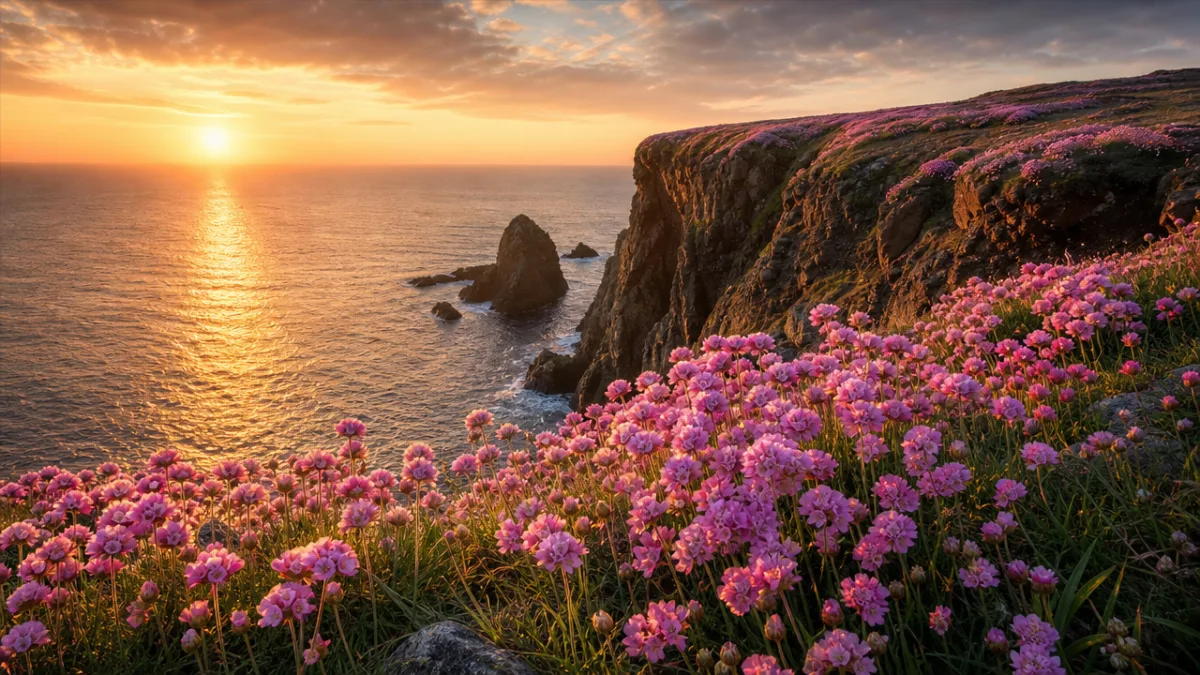
Sea Thrift is a plant of remarkable geographic range, found naturally across a wide swath of the Northern Hemisphere. Its native territory spans the Atlantic coastline of Western Europe from Norway and Iceland in the north, through the British Isles, France, Spain, and Portugal, and extends into the Mediterranean basin. Across the Atlantic, it can be found along the coasts of eastern North America and also appears in isolated mountain populations across central Europe and high-altitude regions of the Iberian Peninsula, where it has adapted to the cold, windswept conditions of alpine meadows much as it has adapted to sea cliffs.
In its natural coastal habitats, Armeria maritima typically colonizes cliff tops, rocky outcrops, salt marshes, sandy dunes, and coastal grasslands. These environments share several key characteristics: excellent drainage, low soil fertility, high exposure to wind and salt spray, and intense competition from other specialized coastal plants. The plant is extraordinarily well-adapted to saline conditions and can be found growing mere meters from the high tide line in some locations, enduring regular bathing in salt-laden air that would desiccate and kill the vast majority of flowering plants.
The ecological role of Sea Thrift in its native habitat is significant and multifaceted. It acts as a pioneer species on newly stabilized coastal soils, helping to bind loose material with its fibrous root system and creating microhabitats for invertebrates. Dense colonies of Armeria maritima provide shelter and foraging opportunities for a range of coastal insects, and the flowers are a particularly important early-season nectar source for bumblebees, solitary bees, and butterflies at a time when other coastal plants may not yet be in bloom. Its cushion-forming growth habit also helps insulate the soil beneath, moderating temperature extremes and retaining precious moisture.
Botanical Characteristics and Identification
Armeria maritima belongs to the family Plumbaginaceae, a group that also includes the ornamental statice (Limonium) and the leadwort (Plumbago). The plant forms dense, evergreen cushions or tufts of narrow, linear leaves that are dark green, slightly succulent in texture, and measure approximately one to four centimeters in length. These leaves emerge directly from the crown of the plant in tight rosettes, giving the resting plant an attractive grassy or mossy appearance even when not in flower. The foliage itself has a subtle blue-green tint in some forms, adding year-round interest to rock garden compositions.
The flowering stems, known as scapes, rise stiffly above the foliage cushion from late spring through summer, each one terminating in a single, spherical flower head approximately one to two centimeters in diameter. Each rounded head is composed of numerous small, five-petaled individual flowers tightly packed together, creating the distinctive pompom silhouette that makes Sea Thrift so recognizable. Just below the flower head sits a papery, brownish bract that remains after the flowers fade, giving the plant a degree of continued interest even in its seed-bearing phase. The overall effect of a well-established clump in full bloom, with dozens of these pink globes hovering above the dark foliage on slender stems, is genuinely spectacular.
Several key features distinguish Armeria maritima from related species and common lookalikes. The combination of its strictly linear, undivided leaves and its single-flowered stems is diagnostic. The flower head bracts are another useful identification feature, and experienced botanists also note the characteristic papery sheath — called a ligule — that appears just above the base of each flowering scape. This structure is unique to the genus Armeria and serves as a reliable identification marker. When the flowers are not present, the tight, grass-like cushions can resemble other compact, cushion-forming alpines, but the distinctive leaf shape and growth pattern usually make identification straightforward for an experienced eye.
Cultivation and Garden Use
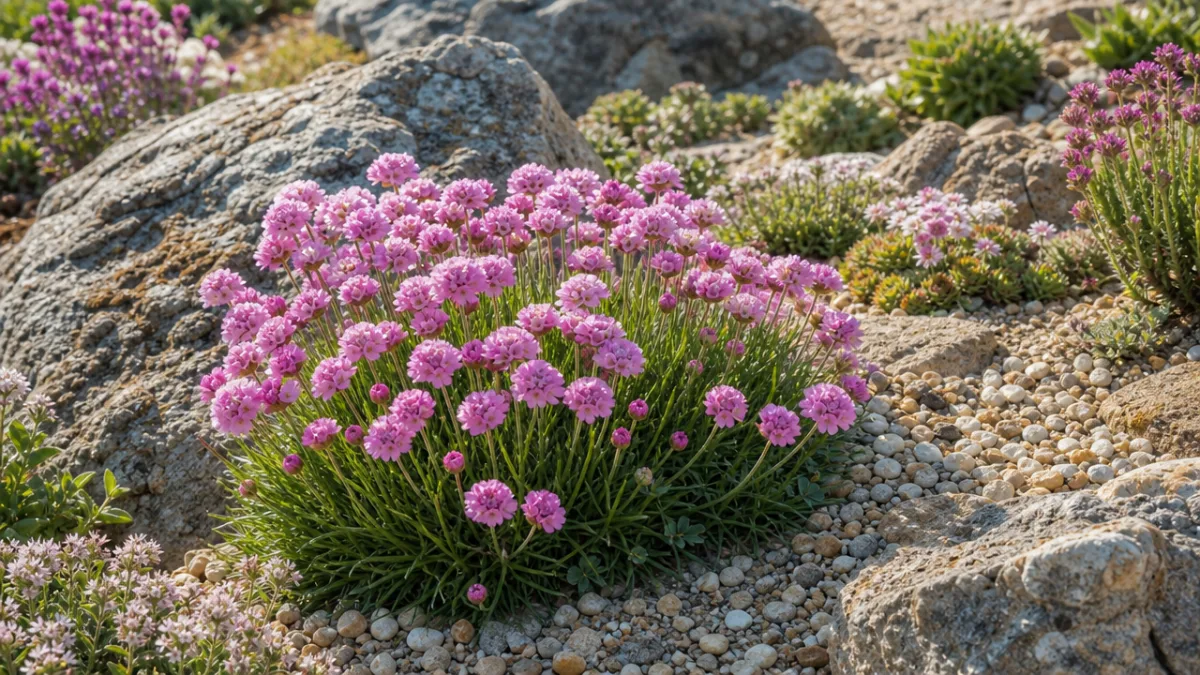
Growing Armeria maritima successfully in the garden is largely a matter of respecting and replicating its natural preferences. The single most important requirement is excellent drainage: this plant abhors waterlogged soil and will quickly succumb to root rot if its roots sit in standing moisture, particularly during the cold winter months. In heavy clay soils, it is essential to improve drainage by incorporating grit, gravel, or coarse sand before planting, or alternatively to grow Sea Thrift in raised beds, dry stone walls, or container plantings where drainage can be easily controlled. A lean, low-fertility soil is actively preferred over rich, well-amended garden soil, which tends to produce lush but floppy growth that is more susceptible to disease.
In terms of sunlight, Sea Thrift is an uncompromising sun-lover that performs best in a position receiving full sun for the majority of the day. While it will tolerate partial shade, flower production is typically significantly reduced in shadier conditions, and the plant can become somewhat leggy and loose in its habit. It is an excellent choice for south or west-facing slopes, dry stone retaining walls, gravel gardens, and the sunny edges of borders where the soil tends to be naturally drier and less fertile. Its salt tolerance makes it uniquely suited to coastal gardens where many other flowering plants struggle, and its wind resistance means it holds up beautifully in exposed locations that would flatten more delicate perennials.
Maintenance requirements for Armeria maritima are pleasingly minimal, which contributes greatly to its popularity among time-pressed gardeners. The primary maintenance task is deadheading spent flower heads, which encourages continued bloom production and keeps the plant looking neat throughout the flowering season. Clipping the entire plant over lightly after the main flush of flowers in late summer can reinvigorate growth and often stimulates a second, though lighter, flush of blooms in early autumn. Every three to four years, established clumps may begin to die out in the center, a common occurrence in cushion-forming plants, and at this point the plant benefits from being carefully lifted, divided, and replanted with refreshed soil around its roots. Sea Thrift is also notably drought-tolerant once established, requiring little or no supplemental watering in most temperate climates.
- Soil preference: Poor to moderately fertile, sharply drained, sandy or gritty soil with a neutral to slightly alkaline pH.
- Sun requirements: Full sun is essential for best flowering performance; tolerates very light partial shade.
- Watering: Drought-tolerant once established; water sparingly and never allow roots to sit in standing water.
- Hardiness: Fully hardy across most of the UK and equivalent temperate zones (USDA Hardiness Zones 4–8).
- Spacing: Plant approximately 20–30 cm apart to allow individual cushions to develop without overcrowding.
- Companion plants: Pairs beautifully with other coastal and rock garden plants including Festuca glauca, Dianthus deltoides, Sempervivum, Sedum, and Thymus species.
Propagation Methods
Armeria maritima can be propagated by several methods, with the choice depending on the scale of production required and the desirability of maintaining specific cultivar characteristics. Seed propagation is the simplest and most economical approach for growing large numbers of plants or for producing the straight species. Seeds should be sown in spring or autumn in a free-draining seed compost mixed with additional grit, and placed in a cold frame or unheated greenhouse. Germination is typically reliable but can be somewhat slow and irregular, occurring over a period of several weeks. Seedlings should be pricked out individually once large enough to handle and grown on in small pots before being hardened off and planted out in their permanent positions.
Division is the preferred propagation method when it is important to maintain the exact characteristics of a named cultivar, since seed-raised plants can show considerable variation in flower color and habit. Established clumps are best divided in spring or early autumn, when the soil is workable and the plant has the best opportunity to re-establish before extremes of heat or cold. The clump should be carefully lifted with a fork, and individual rooted sections separated by hand or with a sharp knife. Each division should ideally include both a portion of the root system and several growing rosettes of foliage. Replant immediately at the original depth, firm in well, and water gently to settle the soil around the roots.
Basal cuttings taken in late spring offer another reliable vegetative propagation route, particularly useful for producing modest numbers of plants from cherished cultivars. Select non-flowering shoots that are short, firm, and growing from the base of the plant. Remove them with a short heel of older wood attached if possible, trim away the lower leaves, and insert into a free-draining cutting compost of equal parts peat substitute and perlite or coarse grit. Place the cuttings in a closed propagator or cover with a clear plastic bag to maintain humidity, and site in bright indirect light at a temperature of around 15–18°C. Rooting typically occurs within four to six weeks, after which the cuttings can be potted individually and grown on before final planting.
Popular Cultivars and Varieties
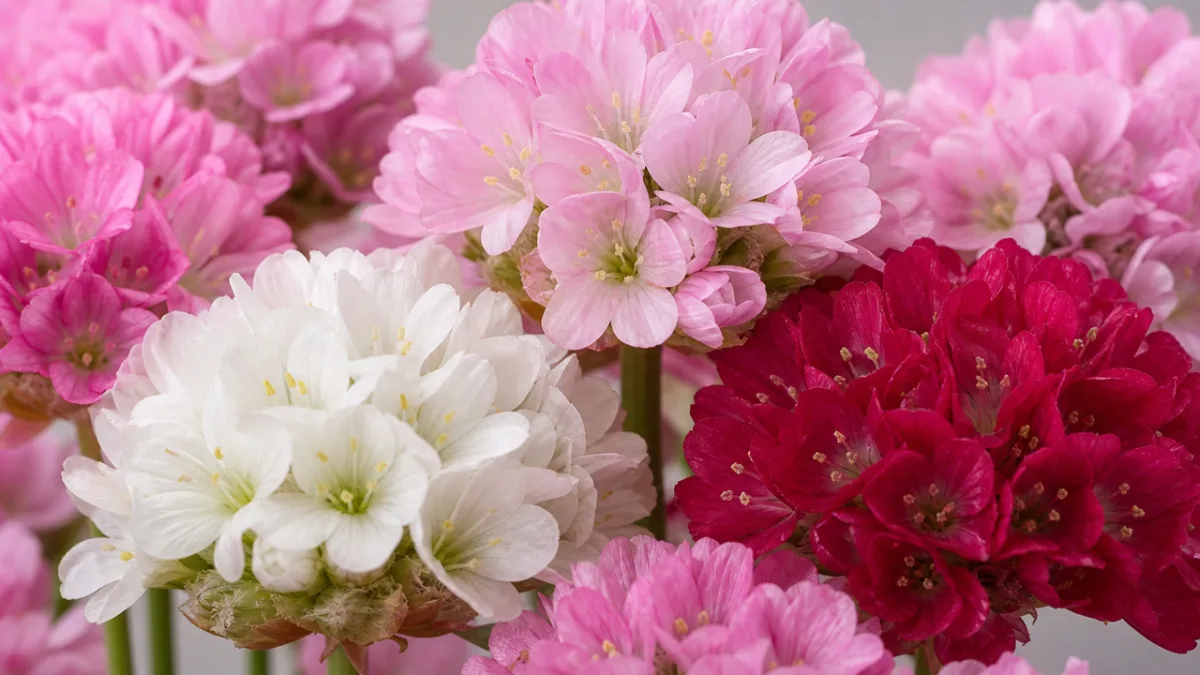
The natural variability of Armeria maritima across its wide geographic range has given plant breeders considerable material to work with, and a number of outstanding garden cultivars have been selected and named over the years. These cultivars differ from the straight species primarily in flower color, flowering stem height, and the compactness of their foliage cushions, offering gardeners a range of options to suit different design contexts and personal color preferences. The availability of white-flowered and deep rose-red forms in particular has significantly expanded the plant’s design possibilities, allowing it to be used in more sophisticated and carefully coordinated color schemes as well as the more traditional coastal wildflower planting.
Among the most widely grown and reliable cultivars, several stand out for their consistently strong garden performance. ‘Splendens’ is perhaps the most commonly encountered cultivar, producing particularly vivid, deep rose-pink flowers on stems that are slightly taller than average, making it an excellent choice for cutting and for more visible border positions. ‘Alba’ is the definitive white-flowered form, producing pure white flower heads above typical dark green foliage cushions — it is especially beautiful when planted in combination with the pink-flowered species or alongside blue-flowering companions such as Veronica prostrata. ‘Dusseldorfer Stolz’ (sometimes sold as ‘Dusseldorf Pride’) is a compact, free-flowering cultivar with deep crimson-red flowers that represents one of the most intensely colored forms available.
More recent introductions have further extended the range of available forms. The ‘Ballerina’ series, developed primarily for container and bedding use, produces unusually large flower heads on compact plants and comes in a range of colors including lilac, white, and red. ‘Nifty Thrifty’ is a distinctive variegated cultivar with creamy-white leaf margins that add foliar interest even when the plant is not in flower, though it is generally considered slightly less vigorous than plain-leaved forms and requires the same sharply drained conditions as the species. For those seeking a taller, more substantial plant, forms from mountain populations of Armeria maritima tend to produce more robust growth and are worth seeking out from specialist alpine nurseries.
- Armeria maritima ‘Splendens’ — Deep rose-pink, vigorous, slightly taller stems, excellent for cutting.
- Armeria maritima ‘Alba’ — Pure white flowers, ideal for mixed color schemes, classic rock garden variety.
- Armeria maritima ‘Dusseldorf Pride’ — Rich crimson-red flowers, compact habit, long flowering season.
- Armeria maritima ‘Nifty Thrifty’ — Variegated cream-edged foliage, pink flowers, distinctive year-round interest.
- Armeria maritima ‘Bloodstone’ — Exceptionally deep red flower heads, compact form, strong garden presence.
Wildlife Value and Ecological Importance
The ecological value of Armeria maritima extends well beyond its visual contribution to the garden landscape. It is a genuinely outstanding plant for pollinators, and this quality alone makes it worthy of inclusion in any garden where supporting local wildlife is a priority. The rounded flower heads, with their densely packed individual florets, are accessible to a wide variety of insect visitors including bumblebees, honeybees, numerous species of solitary bee, hoverflies, and butterflies. The flowers are particularly valuable because they bloom in late spring and early summer, a period when many garden plants are still in the early stages of their flowering cycle, making Sea Thrift an important bridge food source for pollinators between the early spring bulbs and the high summer abundance of other perennials.
Several species of Lepidoptera have specific associations with Armeria maritima that go beyond simple nectaring visits. The small blue butterfly (Cupido minimus), one of the UK’s smallest and most charming native butterflies, lays its eggs exclusively on the flowers of kidney vetch (Anthyllis vulneraria) in most areas, but certain coastal populations have been recorded using Sea Thrift as an alternative larval foodplant, highlighting the plant’s broader significance within coastal grassland ecosystems. More widely, the seeds of Armeria maritima are consumed by various seed-eating birds, and the dense cushion growth habit provides cover and overwintering sites for numerous small invertebrates that in turn support the broader food web of coastal and garden habitats.
In the broader context of coastal habitat conservation, Armeria maritima plays an important role as a characteristic component of maritime cliff and coastal grassland communities that are recognized as priority habitats under European and national conservation frameworks. The distinctive plant community of which Sea Thrift is a hallmark species — often described as maritime heath or coastal grassland — supports a specialized assemblage of insects, lichens, mosses, and other flowering plants found nowhere else. Gardeners who incorporate Armeria maritima into naturalistic planting schemes, meadow gardens, or coastal-themed borders are therefore participating in a small but meaningful way in the preservation and celebration of one of the most ecologically significant plant communities in the temperate world.
Historical and Cultural Significance
The cultural history of Armeria maritima is richer and more extensive than its modest stature might suggest. In the British Isles in particular, Sea Thrift has a long association with coastal landscapes that have shaped national identity and artistic tradition. The plant appears in numerous works of British poetry, watercolor painting, and nature writing from the Victorian era onward, typically as a symbol of wild coastal beauty, resilience in the face of adversity, and the particular melancholy charm of windswept headlands. Gerard Manley Hopkins, one of the great poets of the Victorian period and a close observer of the natural world, referenced the coastal flowers of Welsh clifftops in terms that many scholars believe include Sea Thrift among their subjects.
The most famous cultural moment for Armeria maritima came when it was chosen as the design for the reverse of the British threepenny bit, the small silver — and later nickel-brass — coin that circulated widely from 1937 until decimalization brought it out of use. The coin featured a distinctively stylized rendering of Sea Thrift that was immediately recognizable to anyone familiar with the British coastline, and the choice reflected the plant’s status as a genuinely popular and widely known wildflower rather than a botanical specialist’s plant. For many generations of British people, the threepenny bit was their first conscious encounter with Armeria maritima as a named plant, and the connection between the coin and the flower remained strong in popular memory long after both passed from daily circulation.
In traditional herbal medicine, Armeria maritima was used in a limited way as a medicinal plant, though it never achieved the prominence of many other wildflowers in the European herbal tradition. Historical sources record its use in treatments for obesity, nervous conditions, and various infectious diseases, though none of these applications have been validated by modern pharmacological research and the plant is not currently of significance in either conventional or complementary medicine. Its primary contemporary cultural role remains aesthetic and ecological — as a garden plant of great beauty and wildlife value, and as a symbol of the extraordinary biodiversity and visual richness of the European coastline that it has adorned for thousands of years before the first garden was ever planted.








What do you think?
It is nice to know your opinion. Leave a comment.