










Double Crochet V-Stitch Tutorial: A Complete Guide to Mastering This Beautiful Technique
Introduction to the Double Crochet V-Stitch
The double crochet V-stitch is one of the most elegant and versatile stitch patterns in the world of crochet. Whether you are a beginner looking to expand your skills or an experienced crocheter searching for a fresh texture to incorporate into your projects, the V-stitch offers a perfect combination of simplicity and visual impact. Its open, lacy appearance makes it ideal for a wide range of projects, from lightweight shawls and scarves to decorative blankets and baby garments.
What makes the double crochet V-stitch so appealing is the way it creates a rhythmic, almost hypnotic pattern that flows naturally from one repeat to the next. Once you understand the basic structure — two double crochets worked into the same stitch or space with a chain stitch between them — the rest of the pattern practically works itself. The resulting fabric is airy and open, yet still maintains enough structure to hold its shape beautifully after blocking or washing.
This stitch has been a beloved staple in crochet communities for generations, appearing in vintage patterns from the mid-twentieth century as well as in the most contemporary handmade designs circulating on social media and craft blogs today. Its timeless appeal lies in its ability to look both classic and fresh depending on the yarn weight, color, and project context. By the end of this tutorial, you will have all the knowledge you need to confidently work the double crochet V-stitch into any project you choose.
Why Crocheters Love This Stitch
The double crochet V-stitch earns its widespread popularity for several compelling reasons. First and foremost, it works up remarkably quickly compared to more intricate lace patterns. Because each V is essentially just two double crochets and one chain, even beginners can achieve a fast pace once they have completed a few rows and established their rhythm. This makes it particularly satisfying for larger projects where seeing visible progress helps maintain motivation throughout the work.
Beyond its speed, the V-stitch is forgiving and easy to read as you go. Unlike some stitch patterns that require constant reference to a written pattern or chart, the double crochet V-stitch creates clear visual landmarks. Each completed V tells you exactly where your hook should go on the next row, reducing the chance of mistakes and making it simple to pick up a project after setting it aside. Crocheters who struggle with maintaining stitch counts often find this pattern a welcome relief.
Materials and Tools You Will Need
Before sitting down to practice the double crochet V-stitch, it helps to gather your materials thoughtfully. The right yarn and hook combination can make a significant difference in how the finished fabric looks and feels. For learning purposes, a smooth, light-colored worsted weight yarn is highly recommended because it allows you to see your stitches clearly and correct any mistakes without straining your eyes. Avoid fuzzy or heavily textured yarns until you are confident in the technique.
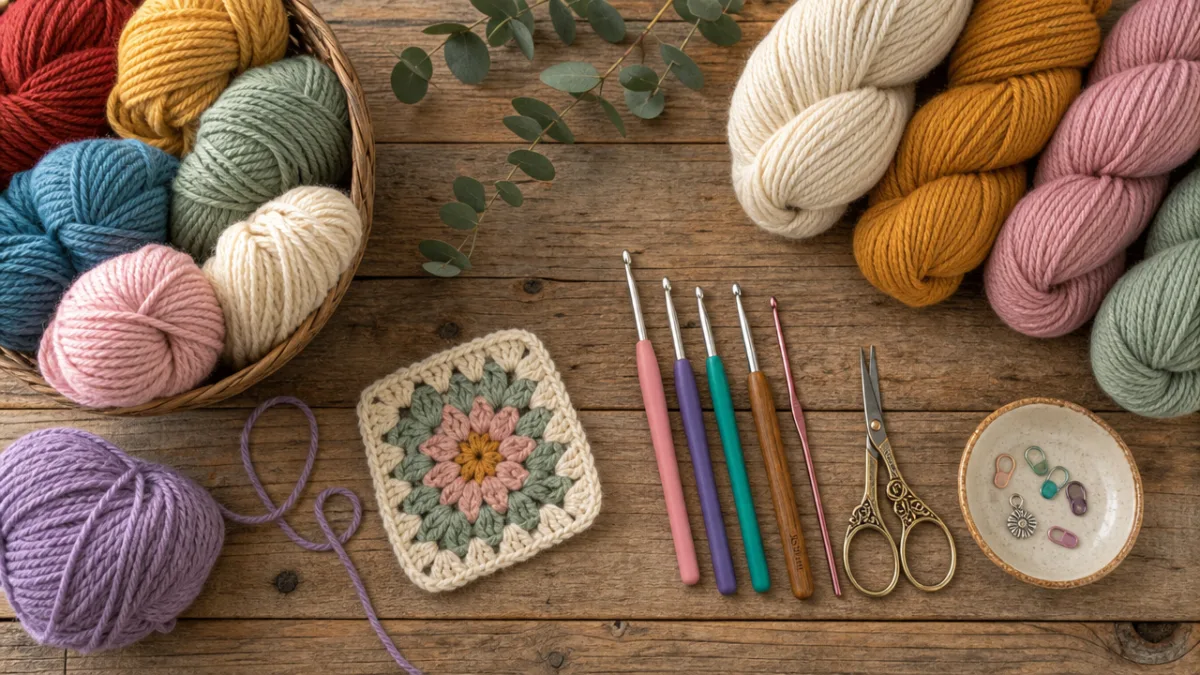
Your crochet hook size should match the recommended gauge on your yarn label, or you can go up one size to achieve a more open, drapey result — which is actually quite desirable with V-stitch projects. For worsted weight yarn, a 5mm or 5.5mm hook is a solid starting point. Having a yarn needle on hand for weaving in ends is also essential, along with a pair of small scissors and stitch markers to help you track the beginning of rows as you work.
The beauty of the double crochet V-stitch is that it translates beautifully across virtually every yarn weight category. Worked in a fine lace-weight yarn, the resulting fabric is delicate and gossamer-thin, perfect for elegant shawlettes or table runners. In bulky yarn with a large hook, the same stitch creates a thick, cozy texture ideal for home décor items like throw blankets or pillow covers. Experimenting with different materials is one of the most enjoyable aspects of mastering this versatile stitch pattern.
Choosing the Right Yarn for Your Project
When selecting yarn for a V-stitch project, fiber content matters as much as weight. Natural fibers like cotton and linen produce a crisp, structured fabric that holds the open spaces of the V-stitch particularly well. Wool and wool blends offer excellent elasticity and stitch definition, making them a wonderful choice for garments where drape and recovery are important. Acrylic yarns are budget-friendly and widely available, and many modern acrylics have enough sheen and smoothness to show off the V-stitch beautifully.
Color choice can dramatically alter the visual character of a V-stitch project. Solid or semi-solid colorways allow the stitch architecture to take center stage, showcasing every V with clarity and precision. Variegated or self-striping yarns create a playful, unpredictable effect where the color changes interact with the open spaces of the stitch in surprising and delightful ways. Both approaches are valid; the key is simply understanding what visual effect you want to achieve before you begin.
Step-by-Step Tutorial: Working the Double Crochet V-Stitch
Now it is time to actually work the stitch. Begin by creating a foundation chain. For practice purposes, chain any even number of stitches plus two for your turning chain. For example, chain 22 to give yourself a manageable practice swatch. Once your foundation chain is complete, you are ready to work your first row of V-stitches, which will establish the pattern for every subsequent row.
To work a double crochet V-stitch, insert your hook into the designated stitch or chain space, yarn over and pull up a loop, then complete a standard double crochet. Without moving to the next stitch, chain one, then work a second double crochet into that same stitch or space. That complete sequence — dc, ch1, dc — all worked into one location, forms a single V-stitch. The chain-one between the two double crochets creates the open center of the V, which is also the space your hook will enter on the following row.
On subsequent rows, instead of inserting your hook into individual stitches, you will work each new V-stitch directly into the chain-one space at the center of each V from the previous row. This is what gives the pattern its beautiful, continuous structure and creates that satisfying vertical alignment of V shapes stacking neatly one on top of another. Turn your work at the end of each row with a chain three, which counts as your first double crochet, then continue working V-stitches across the row.
Reading the Pattern Row by Row
Understanding how to read and follow a V-stitch pattern row by row is an important skill that will serve you across many different crochet projects. Most written patterns for V-stitch designs will describe the stitch as working into the “ch-1 sp” or “chain-one space,” which simply means inserting your hook under that small bridge of yarn connecting the two double crochets of the V below. Developing the habit of identifying these spaces visually as you work will make your crocheting faster and more intuitive over time.
A typical row-by-row breakdown for a basic V-stitch swatch looks like this:
- Foundation Chain: Chain a multiple of 3 stitches plus 2 for the turning chain, ensuring you have enough length for your desired width.
- Row 1: Work your first V-stitch into the 5th chain from the hook, skip 2 chains, then repeat V-stitch into the next chain across, ending with a single double crochet in the final chain.
- Row 2 and beyond: Chain 3 and turn, work a V-stitch into each chain-one space across, ending with a double crochet into the top of the turning chain from the previous row.
- Repeat Row 2: Continue repeating Row 2 until your piece reaches the desired length, then fasten off and weave in ends.
As you practice this pattern, you will naturally begin to anticipate where each stitch should go without needing to count carefully. This internalized understanding of stitch placement is the hallmark of a crocheter who has truly mastered a pattern. Give yourself permission to make mistakes during the learning process — the V-stitch is forgiving, and even imperfect practice swatches will help solidify your muscle memory and visual recognition of the stitch structure.
Common Mistakes and How to Fix Them
Even experienced crocheters encounter challenges when learning a new stitch pattern, and the double crochet V-stitch is no exception. One of the most common mistakes beginners make is accidentally working into the wrong space — specifically, inserting the hook into the top of a double crochet from the previous row rather than into the chain-one space at the heart of the V. This error causes the fabric to tighten and lose its characteristic open appearance, resulting in a denser texture than intended.
Another frequent issue is tension inconsistency. If your tension changes between stitches or rows, the V-shapes may appear uneven, with some Vs looking larger or more open than others. This is entirely normal for beginners and typically resolves itself as you practice. Consciously slowing down and maintaining a consistent grip on both your hook and your working yarn can help regulate tension. Some crocheters find it helpful to practice deep breathing and actively relax their hands every few stitches to prevent gripping too tightly.
Stitch count errors are another common pitfall. If you notice your row getting wider or narrower as you work, it is likely that you are either adding extra V-stitches or skipping one somewhere along the row. To catch these errors early, count your V-stitches at the end of every two or three rows rather than waiting until the piece is significantly longer. Using a stitch marker in the first V of each row can also help you keep track of your count and make it easier to spot where a mistake occurred.
Troubleshooting Specific Issues
If your edges are coming out uneven or wavy, the problem often lies in how you are handling the turning chain and the final stitch of each row. The turning chain of three should always be treated as a double crochet — meaning you skip the first V-stitch at the beginning of the row and work the last double crochet of each row into the top of the previous row’s turning chain. Forgetting this final stitch or skipping the turning chain count are both easy mistakes that create the appearance of shrinking or growing rows.
Some crocheters find that their V-stitches look tilted or slanted to one side rather than forming clean, symmetrical Vs. This can happen when the hook is inserted at a slight angle rather than straight into the center of the chain-one space. Practicing with a larger hook than you think you need can help open up the spaces and make it easier to insert the hook cleanly and correctly every time. Once your technique is established, you can switch back to a tighter gauge.
Creative Project Ideas Using the Double Crochet V-Stitch
Once you have mastered the fundamental technique, the double crochet V-stitch opens the door to an enormous range of creative projects. One of the most popular applications is the V-stitch infinity scarf or cowl, which takes only a few hours to complete and makes an impressive handmade gift. Worked in a soft merino or alpaca blend, a V-stitch cowl has a luxurious drape and a beautiful open texture that keeps the wearer stylishly warm without feeling heavy or bulky.
Baby blankets are another beloved use of the double crochet V-stitch. The lacy, open structure of the pattern creates a lightweight fabric that is perfect for warmer months or layering, and the stitch works up quickly enough that you can finish a full baby blanket in a weekend of relaxed crocheting. Using pastel acrylic yarns in this context is both practical — since the blanket will need to withstand frequent washing — and visually charming, as the soft colors highlight the delicate geometry of the V shapes.
For home décor enthusiasts, the V-stitch translates beautifully into table runners, curtain panels, and decorative wall hangings. Worked in natural cotton in an off-white or ecru colorway, a V-stitch table runner has a timeless, artisan quality that complements both rustic farmhouse and contemporary minimalist aesthetics equally well. Because the stitch creates a semi-transparent fabric, it is also an excellent choice for window treatments where you want to filter light without completely blocking it.
Adapting the Stitch for Different Project Shapes
The double crochet V-stitch is not limited to flat, rectangular pieces. With a little adaptation, it works beautifully in the round for hats, baskets, bags, and circular shawls. When working in the round, you join at the end of each round rather than turning, and the chain-three at the beginning of each round still counts as your first double crochet. The visual result is a seamless spiral of V-shapes that radiates outward or forms a smooth cylinder depending on how you structure your increases.
Garments like cardigans, vests, and crop tops are increasingly popular V-stitch projects in the modern crochet community. These projects require a bit more pattern reading and shaping knowledge, but the stitch itself remains the same throughout. The open structure of the V-stitch makes it breathable and flattering for wearables, and the consistent repeat means that increasing or decreasing for shaping is straightforward once you understand how the stitch structure behaves at edges and corners.
Finishing Techniques and Caring for Your V-Stitch Projects
A beautifully crocheted piece deserves an equally careful finishing process. When you have completed your V-stitch project, the first step is to fasten off your yarn securely and weave in all remaining ends using your yarn needle. Thread the tail through the needle and weave it back and forth through several stitches in different directions to lock it in place without creating a visible bump on the surface of the fabric. For extra security, especially on items that will be washed frequently, a small dab of fabric glue on the woven end can prevent it from working loose over time.
Blocking is one of the most transformative finishing techniques available to crocheters, and it is especially effective on open stitch patterns like the V-stitch. Wet blocking involves soaking your finished piece in cool water, gently squeezing out the excess moisture without wringing, and then pinning the piece to a foam mat or blocking board in the desired dimensions before allowing it to air dry completely. This process relaxes the fibers, opens up the V-shapes, evens out tension inconsistencies, and gives the finished piece a professional, polished appearance that is difficult to achieve by any other means.
Steam blocking is an alternative to wet blocking that works particularly well for synthetic fibers and acrylic blends. Hold a steam iron a few inches above the surface of your pinned piece and allow the steam to penetrate the fibers without the iron ever making direct contact with the crochet work. The heat and moisture gently relax the yarn and set the stitches in place. Always check the care label on your yarn before attempting any blocking method, as some fibers can be damaged by excessive heat or moisture.
Long-Term Care and Storage
Caring properly for finished V-stitch projects ensures they remain beautiful for years to come. Most crochet items made from natural fibers such as wool, cotton, or linen should be hand washed in cool water with a gentle detergent designed for delicate fabrics. Lay them flat to dry rather than hanging, which can cause the fabric to stretch unevenly under its own weight. Storing finished pieces folded in a breathable cotton bag rather than a plastic container helps prevent moisture buildup and protects natural fibers from damage.
For V-stitch items made from acrylic yarns, machine washing on a gentle cycle in a mesh laundry bag is generally safe and convenient. However, avoid putting crocheted items in the dryer unless the yarn label specifically states that the fiber is dryer-safe. High heat can cause acrylic fibers to pill, distort, or even melt slightly, permanently altering the texture and drape of your finished piece. Air drying laid flat is always the safest choice regardless of fiber content.
The double crochet V-stitch is a gift that keeps giving — a technique you learn once and apply throughout a lifetime of creative projects. From your very first practice swatch to an heirloom-quality blanket you pass on to future generations, this stitch grows with you as a crocheter. Its simplicity makes it accessible, its versatility makes it endlessly useful, and its elegance makes every finished piece a source of genuine pride. Pick up your hook, choose a yarn you love, and discover for yourself why the double crochet V-stitch has captured the hearts of crafters around the world for so many generations.








What do you think?
It is nice to know your opinion. Leave a comment.