










Understanding Crochet Stitch Heights: A Complete Guide
Crochet is a craft built on a surprisingly elegant system of logic. Every stitch you make has a defined height, and understanding that height is one of the most important foundations for becoming a confident, independent crocheter. Whether you are following a pattern written in US or UK terminology, or trying to design your own projects, knowing how tall each stitch stands relative to the others will transform the way you think about your work. Stitch height determines everything from the drape of a finished fabric to how many turning chains you need at the start of a new row.
For beginners, stitch heights can feel like a confusing wall of terminology. You hear about slip stitches, single crochets, half double crochets, double crochets, and treble crochets, and it can be hard to picture exactly what sets them apart visually and structurally. The key insight is that each stitch type is essentially built by wrapping the yarn around the hook a different number of times before inserting it into the fabric. That single variable — the number of yarn overs — is what controls how tall the stitch grows.
This guide will walk you through each of the major crochet stitch heights in order from shortest to tallest, explaining what makes each one unique, how they are constructed, and when you might choose one over another in a real project. By the end, you will have a solid mental map of the stitch height ladder that will serve you across every pattern you ever pick up, no matter what skill level you are currently working at.
Why Stitch Height Matters in Every Project
Stitch height directly influences your gauge, which is the measurement of how many stitches and rows fit into a given area of fabric. A swatch made entirely of single crochet stitches will be much shorter and denser than one made with double crochets, even if both use the same yarn and hook size. This matters enormously for garments, blankets, and any project where fit or finished dimensions need to be accurate. A misunderstood stitch height can throw off an entire project by several inches.
Beyond gauge, stitch height affects the texture and feel of your finished fabric. Shorter stitches like single crochet create a tight, sturdy fabric with very little drape, which makes them ideal for amigurumi, bags, and dishcloths. Taller stitches like treble crochet produce an open, airy fabric that flows beautifully, making them the preferred choice for shawls, summer tops, and decorative lacework. Choosing the right stitch height is not just about following instructions — it is about understanding what kind of fabric a project demands.
Stitch height also determines the number of turning chains required at the beginning of each row or round. Turning chains are needed to bring your hook up to the correct height before you begin working the next row, and if you use the wrong number of chains, your edges will pull and pucker or flare out unattractively. Learning the standard turning chain counts for each stitch height is a practical skill that pays dividends every single time you sit down to crochet.
The Slip Stitch: The Shortest of All
The slip stitch stands at the very bottom of the stitch height ladder. It has virtually no height at all — it lies flat against the surface of your fabric rather than building upward. To make a slip stitch, you insert your hook into the designated stitch, yarn over, and pull the loop directly through both the stitch and the loop already on your hook in one single motion. There is no additional step, no building up through multiple loops, and no turning chain needed when used as a joining stitch.
Because it adds almost no height, the slip stitch is rarely used to build rows of fabric on its own. Instead, it serves several important functional roles in crochet. It is most commonly used to join the end of a round to the beginning stitch, creating a seamless circle — a technique used constantly in motif work, granny squares, and working in the round for hats or baskets. It is also used to move your hook and yarn to a different position on the fabric without cutting the yarn, which is an invaluable technique when constructing complex shapes.
Some advanced crocheters do use slip stitches to create fabric intentionally, producing an extremely dense, almost woven-looking textile that is incredibly sturdy. Slip stitch crochet has its own devoted following among those who appreciate its unique visual texture, which resembles knitted fabric more closely than any other crochet stitch. When used in this way, a small turning chain of just one chain stitch is typically added, though even this is debated among practitioners of the technique.
Single Crochet: The Workhorse Stitch
Single crochet sits just one step above the slip stitch on the height ladder, but that single step makes an enormous difference. A single crochet stitch is short and compact, creating a dense, sturdy fabric with a beautiful, even texture. To work a single crochet, you insert your hook into the stitch, yarn over and pull up a loop so that you have two loops on your hook, then yarn over again and draw through both loops to complete the stitch. This two-pull construction gives it just enough height to build visible rows of fabric.
Single crochet is probably the most widely used stitch in all of crochet, and for good reason. Its tight, stable fabric is perfect for projects that need structure and durability. Dishcloths, potholders, tote bags, stuffed animals, and children’s toys are all almost universally worked in single crochet because the dense fabric holds its shape, resists stretching under weight, and keeps stuffing material from poking through. The stitch is also very easy to count and track, making it ideal for beginners learning to manage their stitch counts.
When turning to start a new row of single crochets, you need just one turning chain. Importantly, this turning chain does not count as a stitch — it simply brings your hook up to the correct level. You always insert your hook into the very first stitch of the row, not into the chain itself. This is one of the key distinctions between single crochet and the taller stitches, where the turning chain often does count as the first stitch of the row. Keeping this rule clearly in mind will prevent the common beginner mistake of accidentally adding or losing stitches at the row edges.
Half Double Crochet: The Middle Ground
Half double crochet occupies a fascinating position on the stitch height ladder — it is, as its name suggests, roughly half the height of a double crochet stitch, but it has its own unique structural characteristic that sets it apart from both the stitches above and below it. To make a half double crochet, you begin by yarning over before inserting your hook into the stitch, then yarn over again and pull up a loop, giving you three loops on the hook. You then yarn over one final time and draw through all three loops at once to complete the stitch.
That three-loop finishing pull is what gives half double crochet its distinctive character. Unlike single and double crochets, which leave a clean V-shaped top, the half double crochet produces a third horizontal bar at the back of the stitch called the third loop. Many experienced crocheters specifically work into this third loop to achieve unique textural effects, such as a ribbed appearance that mimics the look of knitting. This ribbing technique has become extremely popular for cuffs, hat brims, and waistbands because it produces a fabric with genuine stretch and recovery.
Half double crochet uses two turning chains at the start of a new row, and there is some variation in pattern convention about whether this chain counts as a stitch. Many modern patterns treat it as not counting, following the same logic as single crochet, but some older patterns do count the two turning chains as the first half double crochet of the row. Always check your individual pattern’s notes to determine which convention is being used, as this will affect where you place your first stitch and how you handle your stitch count throughout the project.
Double Crochet: The Standard of the Craft
Double crochet is perhaps the single most important stitch in the entire crochet vocabulary. It is tall enough to create light, flowing fabric efficiently, but structured enough to provide good stitch definition and stability. Its construction involves yarning over once before inserting the hook, pulling up a loop to create three loops on the hook, yarning over and pulling through two loops, then yarning over and pulling through the remaining two loops. This two-stage finishing process is what gives double crochet its characteristic tall profile and clean appearance.
The standard turning chain for double crochet is three chains, and in most traditional patterns, this chain of three does count as the first double crochet stitch of the row. This means you skip the very first stitch of the row and begin working into the second stitch instead. However, it is worth noting that a strong modern trend in crochet pattern writing has moved away from counting the turning chain as a stitch, instead using it purely as a lift chain and starting the first real stitch immediately below. Both approaches are valid, and modern patterns generally specify clearly which method they use.
Double crochet is the backbone of an enormous range of classic patterns. Granny squares are built almost entirely from clusters of double crochets. Shell stitches, fans, V-stitches, and countless lace patterns rely on double crochet as their primary building block. Blankets worked in double crochet grow quickly and create a pleasantly textured fabric with enough drape to be cozy without being stiff. For many crocheters, double crochet is the stitch they reach for automatically when they want an attractive, versatile result without any fuss.
Treble Crochet and Beyond: Reaching for the Sky
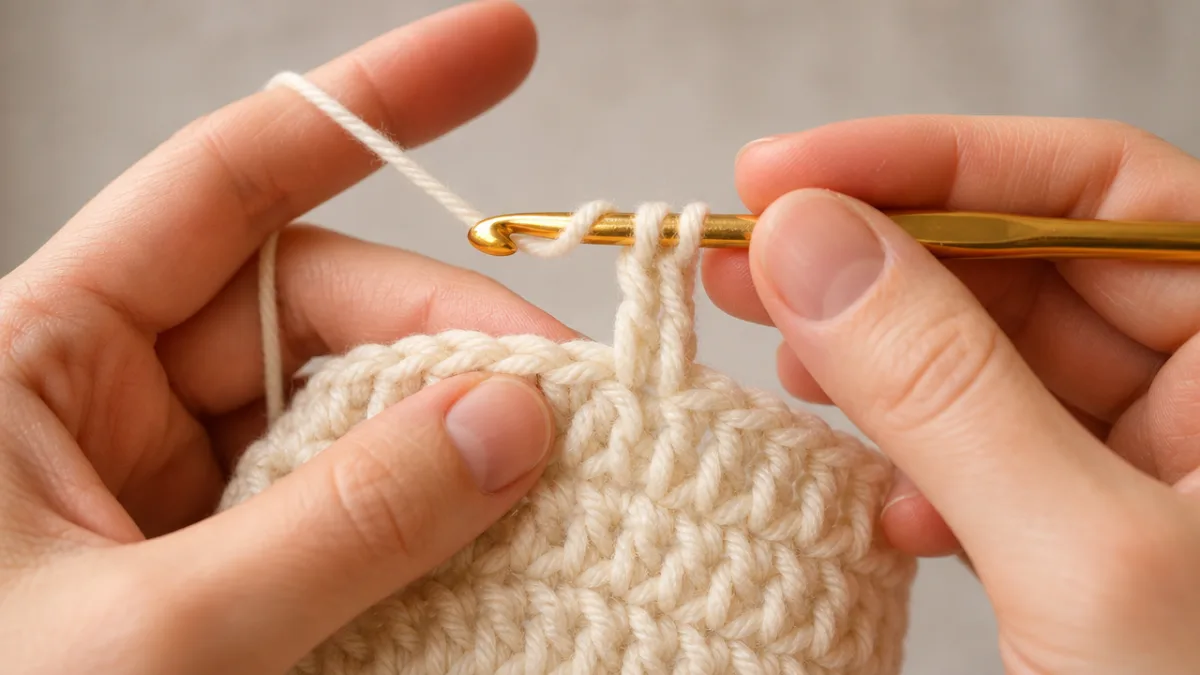
Treble crochet, also called triple crochet, is the next significant step up the height ladder. It is constructed by yarning over twice before inserting the hook, pulling up a loop to create four loops on the hook, then working yarn overs in three separate pull-through steps — each one pulling through two loops at a time until one loop remains. This extended construction makes treble crochet roughly twice the height of a single crochet, creating a beautifully long, open stitch with significant visual impact and excellent drape.
The turning chain for treble crochet is four chains, and this chain typically counts as the first treble crochet of the row in traditional patterns. Treble crochet is a staple of lacework, filet crochet grids, and any pattern where an open, elegant fabric is desired. It works up quickly due to its height, making it an efficient choice for large projects like shawls and blankets where you want to cover ground without sacrificing the beauty of the finished piece. The tall, open stitches catch light in a lovely way, making them especially popular for decorative and wearable items.
Beyond treble crochet, the height ladder continues upward with double treble crochet (yarn over three times), triple treble crochet (yarn over four times), and even taller stitches for highly specialized lace constructions. Each additional yarn over adds more height and more openness to the stitch. While these very tall stitches are less commonly seen in everyday patterns, they appear regularly in traditional Irish lace, Bruges lace, and other fine needle lace traditions where dramatic open fabric is the entire aesthetic goal. Understanding the pattern — one additional yarn over per height level — makes these taller stitches easy to understand and execute even without specific instructions.
Comparing Stitch Heights Side by Side
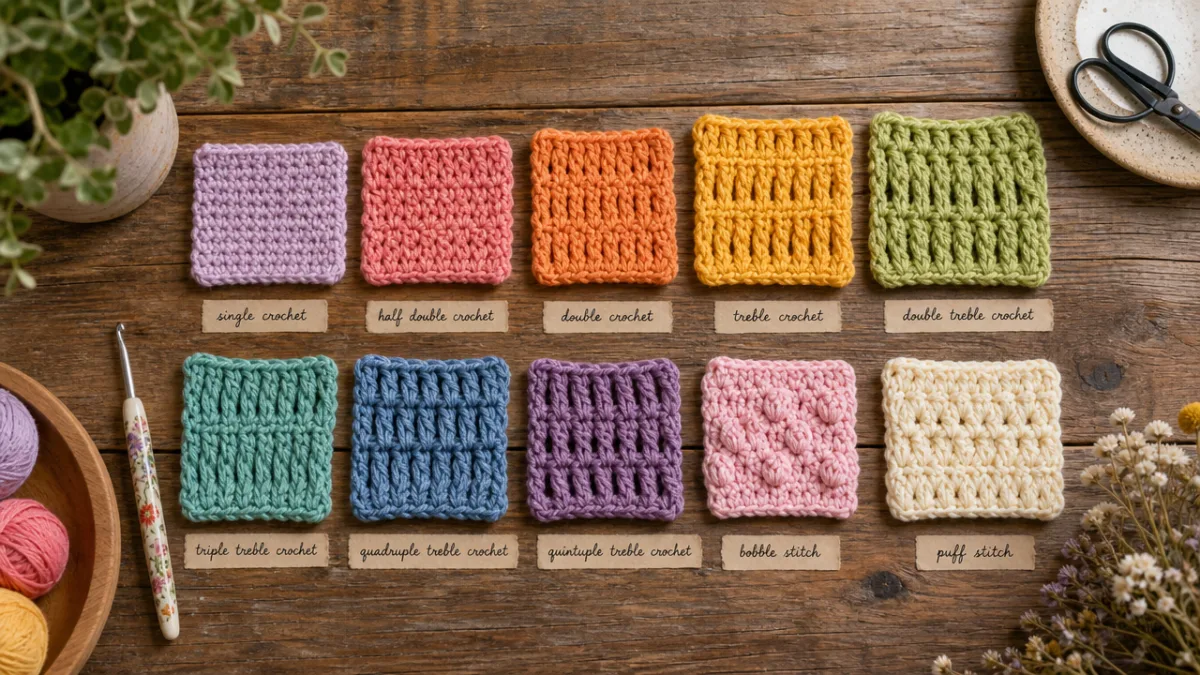
One of the most useful exercises any crocheter can do is to work a sampler swatch that includes all of the major stitch heights worked consecutively in the same piece of fabric. Start with a foundation chain, then work several rows of each stitch type in order from shortest to tallest. What you will see is an unmistakable staircase effect, with each section visibly taller than the last. This visual comparison is worth more than any written explanation, because it makes the height relationships completely concrete and easy to remember.
When comparing stitches side by side in such a sampler, you will also notice differences in fabric density. The single crochet section will look solid and compact, almost like a woven textile. The half double crochet section will show slightly more space between stitches. The double crochet section will have clearly visible gaps between individual stitches, and the treble crochet section will look noticeably open and lacy, with significant space visible through the fabric. These density differences correspond directly to the drape, weight, and stretch characteristics of fabric made from each stitch.
A useful way to summarize the standard stitch heights and their corresponding turning chains is to think of them as a simple reference table you keep in your memory. Slip stitch has no height and no turning chain. Single crochet has the shortest usable height and uses one turning chain. Half double crochet is slightly taller and uses two turning chains. Double crochet is the mid-range standard height using three turning chains. Treble crochet is tall and open, requiring four turning chains. Each level adds one more chain to the turning chain count, which makes the whole system beautifully easy to memorize once you see the pattern clearly.

Putting Stitch Height Knowledge Into Practice
Understanding stitch heights intellectually is valuable, but the real payoff comes when you begin applying this knowledge actively while crocheting. When you encounter an unfamiliar pattern stitch, you can immediately assess its height based on how many yarn overs precede the hook insertion. When a pattern calls for substituting one stitch for another, you can make informed decisions about what changes will be needed in stitch counts and turning chains. When you want to add texture to a design, you can deliberately mix stitch heights within the same row to create waves, shells, and dimensional effects.
Stitch height knowledge is also essential for reading crochet charts, which use standardized symbol diagrams to represent patterns visually. Each stitch symbol in a crochet chart has a height that corresponds to the real stitch it represents — taller symbols for taller stitches, shorter symbols for shorter ones. Once you are comfortable with the height hierarchy, crochet charts become much easier to read and follow, because the visual representation on the page mirrors the physical reality of the fabric you are building. Charts from any country or written in any language become accessible because they use the same universal symbol system.
Finally, knowing your stitch heights opens the door to confident improvisation and original design. Instead of being entirely dependent on following someone else’s pattern, you can begin to draft your own. You know that a row of double crochets will grow your fabric by a predictable amount, that alternating tall and short stitches within a row will create a textured wave pattern, and that combining stitch heights in specific sequences generates shells, fans, V-stitches, and countless other classic effects. The stitch height ladder is not just a reference fact to memorize — it is a creative tool that gives you genuine freedom and authorship over your crochet work.
Common Mistakes and How to Avoid Them
One of the most common mistakes that crocheters make related to stitch height is miscounting the turning chain at the beginning of a row. If a pattern specifies that the turning chain counts as the first stitch and you accidentally work into the top of that chain plus every other stitch, you will end each row with one extra stitch. Over several rows, this error accumulates and your piece will develop a noticeable diagonal slant along one edge. Always clarify at the start of a new pattern whether the turning chain counts or not, and develop a consistent personal approach.
Another frequent error involves confusing US and UK crochet terminology, which uses the same stitch names for different heights. In UK terminology, what Americans call a single crochet is named a double crochet, and what Americans call a double crochet is named a treble crochet. This means that if you are using a UK pattern and working from US habit, every stitch will be one height level off, resulting in fabric that looks nothing like the original. Always confirm which terminology convention a pattern uses before you begin, and keep a reference card handy until the distinction becomes automatic.
A third mistake involves underestimating the importance of the turning chain height match. If your pattern calls for double crochet and you add only two turning chains instead of three, the edge of your work will pull inward and look uneven. If you add four chains, the edge will flare outward. While some experienced crocheters adjust their turning chain counts slightly based on personal tension, the standard counts exist for a good reason and should be your starting point until you have enough experience to judge when a personal modification is genuinely an improvement. Careful attention to these details is what separates neat, professional-looking crochet from fabric that looks slightly off in ways that are hard to identify but immediately visible to the eye.








What do you think?
It is nice to know your opinion. Leave a comment.