










Crochet Spring Bracelets: Free Patterns to Welcome the Season
The Joy of Crocheting Spring Bracelets
There is something deeply satisfying about creating a piece of jewelry entirely by hand, and crochet bracelets offer one of the most accessible and rewarding ways to do just that. As the days grow longer and flowers begin to bloom, spring becomes the perfect season to pick up your hook and start crafting delicate, colorful wrist adornments that celebrate the warmth and renewal all around you. Whether you are a seasoned crocheter or someone who has just learned the basics, spring bracelets are a wonderfully manageable project that can be completed in a single afternoon.
Crochet bracelets have surged in popularity in recent years, finding their place in the broader handmade jewelry movement that values artisanship, sustainability, and personal expression. Unlike store-bought accessories, a crocheted bracelet carries the fingerprint of its maker — the specific tension of the stitches, the choice of color, the type of yarn or thread selected. These small, wearable pieces of art are deeply personal, making them ideal gifts for friends, family, or simply as a treat for yourself. Spring, with its associations of new beginnings and creativity, is a natural time to embrace this craft.
The beauty of spring-themed crochet bracelets lies in the variety of styles you can achieve with just a few basic techniques. From dainty floral motifs worked in fine cotton thread to bold, boho-style bands crocheted with colorful embroidery floss, the range is truly astonishing. Many free patterns are available online, generously shared by talented designers who want to spread the joy of crochet. In this article, we will explore the materials you need, foundational techniques, popular pattern styles, finishing tips, and creative ideas for personalizing your spring bracelet collection.
Choosing the Right Materials for Spring Bracelets
Selecting the right materials is the first and arguably most important step in creating a beautiful crochet bracelet. For spring jewelry, lightweight and breathable fibers are ideal. Fine cotton thread in size 10 is a classic choice — it produces crisp, well-defined stitches and comes in an enormous range of colors, from soft pastels to vibrant tropical shades. Mercerized cotton thread has a subtle sheen that gives finished bracelets an elegant, polished look, making them feel less like craft projects and more like fine accessories.
Beyond traditional cotton thread, many crafters love working with embroidery floss for spring bracelets. Six-strand embroidery floss is widely available, affordable, and comes in hundreds of colors, including gorgeous variegated options that produce a natural gradient effect as you work. Metallic embroidery floss can add a touch of sparkle reminiscent of dewy morning sunlight, perfect for a spring aesthetic. Nylon thread, linen cord, and even fine silk threads are all viable alternatives depending on the look and feel you want to achieve.
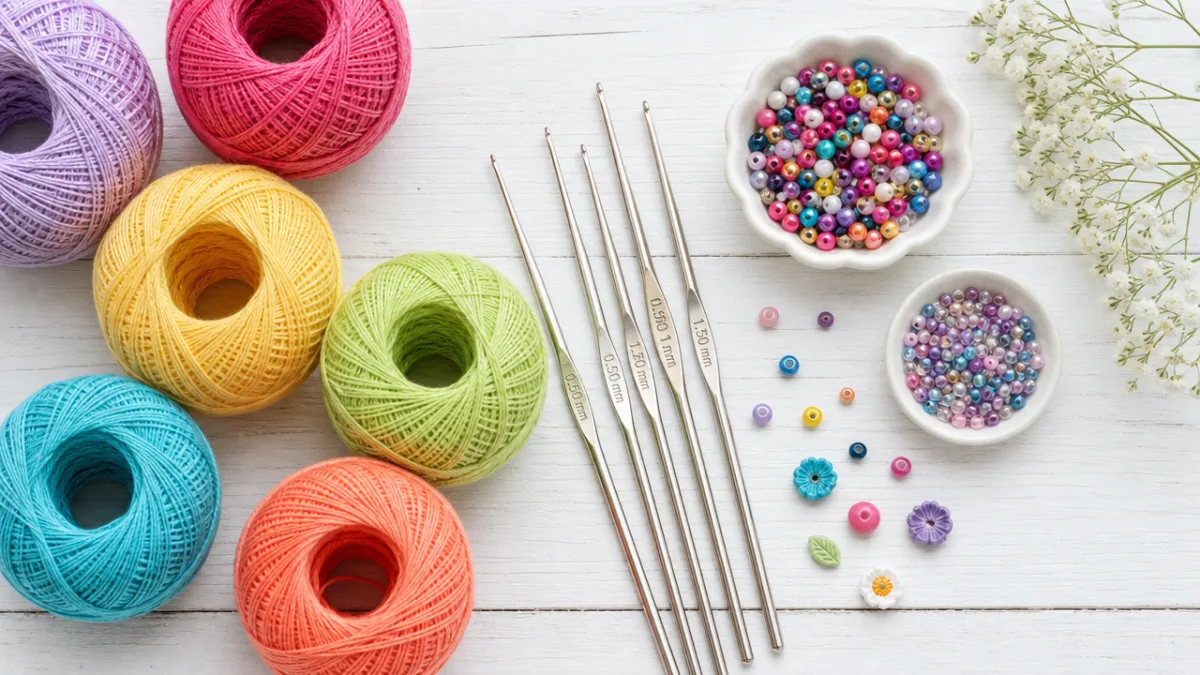
In addition to your thread or yarn, you will need a few other supplies to complete your project successfully. A steel crochet hook in size 6 or 7 is appropriate for working with fine cotton thread, while a standard aluminum hook in size B or C works well with embroidery floss. You will also want a tapestry needle for weaving in ends, sharp scissors, and some kind of closure for your bracelet — options include small lobster claw clasps, toggle clasps, button closures, or even a crocheted button loop. Beads, charms, and seed pearls can be threaded onto your working thread before you begin, allowing you to incorporate them into your stitches as you go.
- Size 10 mercerized cotton thread in your choice of spring colors
- Six-strand embroidery floss for a softer, more casual look
- Steel crochet hook (size 6 or 7) or aluminum hook (size B or C)
- Tapestry needle and sharp scissors
- Clasps, buttons, or toggle closures for finishing
- Optional: seed beads, small charms, or metallic thread for embellishment
Essential Crochet Techniques for Bracelet Making
Before diving into specific patterns, it is worth reviewing the fundamental crochet stitches that form the backbone of most bracelet designs. The chain stitch is the most basic building block — almost every crochet bracelet begins with a foundation chain. Understanding how to create a neat, consistent chain is crucial because the tension and evenness of your foundation chain will directly affect how your bracelet looks and fits. Practice making chains of consistent size until the motion feels natural and your loops are uniform.
The single crochet stitch is another indispensable technique for bracelet makers. Compact and sturdy, single crochet creates a tight, dense fabric that holds its shape beautifully, making it ideal for the base of many bracelet patterns. Slip stitches are also frequently used, both for joining rounds in circular motifs and for creating delicate picot edgings that give bracelets a lacy, feminine finish. The half double crochet and double crochet stitches appear in patterns that call for a slightly more open, flexible fabric — useful when you want a bracelet that drapes softly against the wrist.
For those looking to incorporate floral elements into their spring bracelets, learning the basic flower motif is well worth the effort. Most crochet flowers are worked in the round and involve a combination of chain stitches and double or treble crochet stitches to form petals. Once you have mastered a basic five-petal flower, you can adjust the number of chain stitches between petals, change petal height, or layer multiple flower rounds to create increasingly elaborate blooms. These flowers can then be sewn onto a simple crocheted band to create a stunning statement bracelet that truly captures the spirit of spring.
Working with Beads in Your Crochet
Incorporating beads into crochet bracelets is a technique that takes a little practice but produces truly stunning results. The key is to pre-string your beads onto your working thread before you begin crocheting. As you work, you slide a bead up close to your hook at designated points in the pattern, then work the next stitch around it, locking it into place within the fabric. This technique, sometimes called bead crochet, can be used to create intricate geometric patterns, simple scattered accents, or even elaborate floral designs entirely composed of tiny beads.
Seed beads in sizes 6/0 or 8/0 are the most commonly used beads in crochet jewelry because their round holes accommodate thread easily and their small size integrates seamlessly into fine crochet work. When selecting beads for a spring bracelet, consider colors that echo the natural world — soft pinks, lavenders, mint greens, sunny yellows, and crisp whites all work beautifully. Transparent or opalescent beads add a subtle shimmer, while matte finishes give a more earthy, organic feel. Mixing bead finishes within a single bracelet can create beautiful textural contrast.
Understanding Bracelet Sizing
Getting the sizing right is one of the trickier aspects of making crochet bracelets, and it is a detail that many beginner patterns unfortunately gloss over. The average adult wrist measures between six and seven and a half inches in circumference, but wrist sizes vary considerably. Before beginning any bracelet pattern, it is a good idea to measure your wrist and add half an inch to one inch of ease for comfortable wearing. If you are making a bracelet as a gift, err on the side of slightly larger rather than smaller, since most closures allow for some size adjustment.
Thread tension varies significantly from one crocheter to another, which means that two people following the exact same pattern with the exact same materials may end up with bracelets of slightly different sizes. This is completely normal and is simply a characteristic of handmade work. The best way to manage this is to crochet a small swatch of your chosen stitch pattern, measure it, and compare it to the gauge specified in the pattern. Adjust your hook size up or down as needed — a larger hook will produce looser, larger stitches, while a smaller hook will create tighter, smaller ones.
Popular Free Pattern Styles for Spring
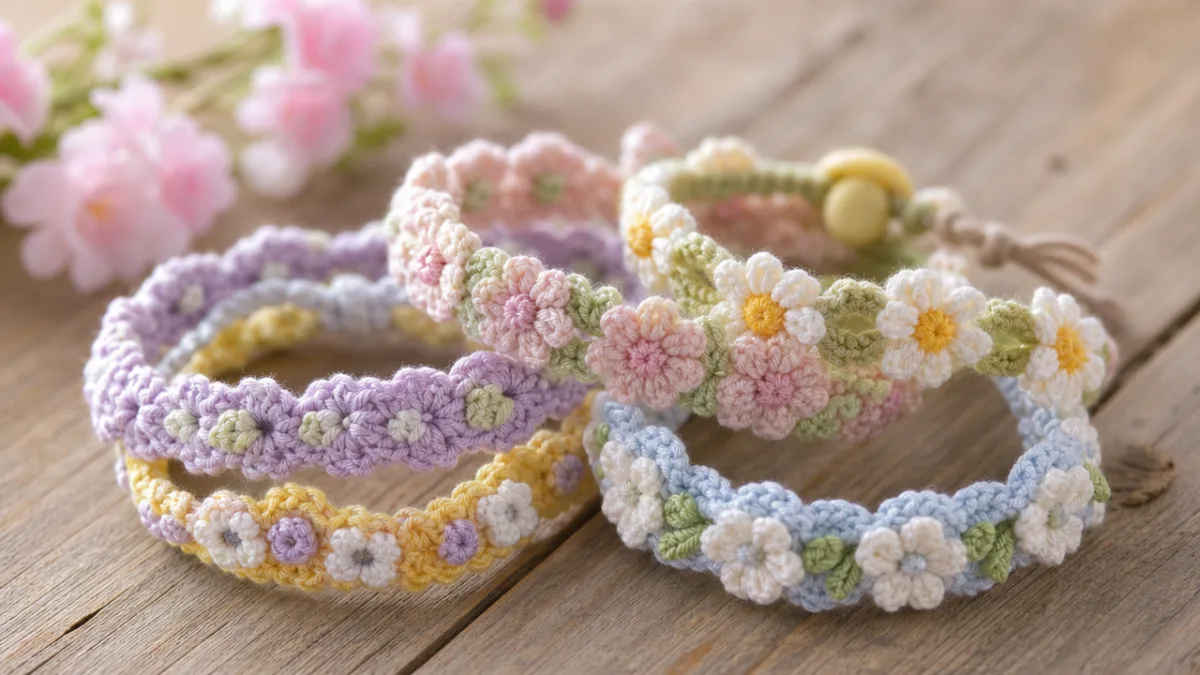
The internet is a treasure trove of free crochet bracelet patterns, and spring-themed designs are among the most popular and plentiful. Daisy chain bracelets are perennial favorites — they feature a continuous line of small crocheted daisy flowers connected by short lengths of chain stitches, creating a delicate, botanical look that feels unmistakably spring-like. These patterns typically require only basic stitches and can be completed in an hour or two, making them ideal for crafters who want quick, satisfying results.
Lacy filet crochet bracelets are another beautiful option for spring. Filet crochet uses a grid-like structure of double crochet stitches and chain spaces to create open, airy fabric that resembles fine lace. Spring-themed filet bracelets might feature motifs of butterflies, small flowers, or simple geometric repeats. The delicate, see-through quality of filet crochet is especially suited to the light, breezy aesthetic of spring fashion. These patterns require a bit more counting and concentration than simpler designs, but the results are truly exquisite.
Boho-style wrap bracelets are perhaps the most popular crochet bracelet style at the moment, and they translate beautifully into spring colorways. These bracelets are typically worked as long, narrow strips that wrap two or three times around the wrist and fasten with a button closure or adjustable tie. The strip itself can be worked in simple single crochet for a solid, minimalist look, or in more decorative stitches like the moss stitch or shell stitch for added texture and visual interest. Worked in a palette of soft spring colors — think peach, sage green, lilac, and cream — these bracelets have a relaxed, bohemian charm that suits the season perfectly.
Free Pattern Recommendations to Get You Started
Several outstanding free patterns are worth seeking out as starting points for your spring bracelet journey. The Simple Daisy Bracelet by Rescued Paw Designs is a beginner-friendly pattern that produces a charming flower chain bracelet using basic stitches and size 10 cotton thread. The Springtime Lace Bracelet by Repeat Crafter Me uses a simple shell stitch repeat to create a lovely, openwork band that looks far more complex than it actually is. For those interested in bead crochet, the Beaded Spiral Bracelet pattern available on Ravelry is a classic that produces a striking twisted rope of colorful beads and thread.
The heart motif bracelet is another popular free pattern style that works wonderfully in spring colors. Small crocheted hearts, worked flat in just a few rounds, are joined together or sewn onto a simple band to create a whimsical, romantic bracelet. These make wonderful gifts for friends and are particularly popular around springtime holidays. Many designers post their heart motif patterns on their blogs or on platforms like Ravelry, Etsy (as free downloads), and Pinterest, so they are easy to find and download at no cost.
Finishing Techniques and Professional Touches
A beautifully crocheted bracelet can be let down by poor finishing, so it is worth taking the time to learn a few techniques that will give your work a polished, professional appearance. The most fundamental finishing task is weaving in your ends. Using a tapestry needle, thread each yarn tail through several stitches on the wrong side of your work, changing direction once or twice to secure it firmly. Trim the tail close to the fabric, being careful not to cut into your actual stitches. Properly woven ends will not work loose over time and will be completely invisible from the right side.
Blocking is a finishing technique that can dramatically improve the appearance of crocheted bracelets, especially those worked in cotton thread. To block a bracelet, dampen it with water, gently reshape it to the correct dimensions, and allow it to dry flat or pinned to a blocking board. Blocking relaxes the fibers, evens out any irregularities in tension, and opens up lacy stitch patterns so they lie flat and display their full beauty. It is particularly beneficial for filet crochet and any pattern with decorative openwork, transforming what might look slightly rumpled off the hook into a crisp, elegant piece of jewelry.
Attaching a closure is the final step in finishing your bracelet, and the method you choose will significantly affect both the look and the practicality of the finished piece. For the most secure and professional-looking closure, sew a small jewelry lobster claw clasp to one end of your bracelet and a short length of chain or a small jump ring to the other, using your tapestry needle and a length of the same thread you used for the bracelet. Button closures have a charming, handmade quality that suits the aesthetic of crocheted jewelry well — simply sew a small vintage button to one end and crochet a button loop at the other.
Caring for Your Crochet Bracelets
With proper care, a well-made crochet bracelet can last for many years and remain as beautiful as the day it was made. Cotton thread bracelets can generally be hand-washed in cool water with a small amount of mild soap, then rinsed thoroughly and laid flat to dry. Avoid wringing or twisting the bracelet, as this can distort the stitches and stretch the fabric out of shape. Bracelets made with metallic thread or embellished with beads should be treated with extra care — spot clean them if possible, and always air dry rather than using heat.
Storing your crochet bracelets properly will help them maintain their shape and prevent tangling. A small jewelry box with individual compartments is ideal, or you can hang them on a small jewelry stand or hook. Keep them away from direct sunlight for extended periods, as prolonged UV exposure can cause colored threads to fade over time. If you are storing bracelets made with natural fibers for a season, a small sachet of cedar or lavender will help repel insects and keep them smelling fresh.
Creative Ideas for Personalizing Your Spring Bracelets
One of the greatest pleasures of making your own jewelry is the freedom to personalize it in ways that mass-produced pieces simply cannot match. Color is the most obvious and powerful tool for personalization — choose shades that reflect your personal style, complement your wardrobe, or capture a particular mood or memory. For spring, a palette inspired by a specific flower or landscape can be especially evocative. Try the soft pinks and greens of cherry blossoms, the rich purples and yellows of a wildflower meadow, or the clean whites and blues of a clear spring sky.
Adding charms to your crochet bracelet is another wonderful way to make it uniquely yours. Small metal charms in the shapes of butterflies, bees, dragonflies, leaves, and flowers can be attached to finished bracelets using jump rings, or incorporated directly into the work by hooking a jump ring through a stitch before closing it. Initial charms and birthstone beads give bracelets a personalized, meaningful quality that makes them especially treasured as gifts. Consider mixing different charm styles — vintage, minimalist, nature-inspired — for a layered, eclectic look.
Combining crochet with other fiber arts techniques opens up even more creative possibilities. Macramé knots can be used in place of crocheted sections for part of a bracelet, creating an interesting textural contrast. Friendship bracelet-style braiding can be incorporated alongside crocheted elements. Embroidery floss in complementary colors can be used to add embroidered accents directly onto a crocheted band. These hybrid approaches allow you to draw on a wider range of skills and create pieces that are truly one of a kind, reflecting your individual creative vision in every stitch.
Making Bracelets as Gifts and for Special Occasions
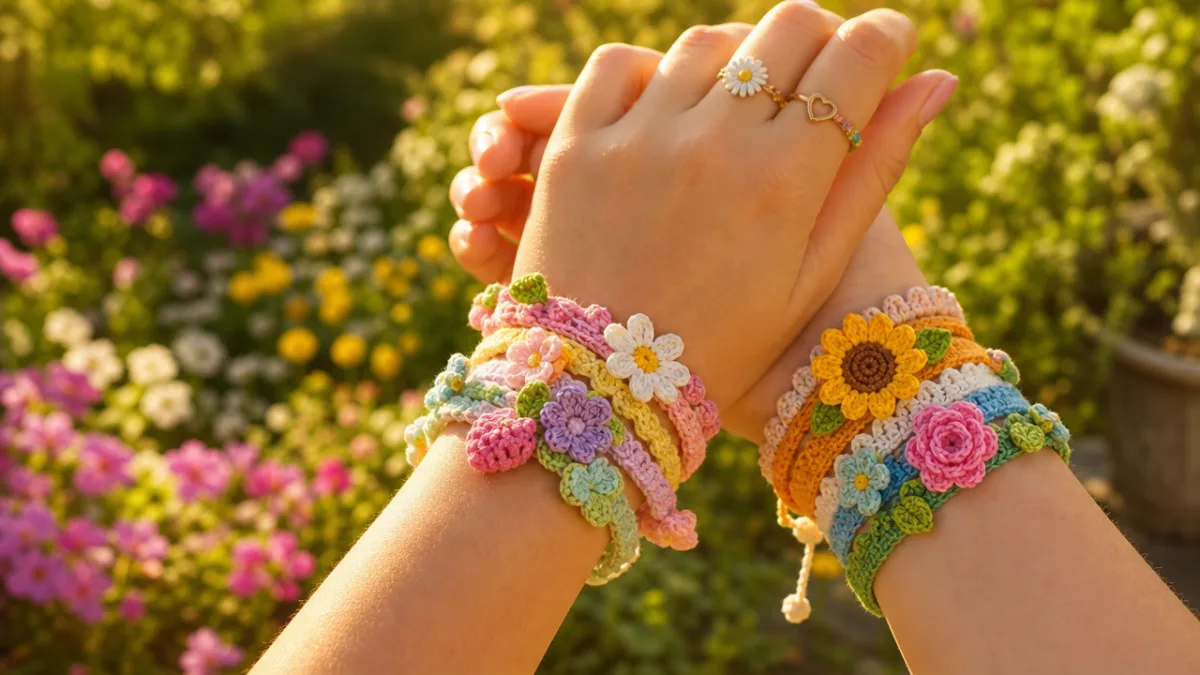
Handmade bracelets make some of the most thoughtful and cherished gifts you can give, and spring offers numerous occasions for gift-giving — Mother’s Day, Easter, spring birthdays, graduation celebrations, and simple gestures of friendship. When making bracelets as gifts, consider the recipient’s personal style and favorite colors. A nature lover might appreciate a bracelet featuring tiny crocheted leaves and flowers, while someone with a more minimalist aesthetic might prefer a simple, elegant band worked in a single neutral color with subtle bead accents.
Packaging your handmade bracelets beautifully elevates the gifting experience and shows the recipient how much thought you have put into the gesture. A small kraft paper jewelry box lined with tissue paper, a handwritten card explaining the materials and techniques used, and a sprig of fresh or dried flowers tucked inside all combine to create a gift that feels special from the moment it is received. You might also consider including care instructions so the recipient knows how to look after their new treasure for years to come.
Making crochet bracelets in batches for craft fairs, markets, or online shops is another exciting direction to take your hobby. Spring markets are wonderful opportunities to sell handmade jewelry, and colorful crochet bracelets displayed on a rustic wooden bracelet stand are enormously eye-catching. Pricing handmade jewelry appropriately means accounting for the cost of materials, the time invested in making each piece, and a reasonable profit margin. Many crafters find that once they begin sharing their work publicly, the positive response they receive deepens their enthusiasm for the craft and inspires them to keep learning new techniques and developing their own signature style.
- Choose colors and materials that reflect the recipient’s personality and style
- Select a pattern appropriate to your skill level and the time you have available
- Crochet a tension swatch and adjust hook size as needed for correct sizing
- Work the pattern carefully, keeping consistent tension throughout
- Block the finished bracelet for a polished, professional appearance
- Attach a suitable closure securely and weave in all ends thoroughly
- Package beautifully and include care instructions when giving as a gift
Crochet spring bracelets represent a perfect intersection of art, craft, self-expression, and seasonal celebration. Whether you are drawn to the meditative rhythm of working stitch by stitch, the joy of wearing something you made with your own hands, or the pleasure of giving a truly personal gift to someone you love, this craft has something to offer everyone. With so many free patterns available and such a wide range of materials and styles to explore, there has never been a better time to pick up a hook, choose your favorite spring colors, and start creating.








What do you think?
It is nice to know your opinion. Leave a comment.