










6 Celestial Cardigan Free Crochet Patterns: Your Complete Guide to Starry Stitchwork
Introduction to Celestial Crochet Cardigans
Celestial-themed crochet has taken the crafting world by storm, and nowhere is this trend more beautifully expressed than in the sweeping, cozy world of cardigans. These garments combine the timeless art of crochet with motifs drawn from the night sky — moons, stars, suns, and constellations — to create wearable pieces that feel both magical and deeply personal. Whether you are a seasoned crocheter or someone just beginning to explore the craft, celestial cardigans offer an inspiring entry point into garment making that rewards patience and creativity in equal measure.
What makes celestial cardigans so appealing is their versatility. A delicate lace cardigan featuring crescent moon motifs can dress up a simple outfit for an evening gathering, while a chunky, star-speckled wrap cardigan serves perfectly as a cozy layer during cooler months. The celestial theme transcends seasonal boundaries, making these garments practical additions to any wardrobe. Designers across the crochet community have embraced this aesthetic, producing patterns that range from beginner-friendly to advanced, ensuring there is something for every skill level and every style preference.
The beauty of free crochet patterns in particular is that they democratize the craft. Anyone with access to the internet, a crochet hook, and some yarn can embark on the journey of creating a celestial cardigan without any financial barrier. The six patterns explored in this article represent some of the finest examples of freely available celestial cardigan designs. Each one has been thoughtfully constructed to celebrate the cosmos through fiber art, offering unique techniques, stitch combinations, and design philosophies that make the finished garment feel truly special and worth every hour of work invested.
Understanding Celestial Motifs in Crochet Design
Before diving into the individual patterns, it helps to understand what defines a celestial motif in crochet design and how these symbolic elements translate from the night sky to the surface of a garment. Stars are perhaps the most recognizable celestial symbol, and in crochet they can be rendered through a variety of techniques including star stitches, bobble clusters arranged in star shapes, or surface slip-stitch embroidery applied after the main fabric is complete. Each approach creates a different visual texture and dimensional quality, and pattern designers often choose their technique based on the overall weight and drape they want for the finished cardigan.
Moon motifs bring a different kind of energy to celestial crochet. Crescent shapes are frequently worked into lace panels, yoke constructions, or as standalone appliqués sewn onto completed garments. Full moon circles are commonly rendered through granny square-style medallion constructions that can then be joined together to form the body of a cardigan. Waxing and waning moons appear frequently in colorwork sections, where careful yarn management creates the illusion of the lunar cycle progressing across the fabric. Understanding these techniques empowers crocheters to modify and personalize any pattern they encounter, substituting one celestial motif for another to suit their artistic vision.
Beyond stars and moons, celestial design vocabulary includes suns, planets, comets, nebulae, and constellation maps. In crochet, these elements are often suggested rather than literally depicted, with radial stitch patterns evoking solar energy, swirling colorwork suggesting the gaseous beauty of distant nebulae, and carefully placed bobbles or popcorn stitches mimicking the scattered brilliance of a star field. The yarn choices matter enormously in celestial crochet — deep navy, midnight black, rich purple, and metallic-flecked fibers all contribute to the cosmic atmosphere. When a designer successfully marries the right stitch architecture with the right color story, the result is a cardigan that genuinely feels like wearing a piece of the universe.

Pattern One and Two: Beginner-Friendly Celestial Wraps
The first two patterns in our celestial collection are specifically designed with newer crocheters in mind, relying on simple stitch combinations that nonetheless produce stunning results. The first pattern, often called a Moonbeam Wrap Cardigan, uses nothing more complex than single crochet and chain spaces worked in a top-down construction. The magic lies entirely in the yarn choice and color blocking — a deep indigo body is punctuated by rows of silver-toned yarn that catch the light beautifully, creating a shimmering effect reminiscent of moonlight reflecting off still water. The pattern is worked in one piece from the neckline down, meaning there are no seams to sew and no pieces to join.
The second beginner-friendly pattern is a Starfall Cocoon Cardigan, which uses an oversized, boxy silhouette beloved in contemporary fashion. This pattern employs the v-stitch as its primary construction element, creating a fabric with a natural open, lacy quality that works beautifully in lighter-weight yarns. Small star appliqués, worked separately in just a few rounds and requiring no more than thirty minutes each to complete, are then scattered across the finished body of the cardigan. This modular approach is clever because it lets the crocheter control the density and placement of the celestial decoration, making each finished garment subtly unique even when many people follow the same pattern.
Both of these beginner patterns share several characteristics that make them excellent starting points for anyone new to garment crochet. They avoid complex shaping, relying instead on generous, flowing silhouettes that forgive minor gauge inconsistencies. They use widely available yarn weights — both calling for bulky or super-bulky yarn — which means the work progresses quickly and rewarding results appear within just a few evenings of stitching. The free versions of these patterns are available on several popular crochet community websites, complete with stitch counts, gauge swatching guidance, and helpful notes from the designers about substituting yarns and adjusting sizing for different body measurements.
Pattern Three and Four: Intermediate Celestial Constructions
Moving into intermediate territory, patterns three and four introduce crocheters to more sophisticated construction techniques while maintaining the ethereal celestial aesthetic. Pattern three is a Constellation Yoke Cardigan, which features a stunning circular yoke construction worked in the round before splitting for the body and sleeves. The yoke itself is the showpiece of this design — it incorporates a detailed constellation chart that the crocheter follows, working color changes to map out one of several recognizable star patterns including Orion, Cassiopeia, and the Southern Cross. The precision required for this colorwork elevates the pattern to intermediate status, but the instructions are exceptionally clear, with row-by-row color guides included in the free download.
Pattern four takes a different approach to celestial design by focusing on texture rather than color. The Lunar Surface Cardigan uses a combination of front post and back post double crochet stitches to create a deeply textured fabric that evokes the cratered, dimensional surface of the moon. Worked in a single soft grey or cream yarn, this cardigan demonstrates that celestial inspiration need not depend on bold colors or literal star imagery — the texture itself tells the cosmic story. The silhouette is a classic open-front cardigan with ribbed cuffs and hem, making it one of the most wearable and seasonally versatile designs in this collection. The free pattern includes detailed written instructions as well as stitch diagrams for the central texture panel.
Intermediate crocheters will appreciate that both of these patterns push their skills forward without becoming frustrating. The key techniques introduced include magic ring construction, working into the front loop only for ribbing effects, increasing and decreasing for raglan-style sleeve shaping, and managing multiple yarn colors without excessive tangling or loose ends. Each of these techniques is transferable to dozens of other crochet projects, meaning that completing either of these cardigans represents a genuine investment in skill development. Many crocheters report that these pattern types become pivotal moments in their crafting journey, marking the transition from making small accessories to confidently tackling full garments.
Pattern Five and Six: Advanced Celestial Masterpieces
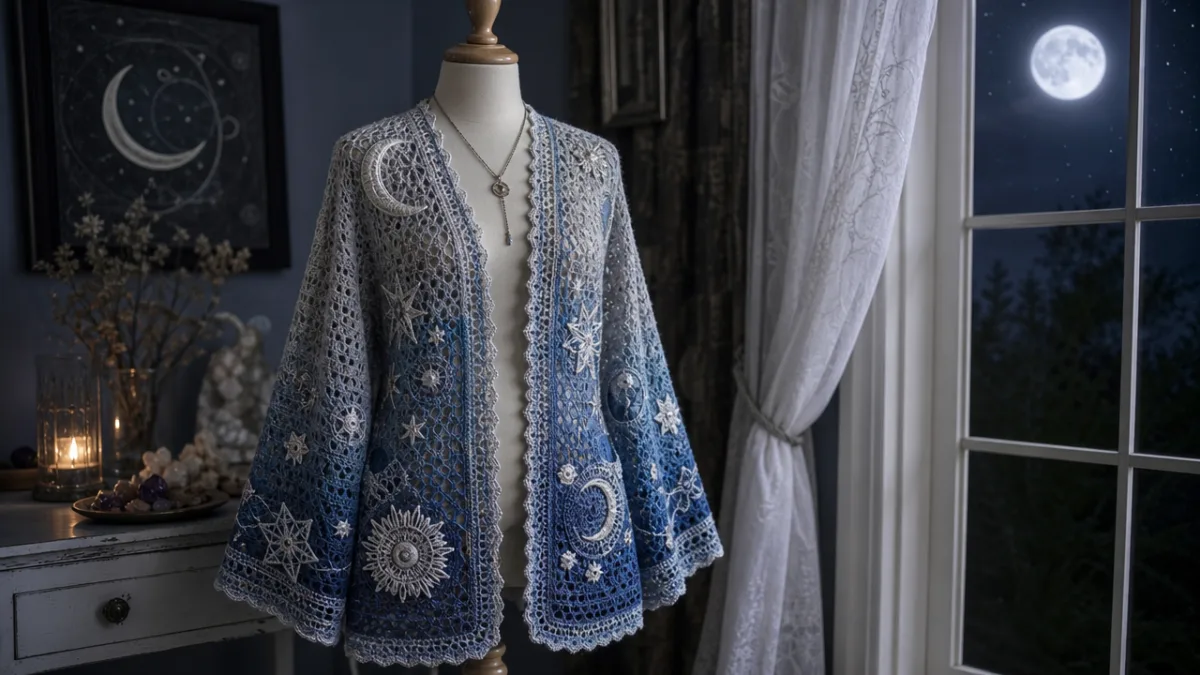
The fifth and sixth patterns in this collection represent the pinnacle of celestial crochet design, intended for experienced crocheters who are comfortable with complex construction, intricate motif work, and advanced finishing techniques. Pattern five is the Galaxy Lace Cardigan, an extraordinary garment that uses a combination of filet crochet, Tunisian entrelac, and traditional Irish crochet techniques to create a layered, dimensional fabric that genuinely resembles the swirling complexity of a galaxy. The free pattern runs to several detailed pages and includes multiple sizing options, gauge charts, and notes on how to modify the color palette to represent different galaxies — from the warm golden tones of an elliptical galaxy to the cool blues and purples of a spiral galaxy like the Milky Way.
Pattern six, the Celestial Granny Square Duster, takes a modular approach to advanced crochet, constructing an entire floor-length cardigan from hundreds of individual celestial-themed motifs. Each motif is its own small masterpiece — some feature eight-pointed stars, others incorporate crescent moon shapes worked in relief against a lace background, and still others evoke sunbursts with radiating chains and picot edging. The challenge and the beauty of this pattern lie in the joining process, where crocheters must carefully sequence their motifs to create a cohesive celestial narrative across the full length of the garment. The free pattern provides a suggested layout map, but experienced crocheters are encouraged to develop their own arrangement, making each finished duster a uniquely personal cosmic atlas.
What both advanced patterns share is an ambition that transcends mere clothing construction and enters the realm of fiber art. Completing either of these cardigans requires significant time investment — experienced crocheters report between forty and one hundred hours of work depending on sizing and yarn weight chosen. However, the resulting garments are genuinely extraordinary pieces that attract admiration and conversation wherever they are worn. Both patterns are generously documented by their designers, who have included extensive video tutorials, stitch-along community threads, and modification notes to support crocheters through the most challenging sections. The combination of detailed instructions and community support makes these advanced patterns accessible to anyone determined enough to attempt them.
Essential Materials, Tools, and Tips for Celestial Cardigans
Approaching any of these six celestial cardigan patterns requires thoughtful preparation, beginning with the selection of appropriate materials. Yarn choice is perhaps the single most impactful decision a crocheter will make, as it determines the drape, warmth, texture, and overall aesthetic of the finished garment. For celestial cardigans specifically, certain fiber types work better than others. Yarns with natural luminosity — those containing silk, bamboo, or Tencel — catch light beautifully and enhance the cosmic quality of starry or moonlit designs. Wool blends provide the structural memory needed for more complex textured patterns, while plant-based fibers like cotton and linen suit lighter, open-lace constructions designed for warmer weather wearing.
When it comes to tools, investing in quality crochet hooks makes a meaningful difference in the comfort and consistency of the finished work. Ergonomic hooks with cushioned handles reduce hand fatigue during long crafting sessions, which is especially important for larger projects like cardigans. For celestial cardigans specifically, having a range of hook sizes on hand is advisable, as gauge adjustment is often necessary when substituting yarns. Additional tools that prove invaluable include locking stitch markers for tracking pattern repeats, a yarn swift and ball winder for managing multiple skeins, blocking mats and rust-proof pins for finishing, and a tapestry needle collection for weaving in the inevitable ends.
Successful completion of a celestial cardigan also depends on good habits and sound technical practices. Gauge swatching is non-negotiable for garment projects — even experienced crocheters should work a swatch of at least four inches square, wash and dry it as the finished garment will be treated, and measure carefully before committing to a pattern size. Reading through the entire pattern before beginning prevents unpleasant surprises mid-project. Keeping notes about yarn lot numbers, the hook size ultimately used, and any modifications made ensures that the crocheter can recreate their process or make a second garment with minimal guesswork. The following practices are particularly recommended for celestial cardigan projects:
- Always photograph your gauge swatch alongside a ruler before and after washing to document any changes in measurements caused by the blocking or laundering process.
- Wind yarn into center-pull cakes before beginning to prevent tangling and ensure even tension throughout the project, especially when working with multiple color changes.
- Keep a dedicated project notebook recording row counts, any pattern modifications made, and notes on stitch counts at key construction points to simplify troubleshooting.
- Join crochet communities online or locally where members are working the same patterns, as collective problem-solving dramatically reduces frustration when challenging sections arise.
- Block each completed section of a modular design before joining to ensure consistent dimensions and to make the joining process significantly easier and more accurate.
Finally, embracing the learning process is essential when tackling celestial cardigan patterns at any skill level. Every project, regardless of outcome, teaches something valuable about tension control, color management, or construction logic. The crochet community is famously generous with knowledge and encouragement, and the designers of these six free patterns have almost universally created companion resources — video tutorials, errata documents, and dedicated help threads — to support crocheters through difficult moments. Approaching each pattern with curiosity rather than anxiety transforms even the most challenging construction sequence into an engaging puzzle, and the eventual result — a wearable, handmade piece of the cosmos — makes every moment of concentrated effort worthwhile.

Styling, Care, and the Community Behind Celestial Crochet
Once a celestial cardigan is complete, the joy of wearing and styling it begins. These garments are remarkably versatile despite their statement-making designs. A deeply textured Lunar Surface Cardigan in cream or grey pairs beautifully with simple linen trousers and leather sandals for a relaxed, earthy aesthetic that lets the texture do the talking. The same garment worn over a silk slip dress and paired with dark boots creates an entirely different impression — romantic, slightly witchy, and unmistakably intentional. Celestial cardigans encourage wearers to think more creatively about their wardrobes, treating clothing as a form of self-expression rather than mere practicality.
Caring for a handmade crochet garment requires a gentle approach that respects both the fiber content and the construction of the piece. Most celestial cardigans, particularly those made with wool or wool blends, benefit from hand washing in cool water with a specialist wool wash, followed by careful pressing between towels to remove excess water and flat drying on a clean surface away from direct heat or sunlight. Cardigans made with cotton or plant-based fibers can often withstand a gentle machine wash cycle, but checking the specific yarn’s care instructions is always advisable. Proper storage is equally important — folding crochet cardigans rather than hanging them prevents the fabric from stretching under its own weight over time.
The community of crocheters who gravitate toward celestial designs is a warm and creative collective that exists across social media platforms, in-person crafting groups, and dedicated online forums. Instagram and Pinterest are particularly rich resources for celestial crochet inspiration, where thousands of makers share their completed projects, work-in-progress photographs, and styling ideas. Hashtags dedicated to celestial crochet connect makers from around the world, fostering friendships and creative collaborations that frequently extend beyond the digital space into real-world craft meetups and collaborative design projects. This community spirit reflects something fundamental about the appeal of celestial themes in craft — the night sky belongs to everyone, and making art inspired by it is an inherently inclusive and unifying act.
For those who fall in love with celestial crochet through these six free patterns, the journey rarely ends with a single cardigan. Many crocheters find themselves building entire celestial wardrobes — matching beanies, shawls, socks, and bags worked in coordinating colors and motifs to complement a beloved cardigan. Others become inspired to design their own celestial patterns, using the technical skills developed through following these six examples as a foundation for original creative work. The craft rewards sustained engagement, and the celestial theme offers virtually unlimited inspiration drawn from the inexhaustible wonder of the universe above us. Whether crafting under a lamp at midnight or in a sunlit window on a quiet afternoon, crocheting celestial garments connects makers to something ancient, beautiful, and profoundly human — the impulse to reach toward the stars.








What do you think?
It is nice to know your opinion. Leave a comment.