










16 Adorable Crochet Plushies: Your Complete Guide to Soft, Squishy Creations
The Magic of Crochet Plushies: Why Everyone Is Falling in Love
Crochet plushies, often called amigurumi when made in the Japanese tradition, have taken the crafting world by storm over the past decade. These soft, huggable creations combine the meditative practice of crochet with the deeply satisfying result of producing something that looks and feels like a professional toy. Whether you are a seasoned crocheter looking for a new challenge or a curious beginner eager to make your first stuffed animal, crochet plushies offer a rewarding creative outlet that is accessible to virtually anyone willing to learn a few basic stitches.
What makes crochet plushies so uniquely appealing is the sheer variety of characters and creatures you can bring to life. From tiny woodland animals like foxes, bunnies, and hedgehogs to fantastical creatures like dragons, unicorns, and monsters, the possibilities are genuinely endless. Each finished plushie becomes a one-of-a-kind creation shaped by your choice of yarn color, size, and personal touches. Many crafters find that once they complete their first plushie, they simply cannot stop — the combination of portability, affordability, and creative satisfaction makes this hobby deeply addictive in the best possible way.
Beyond personal enjoyment, crochet plushies hold enormous practical appeal. Handmade plushies make extraordinarily thoughtful gifts for birthdays, baby showers, and holidays because they carry a sense of time, care, and personal investment that no store-bought toy can replicate. Parents particularly appreciate gifting handmade plushies to young children, knowing exactly what materials went into the toy. With hypoallergenic stuffing options and natural fiber yarns available, you can tailor every plushie to the specific needs and preferences of the recipient, making each one truly special.
Essential Supplies and Tools for Crochet Plushie Making
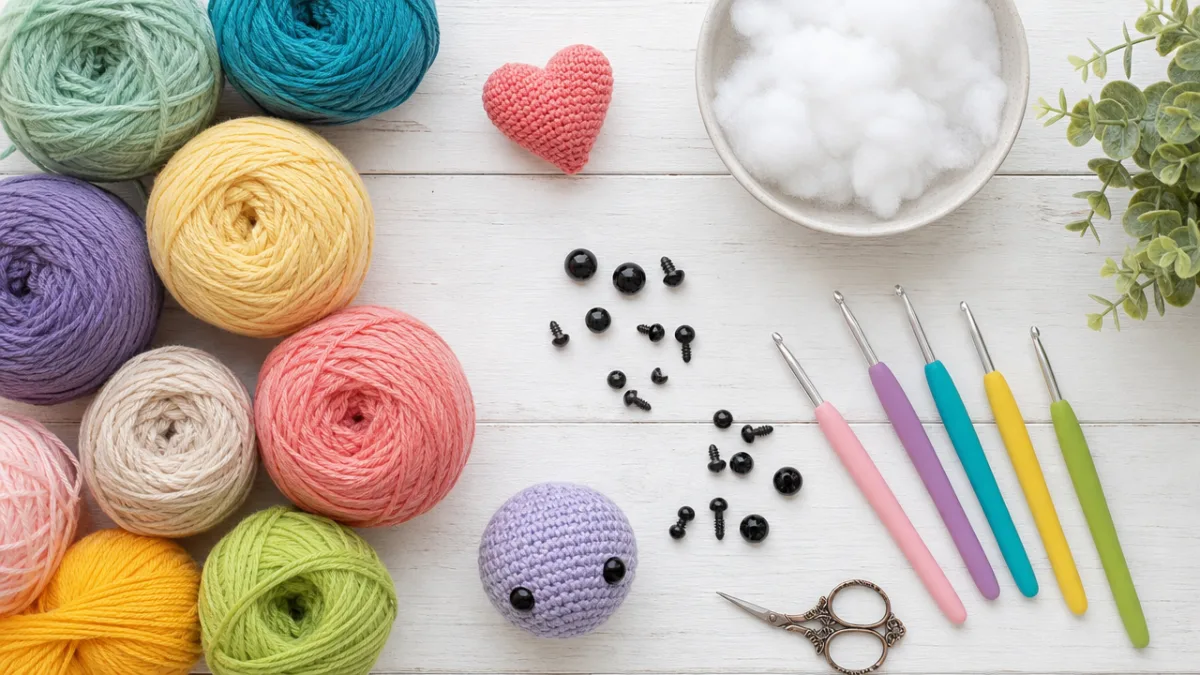
Before diving into patterns, it is important to gather the right supplies. The good news is that crochet plushies require relatively minimal equipment compared to many other crafting hobbies. Your most critical investment will be in quality yarn. For most plushies, a smooth, worsted-weight acrylic yarn works beautifully because it is easy to work with, widely available, machine washable, and comes in hundreds of colors. Brands like Lion Brand, Red Heart, and Paintbox are popular among plushie makers for their consistent quality and vibrant color ranges.
Your hook size should coordinate with your chosen yarn weight. For standard worsted-weight yarn, a 3.5mm to 4.5mm crochet hook is typically ideal. Many plushie makers intentionally use a hook that is slightly smaller than recommended on the yarn label, which creates a tighter stitch that prevents the polyfill stuffing from showing through gaps. Ergonomic hooks with cushioned handles are well worth the small additional investment if you plan to spend long sessions crocheting, as they significantly reduce hand fatigue and wrist strain over time.
Beyond yarn and hooks, you will need a handful of other essential supplies to complete your plushies. Polyester fiberfill stuffing is the standard choice for filling plushies because it is lightweight, washable, and gives toys a satisfyingly plump, huggable feel. Safety eyes, which are plastic eyes with a locking washer that clicks into place on the back side of the fabric, are used for most plushies intended for older children and adults. For toys meant for very young children under three years of age, embroidered eyes using yarn or embroidery floss are the safer alternative since they eliminate any choking hazard. You will also want a blunt tapestry needle for sewing pieces together, stitch markers to keep track of rounds, and scissors.
- Worsted-weight acrylic yarn in your chosen colors
- Crochet hooks in sizes 3.5mm to 4.5mm
- Polyester fiberfill stuffing
- Safety eyes in various sizes (6mm to 12mm are most common)
- Blunt tapestry needle for seaming and weaving in ends
- Stitch markers to track your round beginnings
- Sharp scissors
- Pins for holding pieces in place before sewing
Understanding Amigurumi Construction: The Building Blocks of Every Plushie
Most crochet plushies are built using the amigurumi construction method, which involves crocheting in continuous spiraling rounds rather than flat rows joined at the end. This technique produces a seamless, rounded fabric that is perfect for creating spherical and cylindrical shapes — the fundamental building blocks of almost every plushie body, head, arm, and leg. Learning to recognize and count your rounds, place stitch markers at the beginning of each round, and maintain an even tension are the foundational skills that will carry you through every pattern you attempt.
The magic ring, also called a magic circle or adjustable ring, is the starting technique used for virtually every component of a crochet plushie. This technique allows you to begin crocheting in the round with a completely closed center, which is essential for creating tight, gap-free shapes. Unlike a chain ring, which can leave a small hole in the center, a magic ring starts with zero gap and can be tightened completely once you have worked your first round of stitches. If you have not yet mastered the magic ring, it is the single most important skill to practice before beginning your first plushie pattern.
Increasing and decreasing stitches within your rounds is what transforms flat circles into three-dimensional shapes. When you increase — typically by working two single crochet stitches into the same stitch — your circle expands outward. When you decrease — usually by crocheting two stitches together into one — the fabric contracts and curves inward, eventually closing off a shape entirely. Understanding this simple principle means you can intuitively follow any pattern and begin to understand why each instruction exists, which ultimately gives you the confidence to modify patterns and eventually design your own original plushies.
16 Adorable Plushie Categories and Pattern Ideas
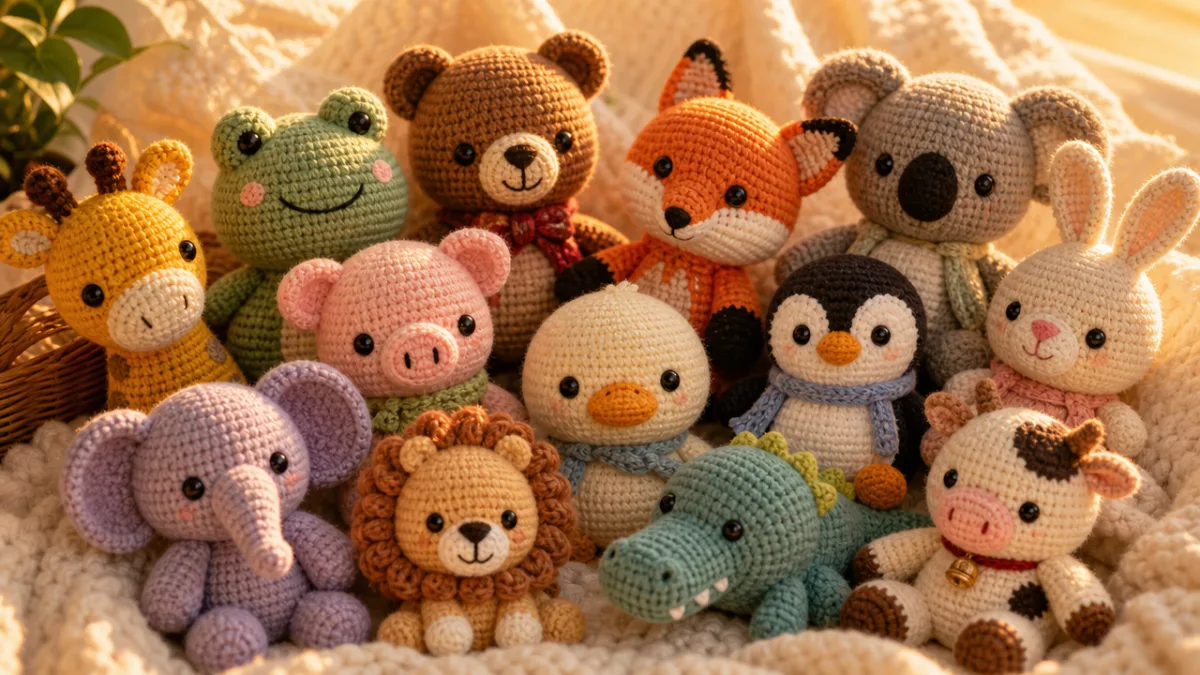
The world of crochet plushie patterns is remarkably diverse, spanning animals, fantasy creatures, food characters, and beloved pop culture icons. Among the most popular categories for beginners are simple animal plushies like teddy bears, bunnies, and cats. These creatures typically feature a round body, a similarly round head, and simple appendages like ears, arms, and legs that are crocheted separately and then sewn on. Their familiar shapes and forgiving proportions make them ideal first projects that produce impressive results even for those who are relatively new to crochet.
Ocean-themed plushies have surged in popularity and represent another wonderful category to explore. Octopuses, narwhals, whales, jellyfish, and axolotls (technically freshwater amphibians but beloved in the crafting community) have all become crochet sensations in recent years. The axolotl in particular has become something of a mascot for the crochet plushie community, with its distinctive feathery gills and eternally smiling face making for an endearing finished product. Sea turtle plushies with their textured shells and little flipper arms are another fan favorite that photographs beautifully and makes a wonderful gift for ocean lovers of all ages.
Fantasy and whimsical creature plushies represent perhaps the most exciting category for those who want to let their creativity run wild. Dragons, unicorns, phoenixes, mermaids, and even original monster designs allow crafters to experiment with bold color combinations, unusual textures achieved through specialty yarn, and creative embellishments like yarn manes, sewn-on wings, and embroidered facial expressions. Many crafters find that fantasy plushies are where they truly begin to develop their own creative voice, personalizing patterns with color choices and modifications that reflect their individual aesthetic sensibility.
- Classic Teddy Bear — a timeless beginner-friendly pattern
- Floppy-Eared Bunny — perfect for spring and Easter gifting
- Smiling Axolotl — one of the most viral crochet plushies online
- Chunky Dragon — great for practicing color changes
- Sleepy Cat — with embroidered closed eyes for a peaceful expression
- Round Baby Chick — quick, small, and ideal for beginners
- Strawberry Plushie — a fruit character beloved by all ages
- Dumbo Octopus — with adorable ear-like fins
- Pastel Unicorn — featuring a yarn mane and horn
- Hedgehog with Textured Spines — using a loop stitch technique
- Jellyfish with Trailing Tentacles — elegant and surprisingly simple
- Baby Dinosaur — a perennially popular gift for children
- Friendly Ghost — minimal pieces and quick to finish
- Narwhal with Spiral Horn — fun with variegated yarn
- Snuggly Sloth — hanging from a crocheted branch for display
- Miniature Fox — with signature pointed ears and fluffy tail
Finding and Reading Crochet Plushie Patterns
One of the greatest strengths of the crochet plushie community is its incredible generosity when it comes to sharing patterns. Thousands of high-quality free patterns are available across platforms including Ravelry, Pinterest, dedicated crochet blogs, and YouTube channels. Paid patterns, typically available on Etsy or through individual designers’ websites, often come with more detailed photography, written instructions, and sometimes video tutorials that make them worth the modest investment — usually between two and six dollars. When you purchase a paid pattern, you are also directly supporting an independent designer and encouraging them to create more wonderful projects.
Reading a crochet pattern for the first time can feel overwhelming, but most amigurumi patterns follow a very consistent structure once you learn the abbreviations. Standard abbreviations used in English-language patterns include MR for magic ring, SC for single crochet, INC for increase, DEC for decrease, ST for stitch, and BLO or FLO for working through the back loop only or front loop only. Pattern instructions are typically written round by round, with the total stitch count at the end of each round given in parentheses so you can verify you have the correct number of stitches before moving on. Developing the habit of counting your stitches at the end of every round will save you enormous frustration later in the pattern.
Video tutorials have been transformative for the plushie crochet community, making patterns accessible to visual learners who struggle with written instructions. YouTube channels dedicated to amigurumi and crochet plushies often feature full pattern walkthrough videos where you can watch every stitch being worked in real time. Creators like Bella Coco Crochet, Yarn Bibi, and HandiworksBySarah have introduced countless beginners to the craft through their generous, clearly filmed tutorials. When tackling a particularly complex pattern, searching for a video tutorial alongside the written pattern can dramatically shorten your learning curve and reduce the likelihood of mistakes.
Tips for Flawless Finishing: Bringing Your Plushie to Life
The finishing stage of a crochet plushie — sewing pieces together, inserting eyes, and adding any embellishments — is where your creation truly comes to life, and it is also where many beginners feel the most anxious. The placement of safety eyes has an enormous impact on the personality and expression of your finished plushie, so it is worth spending time experimenting before committing. Use pins or chalk to try different positions, and take a step back to evaluate the effect before clicking the safety washer into place, since the eyes cannot be removed without damaging your work once locked.
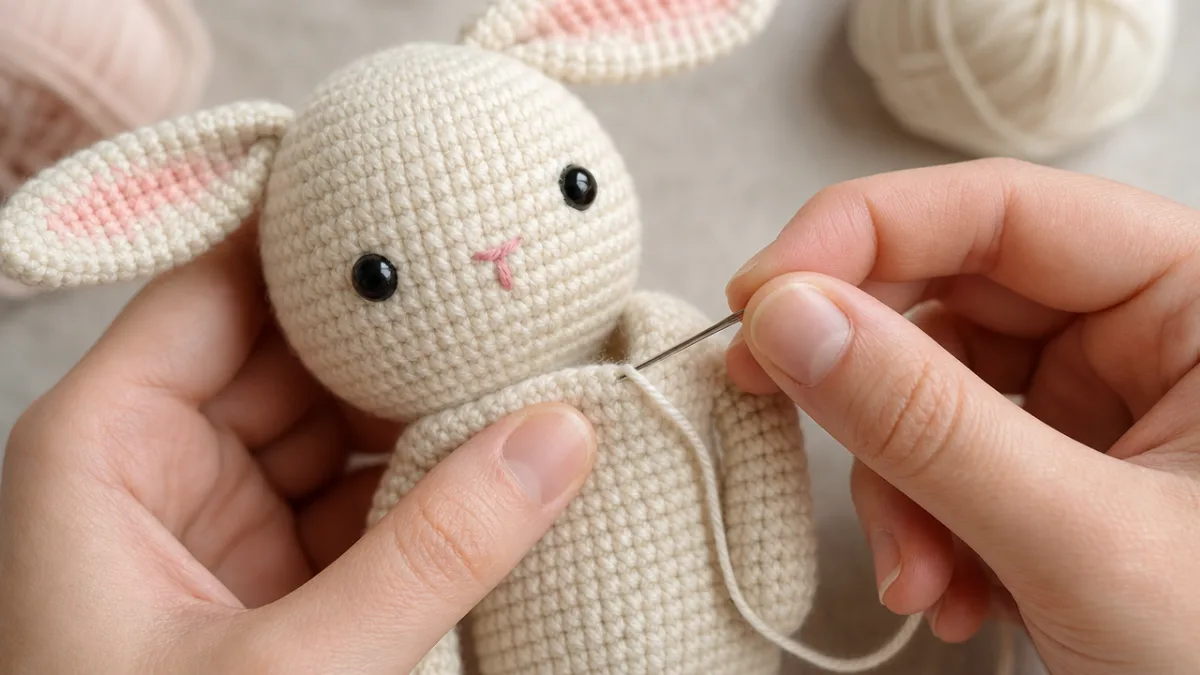
Sewing pieces together neatly is the other technique that separates a polished plushie from a homemade-looking one. The key is to use the yarn tail left at the end of each piece and a blunt tapestry needle to work a whipstitch or mattress stitch around the perimeter of the attachment point, pulling firmly enough to create a secure join but gently enough to avoid puckering the fabric. Pinning pieces in place and checking the positioning from multiple angles before sewing ensures that arms sit symmetrically, ears align evenly, and tails attach at the right angle. Stuffing limbs firmly before closing them off also creates a more professional result.
Facial embroidery is a skill that adds enormous character to your plushies and is worth practicing on scrap fabric before attempting on a finished piece. Simple embroidered features like a curved smile, a tiny nose, rosy cheeks using a light touch of blush or pink yarn, and eyebrow details can transform a plain plushie face into something full of personality and charm. Use a long needle to bury your knots safely inside the stuffing so no raw ends are visible on the surface. Taking your time with the finishing details, even when you are eager to call the project complete, consistently produces plushies that look as though they could have been purchased from a high-end toy boutique.
Sharing Your Plushies and Growing as a Maker
The crochet plushie community is one of the warmest and most welcoming spaces in the entire crafting world, and sharing your finished creations is one of the great joys of the hobby. Instagram, Pinterest, TikTok, and Reddit’s r/amigurumi and r/crochet communities are all vibrant spaces where makers post progress shots, finished pieces, and tips with genuine enthusiasm and encouragement. Photographing your plushies against simple, uncluttered backgrounds — a plain white sheet, a wooden table, a patch of outdoor greenery — tends to produce the most striking images that show off your work to its best advantage.
Many makers eventually transition from following patterns to designing their own original plushies, and this creative leap is more accessible than it might initially seem. Understanding the mathematical relationship between increases, decreases, and the resulting three-dimensional shapes gives you a functional design language that you can use to sketch out new creatures. Keeping notes as you crochet your own designs — round by round, stitch count recorded carefully — allows you to recreate and refine your original patterns, and eventually to share them with the broader community either as free offerings or as paid patterns on platforms like Etsy.
Turning your plushie making into a small creative business is a path many skilled makers have successfully followed. Handmade crochet plushies command genuine market value, with unique or custom pieces often selling for between twenty and eighty dollars depending on size, complexity, and the maker’s established reputation. Craft fairs, local markets, and online shops through Etsy or Instagram all provide viable sales channels. Whether you choose to keep plushie making as a purely personal hobby, a way to give meaningful handmade gifts, or the seed of a creative business venture, the skills and satisfaction you build along the way will enrich your creative life for years to come.








What do you think?
It is nice to know your opinion. Leave a comment.