










“`html
Tile Fire Art: The Ancient Craft of Transforming Clay and Flame into Timeless Beauty
The Origins and History of Tile Fire Art
Tile fire art — the practice of shaping clay into decorative and functional tiles, then transforming it with intense heat — goes back more than five thousand years, all the way to the earliest civilizations of Mesopotamia and ancient Egypt. Those early artisans stumbled onto something remarkable: clay, when fired, becomes durable, water-resistant, and capable of holding color and pattern for centuries without fading. It’s hard to separate the history of tile art from the history of human civilization itself. Tiles have decorated the walls of palaces, temples, and bathhouses on every inhabited continent.
As trade routes spread across the ancient world, glazed tile techniques traveled from the Middle East into Persia, North Africa, and eventually medieval Europe. The Islamic tradition of geometric tile work — called zellige in Morocco and azulejo in Spain and Portugal — became one of the most sophisticated art forms the world has ever seen. Craftsmen in cities like Fez and Seville spent entire lifetimes perfecting the art of hand-cutting and hand-laying intricate mosaic tile panels. These weren’t just decorative flourishes; they covered entire walls and floors with mathematically precise, spiritually resonant patterns of staggering complexity.
In East Asia, particularly China and Japan, tile fire art took a very different path. Rather than geometry, the focus was on naturalistic imagery, celadon glazes, and ideas like wabi-sabi — the beauty found in imperfection and transience. Chinese roof tiles bearing mythological dragons and phoenixes guarded temples and imperial palaces, while Japanese tile makers developed a quieter tradition of rustic, hand-formed tiles that let the natural texture of clay speak for itself. These parallel traditions are a good reminder that tile fire art isn’t one story — it’s many, each one rooted in its own landscape and spiritual tradition.
Understanding the Materials: Clay, Glaze, and Fire
Every piece of tile fire art comes down to three elemental materials working together: clay, glaze, and fire. The clay body sets the structural character of a tile — its weight, porosity, strength, and the color it turns after firing. Artists typically choose between earthenware, stoneware, or porcelain, and each fires at a different temperature with its own distinct personality. Earthenware, fired between 1,000 and 1,150 degrees Celsius, holds onto a warm, rustic quality with a slightly rough surface. Stoneware, fired hotter, becomes dense and glass-like. Porcelain, which needs the highest temperatures of all, achieves an almost translucent whiteness that carries color with extraordinary delicacy.
Glazes are essentially liquid glass that turns a raw bisque tile into something luminous and sealed. At their core, they’re a mix of silica, fluxes, and colorants that melt into a glassy coating during the final firing. The chemistry of glazing sits right at the edge of science and art: the same glaze recipe on two different clay bodies, or in two different kilns, can produce completely different results. Reduction firing — where the kiln is deliberately starved of oxygen — creates dramatic color shifts in metallic oxide glazes, giving you those iridescent copper reds and deep celadons that collectors have been obsessing over for centuries.
Fire itself might be the most mysterious partner in the whole process. Modern ceramic artists work with electric kilns, gas kilns, wood-fired anagama kilns, and even primitive pit-firing, and each one leaves its own unmistakable mark on the finished tile. Wood-fired kilns need to be stoked continuously for days, but the payoff is that fly ash from the burning wood settles on tile surfaces and melts into unpredictable, natural glaze effects. No two tiles from a wood firing ever come out identical — which is exactly why artists who’ve spent years working with electric kilns sometimes return to wood firing. There’s a beautiful unpredictability there that no amount of controlled precision can replicate.
- Earthenware clay — fired between 1,000–1,150°C, warm rustic texture, excellent for hand-painted decorative tiles
- Stoneware clay — fired between 1,200–1,300°C, dense and durable, ideal for floor tiles and high-traffic applications
- Porcelain clay — fired above 1,260°C, fine-grained and translucent, preferred for delicate decorative work
- Raku clay — formulated to withstand thermal shock during rapid cooling, used in Japanese-inspired raku tile techniques
Techniques Used in Tile Fire Art
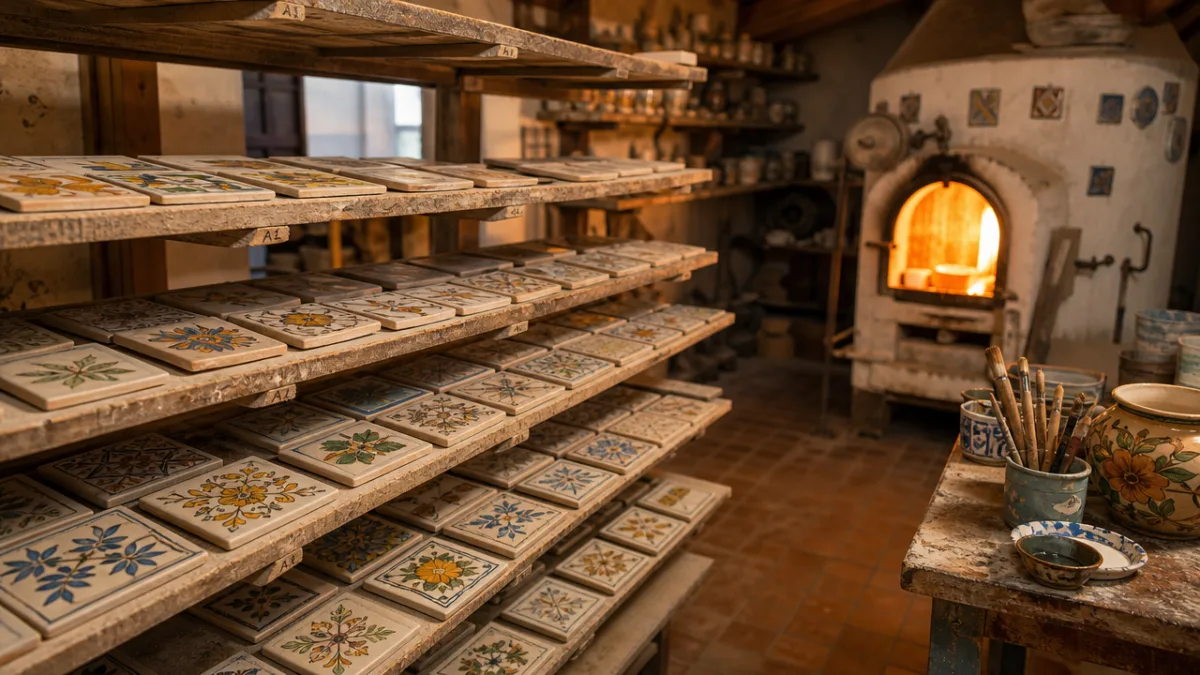
The techniques available to a tile fire artist run an enormous range — from processes that haven’t changed in thousands of years to methods that combine digital design with ancient kiln traditions. Hand painting on bisque-fired tiles using metal oxide pigments is one of the oldest approaches, and it’s still popular today for good reason: cobalt gives you blue, iron gives brown and amber, copper gives green, manganese gives purple. A skilled hand painter can lay down watercolor-like washes of pigment that fire into rich, jewel-toned colors with a depth and luminosity you simply can’t get from surface-applied paint.
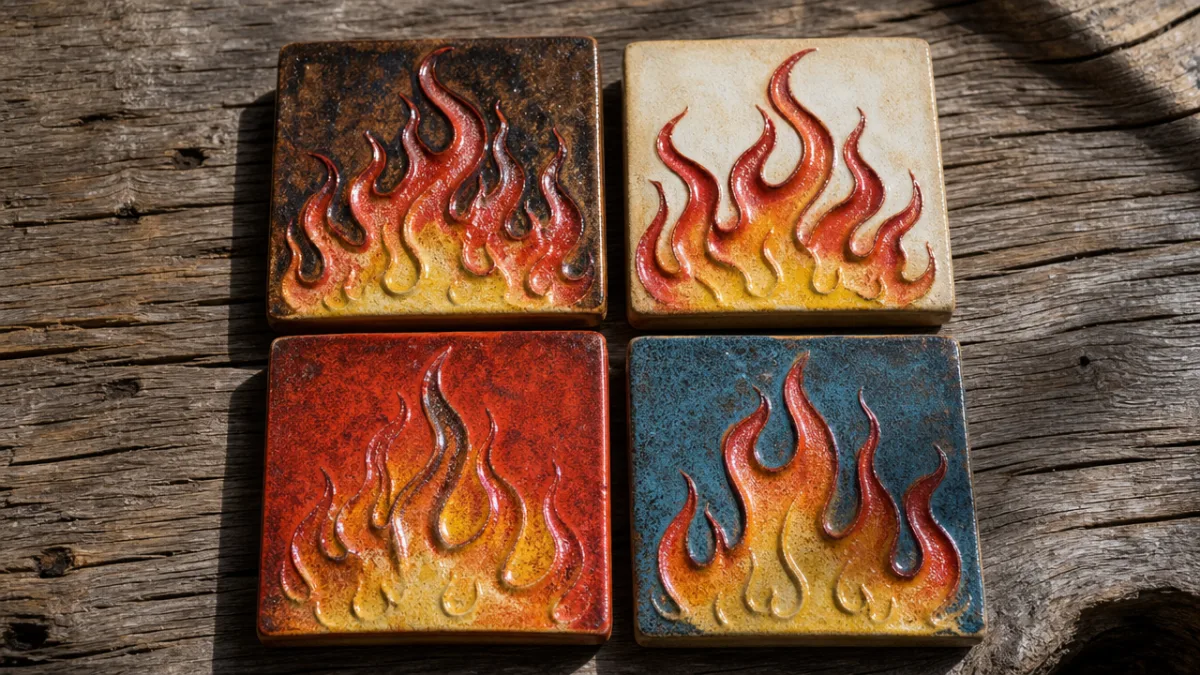
Sgraffito — scratching through a layer of slip or glaze to reveal the contrasting clay body underneath — produces bold, graphic imagery with a tactile quality you can actually feel. Majolica painting, which is associated with Italian Renaissance ceramics and Dutch Delftware, involves painting detailed figurative or floral imagery directly onto an unfired white tin glaze. You have to work with confidence and speed because the absorbent surface doesn’t forgive mistakes — and that constraint is actually what gives majolica painting its freshness and spontaneity. Relief tile work adds a sculptural dimension by modeling designs in low or high relief before firing, something that comes alive beautifully under raking light.
Contemporary tile artists have also embraced photographic transfers, laser etching, and 3D-printed clay forms, pushing hard at the boundaries of what a tile can even be. Some create large-scale tile murals by printing designs onto decal paper with ceramic oxide pigments, applying those decals to glazed surfaces, and refiring to fuse the image permanently into the glaze. Others work with encaustic techniques, pressing colored clay slabs together in patterned molds so that the color runs through the tile’s entire depth rather than sitting on the surface — a method that produces floor tiles of extraordinary durability and visual richness.
- Bisque firing — the initial low-temperature firing that hardens raw clay into a porous, workable form ready for glaze application
- Glaze application — brushing, dipping, or spraying glaze onto bisque-fired surfaces with careful attention to thickness and evenness
- Glaze firing — the second, higher-temperature firing that melts glaze into glass and completes the ceramic transformation
- Reduction firing — manipulating kiln atmosphere to create dramatic color shifts in metallic oxide glazes
- Raku firing — rapidly removing red-hot tiles from the kiln and placing them in combustible materials for post-firing reduction effects
Design Principles and Aesthetic Traditions in Tile Fire Art
The design traditions behind tile fire art are as diverse as the cultures that shaped them, but certain principles keep showing up across traditions in ways that are hard to ignore. Symmetry and repetition sit at the core of tile art’s visual language, and for an obvious reason: tiles are meant to be multiplied across surfaces. A single tile might carry only a fragment of a larger pattern, with the full picture only emerging once many tiles are assembled together. This logic of the repeated unit connects tile art to mathematics, music, and weaving — all arts built on the idea that complex beauty can grow from the disciplined repetition of simpler elements.
Color theory matters enormously in tile work, but it comes with a twist: ceramic colors look completely different before and after firing. Experienced tile artists develop a kind of mental translation ability, learning to see past the dull, chalky appearance of raw metal oxide pigments to the vivid fired colors they’ll become. Cobalt oxide is a grayish-blue powder when raw, but it fires to a rich, saturated ultramarine that has captivated ceramic artists from Tang Dynasty China to eighteenth-century Delft to today’s studio potters. Learning to trust that transformation — to see potential in what looks like mud — is one of the deepest skills in the craft, and one that genuinely takes years to develop.
Negative space and contrast are just as important in tile design as in any other visual art. The white ground of a tin-glazed tile offers a luminous foundation that gives painted imagery maximum impact, which explains why the white-ground tradition of Delftware, Iznik pottery, and Spanish talavera has stayed popular across so many centuries and cultures. Contemporary tile artists often take this further by leaving areas of raw clay body exposed within a composition, letting the warm terracotta or buff stoneware act as an active design element rather than just something to cover up. The tension between glazed and raw, painted and plain, covered and exposed — that’s one of the most powerful tools a tile artist has.
Tile Fire Art in Architecture and Interior Design
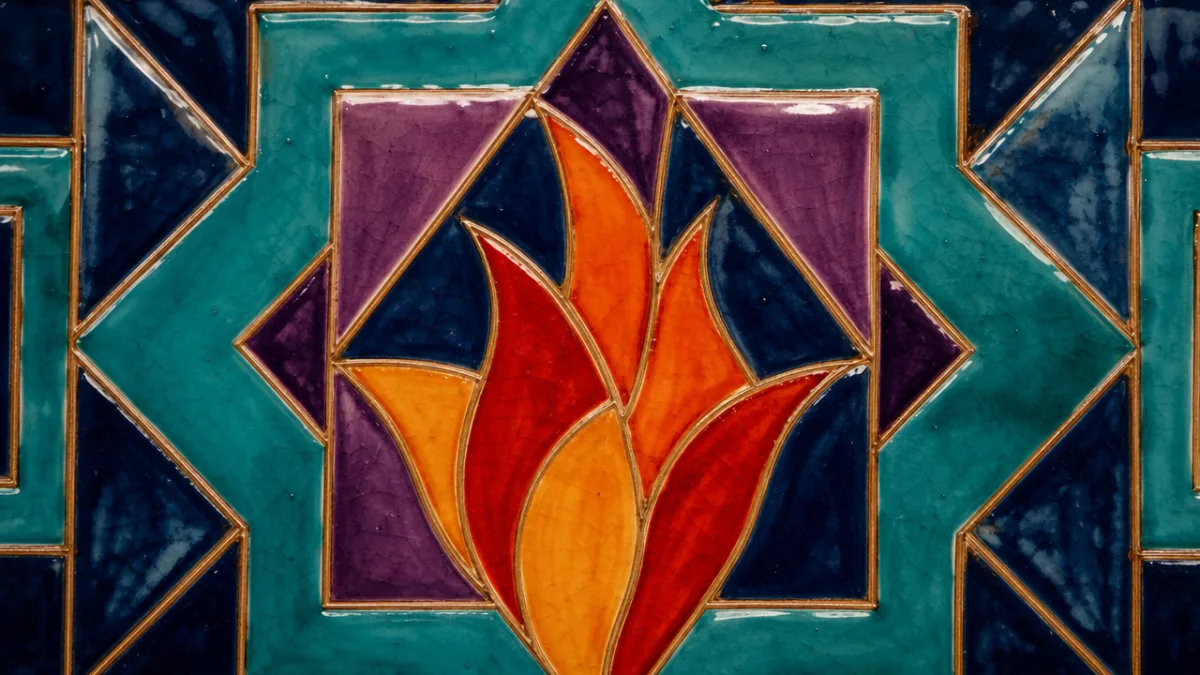
Throughout history, tile fire art has been one of the primary ways architecture communicates meaning, beauty, and cultural identity. The Alhambra palace in Granada features room after room of zellige tile work in interlocking geometric patterns that encode astronomical and mathematical knowledge in their visual structure. The Süleymaniye Mosque in Istanbul glows with walls of Iznik tiles in turquoise, cobalt, and tomato red — their extraordinary quality a testament to a brief golden age of Ottoman ceramics in the sixteenth century. These buildings make a compelling case that tiles aren’t just decorative additions to architecture; they can be its essential visual language.
In domestic life, the Arts and Crafts movement of the late nineteenth and early twentieth centuries championed handmade tile as a direct response to the mass-produced uniformity of industrial building materials. Designers like William De Morgan in England and the Grueby Faience Company in America produced hand-decorated tiles of exceptional quality, installed in fireplaces, bathrooms, and entrance halls of middle-class homes hungry for beauty and craft in everyday life. The fireplace surround became a particular showcase for tile fire art — hand-painted narrative panels depicting scenes from nature, mythology, or literature framing the hearth at the symbolic center of the home. It’s a tradition that connects tile art directly to its most elemental inspiration: the fire that transforms clay.
Today, architects and interior designers are rediscovering what handmade and studio tile can bring to spaces increasingly dominated by digital fabrication and standardized finishes. Custom tile commissions for hotels, restaurants, and residential projects have created a thriving market for studio ceramic artists who can work at architectural scale. The slight variation you get with handmade tiles — small differences in glaze color and surface texture from tile to tile — is no longer seen as a flaw. It’s celebrated as something mass production simply cannot replicate, lending spaces an organic warmth and visual richness that feel genuinely human in an age of machine precision.
Getting Started: How to Create Your Own Tile Fire Art
If tile fire art has caught your interest, the good news is that getting started is more accessible than most people expect. Community ceramic studios in most cities offer kiln access, clay, glazes, and instruction on a drop-in or membership basis, so you can experiment with fired tile making without investing in your own equipment. A great entry point is hand-painting on pre-made bisque tile blanks, which are available from ceramic supply companies. Starting this way lets you focus on design and color rather than clay preparation and forming, which means you can produce your first real tile with just a set of metal oxide pigments or commercial underglazes, a few brushes, and access to a community kiln glaze firing.
As your skills develop, you’ll likely get curious about making your own tile blanks from scratch — and that opens up a whole new world of custom sizes, relief surfaces, and clay body choices. The core tile-making techniques — slab rolling, press molding, and extruding — are all learnable with basic instruction and modest equipment. Slab-rolled tiles are made by rolling clay to an even thickness, then cutting to size and drying slowly under plastic to prevent warping. Relief tiles are made by pressing clay into plaster or bisque-fired molds, then releasing and drying before firing. Both techniques require patience, particularly during drying, which is when most warping and cracking tends to happen.
The most useful piece of advice for anyone starting out is simply this: embrace the unpredictability instead of fighting it. Kilns have their own personalities. Glazes develop in ways even experienced ceramists can’t fully predict. Clay cracks sometimes, despite every precaution. Learning to find beauty in unexpected outcomes — to see a glaze that ran differently than planned as a happy accident rather than a failure — is a fundamental shift in perspective that separates experienced ceramic artists from beginners. That openness to collaboration with chance and material is, in a very real sense, what tile fire art is all about. It’s a partnership between human intention and elemental forces that has been producing beautiful objects for five thousand years, and it shows absolutely no signs of stopping.
- Join a community studio — access to kilns, glazes, and expert guidance without the cost of setting up a home studio
- Start with bisque blanks — focus on painting and glazing before tackling clay forming and tile making from scratch
- Keep a glaze test journal — record every glaze combination and firing temperature to build an invaluable reference over time
- Dry tiles slowly — cover freshly made tiles loosely with plastic and dry over several days to minimize warping and cracking
- Experiment with firing atmospheres — if your studio offers gas or wood firing, try it at least once to discover effects impossible in electric kilns
“`








What do you think?
It is nice to know your opinion. Leave a comment.