










The Rise of Custom Die Cut Business Cards in Today’s Competitive Market
Let’s be honest — the standard rectangular business card just doesn’t do much anymore. In a world where first impressions matter more than ever, custom die cut business cards have become one of the smartest branding moves a small business owner, entrepreneur, or creative professional can make. These uniquely shaped cards go way beyond swapping contact info. They give your brand a physical, tactile presence that people actually want to hold onto rather than shove in a junk drawer. When your card is the thing that starts the conversation, you’re already ahead before you’ve said a word.
The charcuterie world has had quite a moment over the past few years. Grazing boards, cheese boards, and beautifully arranged meat-and-cheese spreads have become a go-to for weddings, corporate events, holiday parties, and cozy dinner gatherings. What started as a niche hobby has turned into a real, thriving cottage industry, with thousands of talented folks running charcuterie businesses right out of their home kitchens. But as the market has gotten more crowded, standing out has gone from a nice-to-have to an absolute necessity. Your branding needs to be just as carefully put together as your boards.
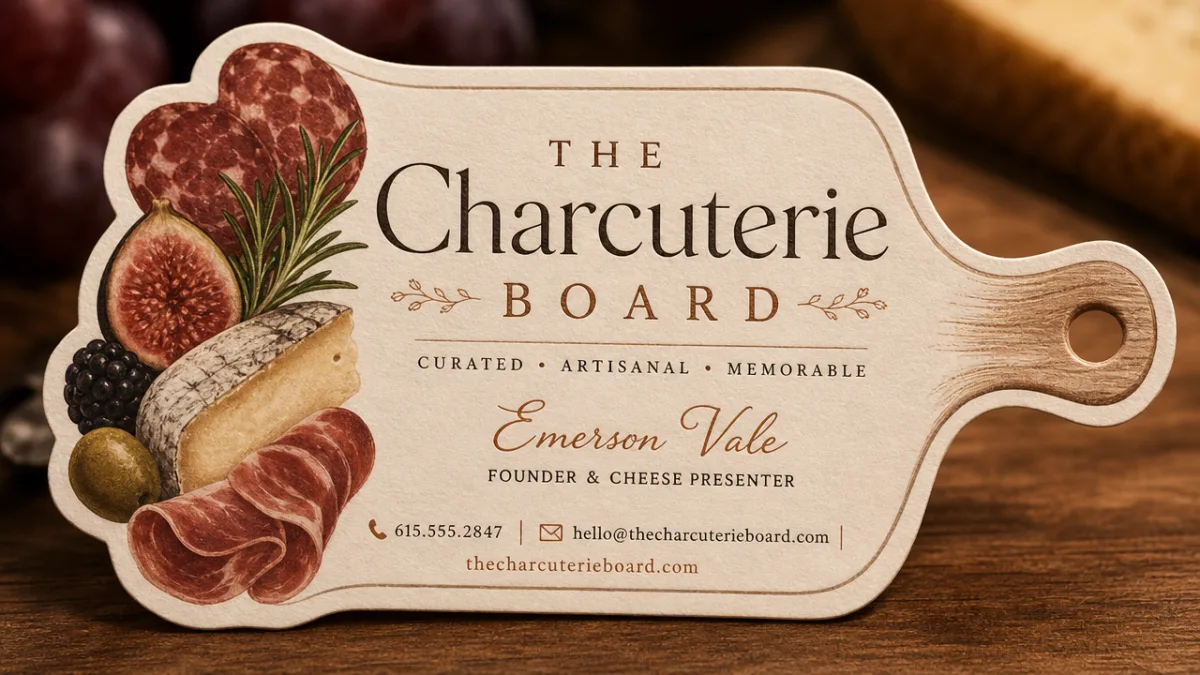
That’s exactly where custom die cut business cards come in — shaped like charcuterie boards, shopping carts, or other icons that speak to what you do. These cards pull double duty: they carry your contact info and act as tiny little advertisements for your eye for detail and creative sensibility. When a potential client holds a card that’s shaped exactly like the thing you make or do, the message lands instantly. There’s something about that choice that says you take your craft seriously and put thought into every corner of your brand — and that matters to the kind of clients you want to attract.
What Are Die Cut Business Cards and How Are They Made
Die cutting is a manufacturing process that uses a custom-shaped metal tool — called a die — to punch out specific shapes from sheets of paper or cardstock with impressive precision. Unlike laser cutting, which uses heat, die cutting relies on mechanical pressure to push a sharp blade cleanly through the material. That makes it efficient and consistent, which is exactly what you want when you’re printing hundreds or thousands of identically shaped cards. The technique has been around in packaging and printing for well over a century, but improvements in tooling and printing technology have made it much more accessible and affordable for small business owners who want something beyond the ordinary.
For something like a charcuterie board or cart-shaped card, the process starts with a designer building the artwork in a vector program and mapping out the exact path the die will follow when it cuts. The printer either makes or sources the right die, runs the printed sheets through the cutting press, and out comes a perfectly uniform stack of brand-shaped cards ready for whatever finishing touches you’ve chosen — lamination, spot UV, foil stamping, you name it. One of the best things about die cutting is that whether you’re printing 500 cards or 5,000, every single one comes out looking identical. That kind of consistency matters when you’re trying to build a professional brand, even if the shape itself is anything but conventional.
As for materials, the options are genuinely fun to think through. Standard cardstock ranges from 14pt to 32pt thickness, and you can also go with soft-touch or matte laminated stock, kraft paper for an artisanal feel, or specialty options like recycled or linen-textured paper. Each choice sends its own quiet signal about your brand. A thick, matte-laminated board-shaped card says luxury and high-end service. A kraft paper version might say something closer to natural ingredients, rustic charm, and farm-to-table values. The medium is almost as much a part of the message as anything you print on it.

Why Charcuterie Businesses Specifically Benefit from Shaped Cards
Charcuterie is one of those businesses that’s deeply rooted in the visual and the sensory. Clients aren’t just paying for food — they’re paying for an experience, an aesthetic, a spread that photographs beautifully and wows the room. When your marketing materials carry that same level of intentionality, you’re quietly telling prospective clients that you get what they’re actually buying. A card shaped like a wooden cutting board or a wheeled serving cart does that instantly, without needing a single word of explanation.
Word-of-mouth is the engine behind most charcuterie businesses, especially those selling at farmers markets, doing pop-up events, or booking through Instagram. When someone passes your card along to a friend who might need a caterer, a shaped card is so much more likely to travel with a story attached to it than a plain white rectangle would be. The card itself becomes part of the referral — a physical little piece of your brand that sparks curiosity and signals professionalism all at once. That kind of organic marketing has an authenticity that paid advertising genuinely can’t replicate.
Think about where charcuterie business owners actually hand out cards: food markets, catered events where guests are already impressed, bridal expos, consultations with event planners. In every one of those settings, your card is going to end up next to cards from other vendors. A standard card in that pile is forgettable almost by definition. A die cut card shaped like a charcuterie cart or board isn’t just memorable — it’s a mini demonstration of your brand’s whole personality. Event planners, brides, and corporate clients are the kind of people who will actually keep it, pin it to a mood board, or hand it to a colleague who’s already planning the next big gathering.
Key Benefits at a Glance
- Your business niche comes through instantly, no tagline or extra explanation needed.
- People hold onto shaped cards far longer than standard ones, which keeps your contact info in circulation and out of the recycling bin.
- It’s a natural conversation starter at markets, expos, and catering consultations — the card does some of the talking for you.
- It signals creativity and attention to detail, which is exactly what clients are looking for when hiring a charcuterie artisan.
- Unique cards are highly shareable — recipients often photograph them and post them, giving you a little organic social media boost.
- At crowded events like bridal fairs or food festivals, you stand out from the stack of competitors right away.
Design Tips for Creating the Perfect Charcuterie or Cart Shaped Card
Good die cut card design means thinking about the shape and the content together from the very start, not as two separate decisions you tackle one after the other. The silhouette should be immediately recognizable and directly tied to your business, but it also needs to be practical enough to hold your essential contact info without feeling crowded or hard to read. A charcuterie board outline, for instance, gives you a naturally elongated and slightly irregular shape with enough surface area for your logo, name, phone number, website, and social handle — and it still reads clearly as a board. Let the shape guide the layout from day one rather than trying to squeeze a rectangular layout into an unconventional form.
Color palette matters a lot here, and charcuterie businesses have a genuinely rich visual vocabulary to pull from. Warm wood tones, deep burgundies, creamy whites, and muted sage greens all capture that natural, artisanal quality of a beautifully arranged board. These colors translate really well to print, especially when paired with quality paper stocks and the right finishing options. If you already have an established Instagram presence or an existing logo, your card colors should feel like a natural extension of those — not a jarring detour. Consistency between your digital presence and your physical materials is what turns a decent brand into one people actually remember.
For typography, the goal is legibility with a little personality. Script fonts can beautifully capture the handcrafted, personal spirit of charcuterie work, but they need to be handled carefully so your contact details stay readable at smaller sizes. A classic approach that works really well on shaped cards is pairing a decorative script for your business name with a clean, modern sans-serif for the practical details. Space can be tighter on an unusual shape, so every font choice counts. And always, always request a physical proof before you approve a full print run — colors and font sizes look different on a screen than they do in your hand under normal light, and you’ll want to catch any issues before they’re multiplied across 500 cards.
Essential Information to Include on Your Card
- Your full name and business name or brand identity
- Primary phone number and professional email address
- Website URL and your main social media handle — especially Instagram for a visual business like charcuterie
- A short descriptor or tagline that makes clear what you actually offer
- A QR code linking to your portfolio, menu, or booking page so people can get from card to client in seconds
Choosing the Right Printing Partner for Your Die Cut Cards
Finding the right printer for your custom die cut cards is just as important as nailing the design. Even the most beautiful artwork will fall flat if the production quality doesn’t hold up. Not every print shop offers die cutting, and among those that do, there’s a real range in the quality of cuts, the precision of registration between print and cut lines, and how many paper stocks and finishing options they actually have available. When you’re vetting potential printers, ask specifically about their die cutting capabilities, request samples of previous custom shape work, and find out about minimum order quantities, which can vary a lot between vendors and have a big impact on your upfront costs.
Online printing platforms have made custom die cut cards more accessible than ever. Services like Moo, Canva Print, Vistaprint, and various boutique specialty printers all offer shaped card options across a range of price points. That said, if you want a truly custom shape — like a specific charcuterie cart silhouette or a detailed board outline — you may need to work with a local commercial printer or a specialized online vendor who can fabricate a die to your exact specs. The cost of creating a custom die is usually a one-time setup fee, and it gets spread across your print run, so the more cards you order, the more economical each card becomes.
Always request a digital proof and, if at all possible, a physical proof before you green-light a full production run. A physical proof lets you feel the weight of the cardstock, check that the colors are printing accurately, make sure the cut lines are clean, and confirm that the overall size and shape actually work in your hand the way you imagined them on screen. It adds a little time and a small cost, but it’s almost always worth it — especially when you’re working with a printer for the first time. Building a solid relationship with a reliable printing partner who understands your brand will pay off across all your marketing materials, not just your cards.
Questions to Ask Your Printer Before Ordering
- Do you offer truly custom die shapes, or are you working from a pre-existing catalog of options?
- What’s the setup or die creation fee, and do repeat orders use the same die without an additional charge?
- What file format and bleed specifications do you need for die cut artwork?
- What’s the minimum order quantity, and how does pricing change at higher volumes?
- Do you offer physical proofing before going into full production, and what’s the turnaround time?
- What finishing options do you carry — lamination, spot UV, foil, edge painting, and so on?
Integrating Die Cut Cards into Your Overall Charcuterie Brand Strategy
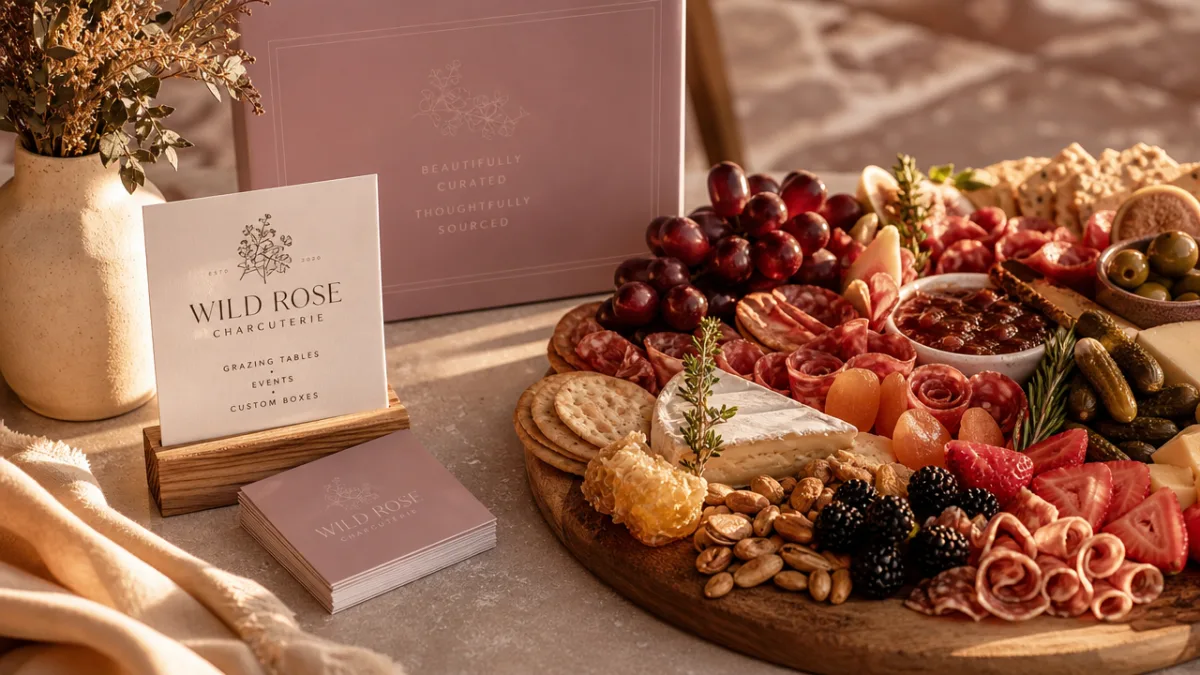
A gorgeous die cut business card does its best work when it’s part of a bigger, cohesive brand story rather than just a standalone novelty. Your card should feel like a natural piece of the same world as your Instagram grid, your packaging, your grazing table presentation, and the whole client experience from first inquiry to final delivery. When every touchpoint speaks the same visual language — same colors, same fonts, same overall feel — you build the kind of brand coherence that clients remember and trust. Think of your business card not as one isolated marketing item, but as the physical distillation of everything your brand is about.
There are a lot of fun ways to let your die cut cards work in harmony with other custom-printed materials. Matching stickers in the same shape as your card can go on packaging, jars of accompaniments, or handwritten thank-you notes. Event menu cards can echo the same design language and color palette. Custom tissue paper or a branded stamp on your boxes can reinforce the identity your card introduces. The goal is to build a brand experience so consistent and beautiful that from the very first card someone receives through the final presentation of their grazing board, it all feels unmistakably like you.
It’s also worth thinking deliberately about how your cards play into your social media strategy. Design the card to be genuinely photogenic — something that looks as good on a marble countertop or styled flat lay as it does tucked in a wallet. Making your Instagram handle prominent and adding a small prompt on the back, something like “Tag us in your spread,” can turn each card handoff into a potential social media moment. In the charcuterie world, where visual content drives discovery and bookings, every touchpoint that generates authentic imagery of your brand is a marketing asset that keeps building value over time.
Budgeting and ROI for Custom Shaped Business Cards
The most common sticking point for charcuterie business owners considering die cut cards is the upfront cost, which is genuinely higher than ordering a stack of standard rectangles from a big-box printer. But when you look at the actual return on investment, the math shifts pretty quickly. A single booked charcuterie event can bring in anywhere from a hundred dollars to several thousand, depending on the size and scope. If a beautifully crafted die cut card helps you land even one booking per year that you might have otherwise lost to a competitor with sharper branding, those cards have almost certainly paid for themselves many times over.
When you’re building your budget, think beyond just the per-card printing cost — factor in the design work, the die setup fee if applicable, and any finishing options you want to add. A lot of charcuterie entrepreneurs find that hiring a freelance graphic designer who specializes in food and hospitality branding is well worth the upfront investment, because the artwork can be repurposed across menus, social graphics, labels, and more. If you’d rather keep costs down, Etsy has a solid selection of pre-designed charcuterie business card templates specifically built for die cut printing, which can give you a polished, professional result without the custom design price tag.
Order quantity is another big lever for controlling your per-unit cost, so it’s worth thinking through before you place an order. Most printers offer their best pricing at quantities of 250, 500, or 1,000 cards, and if you’re actively attending markets or events, going through 500 cards in a year is very doable. Ordering in larger batches upfront means a lower cost per card and no scrambling to reorder right before your busiest season. Think of your business cards as a real line item in your operating budget, not an afterthought. Order before you run out, keep your branding consistently in front of people, and let the cards do some of the work for you.








What do you think?
It is nice to know your opinion. Leave a comment.