










“`html
Colour Sorting Fine Motor Jellyfish: A Complete Guide to This Magical Early Learning Activity
What Is the Colour Sorting Fine Motor Jellyfish Activity?
If you’re looking for an early childhood activity that ticks a lot of boxes without feeling like a structured lesson, this one’s a gem. The Colour Sorting Fine Motor Jellyfish activity brings together sensory play, colour recognition, and fine motor practice all in one go — and because it involves jellyfish, toddlers and preschoolers are usually immediately on board. There’s something about that wobbly, tentacled shape that just captures little imaginations in a way a plain sorting tray never quite manages.
The basic setup is pretty simple: you make a jellyfish shape from a paper plate, cardstock, or a cereal bowl traced onto cardStock, then attach coloured streamers, ribbons, or pipe cleaners as the tentacles. Children then get a small collection of matching coloured objects — pom poms, buttons, beads, coloured craft balls — and sort them onto the right tentacle. It sounds straightforward, but that combination of spotting the colour and then physically handling the object works on several developmental levels at once, which is why early childhood educators keep coming back to it.
What really makes this activity worth your time is how flexible it is. You can set it up as a quiet independent activity, run it as part of a group session at nursery or preschool, or spread a blanket in the garden and do it outside. For parents at home, it comes together quickly from things you’ve probably already got lying around. And the jellyfish theme opens the door to storytelling and ocean adventures that turn what could be a dry sorting exercise into something children actually ask to do again.
The Developmental Benefits for Young Children
The most obvious thing this activity works on is fine motor skills. Picking up small objects, carrying them across, and placing them precisely uses the pincer grip — that thumb-and-forefinger action that’s the foundation for writing, cutting, doing up buttons, and tying laces. It’s the kind of repetitive, low-pressure practice that builds real hand strength, and kids don’t even notice they’re doing it because they’re too busy feeding their jellyfish.
Colour recognition is another big one, but it goes a bit deeper than just naming colours. When a child picks up a red pom pom, looks across their jellyfish, finds the red tentacle, and places it there, they’re actually doing visual discrimination, working memory, and classification all at the same time. Those are the same cognitive skills that underpin early maths and literacy. The jellyfish format helps here too — having clearly separated, colour-coded tentacles gives children a visual anchor that’s much easier to work with than a jumbled tray of mixed objects.
There’s also something worth saying about concentration. Young children who normally flit between activities every minute or two will often settle into a well-designed sorting activity for fifteen to twenty minutes, especially when it has a playful theme they’re invested in. Each successful match gives a little hit of satisfaction that keeps them going. For children with sensory processing differences, the variety of textures in the tentacles and sorting objects can actually be genuinely calming as well as engaging.
- Strengthens pincer grip and hand muscles essential for writing readiness
- Builds colour recognition and categorical thinking skills
- Develops concentration, task persistence, and self-directed play
- Supports visual discrimination and spatial reasoning abilities
- Encourages language development through naming, describing, and sorting vocabulary
- Provides sensory stimulation through varied textures and materials
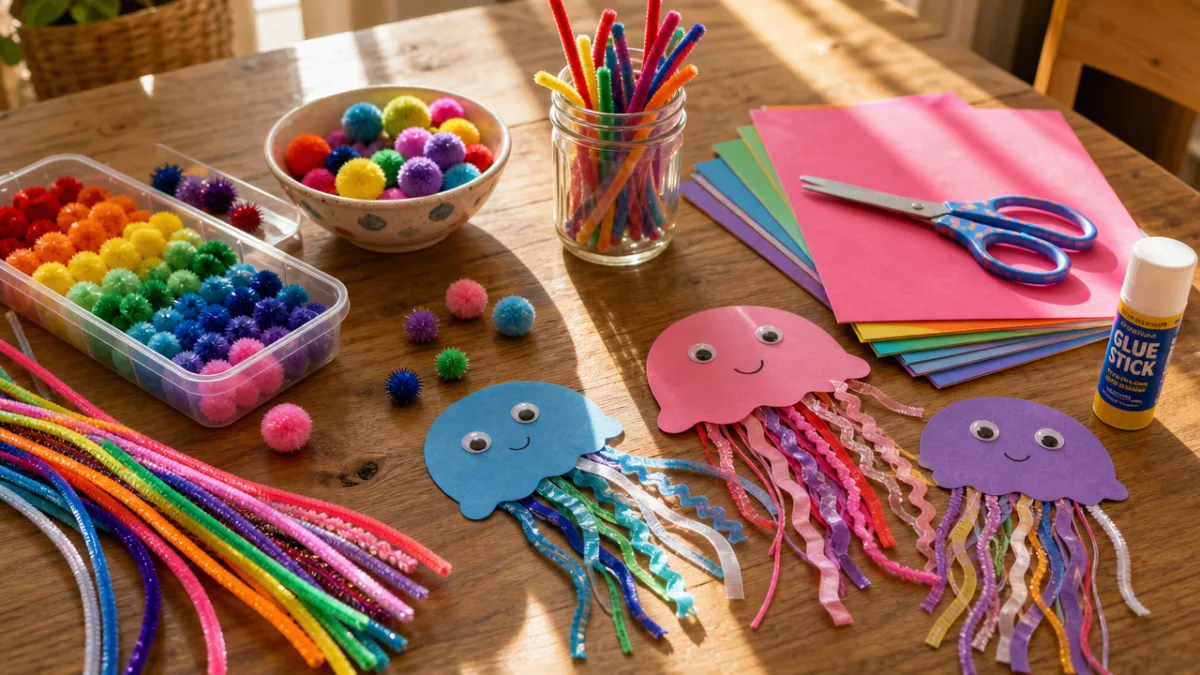
Materials You Will Need and How to Source Them
One of the best things about this activity is how little it costs. The jellyfish body can be made from a paper plate cut in half, a small cereal bowl traced onto cardstock, or just a freehand half-circle on thick craft paper. It doesn’t need to be perfect — honestly, getting your child involved in cutting and shaping their own jellyfish is another fine motor win, plus they’ll be far more invested in playing with something they helped make.
For the tentacles, coloured ribbon, crepe paper streamers, tissue paper strips, and pipe cleaners all work well. You’ll want each tentacle to be a clearly distinct colour — somewhere between five and eight tentacles tends to work nicely — so they correspond to the sorting objects you’re using. Pipe cleaners are great because they’re three-dimensional and children can hook objects around them, which adds an extra challenge. Crepe paper streamers give a more flowy, realistic look and tend to photograph beautifully if that’s something you’re into.
For the sorting objects themselves, coloured pom poms are the go-to choice — soft, safe, available in every colour, and easy for little hands to grip. But you could also use coloured buttons for children who are past the mouthing stage, small plastic counting bears, coloured wooden beads, or even painted rocks if you’re feeling adventurous. Just think about where your child is developmentally: bigger objects for younger toddlers, smaller ones to challenge older preschoolers as their fine motor control gets more refined.
- Paper plates, cardstock, or a cereal bowl for tracing the jellyfish body
- Scissors for adults, and child-safe scissors if children are participating in cutting
- Coloured ribbon, pipe cleaners, crepe paper, or tissue strips for tentacles
- Glue, tape, or a stapler to attach tentacles to the jellyfish body
- Coloured pom poms, buttons, beads, or counting bears as sorting objects
- A shallow tray or bowl to contain the sorting objects during play
- Optional: googly eyes, markers, and stickers to decorate the jellyfish faces
Step-by-Step Instructions for Setting Up the Activity
Once you’ve done this a couple of times it genuinely takes under twenty minutes to set up, and the first time isn’t much longer than that. Start with the jellyfish bodies. If you’re in a classroom or playgroup, it’s worth cutting the shapes in advance so you’re not scrambling during the session. At home, though, bring your child in on this part — letting them help choose the tentacle colours right from the start builds their investment in the activity and sneaks in some colour vocabulary before play has even begun.
Attach the tentacles along the bottom edge of the jellyfish body, spacing them evenly so the colours are easy to distinguish. Pipe cleaners can be folded over the edge of the cardstock and taped down; ribbon and crepe paper work well with staples or glue. Then add a face. Seriously, don’t skip this bit — a pair of googly eyes and a quick curved mouth in marker turns your craft into a character, and children play longer and more focused when they feel some connection to their materials. A jellyfish with a face is a jellyfish with a personality.
For the play setup, lay the jellyfish flat and put a small bowl or tray of mixed sorting objects nearby. Before handing it over, try narrating a little story: the jellyfish are hungry, but they’ll only eat food that matches their tentacle colour! That single reframe turns a cognitive sorting exercise into imaginative play. Do one demonstration — pick up an object, say its colour out loud, find the matching tentacle, and place the object there while talking through your thinking. This models the process before the child works independently, which is a simple but genuinely effective scaffolding technique.
Once they’re going, try to hold back from correcting mistakes straight away. Give them space to notice, reconsider, and self-correct. If a blue pom pom ends up on the red tentacle, a gentle “What colour is that one? Can you find the tentacle that looks the same?” prompts them to think it through rather than just copying a correction. The point isn’t a perfectly sorted jellyfish — it’s a child who has practised looking carefully, making decisions, and adjusting when something doesn’t quite fit. That process is worth far more than the tidy end result.
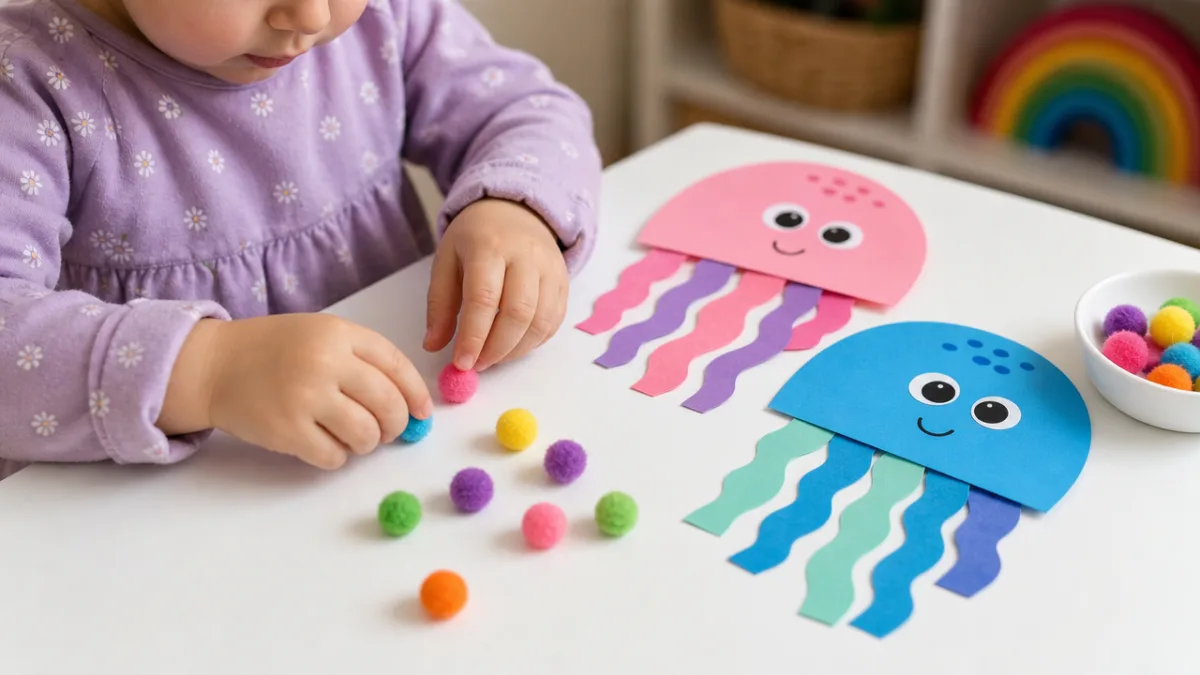
Variations and Extensions to Keep the Activity Fresh
A really good early childhood activity should grow with the child, and this one does that well. For younger toddlers just getting their heads around colour, start with just two or three colours and large, easy-to-grab sorting objects. As they get more confident, bring in more colours and trickier challenges — sorting by shade, for instance, asking them to put light blue objects separately from dark blue ones, is a surprisingly sophisticated extension that takes colour discrimination to a whole new level.
You can also nudge the activity into literacy and numeracy territory without much extra effort. Writing the colour word on each tentacle creates a bridge between the spoken name and its written form — a quiet but meaningful early literacy connection. For numeracy, give children a specific number of objects per tentacle and ask them to count as they place each one. You could even introduce a simple tally chart where they record how many objects each colour received, which brings in basic data skills that link directly to early years maths outcomes.
Seasonal themes are an easy way to keep the activity feeling fresh throughout the year. During an ocean or sea life unit the jellyfish fits perfectly, sitting alongside ocean books, water play, and blue sensory bins. Come autumn, swap the jellyfish for colour-sorting leaf shapes in seasonal colours. At Christmas, a colour-sorted reindeer or a Santa with a colour-coded beard hits the same developmental goals with a festive twist. The structure stays the same; the theme does the work of making it feel new.
- Beginner variation: Use two or three colours and large pom poms for youngest toddlers
- Advanced variation: Include shades of the same colour to develop discrimination skills
- Literacy extension: Label tentacles with the written colour word for pre-reading connection
- Numeracy extension: Count objects as they are sorted and record totals on a tally chart
- Sensory variation: Use water beads or sand-coated objects for enhanced tactile input
- Seasonal adaptation: Swap jellyfish for trees, snowflakes, or holiday-themed characters
- Group variation: Each child manages one jellyfish colour and children pass objects to each other
Incorporating the Activity Into Early Years Curricula and Home Learning
For educators working within frameworks like the EYFS in the UK, the Australian Early Years Learning Framework, or the Creative Curriculum used in many American preschools, this activity is a genuinely efficient one to document. In a single session you can observe fine motor development, cognitive sorting and classification, communication through colour naming, and personal development through concentration and self-management. That kind of multi-domain richness means one activity can support evidence across several areas of learning at once, which any busy early years practitioner will appreciate.
For parents doing home learning, it’s a welcome change from worksheets and screen time. This activity puts a child in physical contact with real, three-dimensional objects — and that kind of hands-on, tangible engagement is consistently what developmental research points to as more effective for young children than passive or flat alternatives. If you photograph the session and jot down a few observations, you’ll find you end up with both beautiful images and a meaningful record of your child’s growing abilities. It becomes a lovely thing to look back on.
It’s also worth noting that this activity adapts well for children with a range of learning needs. Children with fine motor delays can work with larger objects and wider tentacle spacing. Children on the autism spectrum who thrive with structured, repetitive tasks often find the predictable sorting format genuinely satisfying. And for children with colour vision differences, you can add patterns or shapes alongside colour as the sorting variable, so every child can participate meaningfully and feel the satisfaction of completing the task. That kind of natural inclusivity is what makes an activity truly universal.
Whether you use it as a standalone activity, part of a themed week, or a regular slot in a morning fine motor rotation, this one earns its place. It’s low-cost, developmentally rich, works across a wide age range, and leaves room for you to put your own creative stamp on it. Not many activities do all of that while also making children genuinely happy to sit down and play — which is probably why it keeps turning up on Pinterest boards and in early years classrooms all over the world.
Tips for Success and Common Mistakes to Avoid
The difference between a session that goes really well and one that ends in tears is usually preparation and timing. The most important thing you can do is match the difficulty of the activity to where your specific child actually is right now — not their age on paper, but how they’re handling similar tasks this week. Children develop at wildly different rates, and an activity pitched too high becomes demoralising quickly, while one that’s too easy won’t hold their attention. Take a moment to think about recent play before you set up, and feel free to simplify or extend mid-session if you need to.
Timing matters more than you might think. Young children tackle focused fine motor tasks best when they’re rested, fed, and calm. Setting this up right before dinner or after a long car trip is a recipe for frustration all round. Morning tends to be the sweet spot — energy is up, the day hasn’t accumulated yet, but they’ve had enough time to shake off sleep. And keep the first session short. Ten minutes of genuinely engaged play is worth far more than half an hour of distracted, reluctant participation.
A really common mistake is starting with too many colours at once. Eight tentacles looks fantastic in a photo, but for a two-year-old still working out the difference between red and orange it can be genuinely overwhelming. Start small, let mastery happen, and then expand. Another mistake is giving up on the whole concept when a child starts mouthing the objects. Rather than scrapping it, just switch to larger mouth-safe objects and keep a close eye — mouthing is completely normal sensory behaviour in young toddlers and doesn’t mean the activity isn’t working for them.
And finally — the process really is more important than how the finished jellyfish looks. A perfectly sorted result achieved because an adult was steering every move doesn’t actually teach the child much. A gloriously chaotic jellyfish sorted through independent effort and genuine thinking is full of learning. Celebrate the effort, talk positively about what they’re doing, and follow their lead when they start inventing new rules or using the jellyfish in ways you hadn’t planned for. That willingness to play alongside them and honour their ideas is honestly the most powerful thing you bring to any activity — and it doesn’t cost a thing.
“`








What do you think?
It is nice to know your opinion. Leave a comment.