










15+ Inspiring Basement Craft Room Ideas to Transform Your Creative Space
Why Your Basement Is the Perfect Home for a Craft Room
Basements are often overlooked as functional living spaces, relegated to storage duty or left unfinished for years. But for crafters, artists, and DIY enthusiasts, a basement offers something genuinely rare in modern homes: a large, dedicated space that can be fully customized without disrupting the rest of the household. When you convert your basement into a craft room, you reclaim square footage that might otherwise go to waste and create a personal sanctuary where creativity can flourish without limits.
One of the most compelling advantages of a basement craft room is the separation it provides from the main living areas. Crafting often involves mess — glue guns, paint, fabric scraps, and paper trimmings — and having all of that contained in a basement means the rest of your home stays clean and organized. Family members can go about their daily routines without worrying about stepping on a bead or finding glitter on the kitchen counter. That physical separation also creates a psychological boundary that helps you enter a focused, creative mindset the moment you descend the stairs.
Basements also tend to stay cooler in summer and more insulated in winter, making them comfortable year-round workspaces without significant energy costs. The natural absence of windows in many basement layouts, while sometimes seen as a drawback, actually gives you complete control over your lighting — a factor that is critically important for detail-oriented crafts like embroidery, jewelry making, or precision cutting. With the right lighting setup, a basement craft room can be better illuminated than almost any above-ground room in the house.
Assessing Your Basement’s Potential
Before diving into design ideas, take stock of what your basement currently offers. Measure the square footage carefully and note the ceiling height, since anything below seven feet can start to feel cramped once furniture and shelving are added. Check for moisture issues, existing electrical outlets, and the location of support columns or load-bearing walls, all of which will affect your layout decisions. A dry, structurally sound basement is the foundation upon which every great craft room is built.
Consider the natural flow of the space and how you move through it. If your basement has a separate entrance or connects directly to a garage, you have an advantage for bringing in bulky supplies or large project materials. Identify where the best wall space is for mounting pegboards, shelving units, and tool organizers. Think about where natural light enters, if at all, and plan accordingly. Even a few small egress windows can make a significant difference in the feel of the space when positioned thoughtfully in your design.
Storage Solutions That Keep Your Craft Room Organized and Functional
Storage is the backbone of any successful craft room, and in a basement you have the luxury of going big. Floor-to-ceiling shelving units can house an enormous quantity of supplies without eating into your valuable workspace. Open shelving is particularly popular in craft rooms because it lets you see everything at a glance, eliminating the frustrating hunt for that one specific shade of ribbon or the right size of needle. Using clear bins and labeled containers on open shelves takes organization to an even higher level of efficiency.
Pegboards are one of the most versatile and beloved storage tools in any crafter’s arsenal. Mounted on a basement wall, a large pegboard can hold scissors, rulers, wire cutters, paint brushes, spools of thread, and dozens of other tools within easy arm’s reach. The beauty of a pegboard system is its total flexibility — hooks and baskets can be repositioned in minutes as your collection of tools grows or your workflow changes. Painting your pegboard a bold accent color also turns it into a visual focal point that adds personality to the room.
Rolling carts are another basement craft room essential, especially in larger spaces where different creative disciplines occupy different zones. A rolling cart loaded with watercolor supplies can be wheeled to the painting station, then rolled back out of the way when you switch to sewing. Mobile storage lets your basement craft room adapt to whatever project you are working on without requiring a full reorganization every time. Look for carts with lockable wheels so they stay firmly in place when you need them to.
Specialized Storage for Different Craft Types
Different crafts demand different storage approaches, and a thoughtfully designed basement craft room accounts for the specific needs of its owner. Sewists benefit enormously from dedicated thread towers, fabric bolt organizers, and clear drawer units sized to hold patterns and notions. Paper crafters need flat file drawers or large shallow bins to store cardstock and patterned paper without bending or creasing. Scrapbookers thrive with spinning carousel organizers that keep embellishments visible and sorted by color or theme.
- Thread and yarn storage: Wall-mounted dowels, spinning towers, or clear stacking drawers with individual compartments keep fibers tangle-free and color-sorted.
- Paper and cardstock storage: Vertical file folders, flat file cabinets, and magazine holders prevent warping and make it easy to flip through collections quickly.
- Paint and ink storage: Tiered shelving or lazy Susans allow you to see bottle labels at a glance without shuffling through stacks.
- Small tools and notions: Ice cube trays, tackle boxes, and clear stackable containers with dividers keep tiny items like buttons, beads, and eyelets perfectly sorted.
- Bulky supplies: Large bins on the lower shelves of floor-to-ceiling units handle oversized items like fabric yardage, foam sheets, and bulk paper packs.
Designing the Ideal Workstation Layout for Maximum Creativity
The workstation is the heart of your basement craft room, and getting the layout right can mean the difference between a space you love spending time in and one that constantly frustrates you. Start with the primary work surface — this should be large enough to accommodate your biggest projects with room to spare. A custom-built L-shaped or U-shaped workstation is particularly effective in a basement, where you can tuck the desk into a corner and surround yourself with supplies on multiple sides without losing floor space in the center of the room.
Work surface height is a detail that is easy to overlook but profoundly affects how comfortable and productive you feel. Standard desk height sits around 30 inches, which works well for most seated tasks, but many crafters prefer a counter-height surface of around 36 inches for standing work like cutting fabric, rolling out polymer clay, or assembling large collages. If possible, designing your basement craft room with two different work surface heights gives you the flexibility to choose the right position for each type of project without straining your back or shoulders.
Lighting at the workstation deserves special attention. Overhead ambient lighting, task lighting directly above the work surface, and supplemental lighting for detail work form a layered system that eliminates shadows and reduces eye strain during long crafting sessions. LED daylight Bulbs with a color temperature of around 5000K to 6500K are ideal for craft rooms because they render colors accurately, which is essential when you need your painted project or dyed fabric to look the same under artificial light as it will in natural daylight. Installing dimmer switches gives you further control over the ambiance.
Creating Zones Within Your Basement Craft Room
Even in a moderately sized basement, defining distinct zones for different activities dramatically improves the functionality of the space. A sewing zone might occupy one corner with the machine, ironing board, and fabric storage clustered together, while a painting or mixed-media zone along another wall gets the best lighting and has an easy-clean surface beneath it. A cutting zone with a large self-healing mat and its own dedicated flat storage for rulers and rotary cutters rounds out a comprehensive crafting setup that handles multiple disciplines without chaos.
Zone separation does not require walls or permanent dividers. Area rugs, different flooring materials, overhead lighting that spotlights specific areas, and the arrangement of furniture itself are all effective ways to define zones without sacrificing the open, airy feel of a well-designed basement space. Color can also play a role — painting each zone a subtly different accent color or using different colored storage containers within each zone creates a visual language that helps your brain shift gears as you move from one creative activity to another throughout a single crafting session.
Style and Décor Ideas That Make Your Basement Craft Room Inspiring
A craft room that is purely functional but visually uninspiring is a missed opportunity. The aesthetic environment of your workspace has a real and measurable effect on creativity, mood, and motivation. Since your basement craft room is entirely your own creative domain, it is the perfect place to make bold design choices you might hesitate to commit to in more publicly visible parts of your home. This is where you can finally paint a wall in that vivid turquoise you have always loved or wallpaper an accent wall with a wild botanical print.
Displaying your own finished work is one of the most motivating things you can do in a craft room. Hang quilts on a dedicated display ladder or wall-mounted quilt rack. Arrange a gallery wall of your framed watercolors or illustrated prints. Set out a display shelf for your finished pottery or resin pieces. Seeing the evidence of your creative output every time you walk into the room reinforces your identity as a maker and reminds you of what you are capable of on days when a project feels stuck or frustrating. It turns your craft room into a living portfolio.
Plants, despite the low-light challenge of many basements, can add tremendous life and warmth to the space. Hardy varieties like pothos, snake plants, ZZ plants, and heartleaf philodendrons thrive in low-light conditions and grow happily under full-spectrum LED lighting. A few well-placed plants in your basement craft room soften the hard edges of shelving and equipment, introduce organic color and texture, and contribute to a calmer, more pleasant atmosphere. Small potted herbs on a windowsill or under a grow light even let you snip fresh greenery for pressing and botanical craft projects.
Color Psychology in Your Creative Space
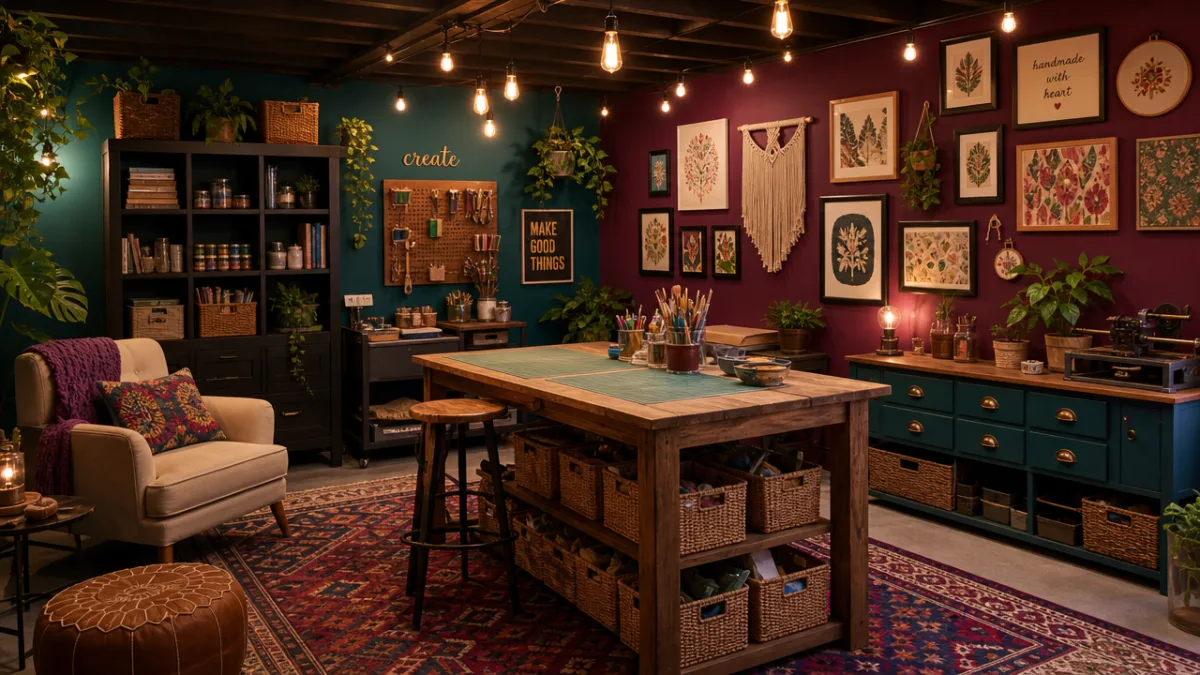
Color choices in your craft room are not merely decorative — they actively influence how you feel and think while you work. Yellow is associated with optimism, mental clarity, and creative energy, making it a popular choice for craft rooms where idea generation is paramount. Soft greens evoke calm and concentration, useful if your craft practice tends toward the meditative, such as knitting, embroidery, or watercolor painting. Bold jewel tones like sapphire blue, emerald, or deep plum create a rich, cocooning atmosphere that can feel luxurious and stimulating at the same time.
Budget-Friendly Basement Craft Room Transformations
Transforming a basement into a dream craft room does not have to drain your savings. Some of the most stunning and functional craft rooms are built on modest budgets through strategic thrifting, repurposing, and phased investment over time. The key is to prioritize spending on the elements that most directly affect your productivity and enjoyment — good lighting, a solid work surface, and adequate storage — and to find creative, affordable solutions for everything else.
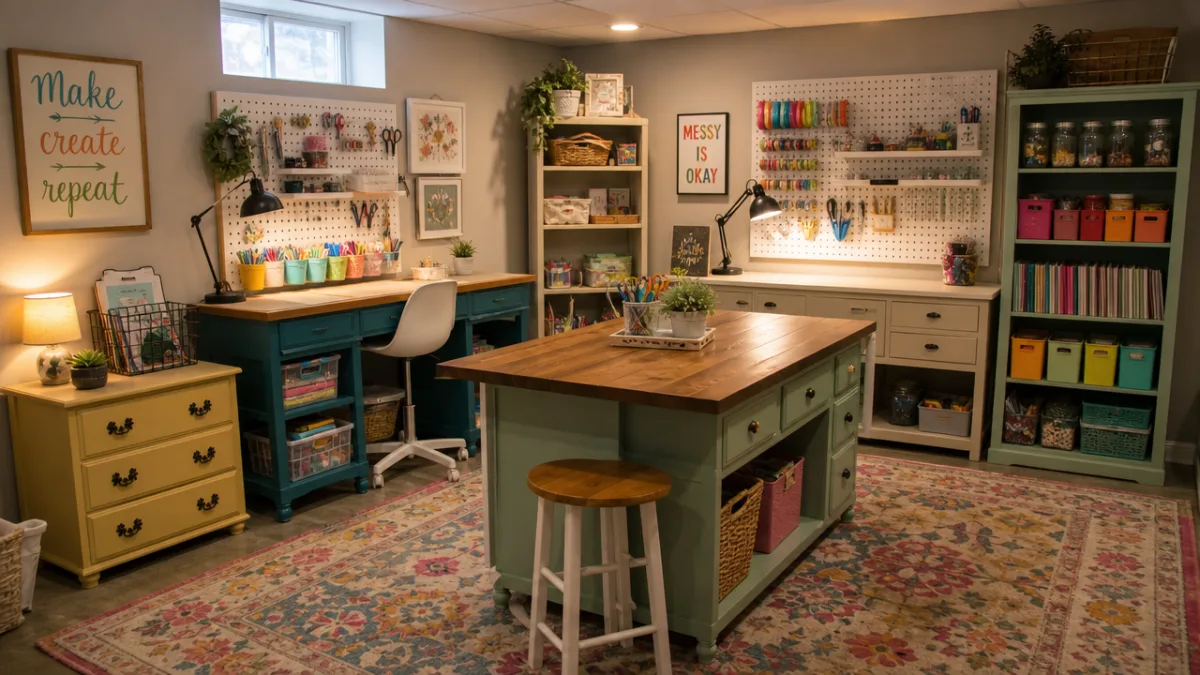
Secondhand furniture is one of the biggest budget wins available to craft room builders. Thrift stores, Facebook Marketplace, and estate sales are filled with bookshelves, dressers, filing cabinets, and desks that can be sanded down, painted, and repurposed into beautiful and highly functional craft storage. A sturdy old dresser with deep drawers becomes perfect fabric storage. A set of mismatched bookshelves painted the same color creates a cohesive built-in look at a fraction of the cost of custom cabinetry. Old kitchen cabinets, often available for free during renovation projects, make exceptional lower storage units for a craft room workstation.
DIY shelving is another area where a small investment of time yields outstanding results. Basic pine boards from a hardware store, cut to length and supported by simple bracket hardware, can create meters of shelf space for a very low cost. Floating shelves mounted at varying heights give a modern, intentional look that feels expensive even when it is not. If you are comfortable with basic carpentry, building a simple pegboard frame from furring strips and mounting it with standard hardware creates a professional-looking tool organization system for remarkably little money.
Phasing Your Basement Craft Room Build
If budget constraints make a full basement craft room renovation feel impossible right now, approaching the project in deliberate phases is a practical and stress-free alternative. In the first phase, focus on the basics: clean out the space, address any moisture issues, add adequate lighting, and set up a functional work surface with whatever storage you already have on hand. Getting into the space and actually using it, even imperfectly, will teach you more about what you really need than any amount of planning from the outside.
In subsequent phases, you can add more sophisticated storage solutions, improve the flooring, add decorative touches, and invest in specialized equipment as your budget allows. Many experienced craft room builders recommend waiting to purchase major storage furniture until you have spent several months using the room, because real-world use almost always reveals priorities and needs that are impossible to anticipate at the planning stage. A craft room that evolves alongside your practice will always fit you better than one designed all at once based on assumptions about how you work.
- Phase One — Functional foundation: Clean, dry, light, and a work surface. Get into the space and start creating.
- Phase Two — Storage upgrade: Add proper shelving, pegboards, and containers based on what you have learned from actually using the room.
- Phase Three — Comfort and aesthetics: Improve flooring, add rugs, paint walls, introduce plants and décor that make the space feel truly yours.
- Phase Four — Specialized additions: Invest in equipment-specific storage, upgraded lighting, or custom built-ins that reflect your fully developed practice.
Making Your Basement Craft Room a Space You Never Want to Leave
Beyond the practical concerns of storage, lighting, and layout, the most important quality of a successful basement craft room is that it genuinely invites you in. A space that feels welcoming, comfortable, and personally meaningful is one you will actually use consistently, and consistent use is ultimately what transforms a hobby into a practice and a practice into mastery. Every intentional detail you add — from the playlist you play through a small Bluetooth speaker to the favorite mug you keep on the shelf for your crafting-session coffee — builds the ritual of creative work.
Comfort is non-negotiable for a space where you may spend many hours at a time. Invest in a genuinely good chair for your seated workstation, because back and neck discomfort will end a crafting session faster than anything else. An anti-fatigue mat at your standing work surface makes a significant difference during long cutting or assembly sessions. If your basement tends to be cold, a small space heater positioned safely away from flammable materials keeps the room comfortable through winter months without heating the entire house. A small mini-fridge stocked with drinks means you never have to interrupt your creative flow to run upstairs.
Finally, make your basement craft room a space that celebrates the joy of making in every possible way. Surround yourself with things that inspire you — art books stacked on a side table, a mood board pinned with images and color swatches that excite your imagination, a collection of vintage buttons or beautiful fabric swatches arranged decoratively in glass jars. Crafting is a fundamentally optimistic act, a declaration that you believe in the value of making beautiful, useful, or meaningful things with your own hands. Your basement craft room, at its best, should reflect and reinforce that belief every single time you walk through the door.
Inspiring Others With Your Basement Craft Room
One unexpected joy of creating a beautiful basement craft room is how it draws in other people. Children who see a parent’s organized, welcoming creative space develop their own interest in making things. Friends who visit are inspired to tackle their own basement projects. An inviting craft room naturally becomes a gathering space for creative collaboration, whether that means hosting a monthly crafting circle, teaching a skill to a neighbor, or simply sharing the space with a partner who wants to explore a new hobby. The basement you once ignored has the potential to become one of the most socially and creatively vibrant rooms in your home.
Sharing your craft room transformation online is another way to multiply its impact and connect with a wider community of makers. Documenting the before-and-after process on social media or a personal blog not only provides accountability during the renovation but also serves as a genuine resource for others who are planning similar projects. The craft and DIY community is extraordinarily generous with its knowledge, ideas, and encouragement, and contributing your own experience to that collective wealth of information is a meaningful way to give back to the community that so often provides the inspiration for projects like this one.








What do you think?
It is nice to know your opinion. Leave a comment.