










Sunday Morning Chamomile Soy Wax Candle: A Complete Guide to Crafting Tranquility at Home
There is something deeply restorative about Sunday mornings. The pace slows, the world outside grows quiet, and the rituals we choose to fill those precious hours take on a significance that weekdays rarely allow. A chamomile soy wax candle captures that exact feeling — the soft warmth of golden light, the gentle drift of floral fragrance, and the sense that time, for just a moment, belongs entirely to you. Whether you are an experienced candle maker or discovering this craft for the first time, creating your own Sunday morning chamomile candle is an act of intentional self-care that pays dividends long after the pouring is done.
Chamomile has been treasured across centuries and cultures for its calming, restorative properties. From ancient Egyptian medicinal preparations to modern aromatherapy blends, this delicate flower carries a reputation for soothing anxiety, encouraging restful sleep, and creating an atmosphere of gentle wellbeing. When that essence is translated into a candle, it becomes something you can return to again and again — a small, luminous anchor in the middle of your living space. The Sunday morning association is not accidental. This fragrance evokes warmth without intensity, comfort without heaviness, calm without drowsiness.
Soy wax serves as the ideal canvas for this particular vision. Derived from hydrogenated soybean oil, it is a natural, renewable resource that burns cleanly and slowly, releasing fragrance in a way that feels organic rather than overwhelming. Unlike paraffin-based candles, soy wax does not produce the dark soot that coats walls and irritates airways. It holds scent beautifully, partners well with essential and fragrance oils, and supports that warm, slightly creamy aesthetic that chamomile deserves. This guide will walk you through everything you need to know — from understanding your materials to mastering your pour, troubleshooting your results, and incorporating your candle into a meaningful self-care routine.
Understanding Your Materials: Soy Wax, Chamomile, and Supporting Ingredients
Before you melt a single flake of wax, it is worth taking time to understand what each ingredient brings to your candle. Soy wax comes in several grades, and the one you choose will significantly affect your final product. Container soy wax, typically labeled as 464 or 444, is formulated specifically for vessels like mason jars, ceramic pots, and glass tumblers. It has a lower melt point than pillar wax, which means it pools beautifully across the surface of your container and delivers consistent, even fragrance throw. For a Sunday morning chamomile candle, container soy wax is almost always the right choice, as it lends itself to the soft, domestic aesthetic the concept calls for.
Chamomile fragrance can be introduced to your candle in several forms, each with distinct advantages. Pure chamomile essential oil, steam-distilled from the flowers of Matricaria chamomilla or Anthemis nobilis, delivers a genuine botanical scent that is herbal, slightly apple-like, and quietly floral. It is expensive compared to synthetic alternatives, but for those committed to a fully natural product, it is unmatched. Chamomile fragrance oils, on the other hand, are blended compositions designed to evoke the flower’s character while offering better scent throw in wax. Many experienced candle makers opt for a blend — a chamomile fragrance oil as the base, supported by a few drops of genuine chamomile or lavender essential oil to add depth and naturalness.
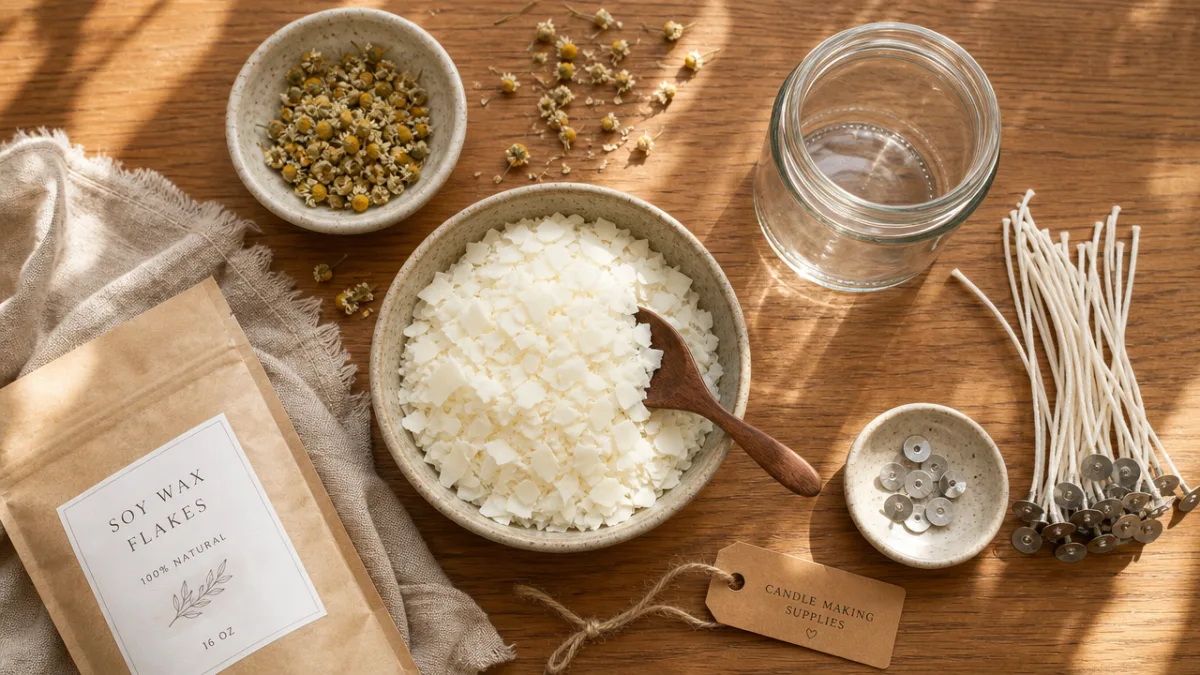
Beyond wax and fragrance, you will need several supporting materials that determine how your candle performs. Cotton wicks, preferably pre-tabbed and sized to your specific container diameter, ensure a clean, even burn. Wick sizing charts are widely available and worth consulting carefully — an undersized wick will tunnel through your candle leaving wasted wax along the walls, while an oversized wick produces excessive heat, heavy soot, and a fragrance throw that is more aggressive than relaxing. You will also want a reliable thermometer, a pouring pitcher, a double boiler or dedicated wax melter, fragrance-safe dye if you wish to tint your wax a soft chamomile yellow, and whatever vessels speak to your aesthetic sensibility.
Gathering Your Tools and Setting Up Your Workspace
Candle making is a craft that rewards preparation. Unlike baking or painting, where you can usually improvise mid-project, working with hot wax requires that everything be in place before you begin. Set up your workspace on a flat, heat-resistant surface — a silicone mat, a sheet of parchment, or a dedicated craft table that you do not mind occasionally dripping on. Lay out your tools in the order you will use them: measuring scale, thermometer, pouring pitcher, stirring spoon or spatula, fragrance oil, wick stickers, and your chosen containers. Having everything within reach means you are not rushing across the kitchen with a vessel of liquid wax at 160 degrees Fahrenheit.
Temperature management is one of the most important skills in candle making, and it begins with your workspace. A room that is too cold can cause soy wax to set unevenly, creating sinkholes or rough surfaces. A room that is too warm may slow the curing process. Ideally, you want to work in a space that sits comfortably between 65 and 75 degrees Fahrenheit. Pre-warming your containers slightly — not hot, just room temperature rather than cold from a cupboard — also helps prevent adhesion issues where the wax pulls away from the glass as it cools. This is especially important in winter months when rooms tend to run colder than we consciously notice.
Safety deserves its own paragraph, not because candle making is particularly dangerous when approached with care, but because hot wax behaves differently from other liquids and deserves respect. Always use a dedicated thermometer rather than guessing temperatures. Never leave melting wax unattended on a heat source. Keep a fire extinguisher or a metal lid nearby — water should never be used on a wax fire. Wear close-toed shoes and avoid loose sleeves when pouring. These precautions are not meant to be intimidating; they simply ensure that your craft practice remains the peaceful, restorative experience it is designed to be rather than an anxiety-provoking one.
The Step-by-Step Candle Making Process
Begin by measuring your soy wax flakes on a kitchen scale. A general rule of thumb is that soy wax loses approximately 10 to 15 percent of its volume when melted, so if your container holds 8 ounces of liquid, start with approximately 9 to 10 ounces of wax flakes by weight. Transfer your measured wax into your pouring pitcher and place it in a double boiler or over a low, indirect heat source. Stir gently and consistently as the wax melts, watching your thermometer. You are aiming for a melt temperature between 170 and 185 degrees Fahrenheit for most container soy waxes, though always confirm the recommendation on your specific wax packaging.
While your wax melts, prepare your containers. Secure your pre-tabbed wicks to the bottom of each vessel using a wick sticker or a small dot of hot glue, pressing firmly to ensure adhesion. Use wick bars, pencils, or dedicated wick centering tools placed across the mouth of the container to hold your wick upright and centered while the wax sets. This step is easy to rush and worth doing carefully — an off-center wick produces an uneven burn that no amount of subsequent care can fully correct. Once your containers are prepared, measure your fragrance oil. The standard recommendation for soy wax is a fragrance load of 6 to 10 percent by weight. For a chamomile candle, 8 percent tends to produce a presence that is noticeable without being assertive — true to the flower’s character.
Remove your melted wax from heat and allow it to cool to between 130 and 140 degrees Fahrenheit before adding your fragrance oil. Adding scent at too high a temperature causes fragrance molecules to flash off, diminishing your scent throw. Adding it too low risks incomplete binding with the wax. At the right temperature, pour your measured fragrance oil in a slow, steady stream, stirring gently for a full two minutes to ensure thorough incorporation. If you are adding color, do so at this stage using fragrance-safe candle dye — a small amount goes a long way. A soft, pale yellow evokes chamomile beautifully without looking artificial. Once blended, allow the wax to cool to your desired pour temperature, typically between 120 and 135 degrees Fahrenheit for most container soy waxes, then pour slowly and steadily into your prepared vessels.
Curing, Troubleshooting, and Perfecting Your Results
Once poured, your candles need time — more time than most beginners expect. Soy wax requires a curing period of at least 48 hours before the first burn, and many experienced makers recommend allowing candles to cure for a full week before evaluating their cold throw or burning them for the first time. During curing, the fragrance oil continues to bind with the wax at a molecular level, creating a more complete and complex scent profile. A chamomile candle burned too soon may smell thin or slightly off; the same candle after a proper cure will reward you with that soft, warm, herbal sweetness that makes the fragrance so appealing.
Soy wax is known for a few common aesthetic issues that can alarm new makers but are generally easy to address. Sinkholes form when the wax shrinks as it cools around the wick, creating a small depression in the center of the candle. This is almost universal with soy wax and can be addressed by doing a second pour — fill a small amount of reserved wax to the level of the sinkhole once the first pour has fully set. Frosting, the white crystalline bloom that sometimes appears on the surface of soy candles, is a completely natural characteristic of natural soy wax and does not affect performance in any way. Many makers actually embrace it as evidence that their product is genuinely natural. Wet spots — areas where the wax appears to have pulled away from the glass — are also common with container candles and do not affect burn quality.
Burn testing is an essential and often underemphasized part of the candle making process. Before considering any candle finished, burn it in a controlled setting and observe it closely. During the first burn, allow the melt pool to reach the edges of the container before extinguishing — this typically takes between 2 and 4 hours depending on container diameter and wick size, and it sets the memory of the wax, preventing tunneling in future burns. Note the height of the flame, the amount of soot produced, whether the wick mushrooms excessively, and how strongly the fragrance throws both while burning and in the hours after the flame is extinguished. Keep detailed notes. Candle making is an iterative craft, and your best results will emerge through informed experimentation rather than luck.
Decorating and Packaging Your Chamomile Candle
A Sunday morning chamomile candle deserves presentation that honors its intention. If you are making candles for personal use, your decorating approach can be as minimal or as considered as you like. A clean, handwritten label with the fragrance name and date of pour carries a quiet charm that printed labels sometimes lack. If you are drawn to a more polished aesthetic, label design software is widely accessible and allows you to create something genuinely beautiful without professional graphic design training. Consider a palette of warm creams, soft golds, and muted sage greens — colors that echo the chamomile meadow without competing with the candle’s own visual presence.
Dried botanicals are a popular addition to chamomile candles, and for good reason — a scattering of dried chamomile flowers pressed against the inside of a glass container before pouring creates a delicate, luminous effect when the candle is lit. However, it is worth noting that botanicals inside candles carry a genuine fire risk if they are in the direct path of the flame or if they float to the top of the melt pool and ignite. The safest approach is to adhere dried flowers to the outer surface of the container using a thin layer of clear adhesive, or to place them as surface decoration on top of the cooled wax, well away from the wick. A sprig of lavender or a few chamomile heads resting on the finished surface adds visual warmth without the risk.
If you are gifting your chamomile candle — to a friend navigating a stressful season, to a family member who deserves a moment of quiet, or to yourself as a deliberate act of care — consider the complete sensory experience of receiving it. Wrap it simply in tissue or linen fabric tied with natural twine. Tuck in a small card with suggested burn instructions and a note about the fragrance’s origins. You might include a small packet of chamomile tea, a packet of dried flowers, or a printed card with a morning ritual suggestion. The candle itself is lovely. The thoughtfulness with which it is offered makes it something more.
Incorporating Your Chamomile Candle Into a Sunday Morning Ritual
A candle is most powerful when it becomes part of an intentional routine. The act of lighting a chamomile candle on Sunday morning is a small but meaningful signal to your nervous system — a physical cue that this time is different, that the pace is changing, that the day ahead belongs to rest and renewal rather than productivity and performance. Rituals do not need to be elaborate to be effective. In fact, simplicity is part of their power. The ritual of striking a match, watching the wick catch, and setting the candle in a designated spot on your kitchen counter or beside your reading chair creates a container for calm that becomes more effective with each repetition.
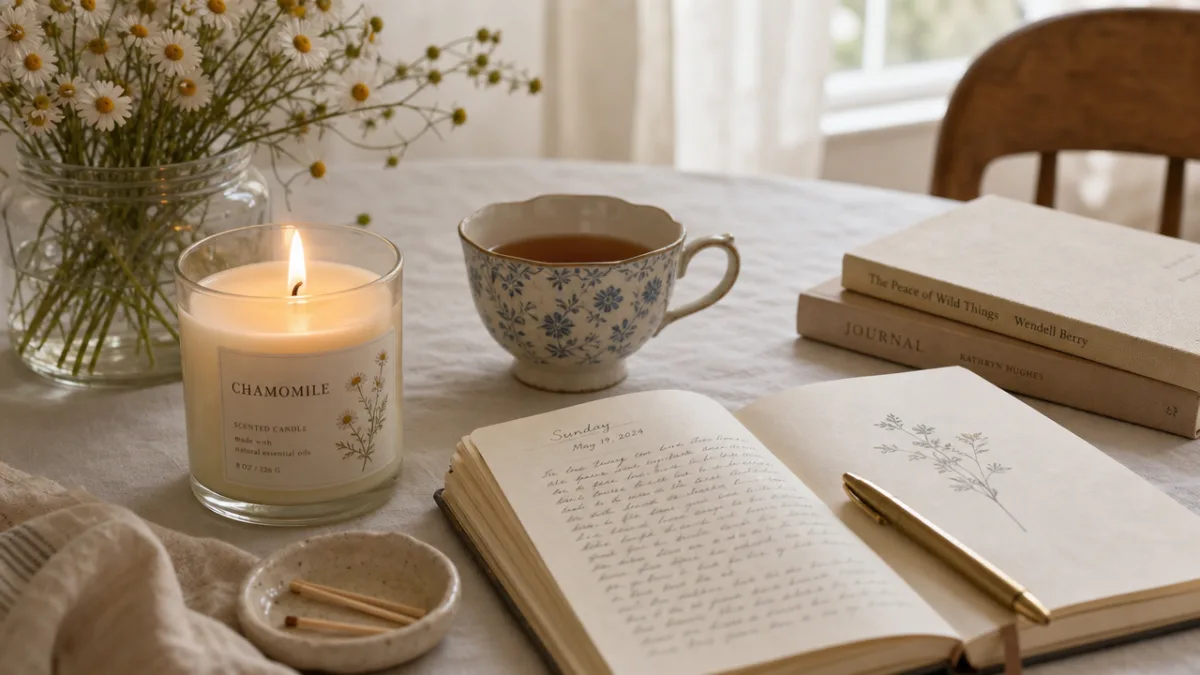
Consider pairing your chamomile candle with complementary sensory experiences that reinforce its mood. A cup of chamomile tea brewed slowly and sipped without screens nearby. A few pages of a novel or a collection of poetry read in the candle’s light. Gentle morning stretches performed beside a window while the fragrance fills the room. Journaling — not task-listing or planning, but genuine reflection — conducted while the candle burns. These pairings are not prescriptive; they are suggestions drawn from the understanding that sensory experiences accumulate meaning when they are consistently associated with one another. Over time, the scent of chamomile alone may begin to trigger that sense of spaciousness and ease.
The Sunday morning chamomile candle is, at its deepest level, a practice in making beauty for yourself. In a culture that often treats self-care as either indulgent or performative, there is something quietly radical about spending a Sunday morning melting wax, blending fragrance, and creating something designed solely to make your own hours more beautiful. The candle will burn down eventually. You will make another. And in that cycle of making, lighting, noticing, and making again, you will find not only a craft you love but a relationship with your own need for rest and loveliness that is worth protecting every single week.
- First burn rule: Always allow the melt pool to reach the full diameter of the container before extinguishing, typically 2 to 4 hours, to prevent tunneling in subsequent burns.
- Trim your wick: Before each burn after the first, trim the wick to approximately one-quarter inch to reduce soot, control flame height, and extend the life of your candle.
- Burn time limits: Never burn a candle for more than 4 hours at a time. Allow it to cool and resolidify completely before relighting to maintain even burning and prevent overheating.
- Safe placement: Always burn your candle on a heat-resistant surface, away from drafts, curtains, flammable materials, children, and pets. Never leave a burning candle unattended.
- Discontinue when low: Stop burning when approximately half an inch of wax remains in the container to prevent the vessel from overheating and potentially cracking.
Your Sunday morning chamomile soy wax candle is not just a home fragrance product — it is a testament to the human need for beauty, craft, and stillness. In the time it takes to melt the wax, blend the fragrance, and watch the poured wax cool and set, you have practiced patience. In the week of curing that follows, you have practiced anticipation. And in the quiet Sunday morning when you finally strike a match and watch the flame take hold, breathing in that soft, herbal, golden scent, you have practiced something close to gratitude. That, ultimately, is what this candle is for.








What do you think?
It is nice to know your opinion. Leave a comment.