










Dark Academia and the Art of Candlelight Reading
There is something almost alchemical about settling into a chair with a heavy book and the quiet company of a candle flame. Dark Academia, the aesthetic movement that draws its soul from crumbling libraries, leather-bound volumes, and the melancholy romance of intellectual pursuit, has found one of its most perfect expressions in the simple ritual of reading by candlelight. This practice is not merely decorative or performative — it is a deliberate act of slowing down, of placing the body and mind in a specific atmosphere that coaxes deeper engagement with language, ideas, and the self. To understand why candlelight reading has become such a cherished cornerstone of Dark Academia culture is to understand something true about how environment shapes thought.
The aesthetic itself draws heavily from the traditions of nineteenth-century European universities, Gothic literature, classical philosophy, and the kind of brooding intellectualism that flourishes in autumn and candlelight rather than in fluorescent offices. Pinterest boards, Tumblr archives, and Instagram feeds devoted to Dark Academia overflow with images of worn wooden desks, stacks of annotated paperbacks, half-drunk cups of tea gone cold, and the warm amber glow of candlelight pooling across open pages. The visual language is immediately recognizable and deeply nostalgic, even for those who have never themselves studied in a grand stone university. It speaks to an idealized world where knowledge is pursued for its own sake, with devotion bordering on the devotional.
Candlelight specifically carries an outsized role within this aesthetic. Unlike electric light, which is neutral, efficient, and democratically distributed across every corner of a room, candlelight is selective. It narrows the visible world to a small radius of warmth. It flickers. It demands that you sit close, that you lean in, that you commit to the page in front of you. In an age of perpetual distraction and screen-mediated fragmentation, this enforced intimacy with a single object — the book — is almost radical. The candle does not merely illuminate the page; it creates a private world around the reader, soft at the edges and full of shifting shadows.
The Historical Romance of Reading by Candlelight
For most of recorded human history, artificial light was expensive, precious, and produced by fire. Scholars of ancient Alexandria, medieval monks illuminating manuscripts, Renaissance humanists poring over newly printed texts — all of them read by the light of oil lamps, tallow candles, or beeswax tapers. The association between candlelight and serious intellectual work is therefore not a modern invention or an aesthetic affectation. It is a genuine historical reality, one that Dark Academia draws upon deliberately when it recreates this atmosphere in contemporary bedrooms and apartments. When you light a candle before opening your book, you are, in some small way, reaching across centuries to touch that unbroken chain of readers.
The physicality of this history matters enormously. Medieval monks developed specific postures and techniques for reading by candlelight — sitting at particular angles to avoid blocking the flame, positioning manuscripts to catch the maximum light, training their eyes to follow text through flickering shadows. Renaissance scholars wrote about the quality of candlelight and its suitability for different kinds of reading. The Romantics, who are among the most important aesthetic ancestors of Dark Academia, practically worshipped the atmospheric qualities of firelight and candlelight as conducive to poetic inspiration and philosophical reverie. When Byron and Keats wrote of burning through the night with books and ink, they were describing a literal as well as metaphorical fire.
This historical depth gives the practice a weight and legitimacy that transcends mere style. Dark Academia at its best is not only about looking a certain way; it is about connecting with a tradition of intellectual and aesthetic seriousness that stretches back through time. The candle is a physical link to all those who came before — all those who believed that ideas were worth sitting with in the dark, worth straining one’s eyes for, worth organizing one’s entire evening around. There is a profound comfort in this continuity, a sense that one is participating in something larger than a personal hobby or an internet subculture.

Creating the Perfect Dark Academia Reading Atmosphere
Atmosphere is not accidental — it is composed, like music or a well-structured argument. The Dark Academia reading environment rewards intentional curation, and candlelight is only the beginning. The space you choose to read in, the objects you surround yourself with, the sounds or silence you allow into the room, the temperature and texture of the air — all of these elements conspire to produce an experience that is either conducive or hostile to deep reading. Most contemporary environments, designed for productivity and multipurpose use, are actively hostile to the kind of sustained, dreamy immersion that Dark Academia celebrates. Creating an alternative requires effort and attention.
Consider the following elements when building your candlelight reading space:
- Candle selection: Beeswax candles burn cleanly and with a warm, honeyed light that is warmer and more flattering than paraffin. Taper candles in brass or wrought iron holders evoke the aesthetic most strongly. Pillar candles placed at varying heights create a layered quality of light. Scented candles with notes of sandalwood, amber, old paper, leather, or dark florals like tuberose or black rose can anchor the sensory experience in place and memory.
- Textiles and comfort: A heavy wool blanket, a velvet throw, or a worn leather armchair changes the quality of reading entirely. The body must be comfortable enough to remain still for extended periods, and there is something about heavy, luxurious fabric that reinforces the sense of being enclosed in a private world apart from the outside.
- Book selection: While any book can be read by candlelight, certain texts respond especially well to the atmosphere. Gothic novels, Victorian poetry, classical philosophy, dense literary fiction, and anything that rewards slow, ruminative reading gains something from the physical context of candlelight.
- Sound: Silence, rain, or low instrumental music — piano, cello, or classical compositions without lyrics — all support the atmosphere. Many Dark Academia practitioners maintain carefully curated playlists specifically for reading sessions.
The most important principle is that each element should reinforce rather than contradict the others. A candle placed next to a bright phone screen creates dissonance; the electric light overwhelms the flame and the phone’s notifications fracture the attention the candle is trying to collect. Choosing to read by candlelight only functions fully when it is paired with a genuine commitment to separation from digital distraction. This is perhaps the hardest and most valuable part of the practice: the candlelight reading session as a designated period of intentional disconnection, a deliberate step outside of the relentless digital present.
The Psychology of Dim Light and Deep Reading
The appeal of candlelight reading is not purely aesthetic or historical — there is genuine psychological and even neurological reasoning behind why low, warm light affects the quality of intellectual and imaginative experience. Researchers studying the relationship between lighting conditions and cognitive states have found that ambient dim lighting, as opposed to bright overhead illumination, tends to promote creative thinking, emotional openness, and a loosening of the analytical, task-oriented mindset that dominates waking life. Bright light keeps the brain alert and slightly guarded; dim light encourages a more associative, wandering quality of thought that is well suited to the kind of deep reading that allows a story or argument to genuinely alter the reader’s inner landscape.
There is also something to be said about the way candlelight forces the eyes to work differently. Reading in lower light requires greater concentration and a more deliberate physical relationship with the text. You cannot skim by candlelight in the same way you might skim in harsh fluorescence. The reading pace naturally slows. The mind is forced to dwell on individual sentences, to hear the rhythm of a paragraph rather than extracting information from it at speed. For those who have trained themselves into the nervous, rapid-scan reading style demanded by internet consumption, this enforced slowness can initially feel uncomfortable, even frustrating. But with practice, it becomes one of the greatest pleasures available — the rediscovery of reading as an experience rather than a transaction.
The flickering of the flame also plays a subtle but real role. Unlike the static, perfectly uniform light of an LED, a candle flame moves. Its small fluctuations in brightness and direction create a micro-environment of constant, gentle variation that keeps the peripheral visual system subtly engaged without distracting the central focus. Some researchers have compared this effect to the way natural outdoor environments — the movement of leaves, the shifting of cloud shadows, the gentle variation of daylight — provide a low-level sensory richness that soothes the nervous system without demanding attention. The candle creates a small, indoor version of this natural variability, and the effect on mood and mental state can be surprisingly powerful.

Curating Your Dark Academia Reading List
No candlelight reading practice is complete without a carefully chosen library to draw from, and Dark Academia has developed a rich and recognizable literary canon over the years. This canon is not rigid or officially prescribed — it grows organically from the aesthetic’s core preoccupations with mortality, beauty, obsession, intellectual ambition, and the dangerous romance of knowledge pursued to its limits. The books that most naturally inhabit the candlelight reading atmosphere tend to be dense with atmosphere themselves, richly textured in their prose, and concerned with inner lives of tremendous complexity and contradiction.
Some cornerstone texts that appear again and again in Dark Academia reading lists include:
- The Secret History by Donna Tartt — perhaps the single most cited Dark Academia novel, following a group of classics students whose love of ancient beauty leads them toward violence and moral dissolution.
- Brideshead Revisited by Evelyn Waugh — a meditation on lost beauty, aristocratic decline, and the impossible nostalgia for an idealized past.
- The Picture of Dorian Gray by Oscar Wilde — a Gothic fable about beauty, corruption, and the cost of pursuing an aesthetic ideal without ethical grounding.
- Jane Eyre by Charlotte Brontë — atmospheric, morally complex, and deeply concerned with the interior life of an intelligent woman navigating a world that underestimates her.
- If We Were Villains by M.L. Rio — a more recent addition to the canon, set among Shakespeare-obsessed drama students whose intensity tips into tragedy.
- The poetry of John Keats, Sylvia Plath, Emily Dickinson, and Rainer Maria Rilke, all of whom grapple with mortality, beauty, and meaning in ways that resonate profoundly with the aesthetic’s core concerns.
Beyond these specific titles, the spirit of Dark Academia reading values depth over breadth, rereading over consumption, and annotation over passive reception. The ideal Dark Academia reader does not merely move through books — they live inside them for extended periods, returning to marked passages, copying favorite lines into handwritten journals, discussing what they have read with others who bring different interpretive frameworks. Reading, in this tradition, is not a solitary act of entertainment but a form of active philosophical engagement with other minds across time. The candlelight, in this sense, is not merely decoration. It is a commitment — an announcement to oneself that this time, this evening, belongs to the life of the mind.
Journaling, Annotation, and the Intellectual Life of the Candlelit Evening
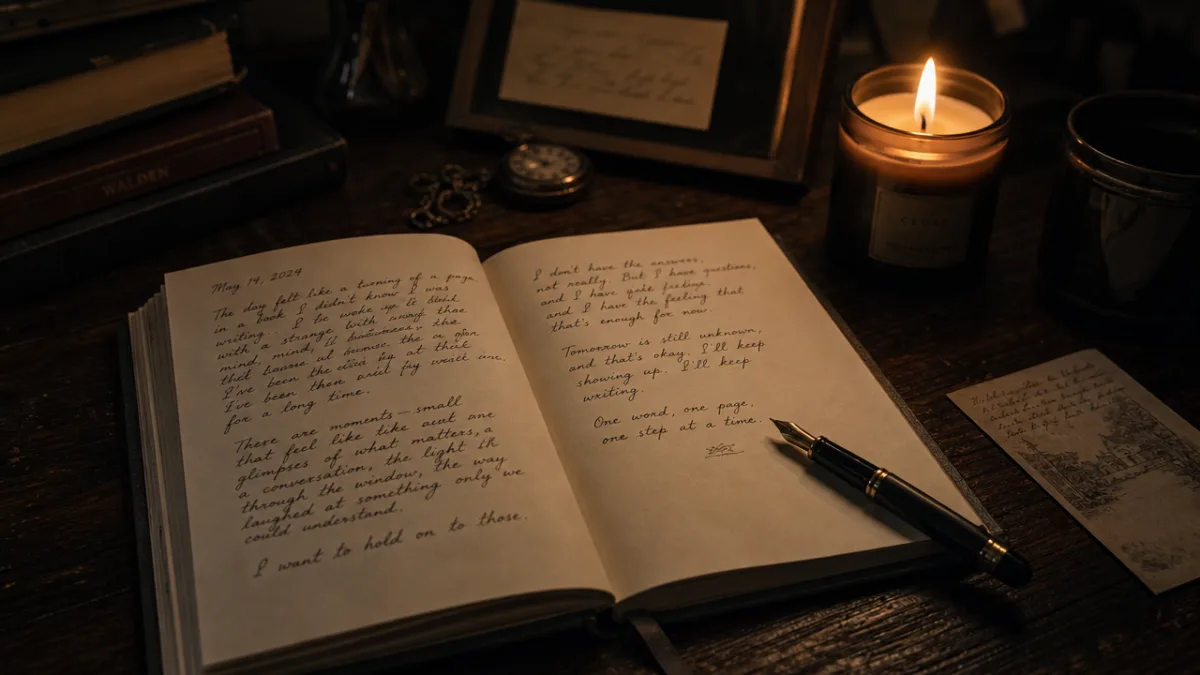
The candlelight reading session in Dark Academia tradition is rarely limited to reading alone. It spills naturally into writing — into the marginalia that accumulate in the borders of beloved books, into the leather-bound or cloth-covered journals that serve as repositories for half-formed thoughts, transcribed passages, responses to arguments, and the private intellectual monologue that serious reading generates. There is a long and distinguished tradition of the reading journal, sometimes called a commonplace book, in which a reader copies out passages that strike them as important, beautiful, or troubling, and adds their own commentary. By candlelight, with pen in hand, this practice takes on a particularly satisfying quality of unhurried contemplation.
The physical act of writing by hand, like the physical act of reading by candlelight, imposes a productive slowness. You cannot write by hand as fast as you can type, and you certainly cannot write as fast as you can think. This gap between thought and inscription forces a kind of editing and prioritization that is itself a form of intellectual clarification. When you choose to copy a particular sentence from a book into your journal, you are making an argument about its value, about why it deserves to survive your reading and be preserved for future consultation. Over months and years, the commonplace book becomes a remarkable document — a map of your own evolving intellectual life, the concerns that have occupied you, the writers who have changed how you think, the questions that return to you again and again.
Alongside the reading journal, many practitioners of Dark Academia maintain a more personal diary that records the texture of these reading evenings themselves — what was read, what was felt, what questions arose, what the weather was doing outside and what the candle was doing inside. This kind of record-keeping elevates the candlelight reading session from a pleasant pastime to something more deliberately cultivated: a practice of attention and self-knowledge. There is a reason that so many of the writers and thinkers who inspire Dark Academia were prolific diarists and letter-writers. They understood that the examined life requires not only experience and reflection but also the discipline of recording — of making one’s inner life visible to oneself through the act of writing it down. The candle burns; the pen moves; the mind clarifies itself in the warm, unstable light.
Building a Ritual: Making Candlelight Reading a Sustainable Practice
The most beautiful reading environment in the world will not sustain a practice that has not been given a regular structure. One of the quiet wisdoms of Dark Academia, for all its romanticism, is that the intellectual life it celebrates is not spontaneous — it is habitual, disciplined, and protected against the constant encroachment of easier entertainments. Building a sustainable candlelight reading practice means establishing a routine, however imperfect or irregular, that the body and mind come to recognize and respond to. The lighting of the candle becomes a signal: the rest of the day is done, and this time belongs to something else.
Practical considerations for building a lasting ritual include setting a consistent time, even if only once or twice a week, that is protected from other obligations. Preparing the space in advance — gathering the books, journal, and pen, selecting the candle, making the tea or wine that will accompany the session — transforms the ritual into something anticipated rather than improvised. Giving the session a defined duration, rather than leaving it open-ended, paradoxically increases commitment; knowing that you have one hour of protected reading time makes it easier to refuse interruptions and distractions than if the session has an indefinite end.
It is also worth resisting the perfectionism that can sabotage any aesthetic practice. The ideal Dark Academia reading session — rain against the windows, perfect silence, antique furniture, the precisely right candle — is an aspiration, not a prerequisite. A pillar candle on a plain desk in a small apartment, a library book with someone else’s pencil marks, a mug of instant coffee rather than artisan tea: these are all sufficient. The aesthetic richness of Dark Academia can be pursued incrementally, built up over time through small and inexpensive additions. What matters most is not the perfection of the setting but the consistency of the attention — the decision, made again and again, to give a few hours to silence, to the page, to the life of the mind. In the end, the candle flame is only as significant as the intention it illuminates.








What do you think?
It is nice to know your opinion. Leave a comment.