










Braided Beeswax Candles: The Art, Craft, and Beauty of Large Handmade Tapers
The Ancient Tradition of Beeswax Candles
Beeswax candles hold a place of remarkable distinction in human history, stretching back thousands of years to ancient Egypt and beyond. Long before paraffin entered the picture in the nineteenth century, beeswax was the gold standard for illumination, prized by royalty, clergy, and artisans alike for its clean burn and naturally sweet fragrance. Unlike tallow candles made from animal fat, beeswax produced a bright, steady flame that did not flicker as dramatically and released almost no soot into the air, making it the preferred choice for sacred spaces and grand households throughout the medieval period and Renaissance.
The connection between bees and candle-making is, in many ways, one of nature’s most elegant partnerships. Honeybees produce wax through specialized glands on their abdomens, secreting tiny flakes that workers then chew and shape into the perfect hexagonal cells of the honeycomb. To gather enough wax for a single pound of beeswax candles, a colony of bees must consume approximately six to eight pounds of honey, making genuine beeswax a genuinely precious material. This labor-intensive origin story is part of what gives beeswax candles their special character and why, even today, they command a higher price than their synthetic counterparts.
When you light a large braided beeswax candle, you are participating in a ritual that stretches back millennia. The soft amber glow, the gentle honey-vanilla scent that rises without any added fragrance oil, and the slow, even burn rate all speak to something deeply natural and unhurried. Beeswax candles have been found in the tombs of pharaohs, used in the great cathedrals of Europe, and burned in the homes of people who understood that some materials simply cannot be improved upon by modern chemistry. Choosing beeswax is, in a very real sense, choosing to honor that lineage.
What Makes Braided Beeswax Candles Unique
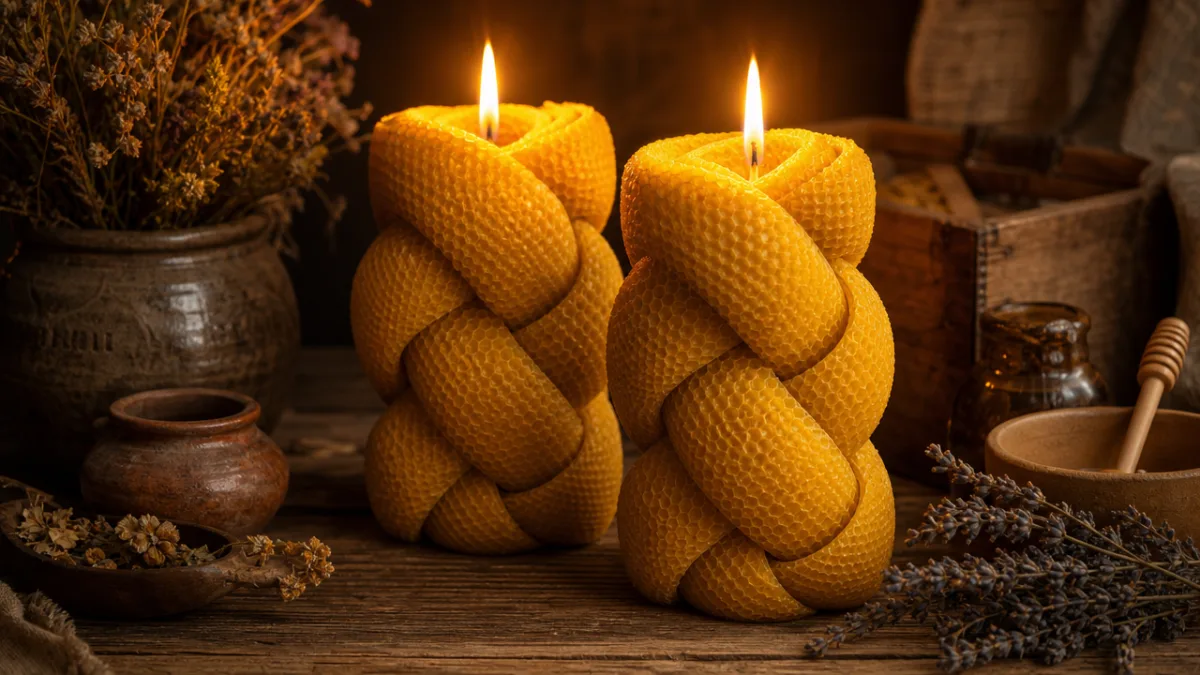
The braided form distinguishes large beeswax candles from their simpler counterparts in both technique and visual impact. Creating a braided beeswax candle requires working with sheets or rolled forms of beeswax while the material is still warm and pliable, weaving multiple strands or rolled tubes together into an interlocking pattern that holds its shape as the wax cools. The result is a candle with striking textural depth, where light plays across the ridges and valleys of the braid, creating a dynamic, living quality even before the wick is ever lit. For large candles intended as centerpieces or statement decor, the braided structure adds unmistakable artisanal character.
Beyond aesthetics, the braided construction has practical advantages that are worth understanding. When multiple columns of wax are braided together, the overall surface area of the candle is increased compared to a simple pillar of the same height and weight. This means the candle radiates more warmth and light as it burns, filling a room with a more generous glow. The intertwining structure also provides a degree of self-support as the candle burns down, with the outer braid helping to contain the melt pool more effectively than a smooth-sided pillar might. The result is a cleaner, more efficient burn over the candle’s full lifespan.
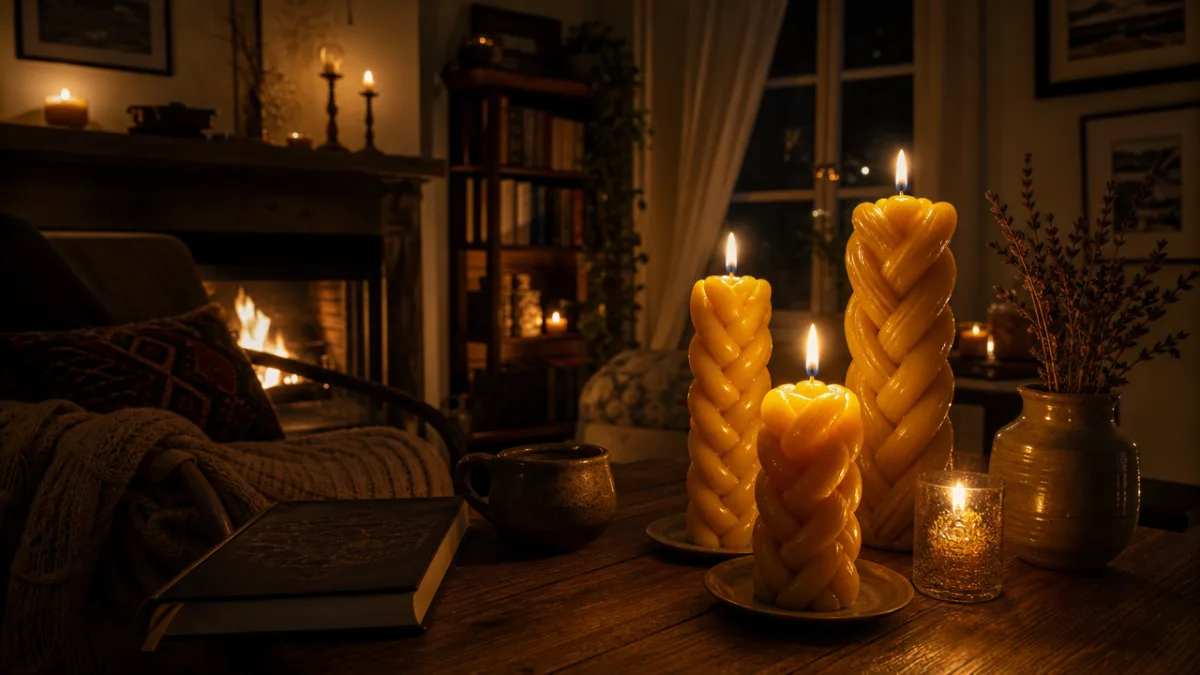
Large braided beeswax candles have become a beloved fixture in both rustic farmhouse and modern artisan interior design movements, serving as focal points on dining tables, mantlepieces, and altar spaces. Their size means they carry a commanding presence — a single large braided candle can anchor an entire tablescape without needing to be surrounded by other decorative elements. Crafters and small-batch chandlers often offer these candles in natural golden tones, but they can also be found in creamy ivory or even lightly tinted shades, allowing them to coordinate with a wide range of home decor palettes while retaining the characteristic warmth that only real beeswax can provide.
Materials and Tools Required for Making Large Braided Beeswax Candles
Creating large braided beeswax candles at home or in a craft studio begins with sourcing high-quality beeswax. The most accessible form for braiding is pre-rolled beeswax sheets, which are widely available from beekeeping suppliers and craft stores. These sheets typically measure around eight by sixteen inches and come in the characteristic honeycomb embossed texture that makes rolled and braided beeswax candles so visually appealing. For truly large candles, you will need multiple sheets per braid strand, and the quality of the wax matters enormously — look for 100% pure beeswax sheets with no paraffin blending, which will burn longer and smell better.
The wick selection process is often where beginner chandlers make mistakes, particularly when scaling up to large candles. A wick that is too thin will drown in the melt pool and extinguish itself, while a wick that is too thick will produce excessive soot and cause the candle to burn unevenly. For large braided beeswax candles, square-braided cotton wicks are the most commonly recommended choice, as their self-trimming curl behavior helps regulate the flame height naturally. Primed wicks — those that have been coated in a layer of wax before use — are much easier to work with, as they hold their shape and can be positioned cleanly at the center of your braided construction.
Beyond wax and wick, the essential toolkit for braided beeswax candle making includes a few straightforward items that are easy to gather. A heat source such as a hair dryer or a warming tray helps keep the wax sheets pliable during the braiding process, which is critical because beeswax becomes brittle and prone to cracking when it cools too quickly. A sharp craft knife or scissors allows for clean trimming of sheet edges, and a flat, clean work surface — ideally one that can be lightly warmed — makes the braiding process far less frustrating. Candle-making thermometers are useful if you are working with melted and re-poured beeswax rather than sheets.
- 100% pure beeswax sheets in honeycomb texture, multiple sheets per strand for large candles
- Square-braided primed cotton wicks sized appropriately for the intended candle diameter
- A hair dryer or warming tray to keep wax sheets workable and pliable during construction
- Sharp craft scissors or a straight-edged craft knife for clean, precise trimming
- A smooth, slightly warm, non-stick work surface such as a silicone mat or parchment paper
- Optional: natural beeswax-compatible dyes or additional beeswax for sealing the base
Step-by-Step Process for Crafting Large Braided Beeswax Candles
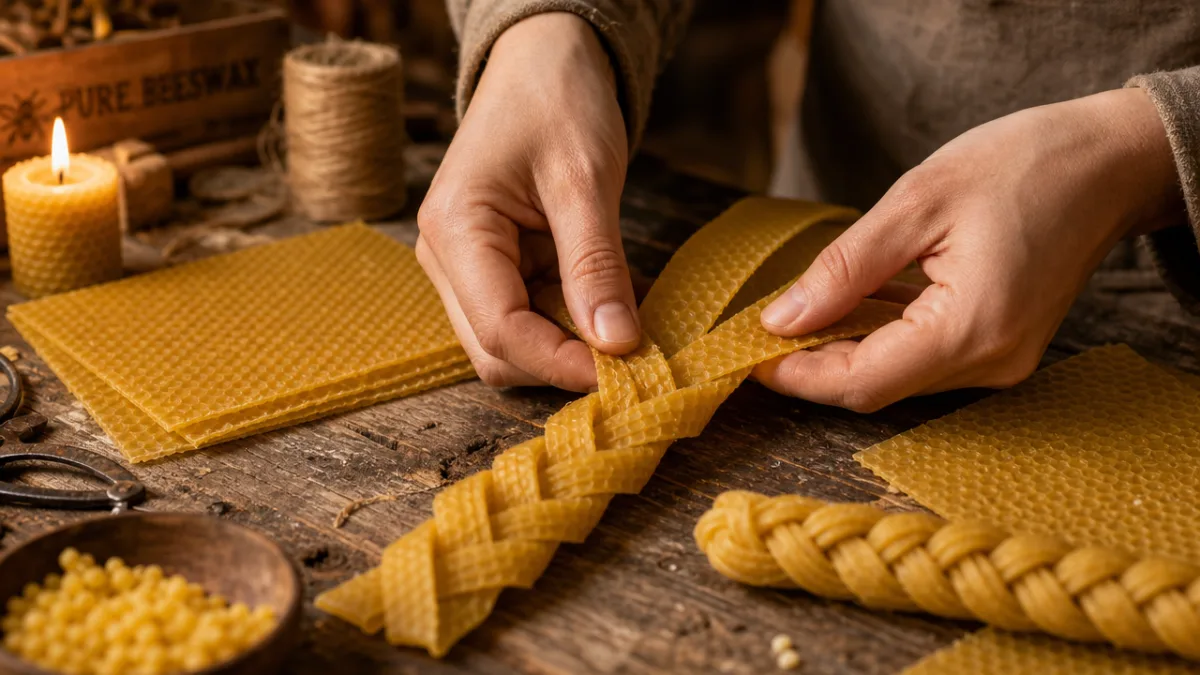
The process of making a large braided beeswax candle begins with preparing your individual strands, which will eventually be woven together. Start by warming your beeswax sheets gently with a hair dryer until they become soft and flexible enough to roll without cracking — you should be able to bend a sheet without hearing any snapping or seeing white stress marks appear in the wax. Lay your wick along the short edge of the first sheet, leaving a half-inch or so of wick extending beyond the end that will become the top of the candle, then roll the sheet tightly and evenly around the wick, pressing the wax gently as you go to ensure good adhesion between each layer. Repeat this process to create two additional roll-cores, which will form the other strands of your three-strand braid.
Once you have three rolled beeswax cylinders of equal length and roughly equal diameter, you are ready to braid. Pinch the three cylinders together firmly at one end and secure them temporarily with a small piece of warm wax pressed over the join — this anchor point will become the base of your finished candle. Begin a standard three-strand braid by crossing the right strand over the center, then the left strand over the new center, continuing this alternating pattern down the full length of the candle. Work slowly and apply gentle, consistent pressure to keep the braid even and symmetrical. If the wax becomes too stiff at any point, pause and warm it briefly with your hair dryer before continuing — trying to force cold beeswax will crack it.
Finishing a large braided beeswax candle well is just as important as the braiding process itself. Once your braid is complete, press the bottom ends of the three strands together firmly and use a small piece of softened beeswax to seal the base flat, which will help the candle stand evenly on any surface. You can also roll the finished candle gently between your palms or on a smooth surface to blend the base into a more unified form. Trim the top wick to approximately a quarter inch above the highest point of the braid — this length provides the optimal starting flame without risk of excessive smoking. Allow the finished candle to rest at room temperature for several hours before burning, which allows the wax to fully set and stabilizes the structural integrity of the braid.
- Warm beeswax sheets gently until pliable, testing flexibility before rolling to prevent cracking
- Place the primed wick along the short edge of the sheet and roll tightly, pressing firmly throughout
- Create three equal rolled cylinders, ensuring consistent diameter for an even braid
- Anchor the three strands at one end with warm wax and begin a standard three-strand braid
- Work slowly down the length of the candle, re-warming the wax as needed to maintain pliability
- Seal and flatten the base, smooth any rough areas, and trim the wick to one quarter inch
- Allow the finished candle to cure at room temperature for a minimum of four to six hours
Caring for and Burning Large Beeswax Candles Safely
Large beeswax candles are an investment of both money and craft, and taking proper care of them before and during burning will dramatically extend their life and performance. Before the first lighting, it is worth spending a moment examining the wick to ensure it is centered and trimmed correctly. A wick that leans significantly to one side will cause the candle to burn unevenly, tunneling down through the wax rather than maintaining a full, even melt pool across the top surface. If the wick appears off-center, you can gently nudge it back into position before the wax sets around it during the first burn.
The first burn of a large candle is arguably the most important one, as it sets a “memory” in the wax that influences every subsequent burn. For a large braided beeswax candle, allow enough time during the first lighting for the melt pool to reach all the way to the outer edges of the candle before extinguishing the flame — this may take two to three hours depending on the candle’s diameter. If you extinguish the candle before this full melt pool develops, the wax will remember that smaller circle and tunnel straight down through the center on every future burn, wasting a significant amount of the candle’s total wax. Patience during the first burn pays dividends over the candle’s entire lifespan.
Safety around large pillar candles deserves careful attention, particularly because their size means they hold a substantial volume of liquid wax when fully lit. Always burn large beeswax candles on a fireproof, heat-resistant surface such as a ceramic plate, a metal tray, or a dedicated candle holder designed for pillar use. Never leave a burning candle unattended, and keep candles well away from drafts, which can cause uneven burning and increase the risk of the flame growing unpredictably large. Trim the wick to a quarter inch before every single burn, not just the first — this simple habit prevents the development of a mushroomed carbon deposit on the wick tip, which can cause excessive flickering, smoke, and an oversized flame.
The Environmental and Wellness Benefits of Beeswax Candles
One of the most compelling arguments for choosing large braided beeswax candles over paraffin alternatives is their dramatically superior environmental profile. Paraffin is a byproduct of petroleum refining, and when it burns it releases a complex mixture of volatile organic compounds including toluene, benzene, and other chemicals that the EPA has classified as potential hazards to indoor air quality. Beeswax, by contrast, is a completely natural substance produced by living organisms, and when it burns cleanly with a properly trimmed wick, it releases virtually no toxic compounds into your home’s air. For households with children, pets, or family members with respiratory sensitivities, this difference is not trivial.
There is a long-standing and widely repeated claim that burning beeswax candles releases negative ions into the air, which then bind to positively charged particulate matter like dust, pollen, and mold spores, effectively purifying the surrounding air. While the science on this specific claim remains somewhat contested and rigorous peer-reviewed studies are limited, what is well-established is that beeswax candles burn more completely and produce substantially less soot and residue than paraffin candles of equivalent size. Regardless of the ion theory’s ultimate validity, replacing paraffin with beeswax is a clear step toward better indoor air quality simply by virtue of what beeswax does not release during combustion.
From a wellness and sensory perspective, large braided beeswax candles offer an experience that synthetic candles simply cannot replicate. The natural honey-vanilla scent that beeswax releases as it warms is subtle, complex, and inherently calming in a way that heavy fragrance oils rarely achieve. Many people who find strongly scented candles headache-inducing discover that they can burn beeswax candles for hours without any discomfort, appreciating the gentle background warmth of the scent rather than an overwhelming olfactory intrusion. The amber, honey-toned light that beeswax flames emit also falls within the warm spectrum that promotes relaxation and is less disruptive to melatonin production than cooler artificial lighting, making large beeswax candles a genuinely supportive element of any evening wind-down routine.
Where to Buy and How to Choose Quality Large Braided Beeswax Candles
The market for handmade beeswax candles has grown significantly in recent years, driven by consumer interest in natural home goods, sustainable sourcing, and the broader artisan craft revival. Online platforms such as Etsy host hundreds of independent chandlers offering large braided beeswax candles, and browsing these shops can be a wonderful way to discover regional makers who work with locally sourced beeswax from small apiaries. When evaluating sellers, look for those who explicitly state the purity of their beeswax — ideally 100% pure beeswax with no paraffin or soy blending — and who can describe their wick type and sourcing. Transparency about materials is a reliable indicator of a maker who takes quality seriously.
Farmers’ markets, craft fairs, and specialty home goods boutiques are also excellent venues for purchasing large braided beeswax candles, with the added advantage that you can examine the craftsmanship in person before committing to a purchase. When inspecting a candle in person, look at the uniformity of the braid — the strands should be even in thickness and spacing, without gaps or areas where the wax has cracked or separated. The base should sit flat without rocking, and the wick should be centered and trimmed cleanly. The surface of the candle may develop a natural white coating over time called bloom, which is a sign of pure, high-quality beeswax rather than a defect — it can be buffed away gently with a soft cloth or simply accepted as evidence of the wax’s authenticity.
Price is an unavoidable consideration when purchasing large beeswax candles, and it is worth understanding why they cost more than comparable paraffin options. The raw material itself is expensive, the craft is time-intensive, and genuinely pure beeswax candles burn more slowly and last significantly longer than paraffin candles of the same size, making the per-hour cost of light and fragrance far more comparable than the upfront price suggests. A large braided beeswax candle that initially seems expensive may in fact represent better long-term value than several cheaper paraffin alternatives that burn quickly and fill your home with petrochemical byproducts. Viewing beeswax candles as a considered, lasting purchase rather than a disposable commodity changes the calculus considerably.








What do you think?
It is nice to know your opinion. Leave a comment.