










The Art of the Crochet Tarot Mat: Where Craft Meets the Sacred
A Sacred Surface for Sacred Work
If you read tarot, you already know that where you lay your cards matters. The surface isn’t just a practical thing — it’s an extension of who you are and what you’re bringing to the table (literally). A handmade crochet tarot mat turns any ordinary table into something that feels intentional, even sacred. The moment you spread it out, something shifts. The ritual has begun.
There’s something a mass-produced velvet spread simply can’t give you: the hours, care, and quiet focus that went into making it. Every stitch in a handmade crochet cloth represents a moment of attention — a breath, almost a meditation. The maker’s energy gets woven right in alongside the yarn, and a lot of practitioners feel that this is exactly what makes handmade altar cloths so powerful for divination work. It’s craft as devotion. Creation as consecration.
Size matters more than beginners usually expect, too. A large reading cloth gives you room not just for the cards, but for the space between them — that breathing room your intuition needs to pick up on the relationships and patterns a spread is trying to show you. When cards are crowded together on something too small, it’s harder to read them as a whole. A generously sized crochet mat can handle a Celtic Cross, a Tree of Life, or whatever sprawling custom layout you’ve been wanting to try, with room left for your hands to move naturally through the reading.
The History and Heritage of the Witch Altar Cloth
Humans have been placing special cloths on sacred surfaces for thousands of years — from the linen-draped altars of ancient Egyptian temples to the richly embroidered silk cloths in medieval European churches. The instinct seems nearly universal: designating and beautifying a surface changes the quality of what happens on it. The witch altar cloth as we know it today draws from all of that history, filtered through contemporary pagan, Wiccan, and eclectic spiritual practice. That ancestral weight is still there, quietly, in every thread.
In folk magic traditions across Europe and the Americas, textile work was deeply tied to women’s spiritual power. Knitting, weaving, and needlework weren’t just domestic skills — they were ways of encoding wishes, protections, and intentions into the fabric of everyday life. When the crochet hook became a widespread craft tool in the nineteenth century, it joined this long lineage of textile magic. Someone crocheting a tarot cloth today is participating in a tradition that goes back much further than crochet itself.
The renewed interest in witchcraft, paganism, and divination over the past couple of decades has also brought renewed appreciation for objects made by hand. Mass production can get the look right, but it can’t replicate the soul. More and more practitioners are actively seeking out artisans who understand the spiritual dimension of what they’re making — people who cleanse their materials, work with intention, and genuinely know what the finished object is for. A handmade crochet tarot mat from a maker like that isn’t just a product. It’s a collaboration.
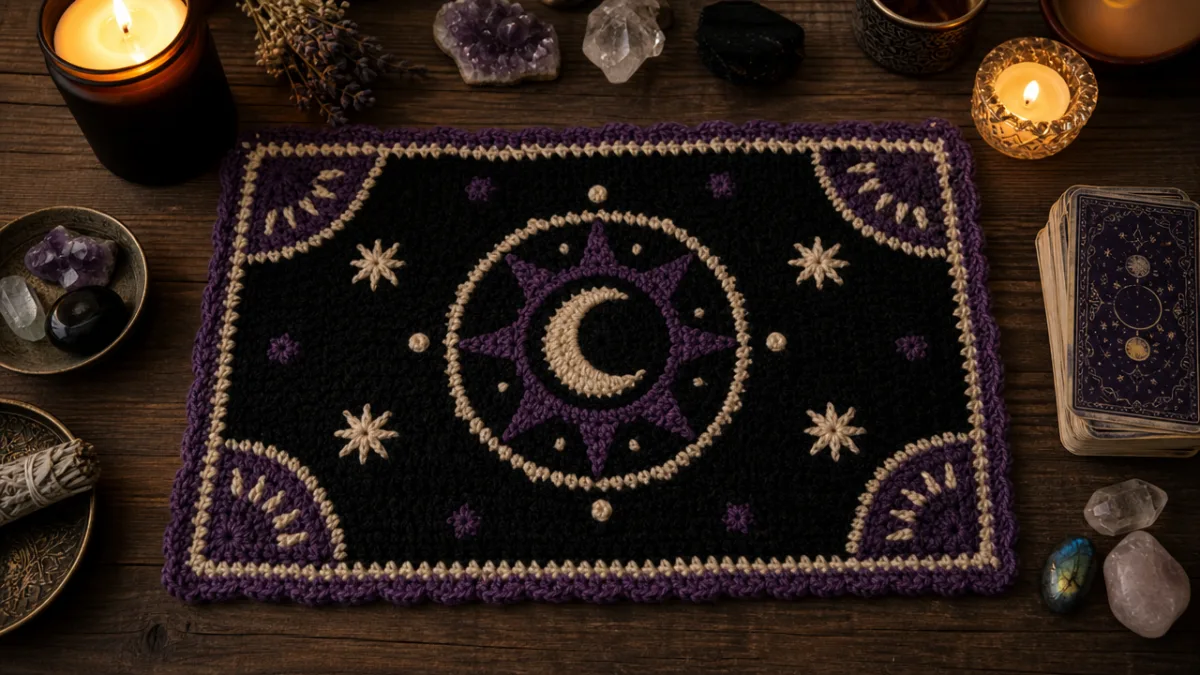
Craftsmanship and Design: What Makes a Quality Crochet Reading Cloth
It starts with the yarn. Cotton is the overwhelming favorite for reading cloths, and for good reason — it drapes flat and stable on a table, doesn’t bunch up under your cards, and holds up well between uses. Natural fibers in general tend to resonate with practitioners who care about keeping their tools grounded and organic. Mercerized cotton in particular has a subtle sheen that makes a finished cloth look beautiful without being distractingly shiny.
The stitch pattern shapes both how the mat looks and how it actually functions. Dense, flat stitches like the moss stitch or linen stitch create a smooth, even surface that won’t catch your cards or cause them to tip — ideal if you want maximum practicality. Lace patterns open things up visually, adding an airy, mysterious quality that a lot of readers find fits the energy of tarot really well. Many skilled makers split the difference by using a solid field in the center (where the cards actually go) surrounded by a lace border — you get function and beauty in the same piece.
Then there’s size, which has real consequences for how useful the cloth actually is day to day. A large tarot mat that can comfortably hold a ten-card Celtic Cross with room to breathe usually starts around 18 by 24 inches, though many readers prefer something closer to 24 by 36. At that scale, the cloth works just as well as a full altar cloth — there’s space for candles, crystals, a significator card, whatever else is part of your setup. In my experience, people rarely wish they’d gone smaller.
Color carries its own symbolic and practical weight. Common considerations when choosing a crochet reading cloth include:
- Black or deep navy: Classic choices that make card imagery pop visually while evoking mystery, the night sky, and liminal space.
- Purple or violet: Associated with psychic ability, wisdom, and the third eye chakra, making these popular among readers focused on intuitive development.
- Forest green or earth tones: Grounding colors that connect the reading practice to nature-based spirituality and herbal traditions.
- Cream or natural white: Clean, clarifying tones that evoke purity, new beginnings, and a blank-slate openness to what the cards reveal.
- Deep red or burgundy: Colors of passion, power, and the blood mysteries, favored by readers working with ancestral or shadow traditions.
Using Your Tarot Mat as an Altar Cloth
One of the things that earns a crochet tarot mat the “altar cloth” label is how well it works beyond just reading days. You don’t have to fold it away when you’re not actively using your cards. A lot of readers leave it out as the foundation of a living altar — their deck resting in its pouch at the center, surrounded by crystals like amethyst, labradorite, moonstone, or clear quartz. The cloth becomes a daily anchor, a visible reminder that this practice is part of your life even when you’re not sitting down for a full reading.
Seasonal and lunar altar arrangements look wonderful on a large crochet cloth too. Around the new moon, you might arrange black tourmaline, obsidian, and a single dark candle on the mat, letting the deep-colored cloth echo that inward, seed-planting energy. Come the full moon, swap in selenite wands, white flowers, and a silver candle. The cloth stays constant while everything on top of it shifts with the seasons — it gives your practice a visual continuity that feels grounding over time.
If you work with other divination tools alongside your tarot deck, a well-sized altar cloth becomes even more valuable. Pendulums need a smooth, flat surface to swing over freely. Runes benefit from a defined space where you can read the pattern they fall in. Oracle decks, astrology charts, crystal grids — they all find a natural home on a cloth that was made with enough space in mind. A maker who designs a truly generous mat understands they’re creating infrastructure for an entire practice, not just a holder for one deck.
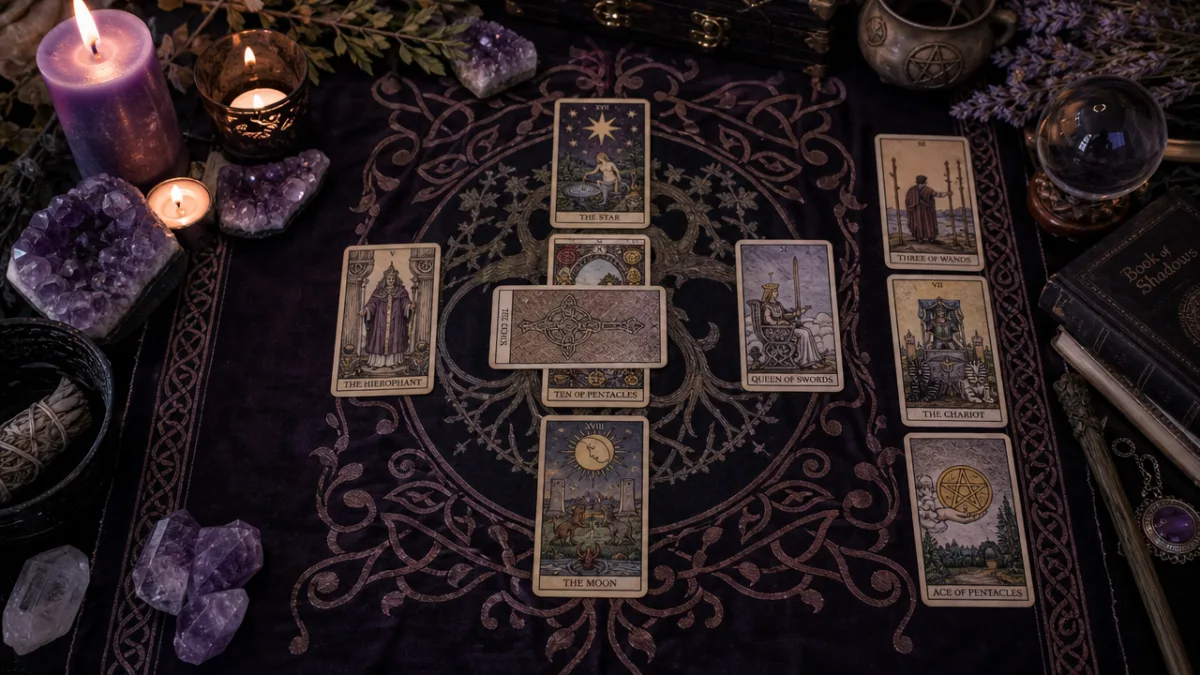
Caring for Your Handmade Divination Mat
A handmade crochet mat is worth taking care of properly. Cotton is durable and washable, but handmade construction is more delicate than machine-made fabric — it needs a gentler touch. Hand washing in cool or lukewarm water with a mild soap is the safest route. If you want to lean into the ritual aspect, a soap infused with cleansing herbs like lavender or rosemary makes the whole process feel intentional. A lot of practitioners treat washing as its own form of energetic clearing, a reset between significant readings or at the turning of a season.
Drying it correctly matters just as much. Lay the wet cloth flat on a clean towel, ease it back into its original shape, and let it air dry away from direct sunlight — UV exposure fades natural fiber dyes over time. Don’t wring or twist it, since that puts stress on the yarn at the stitch points and can distort the pattern. If you block it properly (pinned into shape while still damp) at least once or twice a year, it’ll stay flat and beautiful far longer.
Energetic maintenance is equally important to many practitioners. Some approaches worth considering:
- Smoke cleansing with herbs like rosemary, cedar, or mugwort — passing the cloth slowly through the smoke to clear accumulated energies from previous readings.
- Moonbathing — leaving the cloth on a windowsill or outside under the full moon to recharge it with lunar energy.
- Sound cleansing — running a singing bowl, bell, or tuning fork over the surface and letting the vibration do its clearing work.
- Crystal placement — resting a piece of selenite or clear quartz on the folded cloth when it’s not in use, keeping it in a continuously cleansed state.
- Intentional storage — wrapping the mat together with your tarot deck inside a natural fabric pouch or wooden box, so both tools stay protected and energetically coherent between uses.
Choosing or Commissioning Your Perfect Crochet Tarot Mat
Whether you’re buying a ready-made cloth or commissioning something custom, it’s worth sitting with what you actually need before you decide. Think about the spreads you use most — if you regularly work with large layouts, size should be your first priority. Think about the aesthetic of your reading space — does it call for clean minimalism, rich and layered maximalism, or something in between? Think about color symbolism and what you want to feel when you sit down at your altar. Getting clear on these things turns the selection process into part of the practice itself.
When you’re buying from an artisan, don’t hesitate to ask about their process. Do they work with intention while they crochet? Do they cleanse their materials before they begin? Are they familiar with what the mat is actually going to be used for? A lot of makers who create ritual and divination tools are practitioners themselves, and that understanding genuinely shows up in the finished piece. A brief conversation can tell you a lot about whether a particular maker’s energy is a good fit for what you’re creating.
Custom commissions open up a whole other level of personalization. You might ask for specific symbolic motifs woven into the border — moon phases, stars, pentacles, botanicals — or request that the cloth be made during a particular lunar phase that aligns with your intentions. Some makers will work with specific crystals in their creative space while crocheting your piece, or time their work to astrologically auspicious hours. These aren’t fanciful requests in the world of intentional craft — they’re exactly the kind of considerations that turn a beautiful handmade object into a genuine ritual tool.
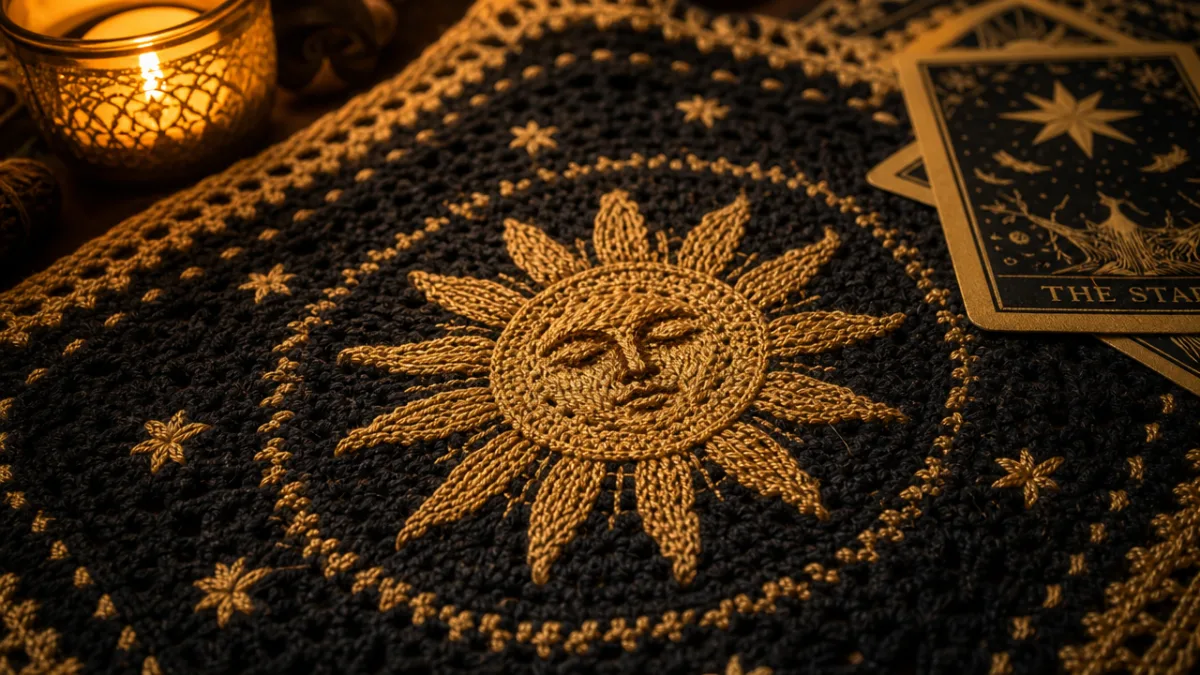
The Deeper Meaning of the Handmade Ritual Object
There’s something quietly radical about choosing a handmade object in a world that defaults to mass-produced everything. Choosing a handmade crochet tarot mat is a statement about what you value — not just in monetary terms, but in terms of human time, skill, and care. It’s saying that your spiritual practice deserves the same quality of attention that you’re trying to bring to the practice itself. That alignment isn’t superficial aesthetics. It’s a form of integrity.
Tarot is a tool for honest self-reflection, for sitting with complexity without forcing easy answers. A handmade altar cloth is a fitting companion for exactly that reason — it resists easy categorization too. It’s art and utility at once. It’s private and sacred, yet made to be seen and used. It carries centuries of textile craft and ritual tradition right into the present moment of a reading. When you lay your crochet mat on the table and pick up your deck, you’re participating in something ancient and still very much alive — something that connects you to every person who has ever sat quietly with their questions and hoped the universe might answer.
And the relationship deepens over time. A crochet tarot mat that’s been present for hundreds of readings takes on a kind of resonance — not in any measurable scientific sense, but in the psychological and spiritual sense that practitioners actually live in. It becomes associated with that particular quality of open, receptive attention that good readings require, so that simply seeing it on the table starts to call that state of mind forward. That’s the alchemy of the ritual object: through repeated, intentional use, it becomes more than yarn and stitches. It becomes a threshold. A marker that sacred time has begun. A quiet, trusted companion in the ongoing conversation between a human mind and the mystery it keeps returning to.








What do you think?
It is nice to know your opinion. Leave a comment.