










Gorgeous Aucuba Japonica: Your Key To Thriving Shade Gardens
Introduction to Aucuba Japonica: The Shade Garden Superstar
If you’ve ever stared at a dark corner of your garden and wondered what on earth you’re supposed to plant there, you’re not alone — and Aucuba japonica might just be the answer you’ve been looking for. Better known as the Japanese laurel, spotted laurel, or gold dust plant, this evergreen shrub is one of those rare finds that actually delivers on its promises in low-light conditions. Bold glossy leaves, genuine shade tolerance, and year-round good looks have made it a firm favorite with gardeners at every level of experience.
Originally from eastern Asia — Japan, China, and the Himalayas specifically — Aucuba japonica has been growing in Western gardens since around 1783, when it first arrived in Europe and swiftly became a staple of Victorian garden design. Shaded woodland borders and formal shrubberies were very much in fashion back then, and this plant fit right in. What’s interesting is that despite countless shifts in garden trends over the centuries, it has never really fallen out of favor. If anything, it’s having a bit of a moment right now, as more gardeners discover the appeal of plants that are genuinely low-maintenance without sacrificing looks.
What sets Aucuba japonica apart is how remarkably adaptable it is. Compact urban courtyard hemmed in by tall buildings? Shaded by a canopy of mature trees? Stuck with a north-facing wall? This shrub handles all of it without complaint. The fact that it thrives where most ornamental plants would give up makes it one of the most useful tools a shade gardener can have, offering real structure, texture, and color throughout the year even in the trickiest spots.
Understanding the Many Varieties of Aucuba Japonica
One of the genuinely fun things about Aucuba japonica is just how many different cultivars there are to choose from. The straight species has deep green leaves, but years of selective breeding have given us a wonderful range of variegated forms splashed, speckled, streaked, and spotted with gold. Whether you want something subtle and sophisticated or a shrub that really makes a statement, there’s almost certainly a variety that fits what you have in mind.
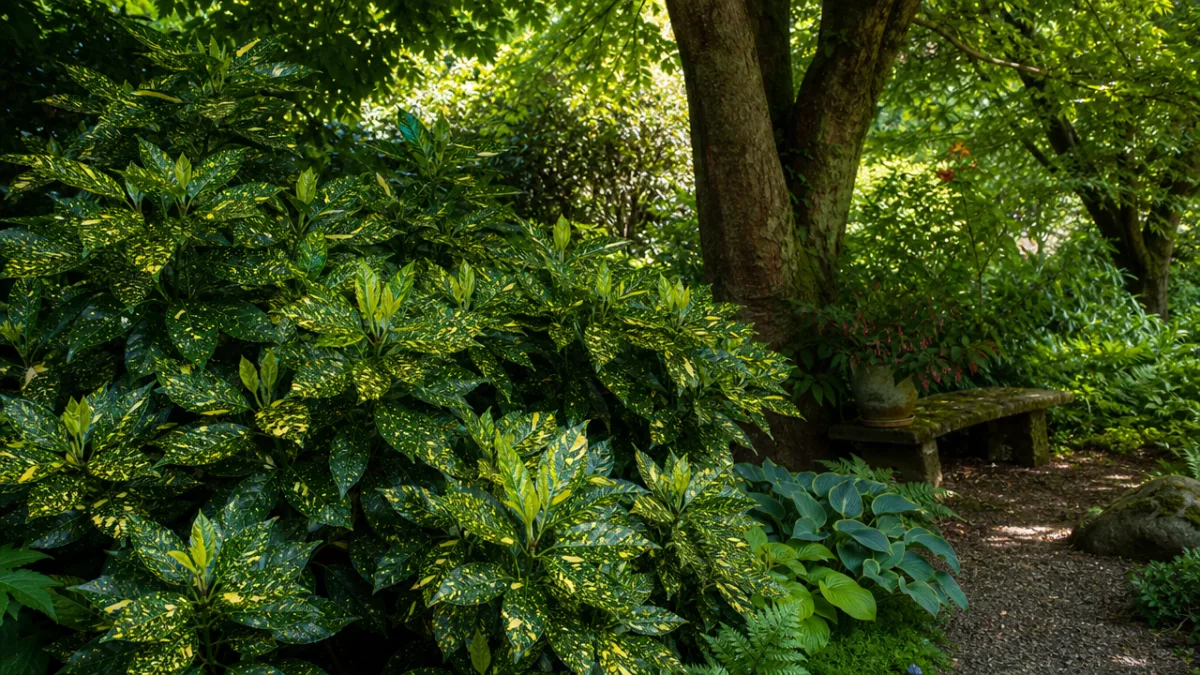
Among the most popular cultivars, Aucuba japonica ‘Crotonifolia’ is a classic for good reason. This female variety has leaves so heavily dusted with gold that the whole plant leans almost yellow — fantastic for lighting up a really dark corner. ‘Gold Dust’ offers something a bit more restrained, with a balanced speckled effect on rich green leaves. If you’d prefer clean, unfussy foliage, ‘Rozannie’ is a compact, self-fertile cultivar with plain green leaves that works brilliantly in smaller gardens and pots.
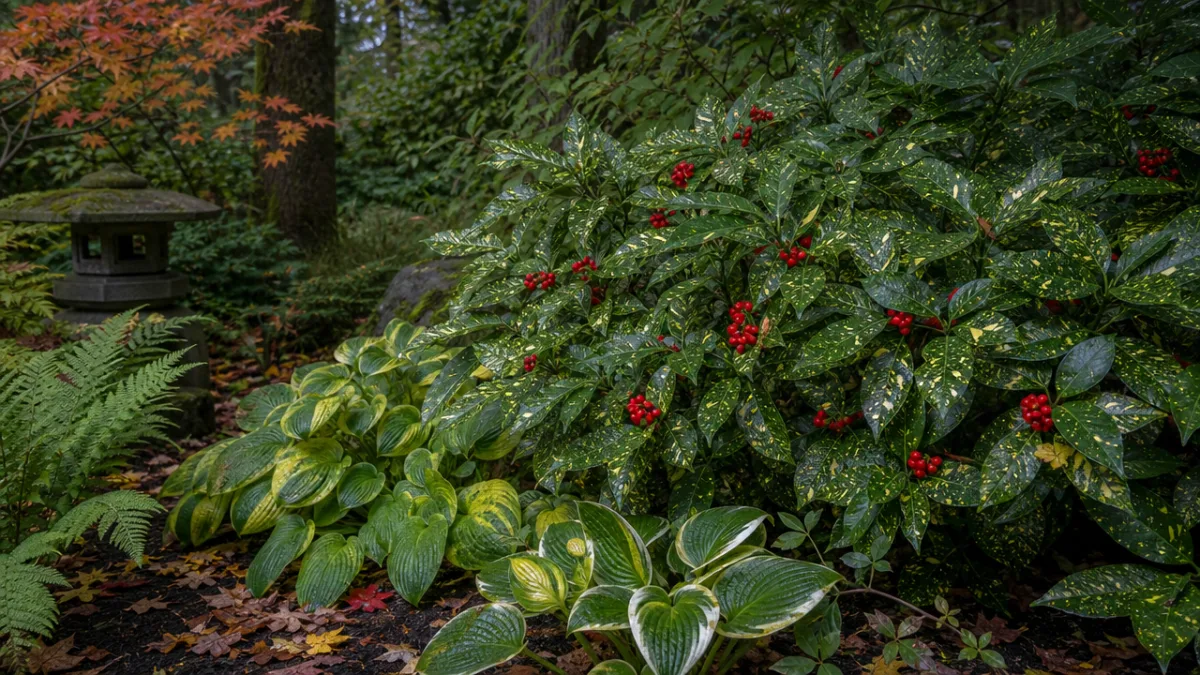
When you’re choosing a cultivar, it’s worth thinking about whether you want berries as well as foliage. Aucuba japonica produces gorgeous bright red berries in autumn and winter, but here’s the catch — the species is dioecious, meaning you need both male and female plants nearby for berries to set. If a winter berry display is part of your plan, make sure you include at least one male cultivar like ‘Mr. Goldstrike’ alongside your female plants. That said, self-fertile varieties like ‘Rozannie’ will berry reliably on their own, which is a real bonus in a small garden where you don’t have room for extras.
- ‘Crotonifolia’ — Heavily gold-speckled female cultivar, one of the most luminous for deep shade
- ‘Gold Dust’ — Classic speckled variety with a balanced green and gold appearance
- ‘Rozannie’ — Compact, self-fertile, plain green leaves, reliable berry producer
- ‘Mr. Goldstrike’ — Male cultivar with bold gold spotting, excellent pollinator
- ‘Picturata’ — Female variety with a large central gold splash on each leaf
- ‘Sulphurea Marginata’ — Subtle yellow-edged leaves, elegant and refined in appearance
How To Grow Aucuba Japonica Successfully
The good news is that Aucuba japonica is far more forgiving than most garden plants. It genuinely thrives in partial to full shade, which puts it in a pretty exclusive club of evergreen shrubs that can handle the darkest spots in your garden without sulking. A little morning sun is fine, especially in cooler climates, but if you expose it to hot afternoon sun for long stretches, you’ll likely end up with scorched leaves and faded variegation. Stick with a shaded or partially shaded spot and you really can’t go wrong.
Soil-wise, this is another area where Aucuba makes life easy. It grows well in most well-drained soils, including heavy clay that would defeat a lot of other plants. The one thing it genuinely can’t stand is waterlogged ground, which will eventually cause root rot and a slow decline. If your soil is on the heavy, slow-draining side, it’s worth digging in some garden compost or well-rotted bark chips before planting to open things up a bit. Aim for a slightly acidic to neutral pH, though honestly the plant has a fairly relaxed attitude toward soil pH and won’t make a fuss if conditions aren’t perfect.
Once it’s settled in, Aucuba japonica becomes remarkably self-sufficient. It’s genuinely drought-tolerant and doesn’t need much supplemental watering, which makes it especially handy in urban gardens where dry soils and pollution are par for the course. That said, in the first growing season after planting it does need regular watering while its roots get established — after that, you can largely step back and let it get on with things. It’s the kind of shrub that rewards a little care upfront with years of trouble-free performance.
Planting and Caring For Aucuba Japonica
Spring and autumn are the ideal times to plant Aucuba japonica, when temperatures are mild and rainfall more dependable — conditions that make it much easier for the plant to settle in without stress. Container-grown plants can go in the ground at other times of year, but it’s sensible to avoid the peak of summer heat or hard winter frost if you can help it. When you dig your planting hole, make it roughly twice as wide as the root ball and the same depth, and mix some slow-release fertilizer or well-rotted compost into the soil you’re backfilling with to give it a decent start.
A spring feed with a balanced, slow-release granular fertilizer each year will keep the plant growing strongly and help maintain the richness of the foliage color — this matters especially with variegated forms, where good nutrition keeps that gold really popping. A layer of organic mulch around the base each spring is also well worth doing; it holds moisture in, keeps weeds down, and gradually improves the soil as it breaks down. Just make sure you keep the mulch a few centimeters clear of the main stem so you don’t create conditions for rot to take hold.
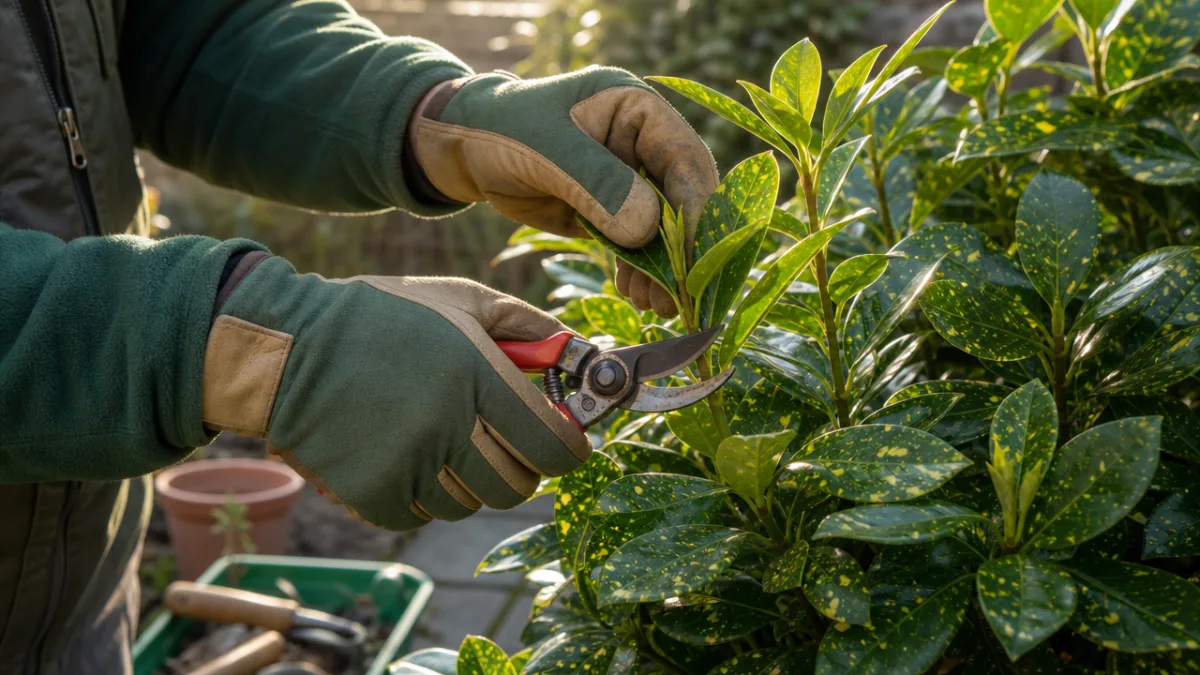
Pruning is about as straightforward as it gets with this plant. It responds well to being cut back if it’s outgrown its space, and can even tolerate quite hard pruning in late spring once the frost risk has passed. One thing to watch: try not to cut through a leaf mid-blade with your secateurs, as the cut edges tend to turn brown and look messy. It’s much better to prune just above a leaf node or take out whole branches at the base for a cleaner, more natural finish. Little and often is definitely the approach to take here rather than infrequent heavy-handed sessions.
- Choose a shaded or partially shaded position with well-drained soil before planting.
- Incorporate organic matter into the planting hole to improve soil structure and fertility.
- Water regularly throughout the first growing season to support root establishment.
- Apply a balanced slow-release fertilizer each spring to encourage healthy, vibrant growth.
- Mulch annually to conserve moisture, suppress weeds, and enrich the soil over time.
- Prune lightly in late spring to maintain shape, cutting cleanly above leaf nodes.
Aucuba Japonica in Garden Design: Creative Uses and Combinations
There’s more to Aucuba japonica than just its practical strengths — it’s a genuinely beautiful plant with a lot of design potential that’s easy to underestimate. Those large, high-gloss leaves bring a sense of lushness and almost tropical richness that you rarely get from other hardy evergreens. In a shaded planting scheme, the variegated forms are particularly useful because they act almost like natural mirrors, catching whatever light is available and reflecting it back into the space. The result is a brightness in dark corners that really doesn’t seem possible until you see it for yourself.
When it comes to companion plants, Aucuba japonica pairs beautifully with a wide cast of shade-loving characters. The bold, spotted foliage plays off wonderfully against the fine, feathery texture of ferns like Polystichum setiferum or Dryopteris filix-mas. Hostas, with their broad ribbed leaves in blue, green, and gold, build up a lush layered look at ground level beneath the taller Aucuba. For flowers, hellebores, astilbes, and foxgloves will bring seasonal color in the dappled light under the canopy before gracefully stepping back, leaving the evergreen shrubs to carry the garden through the quieter winter months.
Aucuba japonica is also an excellent container plant, which is great news if you have a shaded patio, courtyard, or balcony with no room for in-ground planting. Use a large, generously proportioned pot with good drainage and fill it with a quality loam-based compost. Container plants will want more frequent watering and feeding than those in the ground, but the architectural payoff is well worth the extra effort. A pair of neatly clipped Aucuba standards on either side of a front door or garden entrance makes a striking impression that works just as well in a sleek contemporary setting as it does in something more traditional.
Common Problems and How To Solve Them
Tough as it is, Aucuba japonica isn’t completely bulletproof, and knowing what to look out for will save you a lot of head-scratching. Leaf blackening is probably the most common thing people notice, and it can be triggered by a few different things — frost damage, waterlogged soil, or physical injury to stems are the usual culprits. In most cases, you can simply prune away the affected foliage, address whatever caused the problem in the first place, and the plant will bounce back with fresh healthy growth without any long-term drama.
Phytophthora root rot is more serious and worth being aware of, particularly if your soil drains slowly or you’ve had a very wet spell. This water-borne pathogen hits the root system hard and can cause a disturbingly rapid decline — wilting, yellowing leaves, and a plant that looks poorly despite the soil being moist. Prevention really is the best approach here, since once an infection takes hold it’s very difficult to turn around. Good drainage and not overwatering are your main defences. If a plant does succumb, remove it promptly to reduce the risk of the pathogen spreading to nearby shrubs.
Container-grown plants can sometimes fall victim to vine weevil, where the larvae work away at the roots unseen below the compost surface, causing the plant above to wilt and deteriorate seemingly out of nowhere. Applying nematodes to moist compost in late summer or early autumn is a genuinely effective and environmentally friendly way to deal with them. Scale insects and adult vine weevils can also turn up on the foliage occasionally, but a plant that’s well-fed, properly watered, and growing in the right conditions is far better at shrugging off pest pressure than one that’s struggling. Keeping your Aucuba happy is really the most effective pest control strategy of all.
Why Every Shade Garden Needs Aucuba Japonica
When you add it all up, it’s hard to make a case against having at least one Aucuba japonica in any garden that deals with shade. This plant genuinely earns its keep through every season. Through the winter months it provides bold evergreen structure when most other plants have completely disappeared. Come spring, fresh new growth emerges with real energy. And by autumn, the female plants are loaded with clusters of glossy red berries that hang on well into winter, bringing both color and wildlife interest at exactly the time of year when both are most welcome.
The ecological side of things is worth a mention too. Those red berries are a significant food source for birds — thrushes and blackbirds in particular will return to them again and again through the colder months. The dense evergreen structure of a mature Aucuba also provides excellent shelter and potential nesting spots for all kinds of garden wildlife. For anyone who wants to support biodiversity without turning their garden into something purely functional, Aucuba japonica hits a really satisfying balance between looking great and doing genuine good.
Perhaps the most valuable thing about Aucuba japonica, though, is the shift in thinking it encourages. Instead of fighting your garden’s difficult conditions — battling to grow sun-lovers in deep shade, replacing tender plants that never really stood a chance — choosing this shrub means working with what you’ve got. It’s a plant that will genuinely thrive, become more beautiful as the years pass, and ask very little of you in return. For anyone whose garden time is limited and results actually matter, that’s a pretty compelling argument that’s difficult to ignore.








What do you think?
It is nice to know your opinion. Leave a comment.