










Make Your Own Homemade Bug Repellent with Simple Ingredients
Why Homemade Bug Repellents Are Worth Making
Every summer, most of us grab a bottle of bug spray off the shelf without really thinking about what we’re putting on our skin. The majority of commercial repellents rely on DEET or picaridin — synthetic chemicals that do work, but come with a real list of concerns: skin irritation, potential neurological effects with heavy use, and a not-so-great environmental footprint. Making your own bug repellent at home means you know exactly what’s going on your body, which is a pretty compelling reason on its own, especially if you have kids or you’re just more conscious about what you use.
There’s also the cost factor, which really adds up. A small bottle of store-bought repellent can run you anywhere from eight to fifteen dollars and might only last a few outings. Compare that to buying essential oils and carrier liquids in bulk — you can make dozens of batches from the same supplies, and the savings over a whole outdoor season are pretty significant, especially for families who are regularly out hiking, camping, gardening, or just hanging out in the backyard during prime mosquito hours.
And honestly? There’s something genuinely satisfying about making this stuff yourself. Being able to read every ingredient on the label — and actually know what it is — gives you a level of confidence that commercial products rarely match. Whether you’ve been into natural living for years or you’re just starting to question what’s in your everyday personal care products, homemade bug repellent is a great entry point. It’s beginner-friendly, accessible, and when you make it right, it actually works.
Understanding the Science Behind Natural Insect Repellents
Natural repellents work mainly by overwhelming or confusing the sensory receptors that mosquitoes, ticks, and other biting insects use to find you. These bugs track humans through a combination of carbon dioxide, body heat, and skin odor. Certain compounds found in plants — particularly terpenes and aldehydes in essential oils — interfere with an insect’s ability to pick up on those signals. It doesn’t kill them, but it essentially makes you invisible or unappealing to them, which is exactly what you want.
Research into natural repellent compounds has expanded a lot over the last couple of decades. Studies published in journals like the Journal of Insect Science and Malaria Journal have confirmed that compounds like citronellal, linalool, and eugenol — all found in widely available essential oils — genuinely do repel insects. Citronella is probably the most well-known, but oils like eucalyptus, lavender, peppermint, and clove have also shown real protection in controlled studies. The trick is knowing which ones to use and how to combine them well.
One thing that’s really important to understand upfront is reapplication. Natural formulas don’t last as long as synthetic options like DEET, which can hold up for eight hours. Most essential oil-based repellents need reapplying every one to three hours. That’s not a flaw — it’s just a different rhythm. Once you know that going in and plan around it, natural repellents become totally practical rather than a frustrating let-down.

Key Ingredients You Will Need
A good homemade bug repellent comes down to choosing the right base and the right active botanicals. For liquid spray formulas, most people use distilled water, witch hazel, or a light carrier oil like fractionated coconut oil, almond oil, or jojoba oil as their foundation. Witch hazel is a favorite because it acts as a natural astringent, dries quickly on the skin, and does a solid job dispersing essential oils. Distilled water works better in lighter, more refreshing formulas — great for hot weather when you don’t want anything heavy on your skin.
The actual bug-fighting work comes from the essential oils. Citronella is the cornerstone of most natural repellent recipes and gives you broad protection against mosquitoes. Lemon eucalyptus oil — specifically the variety called OLE, or oil of lemon eucalyptus — has actually been recognized by the CDC as a plant-based repellent with solid, documented efficacy. Lavender pulls double duty by both repelling bugs and soothing the bites that sneak through anyway. Peppermint is especially good against flies and gnats, while clove and thyme round out your coverage against a wider range of insects.
Beyond the oils and bases, a few optional add-ins are worth knowing about. Vegetable glycerin helps the formula cling to your skin longer. Neem oil, pressed from neem tree seeds, brings strong insecticidal properties and has been used in natural pest management for centuries — though fair warning, it has a pretty pungent smell. Vitamin E oil isn’t a repellent, but it acts as a natural preservative and is great for your skin. Keeping these on hand lets you tweak recipes as you figure out what works best for your situation.
A Quick Ingredient Reference List
- Witch hazel or distilled water — primary liquid base for spray formulas
- Fractionated coconut oil or jojoba oil — carrier oil for lotion and oil-based formulas
- Citronella essential oil — primary mosquito repellent compound
- Lemon eucalyptus essential oil — CDC-recognized plant-based repellent
- Lavender essential oil — repellent and skin-soothing properties
- Peppermint essential oil — effective against flies and gnats
- Clove and thyme essential oils — broad-spectrum insect deterrents
- Neem oil — powerful insecticidal addition for high-exposure environments
- Vegetable glycerin — improves skin adherence and longevity
- Vitamin E oil — natural preservative and skin conditioner
Step-by-Step Recipes for Every Situation
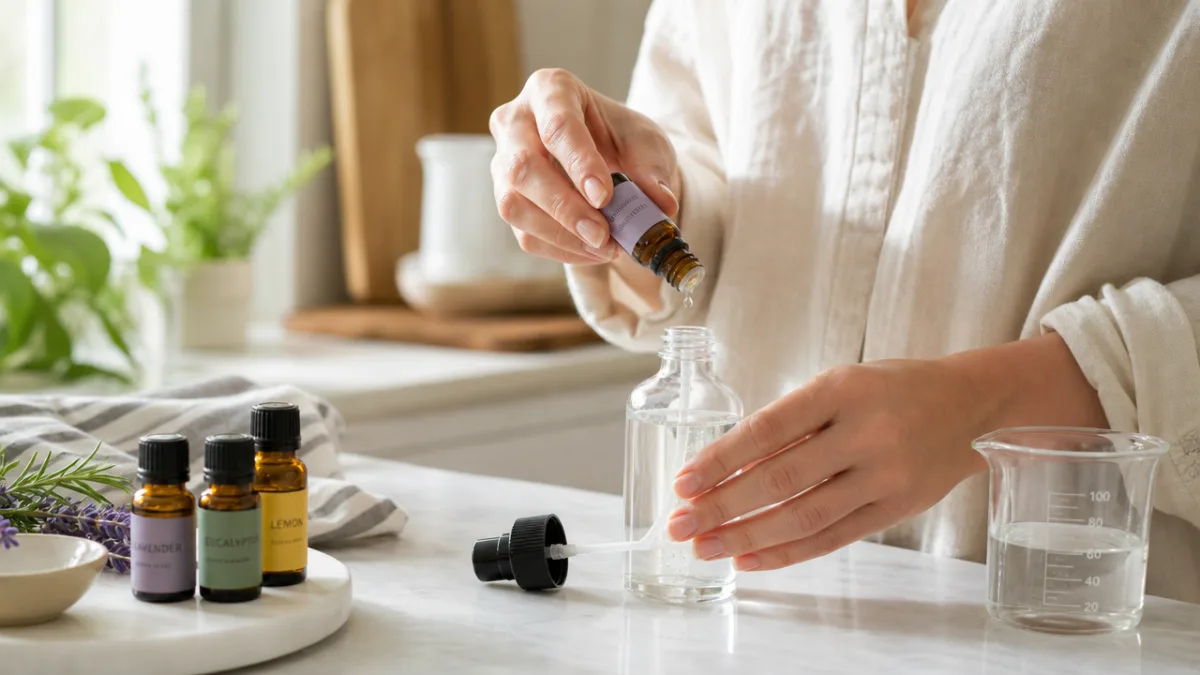
The easiest place to start is a basic witch hazel spray — it’s beginner-friendly and genuinely effective. For a standard four-ounce batch, pour three ounces of witch hazel and one ounce of distilled water into a glass spray bottle. Add fifteen drops of citronella, ten drops of lemon eucalyptus, eight drops of lavender, and five drops of peppermint. Cap it, give it a good thirty-second shake, and you’re done. Before you use it each time, shake it again, then spray onto exposed skin and clothing — just keep it away from your eyes, mouth, and any broken skin.
If you’d rather have something thicker and more moisturizing — something that holds up better in wind or humidity — an oil-based lotion formula is the way to go. Start with two tablespoons of fractionated coconut oil and one tablespoon of jojoba oil. Mix in ten drops of citronella, eight drops of lemon eucalyptus, five drops of clove, and five drops of lavender. If you have neem oil, add half a teaspoon — just know it has a strong, earthy smell that takes some getting used to. Combine everything in a small glass jar and rub a small amount into exposed skin. As a bonus, it also works as a moisturizer, so it’s especially nice if your skin tends to run dry.
For outdoor gatherings or patio spaces where you want area coverage rather than just personal protection, a diffuser blend works really well. Mix equal parts citronella, eucalyptus, and cedarwood and add twenty to thirty drops to an outdoor oil diffuser or electric wax warmer. If you’re around a campfire or bonfire, try tossing in some dried rosemary bundles or fresh sage — the smoke they release deters insects over a surprisingly wide area. Combining area-based methods like these with personal application gives you much better coverage during those peak evening hours when bugs are at their worst.
Dilution Ratios to Follow Safely
- For adults: Use a 2–3% essential oil dilution in your carrier base, which equals approximately 12–18 drops of total essential oils per one ounce of carrier.
- For children over 3 years: Use a 1% dilution — around 6 drops per ounce — and stick to lavender and lemon eucalyptus oils only, avoiding clove, peppermint, and thyme.
- For children under 3: Consult a pediatrician before applying any essential oil-based product to young children’s skin.
- For pregnant women: Avoid clove, thyme, and cinnamon oils entirely and keep dilutions at or below 1%.
- For sensitive skin: Perform a patch test on the inner forearm 24 hours before full application to check for any adverse reaction.
Tips for Maximizing Effectiveness and Safety
Even a well-made natural repellent will fall short if you’re not applying it right or storing it properly. Application technique matters more than most people expect. Instead of spritzing a mist in the air and walking through it, spray directly onto your skin from about six inches away — enough to lightly coat the area, not soak it. Make sure you hit the spots insects love most: ankles, wrists, the back of the neck, and behind the knees. Spraying a bit more generously on clothing also extends your protective barrier beyond skin coverage alone.
Storage is something a lot of people overlook, but it really affects how well your repellent holds up. Essential oils are volatile — they break down with exposure to heat, light, and air. Always use a dark glass bottle (amber or cobalt blue are ideal) and keep your repellent somewhere cool and dark, away from sunlight. A bathroom cabinet works great at home; a small cooler does the job while camping. Witch hazel-based sprays generally stay effective for up to three months, and oil-based versions last a bit longer if you’ve added vitamin E. Get in the habit of dating each batch so you always know when it’s time to mix up a fresh one.
It also helps to think of your repellent as one layer of a bigger strategy rather than your only line of defense. Wearing light-colored, long-sleeved clothing during dawn and dusk cuts down on exposed skin significantly. Getting rid of standing water around your home takes away mosquito breeding spots. Planting lemongrass, basil, marigolds, or catnip near your patio or seating areas creates a passive deterrent that works around the clock. When you combine these habits with a good homemade spray, you end up with genuinely solid protection — no synthetic chemicals required.
Common Mistakes and How to Avoid Them
The most common mistake beginners make is not measuring carefully enough. Essential oils are potent, and using too much can cause skin sensitization, irritation, or an allergic reaction that makes future use a real problem. On the flip side, using too little gives you something that smells nice but doesn’t actually do much. Pick up a small set of measuring spoons and a pipette or dropper for your oils. It takes an extra couple of minutes, but accurate measurements make a huge difference in both safety and how well the formula actually works.
Another thing people frequently skip is shaking before each use. Water-based and witch hazel-based repellents aren’t emulsified, meaning the essential oils naturally separate and float to the top between applications. If you spray without shaking, you’re essentially just applying plain witch hazel with almost no repellent in it. Some people add a small amount of polysorbate 80 or castile soap to help everything stay blended a little longer, but even then, shaking is still good practice. A quick ten seconds before every application makes sure you’re getting a consistent, properly dosed spray each time.
Finally, a lot of first-timers pick their essential oils based on what smells good rather than what actually repels insects. That’s understandable — you want something you’ll enjoy wearing — but if you fill your formula with oils like sweet orange or ylang ylang without anchoring it in proven repellents like citronella, lemon eucalyptus, or lavender, you’ll end up with a lovely-smelling spray that doesn’t do its job. The sweet spot is a formula that smells good enough that you actually reach for it, but is built around oils with real, documented insect-deterring properties. Get that balance right, and making your own bug repellent turns out to be one of the most satisfying and genuinely useful DIY projects you can take on.








What do you think?
It is nice to know your opinion. Leave a comment.