










Ulysses on Rubber Gloves: The Extraordinary Art of Transcribing Joyce’s Masterpiece
The Intersection of Literature and the Unexpected
James Joyce’s Ulysses is about as ambitious as novels get. Published in 1922, it follows Leopold Bloom and Stephen Dedalus through a single day in Dublin — interior monologues, stream-of-consciousness tangents, classical allusions stacked on top of each other — and scholars have been untangling it ever since. By any measure, it’s a towering achievement. Which makes it all the more strange, and somehow perfect, that someone decided to transcribe the entire thing onto rubber gloves.
The Pinterest pin that brought this to wider attention — titled simply “All of Ulysses transcribed on rubber gloves???” — perfectly captures a certain kind of contemporary art: the kind that loves crashing the highbrow into the mundane. Rubber gloves are objects of pure utility. Dishwashers wear them, surgeons wear them, people cleaning their bathrooms wear them. And yet here is Joyce’s 265,000-word masterpiece, written across their surfaces. The conceptual collision is so sharp it almost feels obvious in hindsight, the way the best ideas usually do once someone else has already had them.
What makes this project so immediately grabbing isn’t just the sheer nerve of it — it’s the questions that start bubbling up once you’ve had your second look. What does it mean to carry great literature on your hands? Does writing the words out transform the text, or does the text transform the object? Is this reverence, desecration, absurdist humor, or some weird combination of all three? Good conceptual art tends to refuse clean answers, and this rubber-glove Ulysses earns its place in a long line of provocative, conversation-starting artistic gestures by doing exactly that.
The Tradition of Conceptual Text Art
To really get what a project like this is doing, it helps to know a bit about where text-based and conceptual art has been. At least since the early twentieth century, artists have been interested in language not just as something that carries meaning, but as a visual and physical thing in its own right. The Dadaists cut up newspapers and reassembled them into poems. The Fluxus movement in the 1960s treated instructions and actions as legitimate art forms. Over and over, text has been pulled off the page and placed into stranger, more physical situations.
Ed Ruscha spent much of his career painting words — “HOLLYWOOD,” “OOF” — with the same weight and care you’d give a landscape. Jenny Holzer projected political and poetic texts onto the sides of buildings, insisting that language could physically occupy space. Kenneth Goldsmith retyped an entire edition of the New York Times and called it conceptual poetry. In each case, the move was the same: take text out of its native habitat, put it somewhere unexpected, and watch new meaning emerge from the friction.
Transcribing Ulysses onto rubber gloves fits right into that tradition — but it also does something all its own. The material choice isn’t random. Rubber gloves are about protection, about putting a barrier between your hand and whatever you’re touching. There’s something philosophically interesting about placing a novel so obsessed with interiority — with the raw, unfiltered flow of human consciousness — onto an object literally designed to prevent direct contact. Joyce wanted to get inside everything. The glove is built to keep things out.
Joyce’s Ulysses: Why This Book in Particular
The choice of Ulysses specifically seems far from accidental, and it’s worth sitting with. Joyce’s novel isn’t just long and hard — it has an unusual relationship with physical endurance. People describe reading it in athletic terms: a feat, a marathon, a mountain. Plenty of readers abandon it partway through. Plenty of others carry it around for years, dipping in and out, treating it less like a book to be finished and more like a place to be explored. It actively resists being conquered.
Then there’s the body. Ulysses is one of the most thoroughly physical novels in the Western canon. Joyce was fascinated by digestion, by desire, by the smell of food and the ache of tired feet and the particular feeling of walking through a city. Leopold Bloom eats a kidney for breakfast, attends a funeral, ducks into an outhouse, and — in the novel’s most infamous chapter — masturbates on a beach. The book insists on the physicality of being human in a way that felt scandalous in 1922 and still feels startlingly frank today. Writing all that onto rubber gloves — something worn on a body, touching things, doing work — amplifies that physical dimension in ways you don’t quite expect.
And Ulysses has always had a complicated relationship with simply existing in the world. It was banned in the United States for obscenity. Copies were burned. Its publication history is a story of smuggling and legal battles. The book has spent its whole life fighting for the right to be read. There’s a faint echo of that history in the idea of inscribing it on something as humble as a rubber glove — as if sneaking the text into ordinary life through the back door of domestic labor.
The Art of the Transcription Itself
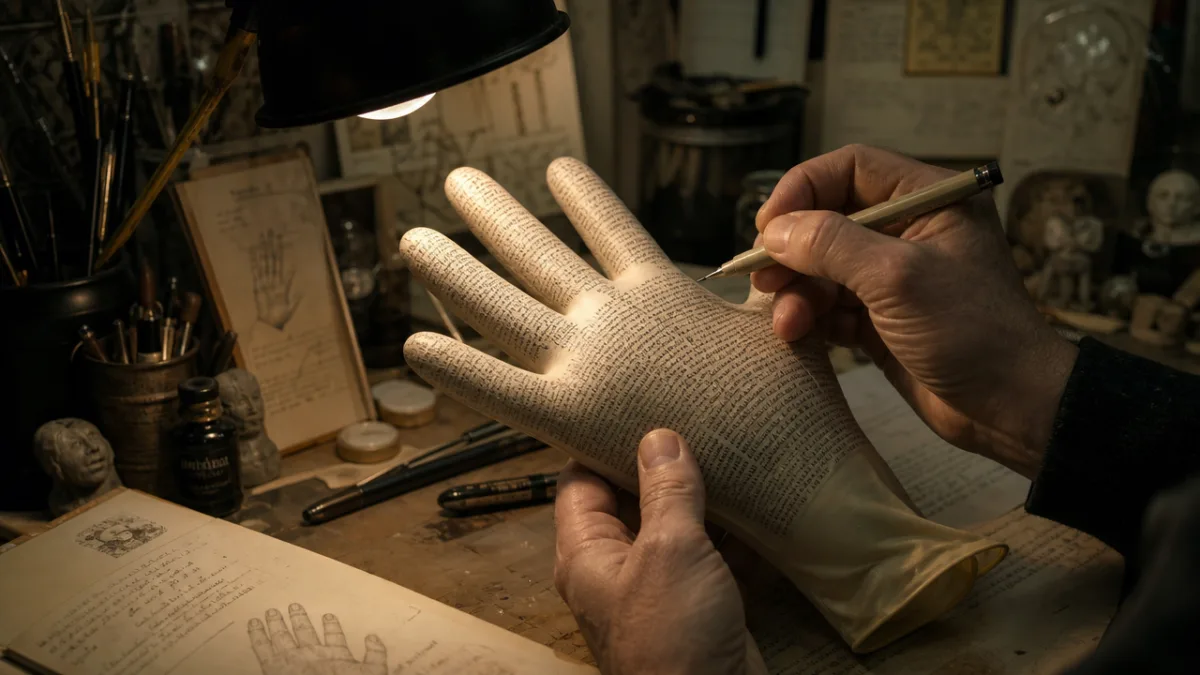
Whatever you make of the concept, the sheer physical labor involved here is worth stopping to acknowledge. Ulysses is roughly 265,000 words. Writing all of them by hand, in what must be tiny script, on the curved and uncooperative surface of a rubber glove — that’s a commitment that’s hard to fully wrap your head around. Even if you’re writing at a brisk 30 words per minute without stopping, you’re looking at nearly 150 hours of pure writing time. In practice, it would take much, much longer.
Writing on rubber is genuinely difficult. The surface flexes, it doesn’t absorb ink the way paper does, and ordinary pen ink tends to bead up and smear. The artist would have needed to figure out the right tools — fine-tipped paint pens, permanent markers, something specialized — and then deal with the fact that the gloves shift and stretch with every movement, making precise lettering a constant battle. Every finished glove represents not just hours of writing but hours of problem-solving, of figuring out how to make language actually stick to something that doesn’t want to hold it.
That stubborn persistence is itself part of the meaning. There’s a long tradition of durational or labor-intensive art — work that gets part of its power from the visible evidence of how much time and effort went into making it. Yoko Ono’s instruction pieces, On Kawara’s date paintings, Roman Opalka’s lifelong project of painting sequential numbers: these are works where the duration of making can’t be separated from what the finished object means. Transcribing Ulysses onto rubber gloves belongs in that company. The labor is the message, or at least a big part of it.
- Estimated word count of Ulysses: approximately 265,000 words
- At 30 words per minute, minimum writing time: roughly 147 hours
- Number of chapters in Ulysses: 18 episodes, each with a distinct style
- Challenges of the surface: flexibility, ink adhesion, curvature, and distortion
- Materials likely required: permanent fine-tip markers or specialized paint pens
Humor, Absurdism, and the Serious Business of Silliness
It would be a mistake to ignore the humor here — and an equal mistake to treat it as somehow less serious than everything else going on. That Pinterest title, with its three cascading question marks, nails the spirit of delighted disbelief this project produces. There’s something genuinely, deeply funny about someone transcribing all of Ulysses onto rubber gloves. The mismatch between form and content is so total, so complete, that laughter is one of the most honest reactions you can have.
Absurdist humor like this has a real intellectual tradition behind it. The Dadaists knew that nonsense could be a form of critique — that laughter could knock over assumptions that earnestness couldn’t budge. Monty Python built whole careers on what happens when you place something ancient and august (the Holy Grail, the Spanish Inquisition) right next to the mundane and the ridiculous. The rubber-glove Ulysses works the same way. The joke isn’t that Joyce is being disrespected. The joke is that smashing these two things together — towering modernist literature and disposable household rubber — produces a kind of conceptual short circuit that illuminates both of them.
But the humor is genuinely inseparable from admiration. Anyone who’s spent real time with Ulysses knows how formidable it is, how much it demands. The person who transcribed every word of it — regardless of what they wrote on — has an intimacy with that text most readers will never reach. There’s real reverence hiding inside the apparent absurdity. The glove is humble; the act of covering it in every word of one of the most demanding novels ever written is not. This is art that holds seriousness and silliness in the same hand — which is, when you think about it, exactly where hands are most useful.
What This Project Means in the Age of Viral Culture
The fact that this surfaced as a Pinterest pin — with that string of question marks and everything — says something real about the moment we’re living in and how unusual creative work travels through it. Social media has built an environment where strange, hard-to-categorize things can move from niche discovery to widespread fascination almost overnight. Something that might once have been seen only by gallery visitors or readers of a specific art magazine can now reach millions of people who stumble across it between a banana bread recipe and a home décor idea.
That’s genuinely valuable. Conceptual art has historically had a hard time finding audiences outside specialized art contexts, and this kind of circulation gives it a shot at the viewership it often deserves. The rubber-glove Ulysses is perfectly suited to the viral moment: it’s visually striking, conceptually rich, immediately graspable in its broad outlines, and endlessly discussable. People who’ve never read Joyce can appreciate the ambition and strangeness of the project. People who have read Joyce get an extra layer of recognition and delight on top of that.
At the same time, going viral tends to flatten things. A project gets reduced to a single image and a caption, optimized for a reaction — amazement, laughter, incredulity — rather than deeper engagement. This isn’t a criticism specific to this project; it’s just how attention works online. The challenge for anyone who encounters this through a pin or a post is to let that first reaction be a starting point rather than the whole experience. Let the question marks in the title open into actual questions, rather than closing into mere exclamation points.
- Encounter the work with genuine curiosity, not just amusement.
- Consider what the choice of Ulysses specifically contributes to the meaning.
- Reflect on the labor involved and what it says about dedication and obsession.
- Think about the material qualities of rubber gloves and what they add.
- Ask what the work does that a straight reading of the novel cannot.
The Deeper Questions Art Like This Asks Us
What ultimately makes the rubber-glove Ulysses worth thinking about seriously is the cluster of real philosophical questions it raises about text, objects, labor, and meaning. When we ask what Ulysses “is,” we usually mean the novel — the words in the order Joyce intended. But that arrangement exists across thousands of physical forms: hardcovers, paperbacks, digital texts, audiobooks, scholarly editions with footnotes. Each one is a different object, and each object shapes the experience of reading in ways we rarely stop to notice. The rubber-glove version shoves that normally invisible question into the foreground by making the container so startlingly wrong.
There’s also something worth sitting with in the question of what it means to truly possess a text — to have it, to hold it, to carry it. We talk casually about “having read” a book, as if the encounter leaves some kind of residue. But the person who wrote out every word of Ulysses by hand has had an encounter with it of a completely different magnitude. They’ve touched each word personally, in sequence, giving it physical form through their own effort. That’s closer to a medieval monk copying scripture in a scriptorium than it is to reading a Penguin Classic on the subway. There’s something almost liturgical about it — devotion expressed through repetitive physical work.
And finally, the project asks what great literature is actually for. The standard answers are education, empathy, aesthetic pleasure, cultural transmission. But art like this suggests another possibility: that great literature can also be raw material, a provocation, something to be done something with rather than simply received. Joyce himself wasn’t a passive receiver of tradition — he took Homer’s Odyssey and turned it inside out, set it in Dublin, ran it through the minds of ordinary people eating breakfast and walking to work. The rubber-glove Ulysses is doing something analogous: taking what Joyce built and putting it somewhere new, somewhere strange, and asking what survives the journey. As it turns out, quite a lot does.








What do you think?
It is nice to know your opinion. Leave a comment.