










SWAN II: The Art of Form, Function, and Sculptural Elegance in Contemporary Candle Holders
Introduction: Where Sculpture Meets Utility
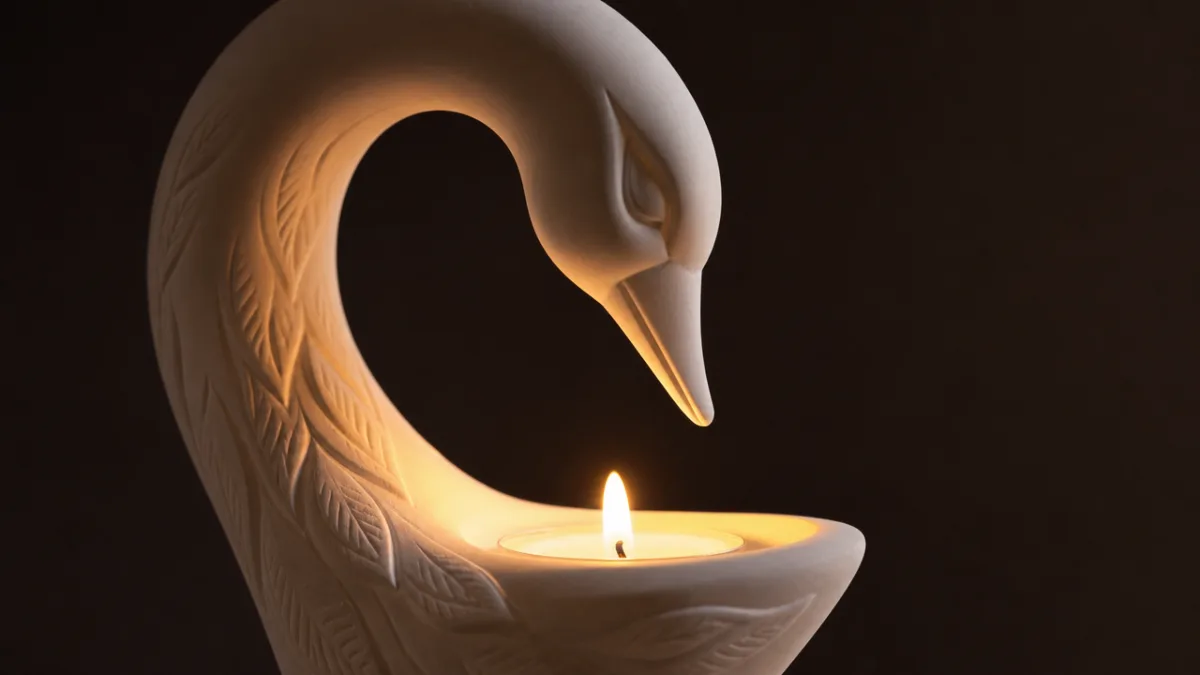
In the evolving landscape of contemporary decorative arts, few objects manage to occupy the precise intersection of fine art and functional design with as much grace as the SWAN II candle holder sculpture by Aleksandra Krasnopolska. Available through Saatchi Art Spain, this extraordinary piece challenges our conventional understanding of what a candle holder can be, transforming a utilitarian object into something worthy of prolonged contemplation. It is not merely a vessel for light — it is a statement about the relationship between negative space, organic form, and the quiet drama of shadow and flame.
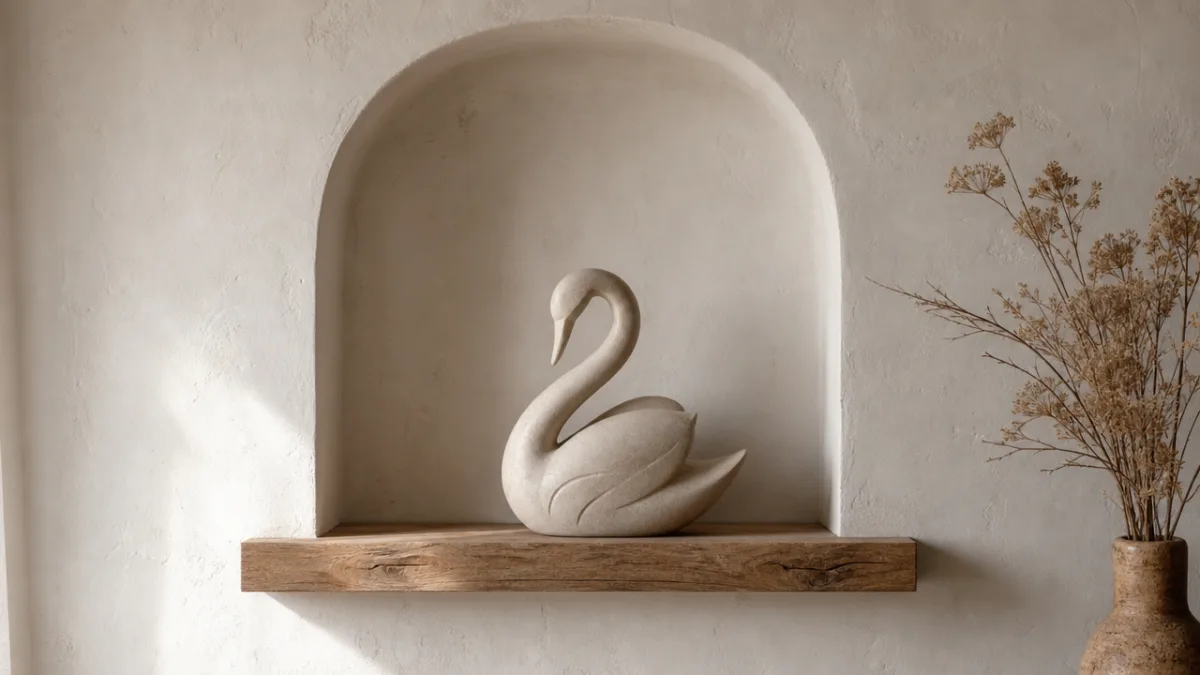
The work arrives at a moment when collectors and interior designers alike are increasingly seeking objects that serve dual purposes: pieces that earn their place in a living space not through decoration alone, but through a kind of philosophical weight. Krasnopolska’s SWAN II does exactly this. Its sculptural silhouette evokes the iconic curve of a swan’s neck, that breathtaking arc of tension and release that has captivated artists from ancient Greece to Romantic-era painters. Yet here, the reference is distilled, abstracted, and made newly urgent through the vocabulary of contemporary ceramics or sculpture.
What follows is an exploration of SWAN II as an object, an idea, and a window into the broader world of artist-made functional sculpture. We will examine Aleksandra Krasnopolska’s creative vision, the long artistic tradition of swan imagery, the role of candle holders in interior design history, and what it means today to collect works that blur the boundary between gallery and home. This article is an invitation to look more carefully at the objects we live with — and to understand why some of them matter deeply.
Aleksandra Krasnopolska: An Artist Working at the Edge of Form
Aleksandra Krasnopolska is a sculptor whose practice engages deeply with organic form and the expressive potential of material. Working across ceramics, mixed media, and sculptural assemblage, she creates objects that feel simultaneously ancient and strikingly modern. Her approach is rooted in a sensitivity to the way natural shapes carry emotional resonance — a curve can suggest vulnerability, a vertical thrust can imply ambition, and a carefully balanced composition can embody stillness. In the SWAN II, all of these qualities converge into a single, deceptively simple object.
Her work reflects a broader European tradition of artist-craftspeople who refuse the distinction between the fine and applied arts. In Poland, where design culture has long intersected with a rich tradition of folk craft and modernist experimentation, artists like Krasnopolska inherit a complex visual language. Polish design of the twentieth century was marked by an ability to find beauty within constraint — to make objects of genuine elegance with limited materials and under ideological pressure. This history inflects her work with a certain resourcefulness and a commitment to meaning over mere aesthetics.
Through Saatchi Art Spain, Krasnopolska’s work reaches an international audience of collectors who are actively looking beyond conventional gallery offerings. Saatchi Art has long positioned itself as a platform for discovering emerging and mid-career artists whose work might otherwise remain invisible to mainstream art markets. For Krasnopolska, this visibility matters enormously. It places her sculptural candle holders in conversation with painting, photography, and large-scale installation — reminding collectors that the objects on their tables and shelves can carry the same conceptual depth as anything hung on a wall.
The SWAN II specifically represents a refinement of ideas Krasnopolska has been developing across her practice. It is not a first attempt but a second iteration — a fact signaled by the title itself — suggesting a rigorous creative process of revision and deepening. Artists who number their works in this way are communicating something important: that they are engaged in an ongoing dialogue with a form or idea, returning to it with fresh eyes and earned understanding. The “II” invites the viewer to imagine the first swan, to wonder what changed, and to appreciate the deliberateness of every decision in the version that survived.
The Swan as Symbol: A History of Artistic Meaning
The swan has occupied a privileged position in the symbolic imagination of cultures across the world for thousands of years. In Greek mythology, Zeus transformed himself into a swan to approach Leda, making the bird a vessel for divine power and erotic force. In Norse tradition, the Valkyries were sometimes described as swan-maidens, capable of removing their feathered forms to walk among humans. In Celtic lore, swans were associated with the souls of the dead and with music — a connection that would persist into the Romantic era and beyond, culminating in the myth of the “swan song,” the final beautiful utterance made just before death.
In the visual arts, swans have attracted painters, sculptors, and decorative artists precisely because of their formal qualities as much as their symbolic charge. The arc of a swan’s neck is one of nature’s most mathematically perfect curves — it follows an S-shape that is inherently dynamic, suggesting motion even in stillness. This curve has been celebrated in the sinuous lines of Art Nouveau, rendered in silver and gold by Art Deco jewelers, and explored in the abstract sculptures of Brancusi, whose famous series of bird forms culminated in shapes so refined they seem to have left representation entirely behind. Krasnopolska’s SWAN II belongs in this lineage, drawing on the same formal fascination while pursuing her own entirely contemporary ends.
The literary tradition of the swan is equally rich. Yeats wrote memorably of “the white rush of wings” and the cold, indifferent beauty of swans on water, seeing in them an image of pure being unconcerned with human suffering. Tchaikovsky’s Swan Lake transformed the swan into a figure of impossible longing, the body expressing what language cannot. In each case, the swan functions as a kind of mirror, reflecting back to the viewer something about beauty, transience, and the painful distance between the ideal and the real. These associations do not need to be consciously activated for them to work in SWAN II — they are embedded in the form itself, available to any viewer who allows the sculpture to resonate.
Contemporary artists working with animal imagery often navigate the risk of sentimentality or illustration — the danger of simply depicting a beautiful animal rather than using it as a vehicle for deeper inquiry. What distinguishes Krasnopolska’s approach is her commitment to abstraction. SWAN II does not represent a swan so much as it distills the essence of swan-ness into a form that holds and channels light. The candle flame, when lit, becomes part of the sculpture’s meaning — a flickering, living presence contained within a form that evokes both grace and impermanence. The work is, in this sense, a meditation on beauty itself.
Functional Sculpture and the History of the Candle Holder
The candle holder is one of humanity’s oldest designed objects. Long before electricity transformed the relationship between human beings and darkness, the management of flame was a matter of profound practical and symbolic importance. Early candle holders were simple, functional things — clay pinched into a cup shape, a spike of iron to hold a taper upright. But very quickly, human beings began to elaborate these objects, to make them beautiful, to invest them with meaning. By the time of ancient Egypt and Rome, candelabra had become markers of status and refinement, their materials and workmanship signaling the wealth and taste of their owners.
Through the medieval period, candlesticks became objects of religious significance, crafted in bronze, silver, and gold for use in liturgical settings. The elaborate pricket candlesticks of Gothic cathedrals and the elegant altar candlesticks of Renaissance churches represent some of the highest achievements of metalwork in European history. As candlelight moved from the sacred to the secular during the early modern period, the candle holder followed, becoming a staple of aristocratic and bourgeois interiors alike. By the eighteenth century, the rococo chandelier and the matching set of silver candlesticks were among the most expressive objects in any well-appointed European home.
The industrial revolution democratized candlelight and, later, electricity rendered many of these objects obsolete as functional tools. But this obsolescence paradoxically freed the candle holder to become something else entirely: a purely expressive object, chosen not for necessity but for the quality of experience it creates. Today, lighting a candle is an intentional act — a choice to slow down, to create atmosphere, to mark an occasion as worthy of a different quality of attention. The candle holder that holds that flame therefore carries a new kind of weight, as a curator of mood and a signal of aesthetic values.
Artist-made candle holders like SWAN II occupy the most elevated position in this contemporary context. They bring together the long history of the object’s symbolic charge with the creative authority of a named, exhibiting artist. When you place SWAN II on a table and light the candle it holds, you are not merely illuminating a room — you are activating a work of art, participating in a ritual that connects you to every person who has ever gathered around a flame and experienced the particular quality of attention that flickering light demands. The sculptor has designed this participation into the work itself.
Collecting Artist-Made Objects: The Case for Functional Art
The decision to collect functional art — objects made by artists that also serve a practical purpose — is one of the most interesting choices available to contemporary collectors. It raises questions that purely decorative collecting does not: How do you relate to a work of art that you also use? Does function diminish the aesthetic experience, or does it deepen it? When you handle an artist-made object daily, do you see it more clearly or begin to take it for granted? These are genuine philosophical questions, and the answers different collectors arrive at reveal a great deal about their relationship to art-making and to domestic life.
The art market has long maintained a hierarchy in which painting and sculpture sit above craft and design. This hierarchy is increasingly challenged — by the ceramics revival of recent decades, by the renewed critical attention to craft traditions from non-Western cultures, and by artists like Krasnopolska who simply refuse to accept the distinction as meaningful. The work of a ceramic sculptor who makes vessels, or a metalsmith who makes jewelry, or a furniture maker who treats each piece as a unique sculptural statement — all of these challenge the assumption that usefulness diminishes artistic value. In many traditions, including Japanese wabi-sabi aesthetics and the British Arts and Crafts movement, daily-use objects made with full artistic commitment are considered the highest form of creative achievement.
Platforms like Saatchi Art Spain play an important role in this cultural shift by presenting functional sculpture alongside more conventional art forms without apology or hierarchical framing. When SWAN II appears on Saatchi Art alongside paintings and photographs priced in similar ranges and presented with the same degree of critical seriousness, it signals that the platform — and by extension the broader market it represents — takes functional art seriously as a category. For collectors who are building environments rather than simply accumulating objects, this is enormously valuable. It gives them permission to trust their own responses to objects that they want to live with and use.
There are also practical advantages to collecting functional art that are rarely discussed in more rarefied collecting circles. Works like SWAN II are designed to be lived with — they do not require climate-controlled storage or special insurance riders or the anxiety of fragility that accompanies many works on paper or canvas. They earn their keep in a household by generating daily beauty, by starting conversations, by marking the quality of care that a person brings to their domestic environment. This is a form of value that the traditional art market has difficulty pricing, but that collectors who live with such objects understand intuitively and deeply.
Interior Design and the Art of Sculptural Lighting
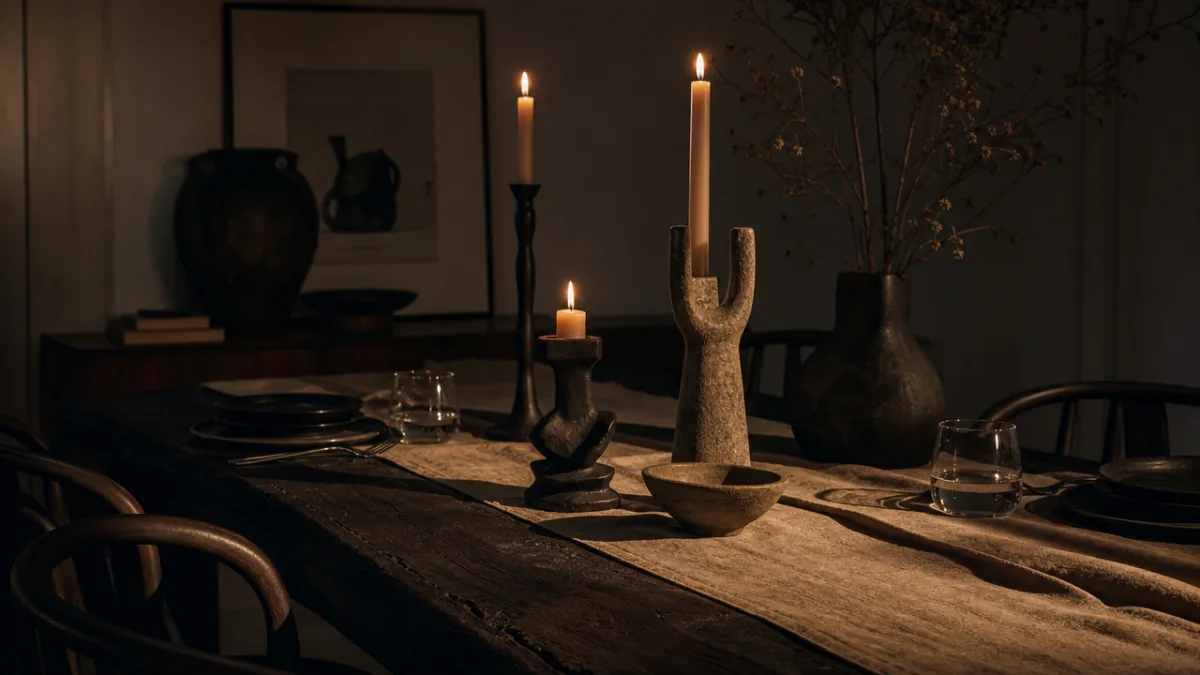
Interior design at its most sophisticated is not about filling rooms with beautiful things but about curating experiences — controlling the way light falls, the way the eye moves through a space, the way objects create dialogue with one another and with the architecture they inhabit. Sculptural candle holders like SWAN II participate in this project at multiple levels simultaneously. They are objects with visual presence in daylight, when they read as sculpture. They are light sources when the candle is lit, casting shadows and warmth that transform the room around them. And they are focal points that organize attention and set the mood for everything that happens in their vicinity.
The current moment in interior design is marked by a strong reaction against mass-produced, algorithmically optimized aesthetics. After more than a decade of “Instagram interiors” featuring identical arrangements of identical objects sourced from the same small number of global retailers, a significant segment of design-conscious consumers is actively seeking the handmade, the unique, and the artist-made. This shift has been good for artists like Krasnopolska, whose work offers exactly the kind of irreducible individuality that no factory can replicate. Each SWAN II is a singular object — shaped, finished, and signed by a specific human hand with a specific artistic vision. This singularity is visible in the work and communicates itself unmistakably to anyone who encounters it in a room.
From a purely compositional standpoint, sculptural candle holders serve several important functions in interior design. They provide vertical interest without the commitment of a large floor sculpture. They introduce organic form into environments that might otherwise feel too geometric or hard-edged. They allow for the introduction of candlelight — the warmest, most flattering, and most psychologically soothing light source available — without requiring fixed infrastructure or permanent installation. And they travel: unlike a chandelier or a built-in sconce, a sculptural candle holder can move with you, adapting to new spaces and new arrangements as your life evolves.
- Sculptural candle holders offer dual functionality as both art objects and light sources, making them among the most versatile investments available to the design-conscious collector.
- Artist-made pieces like SWAN II introduce handmade quality and singularity into domestic spaces that might otherwise be dominated by mass-produced goods, creating environments that feel genuinely personal.
- The warm, flickering quality of candlelight transforms a space in ways that no electric source can replicate, softening architectural lines and creating an atmosphere of intimacy and intention.
- Collecting functional sculpture supports living artists directly, making it one of the most impactful forms of arts patronage available to individuals without institutional resources.
- Objects chosen for their dual artistic and functional value tend to become some of the most deeply cherished possessions in any collection, combining emotional resonance with daily utility.
Conclusion: The Quiet Radicalism of Beautiful Objects
There is something quietly radical about an artist who chooses to make candle holders. In an art world that often privileges scale, spectacle, and conceptual complexity legible from a press release, the decision to work at the scale of the hand, to make something intimate and functional and beautiful, is a kind of counter-statement. Krasnopolska’s SWAN II asserts that art does not need to overwhelm in order to matter — that a single graceful form, holding a single flame, can create a quality of presence and meaning that larger, louder works sometimes fail to achieve. This is the quiet radicalism of beautiful objects made with full artistic commitment.
For anyone considering adding SWAN II to their collection or their home, the most important thing to understand is that what you are acquiring is not simply a candle holder but a relationship — with the artist, with the form, with the long tradition of human beings using art to make the experience of daily life more meaningful. Every time you light the candle in SWAN II, you are participating in that tradition. You are choosing, in the face of all the noise and convenience of the modern world, to slow down, to attend carefully, to honor the particular quality of beauty that a sculptor has worked to distill into a form that fits in the palm of your hand.
The swan as symbol has always been associated with a beauty that carries within it the knowledge of its own impermanence. The flame in SWAN II is exactly this — gorgeous, warming, alive, and temporary. When it gutters out, you are left with the sculpture in darkness, and even then it holds its grace. This is what the best art does: it remains significant across different conditions, different lights, different moods and moments. Krasnopolska has made something that rewards returning to, that changes as you change, that will hold its meaning long after the last candle has burned down to nothing.
Saatchi Art Spain’s presentation of SWAN II is a reminder that great art can come from unexpected directions and exist in unexpected forms. The platform’s commitment to making contemporary art accessible — to presenting the work of artists like Krasnopolska alongside more established names and more conventional formats — reflects a genuinely democratic vision of what collecting can be and who it is for. You do not need a mansion or a museum to live with meaningful art. You need only the willingness to look carefully and the courage to bring home the things that move you. SWAN II is exactly this kind of invitation: extended in the most elegant possible form, shaped like a swan, ready to hold your light.








What do you think?
It is nice to know your opinion. Leave a comment.