










The Art of Repair: Mindful Mending, How to Stitch Old Things to New Life
The Lost Language of Repair
Not so long ago, mending was just something people did. Socks got darned by firelight, worn collars were turned inside out and restitched, and a torn hem was fixed before the garment ever saw the wardrobe again. The know-how passed from hand to hand across generations, woven into daily life as naturally as cooking or tending a garden. Fixing something broken wasn’t a chore — it was instinct. A quiet, practiced kind of care.
Then mass production happened, and somewhere in the decades that followed, that instinct started to fade. Once clothing got cheap enough to toss without a second thought, the needle and thread lost their urgency. The mending basket vanished from the corner of the sitting room. Words like darning, patching, whipstitching, and running stitch became the territory of a shrinking few rather than common knowledge. We traded longevity for convenience, and in doing so, quietly cut a thread that had tied us to our things in a way that actually meant something.
But something is shifting now. A growing wave of makers, textile artists, and perfectly ordinary people are picking up needles with fresh purpose. They’re finding that repair isn’t a step back into scarcity — it’s a step forward into something richer: a more conscious, more connected way of living with the things you own. Mending is having a real moment, and it’s bringing a whole philosophy along with it that goes far deeper than any single seam.
Kintsugi, Sashiko, and the Philosophy of Visible Repair
To really understand mindful mending, it helps to look eastward. The Japanese art of kintsugi — literally “golden joinery” — repairs broken pottery with lacquer mixed with gold, silver, or platinum. Rather than hiding the cracks, kintsugi puts them front and center. The idea behind it is quietly profound: breakage and repair aren’t things to be ashamed of. They’re part of an object’s story, and they deserve to be honored rather than concealed. A kintsugi bowl isn’t diminished by its fractures. It’s made more beautiful by them.
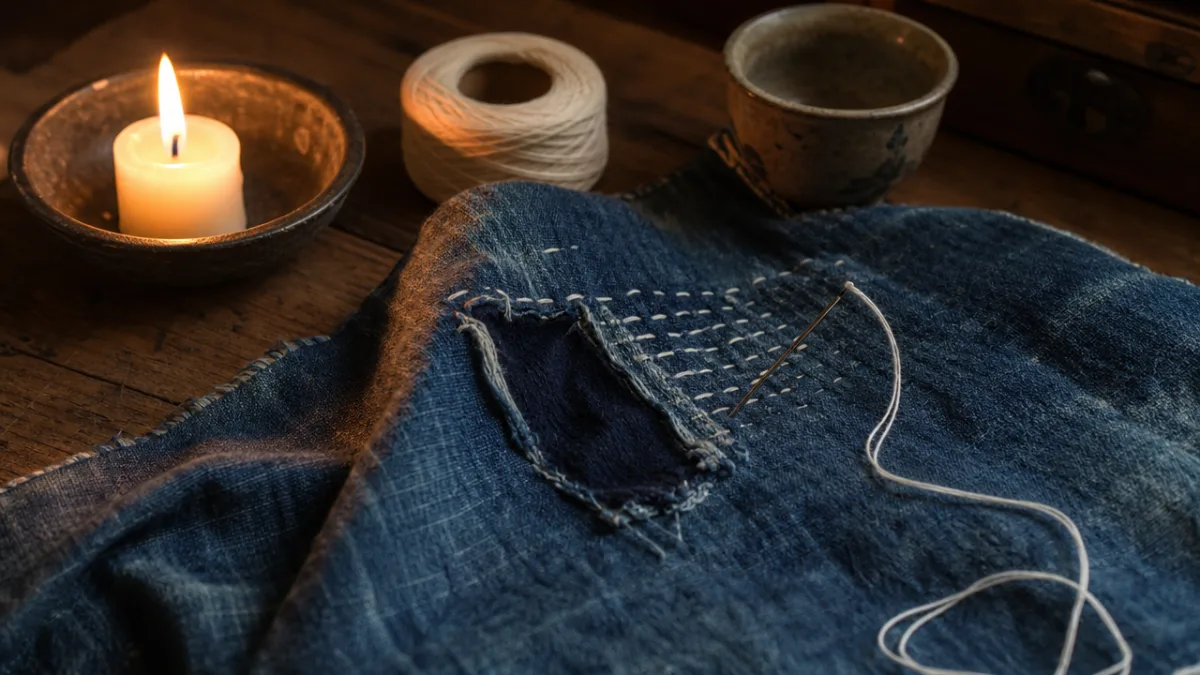
Sashiko, a form of Japanese embroidery originally used to reinforce and repair fabric, works from a similarly elegant place. Born in rural Japan as a way to strengthen worn-out clothing and bedding, sashiko uses simple running stitches in geometric patterns to bind layers of cloth together. What started as pure practicality became an art form with striking visual power. The repairs weren’t tucked away under matching thread — they were done in contrasting white on indigo cloth, quietly announcing themselves with pride. Every pattern said: this garment was loved enough to take care of.
Both traditions offer a counterpoint to the modern urge to make repairs invisible — to fix something so thoroughly that it looks like nothing ever went wrong. Mindful mending asks a different question altogether: what if the evidence of care were beautiful in itself? What if the stitching that saved a beloved shirt from the bin became part of its character, a mark of its ongoing life? That reframe turns repair from a remedial task into a creative one, and it changes how you see the objects that carry your history.
Gathering Your Mending Practice: Tools and Mindset
Starting a mending practice doesn’t take much. Honestly, one of the quiet pleasures of this craft is how little it asks of you in terms of materials. A basic kit is just a handful of needles in different sizes, a small sharp pair of scissors, a thimble, and some thread in colors that work with your wardrobe. Beyond the basics, a darning mushroom or egg — that smooth, dome-shaped tool that holds fabric taut while you work — is genuinely worth having for socks and knits, giving you a firm surface to stitch across without puckering everything up.
Thread is where things get interesting. Embroidery floss comes in hundreds of colors and separates easily into individual strands for finer work, making it a favorite for menders who want their repairs to be as decorative as they are functional. Sashiko thread is thicker and more matte, producing wonderfully visible stitches with a real tactile presence. For repairs you’d rather not see, a fine thread matched carefully to the original fabric is still the classic go-to. Over time, most menders build up a little archive of colors, and there’s something genuinely satisfying about finding exactly the right shade for a repair you’ve already pictured in your head.
But the mindset you bring to the mending basket matters just as much as what’s in it. Mindful mending is, at its core, an act of presence. Unlike most modern tasks that reward speed and multitasking, hand stitching is slow by nature. It asks you to sit still, look closely, move deliberately. A lot of people describe it as meditative — the repetition of a running stitch, the gentle pull of thread through fabric, the gradual emergence of a pattern. Even carving out thirty minutes a week for mending can become a meaningful ritual, a pocket of quiet in an otherwise relentless pace of life.
Common Repairs and How to Approach Them
Most household mending falls into a handful of familiar categories, and getting comfortable with those covers the vast majority of what you’ll actually encounter. The most common are holes and tears in woven fabric, worn-through heels and toes in knitted socks, loose or missing buttons, fraying seams, and spots that haven’t broken through yet but clearly will soon. Each one calls for a slightly different approach, but none of them is out of reach for a careful beginner who’s willing to practice.
Darning — weaving new thread across a hole to rebuild the fabric — is probably the most essential mending skill to get under your belt. You start by anchoring stitches around the edges of the damaged area, then lay parallel threads across the gap, and finally weave a second set of threads perpendicular to the first, passing alternately over and under to create a woven patch right where the fabric used to be. Done well, a darn is impressively strong and, in knitted fabrics especially, can blend almost invisibly into what’s around it. Done boldly, in contrasting thread and geometric patterns, it becomes a deliberate statement.
For visible mends with a decorative bent, several techniques are well worth exploring:
- Running stitch — the foundational stitch of sashiko, worked in straight or geometric lines radiating out from a hole or weak spot to reinforce the surrounding fabric while building pattern.
- Patch mending — backing a hole with a piece of fabric on the reverse side for structural support, then embellishing the front with embroidery stitches that draw the eye and turn the repair into something worth looking at.
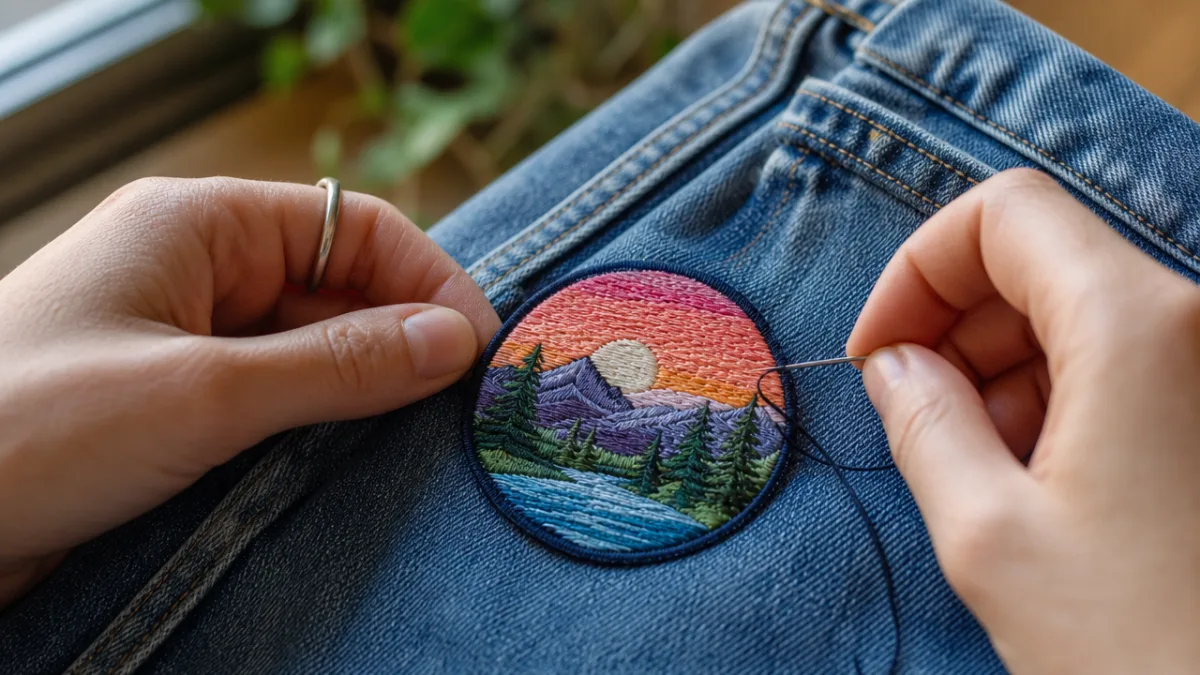
- Satin stitch — long, smooth parallel stitches that fill a shape solidly with thread, great for covering small holes or worn patches with a floral motif or abstract form.
- Chain stitch — a looped stitch that produces a textured, rope-like line, perfect for outlining shapes or creating flowing botanical designs around a repaired area.
- Weave darning — as described above, working warp and weft in thread to reconstruct lost fabric, and one of the most satisfying repairs to pull off well.
Buttons are easy to overlook until they’re gone entirely, but they really reward a little preventive attention. A button that’s started to wobble — its stitching worn thin — is much easier to resecure than to replace after it’s disappeared into the washing machine. When you reattach a button, threading through a small secondary button on the back of the fabric distributes the stress of everyday use more evenly and makes the repair last considerably longer. Taking a moment to understand why the button failed in the first place — often the thread was too fine, wound too tightly, or lacked a shank to handle the fabric’s thickness — is the kind of close attention that turns a quick fix into something that actually holds.
Mending as Environmental Act
You can’t really talk about the renewed interest in mending without acknowledging the environmental moment we’re in. Fashion is one of the most resource-intensive industries on the planet, responsible for enormous amounts of water use, chemical pollution, and textile waste. Millions of tons of clothing end up in landfill every year, much of it after an almost embarrassingly short period of use. Fast fashion has sped up the cycle of buying and throwing away to the point where the idea of a garment lasting years — let alone decades — has started to feel almost radical.
Against that backdrop, every repair is a small act of resistance. When you mend a shirt instead of replacing it, you’re extending the life of all the energy, water, labor, and raw materials that went into making it. You’re keeping one more thing out of the waste stream. On its own, that seems modest. But multiply it across millions of people choosing repair over replacement, and the impact starts to add up to something genuinely meaningful. The environmental case for mending isn’t about self-denial — it’s about recognizing the real value already embedded in the things you own, and respecting that value by taking care of them.
The idea of “cost per wear” is useful to keep in mind here. A shirt that costs fifty dollars but gets worn twice before you toss it is far more expensive — financially and environmentally — than one that costs two hundred dollars and gets worn and mended for fifteen years. Mending is an investment in a garment’s longevity, and when you look at it that way, even a time-consuming repair makes economic sense. Once you start doing the math of careful ownership, it changes how you approach both buying and letting go. To mend something is to quietly insist that it’s worth keeping.
Building a Mending Community and Passing the Skill Forward
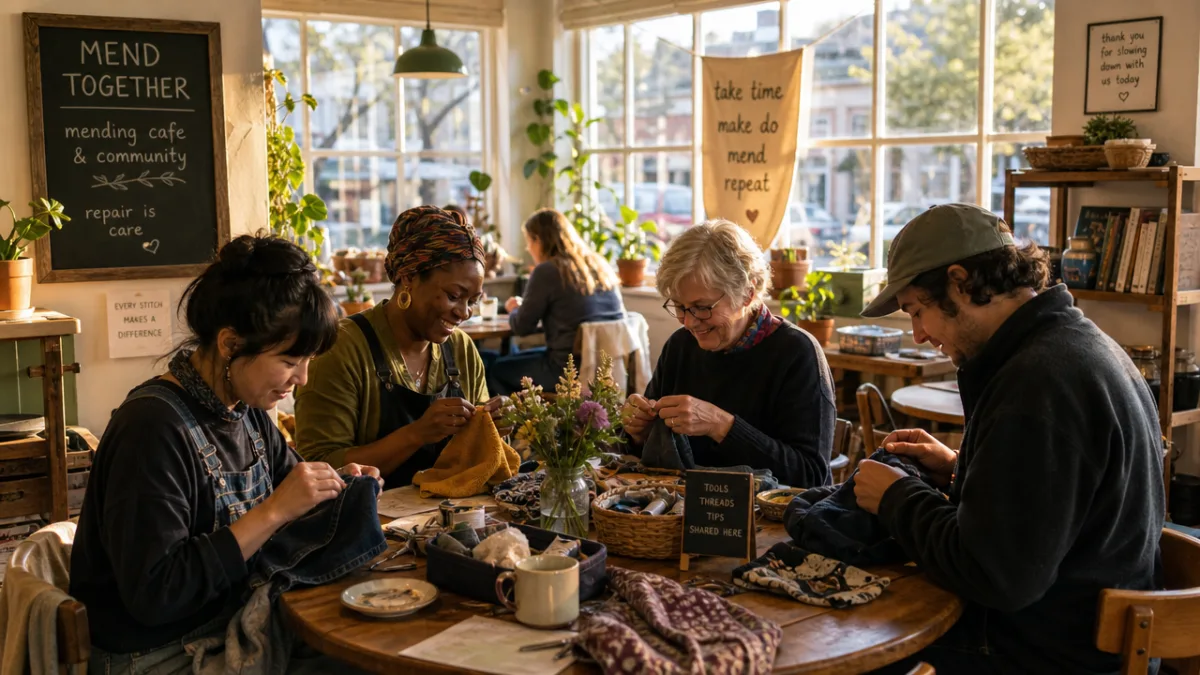
One of the most heartening things about the mending revival is how social it’s become. Mending cafes — community gatherings where people bring worn or broken items to fix with help from skilled volunteers — have popped up in cities and towns across Europe, North America, Australia, and well beyond. The setup is simple and it works beautifully: someone who knows how to fix a zip helps someone who doesn’t; a garment that might have been written off gets another life; knowledge gets shared freely across a table covered in thread and fabric scraps. By most accounts, the atmosphere is one of focused companionship and genuine quiet satisfaction.
Online communities have taken that same spirit into the digital world, with platforms like Instagram and dedicated forums hosting huge archives of visible mends, technique tutorials, and the kind of enthusiastic encouragement that makes a new skill feel actually approachable. Accounts devoted to the art of mending draw real followings, their posts showing everything from masterfully executed sashiko to charmingly imperfect first attempts at darning — all of it celebrated. That visibility matters. When repair is shown as creative, satisfying, and sometimes even beautiful, it becomes something people want to do rather than a marker of necessity or hardship.
Teaching kids to mend might be the most lasting investment in all of this. A child who learns to sew on a button or run a simple stitch across a tear grows up with a fundamentally different relationship to objects — one where damage is a problem to solve rather than a reason to throw something away. Schools and community programs in several countries have started reintroducing basic textile skills precisely because this kind of competence, once it’s lost across a generation, doesn’t just come back on its own. Hands that have never held a needle need to be taught, and the earlier that happens, the more naturally it sticks. Passing mending forward isn’t just passing on a skill — it’s passing on a way of seeing the world as something fixable.
The Deeper Meaning Stitched Between the Lines
At its core, mindful mending is about relationship — between a person and their things, between the present and the past, between a small individual gesture and its wider ripple in the world. To mend something is to make a quiet declaration that this object matters. It’s to say: the time someone spent making this wasn’t nothing. The resources that went into it weren’t nothing. My own memory of wearing this, the life I’ve lived in it, isn’t nothing. Mending is a form of attention, and attention, given with care, is its own kind of love.
There’s also something in the act of mending that speaks to a broader hunger — for slowness, for tangibility, for the satisfaction of working with your hands toward something clear and useful. In a world of frictionless digital consumption, the resistance of a needle pulling thread through cloth, the small effort of working a stitch across a darned heel, feels grounding in the most literal way. It connects you to a long line of people who sat with the same tools, the same problems, the same quiet sense of purpose. Mending is ancient. That’s not its weakness — it’s its depth.
And perhaps most importantly, mending teaches us that imperfection isn’t the end of a story but just a point within it. A garment that’s been repaired carries more narrative than a pristine one. Its patches and reinforced seams are evidence of a life lived — of use and wear and care and continuation. The visible mend, with its contrasting thread and deliberate beauty, doesn’t pretend the damage never happened. It says: something broke here, and here is where someone took the time to make it whole again. That, in the end, is what the art of repair is really about — not erasing wear, but stitching what remains into something that can be worn, and loved, a little longer.








What do you think?
It is nice to know your opinion. Leave a comment.