










What to Plant With Peonies for a Garden That Never Looks Empty
Understanding the Peony’s Role in the Garden
Peonies are among the most beloved perennials in the gardening world, offering lush, extravagant blooms that can stop anyone in their tracks. But experienced gardeners know a bittersweet truth: peonies bloom for only a few weeks each year, typically from late spring into early summer depending on your climate zone. Once those magnificent flowers fade, you’re left with a mound of attractive foliage — but little else to carry the visual excitement through the remaining months of the growing season.
The solution lies in thoughtful companion planting, the art of selecting plants that complement, support, and extend the beauty of your featured specimen. When you build a garden around peonies rather than simply planting them in isolation, you create a living tapestry that shifts and evolves throughout the year. The peony becomes an anchor, a moment of peak drama, rather than the only performer in an otherwise empty stage. Understanding this dynamic is the first step toward designing a garden that always has something to offer.
Companion planting with peonies isn’t just about aesthetics either. Certain plants can help deter pests, improve soil conditions, and even provide structural support or shade that benefits the peonies themselves. The relationship between plants in a well-designed garden bed is often mutually beneficial, creating a micro-ecosystem that is more resilient and self-sustaining than any single-species planting could ever be. This guide will walk you through the best companions to pair with your peonies at every stage of the growing season.
Spring Companions That Share the Spotlight
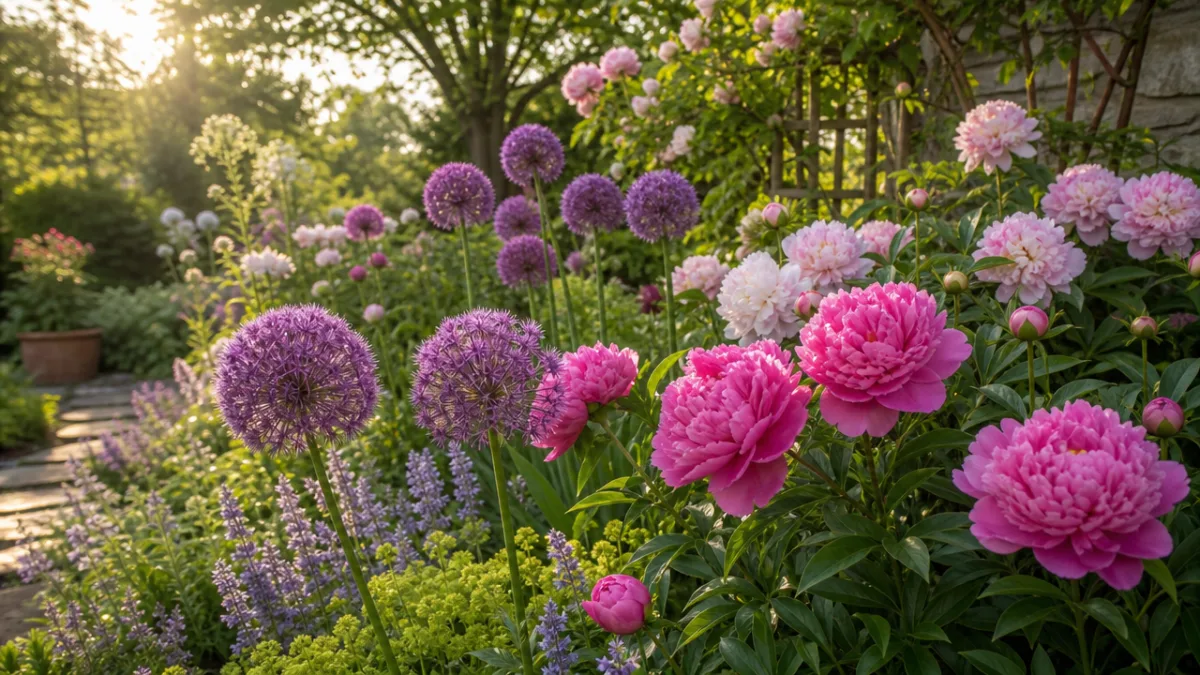
Late spring is when peonies reach their crescendo, and the best companions for this season are plants that either bloom just before or alongside them, creating a layered effect that makes the garden feel abundant and intentional. Alliums, with their spherical purple flower heads held on tall, elegant stems, are one of the finest spring partners. They bloom at roughly the same time as many mid-season peony varieties and provide a striking vertical contrast to the peony’s rounded, low-growing form. The combination of deep purple allium globes hovering above clouds of pink or white peony blooms is one of spring gardening’s most rewarding sights.
Salvia nemorosa, commonly known as woodland sage, is another outstanding spring companion. Its spiky purple-blue flower spikes echo the upright form of alliums while offering a softer, more textured look. Salvia is also an incredibly reliable bloomer, often producing flowers for weeks before the peonies even open, and then continuing well after the peony petals have dropped. Planting salvia in generous drifts around the base of your peony clumps provides a continuous carpet of color that keeps the garden from looking bare during the transitional weeks before and after peak peony bloom.
Baptisia australis, or false indigo, is a native perennial that deserves far more attention in peony gardens. It produces elegant racemes of deep indigo-blue flowers in late spring, just as peonies are beginning their show, and then forms attractive inflated seed pods that persist well into fall. Its foliage is a beautiful blue-green that remains handsome all season long, providing excellent texture and substance after its blooms fade. Baptisia grows into a large, shrub-like clump over time, making it a true structural backbone plant that gives the garden a sense of permanence and maturity.
Early Summer Bridges That Carry the Season Forward
The weeks immediately after peonies finish blooming represent the garden’s most vulnerable period. There’s often a gap where the peony foliage is present but unexciting, and gardeners who haven’t planned for this transition find themselves staring at a patch of green that seems to be waiting for something to happen. Bridging this gap with early summer bloomers is essential to maintaining visual momentum. Catmint, or Nepeta, is perhaps the single best plant for this job. Its lavender-blue flowers begin before peonies and continue long after, and when sheared back after the first flush of bloom, it rebounds quickly with a second wave of color that can last until frost.
Geranium rozanne is another indispensable companion for the post-peony period. This hardy geranium produces an almost endless stream of violet-blue flowers with white centers from late spring through fall, making it one of the longest-blooming perennials available to gardeners. It spreads gracefully as a ground-covering mound, weaving around the base of peony stems and filling in any bare patches of soil with its attractive, deeply lobed foliage. Unlike some ground covers that can become invasive, Geranium rozanne is well-mannered and easy to control, making it ideal for use throughout a mixed perennial border.
Lady’s mantle, known botanically as Alchemilla mollis, earns its place in any peony garden through its extraordinary foliage and frothy chartreuse flowers. The velvety, scalloped leaves collect dewdrops in a way that looks almost magical in morning light, and the airy clusters of yellow-green flowers provide a soft, neutral bridge between bolder bloomers. Lady’s mantle is particularly effective planted at the front of a border, where its spreading habit softens the edge and creates a sense of abundance at ground level. It pairs beautifully with virtually every peony color, from the deepest burgundy-red to the softest blush pink.
Consider these reliable early summer bridge plants to keep in your design toolkit:
- Catmint (Nepeta mussinii or N. faassenii) — long-blooming, fragrant, and beloved by pollinators
- Geranium rozanne — virtually everblooming from late spring through hard frost
- Lady’s mantle (Alchemilla mollis) — exceptional foliage and soft chartreuse flowers
- Veronica spicata — upright spikes of blue or pink that complement peony forms beautifully
- Astrantia major — intricate, pincushion-like flowers in white, pink, or deep red
Midsummer and Fall Plants That Keep the Garden Alive
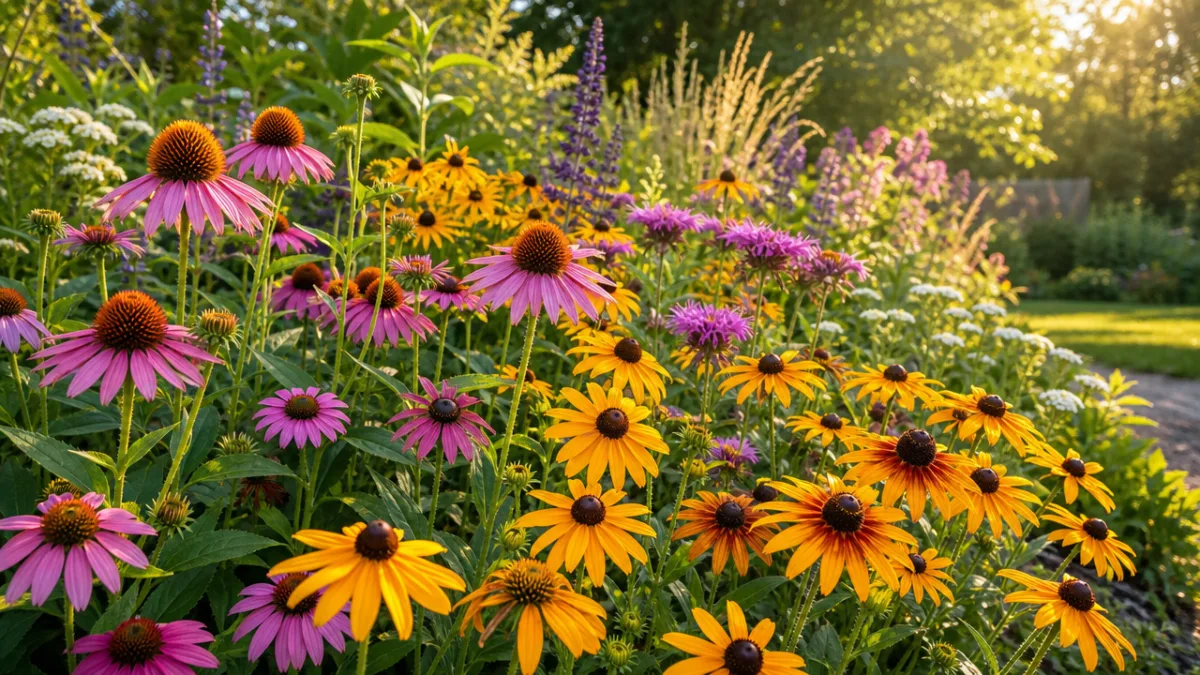
By midsummer, the peony is purely a foliage plant, and it actually performs this role quite admirably. The dark green, deeply divided leaves provide excellent texture and substance in the border throughout the hot months. But to keep the garden from feeling static and one-dimensional, you need companions that take center stage during this period. Rudbeckia, or black-eyed Susan, is a classic American native that begins blooming in midsummer and continues prolifically into fall. Its bright golden-yellow flowers with dark centers provide a warm, sunny energy that enlivens the border during the dog days of summer and harmonizes beautifully with the deep green of peony foliage.
Echinacea, or coneflower, is another native perennial that pairs exceptionally well with peonies in a mixed border. Available in a remarkable range of colors from traditional magenta-pink to orange, yellow, white, and deep red, echinacea begins blooming in early to midsummer and continues for many weeks. The dried seed heads that remain after the petals fall are attractive in their own right and provide important food for songbirds like goldfinches through fall and winter. Planting echinacea in large groupings near peonies creates a transition from the extravagance of peony season to the more naturalistic beauty of late summer.
For the fall garden, asters are absolutely essential in any border that includes peonies. These late-season bloomers erupt into clouds of daisy-like flowers in shades of purple, lavender, pink, and white just as most other perennials are winding down for the year. Symphyotrichum oblongifolium, the aromatic aster, is particularly reliable and pest-resistant, forming tidy mounds covered with small lavender flowers that seem to glow in the lower-angled light of autumn afternoons. Japanese anemones are equally valuable for fall interest, producing elegant, cup-shaped flowers in white or soft pink on tall, wiry stems that move gracefully in any breeze.
Structural Plants and Shrubs That Provide Year-Round Bones
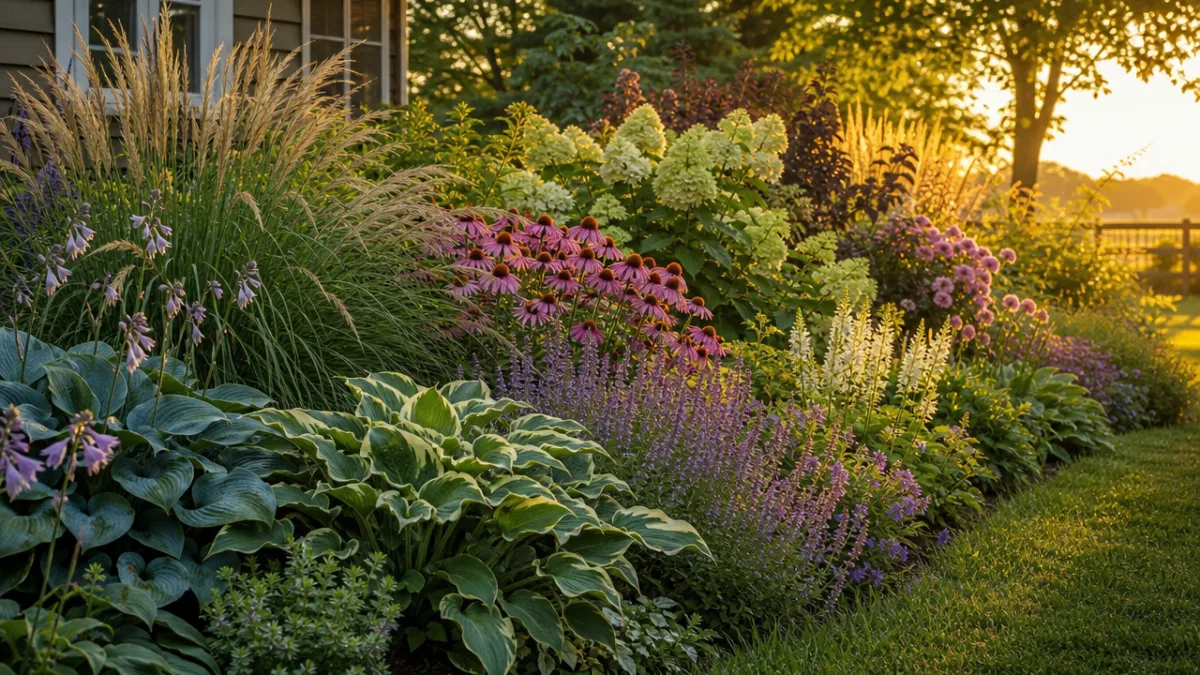
A garden that never looks empty isn’t just about having something in bloom at all times — it’s also about having structural elements that give the space definition, depth, and visual interest even in the depths of winter. Ornamental grasses are among the most valuable structural companions you can pair with peonies. Varieties like Pennisetum alopecuroides (fountain grass), Calamagrostis acutiflora (feather reed grass), and Panicum virgatum (switchgrass) provide graceful movement, interesting texture, and attractive seed heads that persist through winter. Their upright or arching forms contrast beautifully with the rounded habit of peony clumps, creating a dynamic interplay of shapes throughout the border.
Shrub roses are perhaps the most natural companions for peonies, as both plants evoke a similar sense of romantic abundance. Modern shrub roses like the Knock Out series or the David Austin English roses bloom repeatedly throughout summer and fall, effectively extending the rose-and-peony aesthetic well beyond peony season. The key is to choose roses with a growth habit that complements rather than overwhelms the peonies — medium-height shrub roses work best, positioned behind or beside peony clumps so that their blooms are visible without shading out the peonies below. The combination of peony blooms in late spring followed by continuous rose flowering creates a cutting garden-inspired border that always has something worth harvesting.
Boxwood and other evergreen shrubs, used thoughtfully and in moderation, provide the kind of permanent structure that makes a garden look intentional and cared-for in every season. A low boxwood hedge or a few well-placed globes of evergreen shrub behind a peony border create a dark green backdrop that makes the peony blooms pop in spring and provides a visual anchor when nothing else is blooming. Dwarf conifers serve a similar purpose and come in a wonderful range of colors from gold to blue-green to nearly black-green, offering year-round textural interest that requires almost no maintenance once established.
Design Principles for a Cohesive Peony Garden
Knowing which plants pair well with peonies is only half the battle — the other half is understanding how to arrange them for maximum visual impact. One of the most important principles is layering by height, placing taller plants at the back of the border, medium-height plants in the middle, and low-growing plants or ground covers at the front edge. Peonies typically occupy the middle layer, which means they need something taller behind them to provide context and something lower in front to complete the picture. This three-tier structure creates depth and makes even a relatively narrow border feel rich and dimensional.
Color harmony is another critical consideration when planning a peony companion garden. Peonies come in a range of colors from white to cream, blush, pink, coral, red, magenta, and even near-purple, and your companion plant choices should take the specific peony varieties you’re growing into account. For pink and blush peonies, companions in purple, lavender, blue, and silver work beautifully, creating a cool, romantic palette that feels cohesive and intentional. For red and coral peonies, warm-toned companions in orange, gold, and bronze create a vibrant, energetic border. White peonies are the most versatile, working well with virtually any companion color.
Repetition is the secret weapon of successful border design. Rather than planting one of everything, choose a core group of five to seven companion plants and repeat them in clusters throughout the border. This creates a sense of rhythm and unity that makes the garden feel designed rather than accidental. A border where catmint, alliums, and lady’s mantle appear in generous drifts around multiple peony clumps will feel far more satisfying than one where a dozen different plants each make a single appearance. Repetition also benefits the plants themselves, as larger groupings are more ecologically effective and visually impactful than isolated specimens.
Finally, don’t underestimate the power of foliage as a design element throughout the growing season. Many of the best peony companions earn their place primarily through their leaves rather than their flowers. Consider plants with distinctive foliage textures and colors to build your garden’s visual foundation:
- Hosta — enormous range of leaf colors, textures, and sizes; provides lush ground-level interest throughout summer
- Heuchera — colorful foliage in burgundy, bronze, lime, and silver; excellent for edging
- Ferns — delicate, airy texture that contrasts beautifully with the bold peony leaf form
- Brunnera macrophylla — heart-shaped leaves, sometimes with silver markings, and forget-me-not-blue spring flowers
- Sedum — succulent foliage that provides interest from spring through winter’s first snow
Practical Tips for Planting and Maintaining Your Peony Border
Even the best-designed companion planting scheme can fail if the plants aren’t given the right conditions to thrive. Peonies are famously particular about their planting depth — the eyes, or growth buds, should be set no more than one to two inches below the soil surface in most climates. Plant them too deep and they will grow lush foliage but refuse to bloom, sometimes for years. When introducing companions into an established peony bed, work carefully around existing peony roots, which can be extensive and fleshy. Disturbing the roots too aggressively can set the peonies back significantly, so take your time and use a garden fork rather than a spade for any digging near established plants.
Soil preparation is the foundation of any successful mixed border. Peonies prefer rich, well-drained soil with a slightly neutral to mildly alkaline pH, and most of the companion plants described in this article share similar preferences. Before planting, work generous amounts of compost into the bed to improve drainage, fertility, and soil structure. A top dressing of compost each fall will continue to feed the plants and improve the soil over time. Avoid heavy clay soils where water pools around plant crowns, as this can cause root rot in peonies and many of their companions. Raised beds or berms are an excellent solution if your native soil is heavy and poorly draining.
Water management in a mixed peony border requires some finesse. Peonies are remarkably drought-tolerant once established, but they perform best with consistent moisture during their spring growing season. Many companion plants share this preference, making irrigation relatively straightforward. However, once a border becomes established — usually after two to three growing seasons — most of the plants described here will require little supplemental watering except during extended dry spells. Mulching the border with two to three inches of shredded bark or wood chips helps retain moisture, regulate soil temperature, and suppress weeds, making maintenance significantly easier while also giving the garden a polished, finished appearance.
Dividing and managing your companion plants regularly is essential to preventing any single species from crowding out its neighbors. Fast-spreading plants like catmint and geranium rozanne may need to be divided every three to four years to keep them in bounds, while slower growers like baptisia and peonies themselves can be left undisturbed for many years. A well-maintained companion planting scheme is a dynamic thing that requires annual editing — moving plants that have grown too large, filling gaps with new additions, and occasionally rethinking sections of the border that aren’t performing as expected. This ongoing process of refinement is part of what makes gardening so endlessly engaging and rewarding, and a thoughtfully planted peony border gives you an exceptional canvas to work with season after season.








What do you think?
It is nice to know your opinion. Leave a comment.