










7 Crochet Plant Coasters: Free Patterns to Brighten Your Home
The Growing Trend of Crochet Plant Coasters
Crochet plant coasters have become a quiet favorite in the fiber arts world, and honestly, it makes a lot of sense. As more of us fill our homes with houseplants, we start noticing all those water rings and soil marks on our furniture — and suddenly, a pretty little coaster under each pot doesn’t seem like such a small thing. What started as a practical fix has turned into a genuinely fun creative outlet, one that sits right at the intersection of handmade craft and home décor.
One of the things people love most about these projects is that you can actually finish one in an afternoon. Unlike a sweater or a blanket that follows you around for months, a plant coaster gives you that satisfying “I made this” feeling in just a few hours. That makes them great for beginners who are still finding their groove, but experienced crocheters stay hooked too — because there’s so much room to play with stitches, shapes, and color combinations. Simple granny squares, intricate mandala rounds, everything in between — the possibilities really do go on and on.
There’s also something bigger driving the love for these little projects. People are gravitating toward handmade things again, toward items that feel considered and personal rather than mass-produced. A crocheted coaster tucked under a trailing pothos or a chunky succulent quietly says something about the person who made it — that they took the time, that they care about their space, that they find joy in making things with their hands. That’s a pretty meaningful thing for something that fits in your palm.
Choosing the Right Materials for Plant Coasters
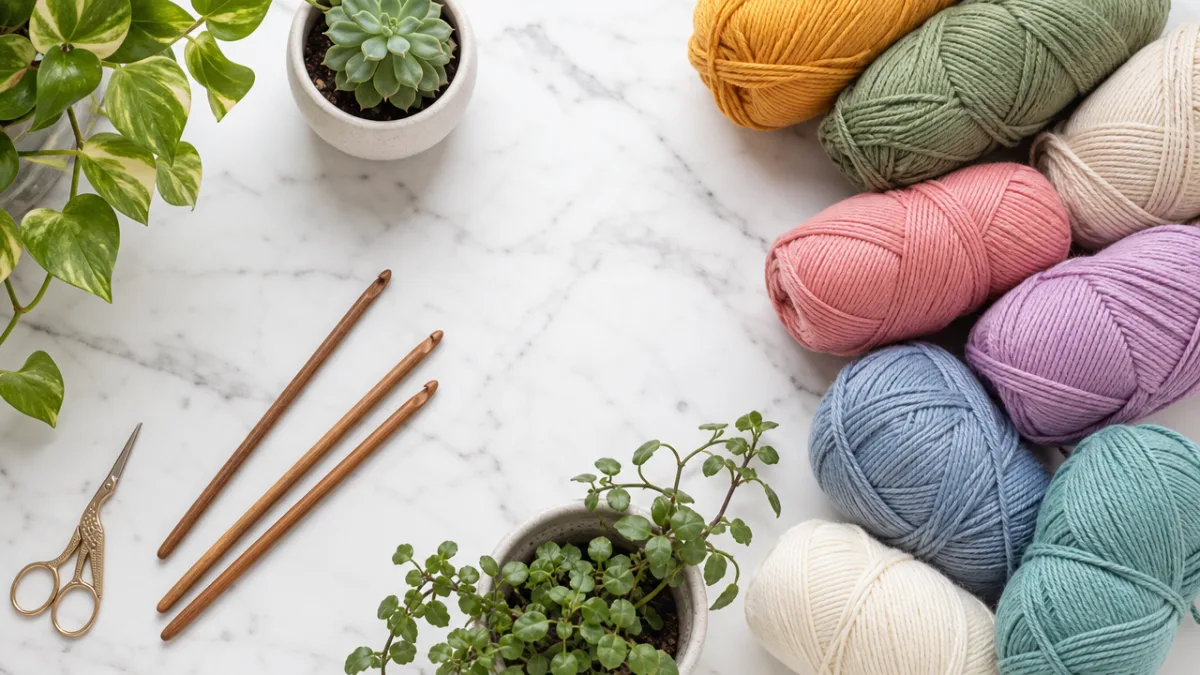
Before you pick up your hook, it’s worth thinking carefully about your yarn, because these coasters are going to deal with moisture on a regular basis. Watering, drainage, condensation — it all adds up. You want a fiber that can handle getting a little damp without losing its shape or falling apart over time. That’s why cotton yarn is pretty much the go-to choice here. It’s durable, it holds up to moisture well, and it has a nice texture that looks great in home décor.
When it comes to weight, worsted and DK cotton both tend to work really well for plant coasters. They’re thick enough to actually protect your surfaces but still flexible and pleasant to work with. Cotton is also easy to find at most craft stores, comes in a huge range of colors, and won’t break the bank — so if you want to make a whole set in coordinating shades to match a room, that’s totally doable without spending a lot.
Your hook size matters more than you might think, too. Going down a size from what your yarn label recommends will give you a tighter, denser fabric that does a better job of keeping moisture from seeping through to your furniture. It’s also worth considering whether to add a non-slip backing once you’re done — a little fabric glue and a piece of grippy shelf liner cut to size can make a real difference. It’s one of those small finishing touches that takes a simple coaster and makes it feel genuinely polished.
Seven Free Patterns Worth Your Time
The crochet community is wonderfully generous about sharing patterns, and plant coasters are no exception. The seven patterns featured here cover a good range of skill levels, styles, and techniques, so whether you’re just starting out or you’ve been crocheting for years, there’s something here for you. Every one of them is available free online — on Ravelry, craft blogs, or yarn brand websites that love to show off what their materials can do.
The first pattern is a classic solid round coaster worked in single crochet from the center out. If you’re a beginner, this is the perfect place to start — it uses just one basic stitch and teaches you how to increase evenly to keep a circular shape flat. The finished coaster looks clean and modern, the kind of thing that fits right in with a minimalist or Scandinavian-inspired space. Keep it one color for simplicity, or change colors every few rounds to get a cheerful striped effect without adding any extra technical challenge.
The second pattern introduces the magic ring and basic shell stitches to create a flower-shaped coaster with scalloped petal edges. It’s a natural step up from the solid round — you just need to pay a bit more attention to stitch counts and placement. Despite that, the finished result looks surprisingly intricate, and it photographs beautifully next to a little terracotta pot. Using a contrasting color for the outer petal round gives you a two-tone effect that feels like a deliberate design choice rather than something thrown together.
The remaining five patterns branch out into even more styles and techniques. There’s a granny square coaster with a retro charm, a boho-inspired mandala worked in multiple colors, a textured bobble stitch coaster that adds some satisfying dimension, a delicate star-shaped coaster crocheted in fine cotton thread, and a contemporary geometric design with a simple but striking color block look. Together, these seven patterns give you a full range of approaches to explore — enough to keep you busy across different seasons and decorating moods.
Step-by-Step Tips for Crochet Success
Even seasoned crocheters can hit a snag with a new pattern, and circular crochet has its own particular quirks. The most common problem with plant coasters is that they cup or curl instead of lying flat — which is really frustrating when it happens. Usually the culprit is tension that’s too tight, or increases that aren’t spread evenly through the rounds. Trying a larger hook, double-checking your increase counts against the pattern, and blocking the finished piece will almost always sort it out.
Speaking of blocking — a lot of newer crocheters skip this step, and it really is worth doing. For cotton yarn, wet blocking works beautifully. Soak your finished coaster in cool water, gently squeeze out the excess without wringing it, then pin it to a foam blocking mat and let it dry completely. The transformation is genuinely satisfying: a noticeably smoother, more even fabric with crisp edges and just enough firmness to sit perfectly flat under a pot.
Getting comfortable reading crochet patterns is a skill that builds with time, and short self-contained projects like these are a great way to develop it. One thing to watch carefully: stitch abbreviations can vary between designers and between countries. US and UK crochet terminology are different in ways that actually matter — a US single crochet is what UK patterns call a double crochet, for instance. Always check which system a pattern is using before you start, and keep a reference chart close by until you’ve got the differences down.
Here are some general tips to keep in mind as you work through any of the seven patterns in this collection:
- Use a stitch marker to track the beginning of each round, especially in spiral rounds where there’s no visible join between them.
- Count your stitches at the end of each round before moving on — it’s much easier to catch a mistake early than several rounds later.
- Weave in ends securely with a tapestry needle, running the tail through stitches in a few different directions so it won’t unravel in the wash.
- When changing colors, carry or cut the old yarn neatly to keep any tails from poking through on the right side.
- If blocking pins alone don’t get you a perfectly flat result, a light press with a cool iron over a damp cloth can help.
Creative Customization and Color Play
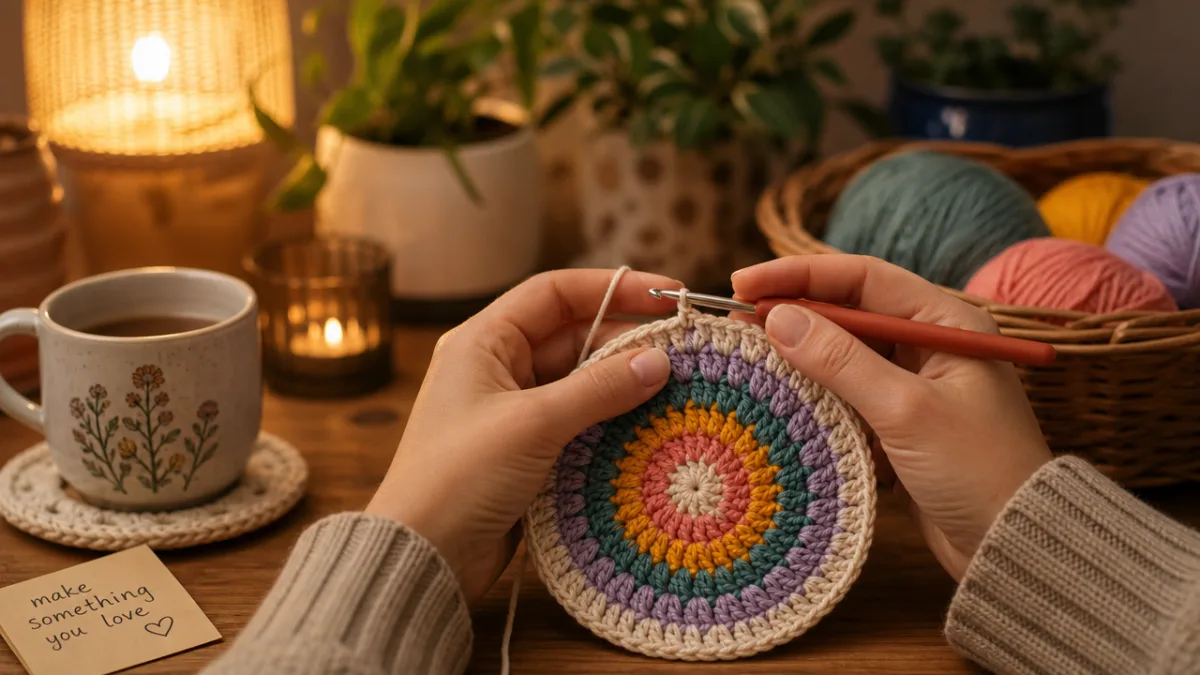
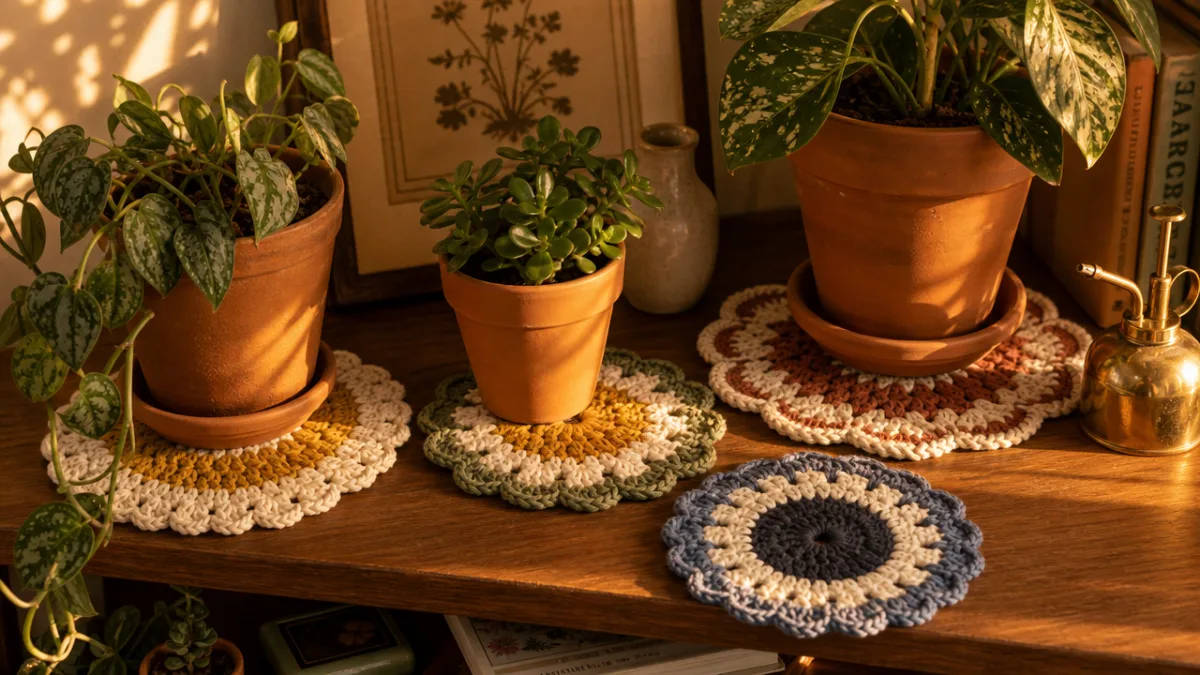
One of the best things about working with free patterns is that you can make each finished piece entirely your own just by playing with color. A single pattern can produce dozens of completely different-looking coasters depending on the palette you choose, which means you can come back to a favorite over and over without anything ever looking the same. Try pulling color inspiration from the plants themselves — earthy terracotta to complement clay pots, soft greens and creamy whites to echo the foliage, or bold jewel tones for a striking contrast against a plant shelf full of natural textures.
Seasonal color shifts are another fun way to keep your collection feeling fresh. A set of warm golden yellows and burnt oranges for autumn, icy blues and silvers in winter, soft pastels in spring, saturated brights in summer — because each coaster only takes a few hours, rotating your collection with the seasons is actually realistic. It’s one of the easiest and least expensive ways to give your home décor a little refresh without any major effort.
Beyond color, there’s a lot of room to personalize once the main piece is finished. Embroidered details in contrasting floss — tiny flowers, initials, simple geometric accents — can add real character to a plain base. Small appliquéd shapes sewn on top add dimension. Even the finishing edge changes the whole feel of a coaster: a simple single crochet border reads as clean and modern, while a shell or picot border tips it into something more romantic and cottage-inspired. Think of the pattern as the starting point for a creative conversation, not the final word.
Making Crochet Plant Coasters as Gifts
Handmade gifts have a warmth that you just can’t get from something off a shelf, and crochet plant coasters are surprisingly versatile as presents. They’re a natural fit for housewarming gifts, especially when you pair one with a small living plant — the recipient can set their new plant right on the coaster the moment they unwrap it. That kind of thoughtful pairing shows you considered both the practical needs of a new home and the taste of the person you’re celebrating.
They also work really well as holiday gifts, teacher appreciation gifts, or small thank-you tokens for friends who’ve been there for you. Because they come together quickly, it’s genuinely realistic to make a matching set of four or six rather than just one, which makes a much more impressive gift overall. Stack them together with a ribbon, tuck them into a little basket or wrap them in tissue paper, and you’ve got something that feels considered and special — the kind of thing most people would never think to buy for themselves but absolutely love to receive.
If you want to take things further, plant coasters can also work well as small handmade products at craft fairs or in an online shop. Cotton yarn is affordable, and the relatively quick turnaround makes them practical to produce in larger quantities. Offering them in coordinated sets with a cohesive theme — tropical, desert, woodland — gives buyers a reason to pick up multiple pieces at once and helps your work stand out from the crowd.
Building a Sustainable Crochet Practice Around Small Projects
For most crafters, the hard part isn’t finding the motivation to start something — it’s finding enough time and mental energy to actually finish it. Life gets busy. That’s exactly where small projects like crochet plant coasters can genuinely change your relationship with your craft. Because you can finish one in a single sitting or across a couple of evenings, that feeling of completion is never too far away, and it keeps pulling you back to pick up the hook again.
Working through a collection of seven patterns also gives your practice a natural structure that can sustain you for weeks or even months, especially if you make several versions of each one in different colors. Setting a gentle goal — one new coaster a week, say — gives your creative life a pleasant rhythm without turning a hobby into a chore. Over a season, you’ll have built up a beautiful, functional collection that genuinely transforms the look of your home. And every piece is real, tangible evidence of time and care invested in something you love doing.
There’s an environmental side to this too, if that matters to you. A lot of cotton yarn brands now produce with ecological responsibility in mind — certified organic options, yarns made from recycled or upcycled fibers. Choosing those where you can is a nice way to align your creative practice with your broader values. And even using up yarn scraps and remnants from bigger projects in a coaster, shifting colors round by round, is its own small act of sustainability. Every stitch in a handmade coaster is a small choice to value craft and care over the convenience of something mass-produced.








What do you think?
It is nice to know your opinion. Leave a comment.