










Flamme & Voile: The Art of Fire and Veil in Modern Celebration
The Origins of Flamme & Voile
The concept of Flamme & Voile, which translates from French as “Flame and Veil,” represents one of the most evocative pairings in ceremonial and aesthetic traditions across the world. This duality speaks to the interplay between the raw, luminous energy of fire and the delicate, translucent grace of fabric — two opposing forces that, when brought together, create something deeply moving and visually breathtaking. Their combination has shaped rituals, celebrations, and artistic expressions for centuries, from ancient civilizations to contemporary design studios.
Throughout history, flame has been a universal symbol of transformation, passion, and the divine. Ancient cultures from Greece to Mesopotamia kept sacred fires burning as offerings to their gods, while the veil served as a threshold between the sacred and the mundane, the seen and the unseen. Together, fire and veil have marked the most significant transitions in human life: marriage, mourning, celebration, and spiritual awakening. This pairing was never merely decorative — it carried profound meaning about the nature of existence itself.
In modern times, the Flamme & Voile aesthetic has been revived and reinterpreted by event designers, photographers, fashion houses, and interior stylists who recognize the timeless power of these elements. Rather than recreating ancient rituals wholesale, contemporary practitioners draw upon the symbolic vocabulary of flame and veil to evoke atmosphere, emotion, and narrative. The result is a visual and sensory language that feels simultaneously ancient and utterly of the moment, capable of transforming any environment into something otherworldly and memorable.
The Symbolism of Fire in Ceremonial Contexts
Fire has held a privileged place in human symbolism since the earliest days of recorded thought. Its warmth sustains life, its light dispels darkness, and its capacity for destruction reminds us that transformation is never without cost. In ceremonial contexts, the flame becomes more than a source of heat or illumination — it becomes an active participant, a witness to vows, a purifier of intentions, and a living emblem of the energy that bonds people together. Whether burning in a cathedral candelabra or a simple handheld taper, the flame carries with it an entire cosmology of human meaning.
Wedding ceremonies across dozens of cultures incorporate fire in deliberate and meaningful ways. The Hindu Saptapadi, in which couples walk around a sacred fire seven times, treats the flame as the divine presence before which promises are made binding. In Jewish tradition, the lighting of candles by the bride signals the beginning of her new life. Celtic handfasting ceremonies often conclude with the jumping of a small flame, symbolizing the couple’s shared leap into the unknown. These traditions all rest on the same fundamental understanding: that fire bears witness in a way that human witnesses cannot, reaching beyond the social contract into something more elemental.
Contemporary event designers who work within the Flamme & Voile tradition are deeply aware of this symbolic weight. They use fire — through pillar candles, floating wax lights, lanterns, torch installations, and controlled flame sculptures — not merely to create ambient light, but to signal intention. Every candle placed on a table, every flame-lit pathway, every torch anchored at the entrance to a ceremony space is a statement about the seriousness and sacredness of the occasion. The designers who do this work best understand that fire is not a prop but a presence, one that requires respect, care, and a clear understanding of what is being communicated.
- Sacred fire traditions appear in Zoroastrianism, Hinduism, ancient Greek religion, and Celtic paganism, all treating flame as a divine intermediary between human and transcendent realms.
- The color and quality of candlelight — warm, flickering, impermanent — communicates intimacy and honesty in ways that artificial lighting cannot fully replicate.
- Fire’s inherent danger, carefully managed, adds a quality of aliveness and presence to any ceremony or installation, reminding participants that what is happening matters.
The Language of the Veil: Fabric, Transparency, and Transformation
The veil is one of the most multivalent objects in the entire lexicon of human adornment and ceremony. It simultaneously reveals and conceals, protects and presents, surrenders and asserts. In bridal traditions, the veil has been interpreted variously as a symbol of modesty, a protection against evil spirits, a marker of the transition from one social identity to another, and more recently, as a purely aesthetic choice that connects contemporary brides to generations of women who have worn the same diaphanous fabric before them. To understand the veil is to understand something fundamental about the human relationship with visibility and hiddenness.
Textile artists and fashion designers working within the Flamme & Voile aesthetic treat fabric with the same reverence that their counterparts treat fire. The choice of material — silk organza, point d’esprit, Chantilly lace, French tulle, or raw-edged silk chiffon — is never arbitrary. Each fabric speaks in a different register: organza is architectural and dramatic, tulle is romantic and soft, chiffon is fluid and melancholic, lace is historic and intricate. When these materials are deployed in event design or bridal fashion, they carry the accumulated associations of every context in which they have previously appeared, creating a kind of textile memory that the wearer or viewer senses even if they cannot articulate it.
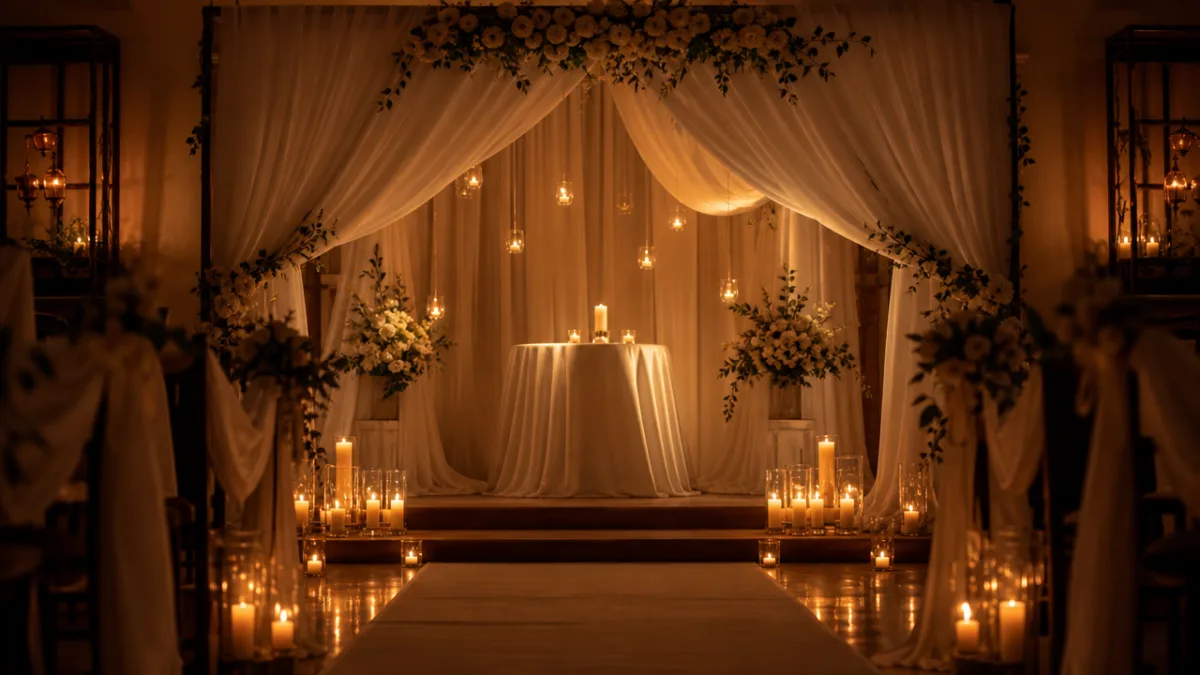
The interplay of light through translucent fabric is one of the most visually compelling phenomena in all of design. When firelight passes through a layer of fine tulle or silk chiffon, it creates a diffused, glowing halo effect that seems to elevate the material from the physical to the ethereal. This is the central visual magic of the Flamme & Voile aesthetic: neither the flame alone nor the fabric alone achieves this effect, but together they produce something that stops the viewer in their tracks. Event designers who master this combination understand that they are working with light itself as their primary material, using fabric as a lens to sculpt and redirect it.
The veil also carries profound associations with liminality — the threshold state between one condition and another. Anthropologists have long noted that veiling appears at moments of transition: brides crossing into marriage, mourners crossing into grief, initiates crossing into new spiritual identities. This liminal quality is precisely what makes the veil so useful to designers working in ceremonial contexts. It marks the threshold, signals that something is changing, and prepares the viewer or participant to receive what comes next. In this sense, every carefully draped length of sheer fabric in a ceremony space is doing important narrative and psychological work, whether the guests consciously recognize it or not.
Designing with Flamme & Voile: Principles and Practices
For event designers, wedding stylists, and interior architects who work within the Flamme & Voile aesthetic, the challenge lies in translating a poetic concept into practical, executable design decisions. The first principle of this work is restraint. Because both fire and translucent fabric carry such inherent visual and emotional power, the temptation to use too much of either must be actively resisted. A single large installation of floating candles behind a sheer curtain of silk gauze will almost always be more powerful than a room crammed with candles and fabric in every corner. The goal is to create a few moments of concentrated beauty rather than a continuous backdrop of stimulation.
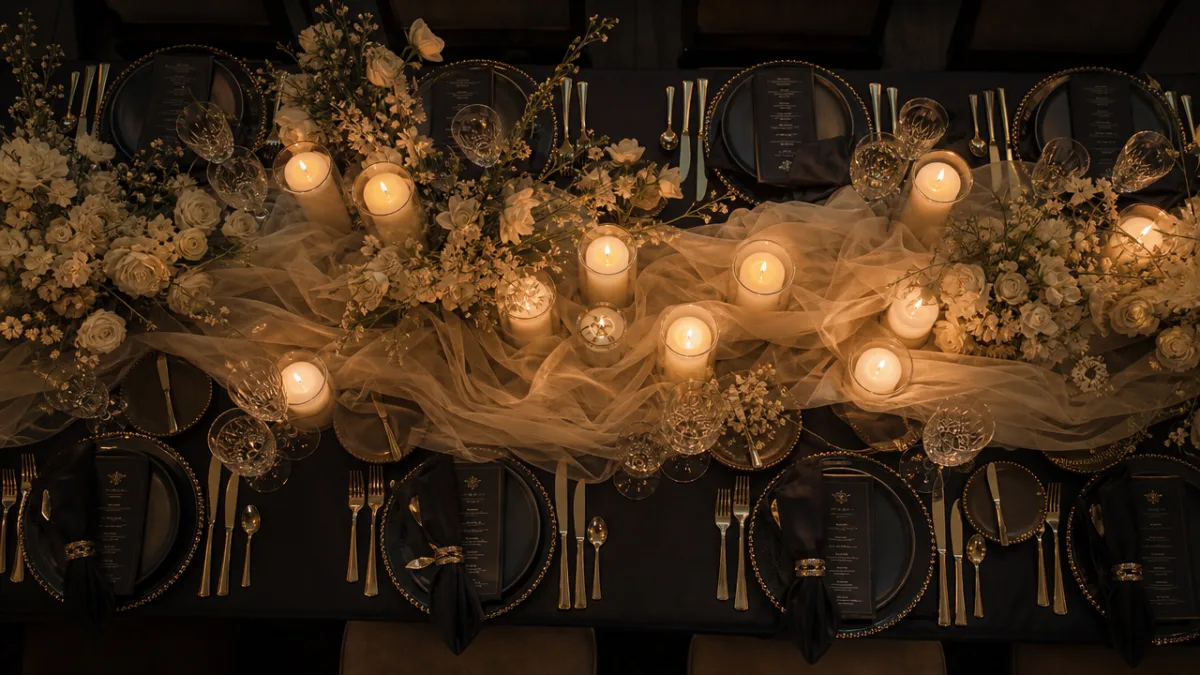
Color palette plays an equally critical role in Flamme & Voile design. The warm spectrum of flame — amber, gold, deep orange, and the blue-white of a burning wick’s core — suggests a corresponding palette for fabric choices: ivory, champagne, pale blush, dusty rose, and the deepest midnight navy or black that allows candlelight to glow against a dark ground. Designers who fight against the natural color temperature of firelight by using cool whites or stark primary colors often find their installations feel disconnected and unsettled. Conversely, those who work with the warmth of flame — choosing linens and organzas that absorb and reflect amber light — create environments that feel coherent, enveloping, and deeply beautiful.
Scale and proportion require careful consideration when designing with these elements. A single taper candle placed at the center of a vast, draped ceremony space will be lost; a forest of pillar candles in a small, intimate room will overwhelm. The relationship between the scale of the flame element and the expanse of fabric must be calibrated so that neither dominates but each enhances the other. Experienced designers often speak of this balance in musical terms — the flame as the melody, the fabric as the harmony, each incomplete without the other, together creating the full chord of the experience.
- Begin with intention: Identify the emotional register you want to create — intimate and sacred, dramatic and theatrical, soft and romantic — before selecting specific materials or quantities.
- Choose fabric with purpose: Test your chosen textiles with the actual light sources you plan to use before finalizing any design decisions; fabric behaves very differently under candlelight than under daylight or artificial lighting.
- Edit ruthlessly: Remove any element that does not contribute directly to the central effect; every unnecessary candle or unnecessary layer of fabric dilutes the impact of the whole.
- Consider movement: Both flame and light fabric move in response to air currents, and this movement is a feature, not a flaw — design your space so that gentle movement is possible and even encouraged.
- Safety is non-negotiable: Work with certified flame-retardant treatments for all fabrics used near open flame, and always have a clear safety plan in place for any event using live fire elements.
Flamme & Voile in Bridal Fashion
Perhaps nowhere is the Flamme & Voile aesthetic more directly and personally expressed than in bridal fashion. The bride herself becomes the embodiment of the concept: a living figure in whom fire — the passion, vitality, and transformative energy of the occasion — and veil — the diaphanous, liminal, threshold-marking fabric — are united. Bridal designers who work consciously within this tradition think carefully about how every element of the gown and its accessories will interact with the specific lighting environment of the wedding, recognizing that a dress is not worn in a void but in a particular space, at a particular hour, under a particular quality of light.
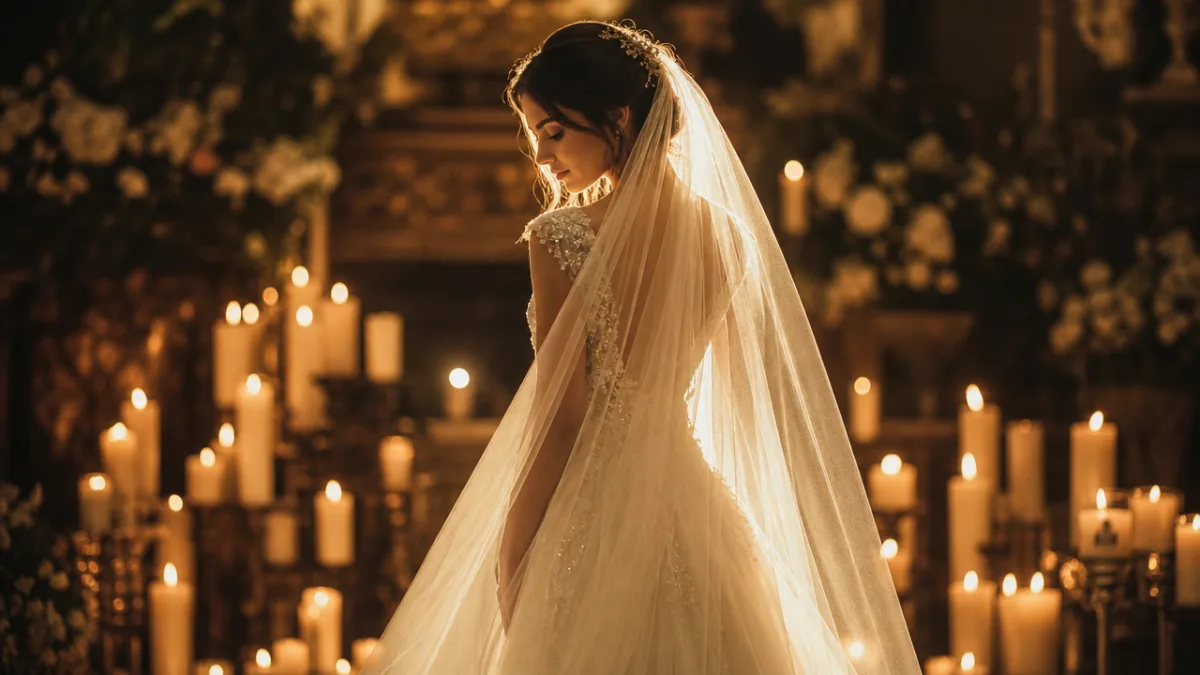
The choice of veil style is one of the most powerful single decisions a bride can make within the Flamme & Voile aesthetic. A cathedral-length veil of unembellished silk tulle creates a dramatic architectural line that trails behind the bride like smoke, pooling on the floor in a way that suggests both grandeur and impermanence. A blusher veil of fine point d’esprit worn over the face during the processional literalizes the concept of the threshold: the face is veiled, not yet fully present to the ceremony, and its unveiling marks the moment of full commitment. Shorter veils — the birdcage, the elbow length, the fingertip — each create their own specific relationship between concealment and revelation, and each interacts differently with candlelight and soft architectural light.
Gown fabrication within this tradition tends toward materials that move with intention and respond beautifully to warm light. Bias-cut silk charmeuse creates fluid, bodyconscious silhouettes that shimmer and shift with every movement. Layers of hand-gathered silk organza create volume that appears almost weightless, the outer layers so fine that they seem to dissolve into the light around them. Embellished fabrics — those with scattered beading, delicate embroidery, or panels of fine lace — catch candlelight in ways that animated the surface of the gown throughout the ceremony and celebration, creating a garment that is literally luminous. This last quality is perhaps the defining hallmark of truly great bridal fashion within the Flamme & Voile tradition: the gown should appear to generate its own light.
Accessories complete the vision by extending the dialogue between fire and veil throughout the bridal ensemble. Jewelry in warm gold, rose gold, or antique silver settings carries the warmth of candlelight at the wrist, ear, and throat. Floral choices tend toward the organic, unstructured, and lushly scented — garden roses, ranunculus, sweet peas, trailing jasmine — rather than the architectural and crisp. Even the bridal fragrance becomes part of the design: warm, resinous, slightly smoky notes like amber, sandalwood, and frankincense echo the ceremonial origins of the aesthetic in ways that work below the level of conscious thought, creating a complete sensory environment in which every element tells the same story.
Photography and Visual Storytelling in the Flamme & Voile Tradition
The Flamme & Voile aesthetic presents both extraordinary opportunities and genuine technical challenges for photographers who work in wedding, editorial, and fine art contexts. The opportunity lies in the unmatched quality of firelight as a photographic medium: it is warm, directional, full of depth, and above all alive in a way that no studio strobe or LED panel can fully replicate. The challenge lies in the fact that candlelight is dim, variable, and in constant motion, requiring photographers to work at high ISO values, wide apertures, and slow-ish shutter speeds that amplify any movement in the subject. Mastering Flamme & Voile photography means learning to work with these constraints rather than against them.
The most compelling images made within this tradition typically share a number of compositional strategies. They use negative space generously, allowing pools of darkness to frame the illuminated subject in ways that emphasize the precious, isolated quality of the light. They embrace lens flare and light scattering through fabric as intentional compositional elements rather than imperfections to be avoided in post-processing. They favor long exposures that allow the slight movement of flame and fabric to register as a softness or blur that suggests life and breath rather than photographic failure. And they consistently place the human subject — whether a bride, a couple, or an individual in a fine-art context — in a relationship with the light and fabric that feels intimate and personal rather than posed and performative.
Post-processing choices in Flamme & Voile photography tend to enhance the warmth and depth of the original captures rather than neutralizing them toward a cooler, more modern look. Film emulations that add grain and deepen shadow areas, warm toning that shifts the midtones toward amber and the shadows toward deep chocolate or violet-black, and careful skin tone preservation that allows the warmth of candlelight to read as flattering rather than orange — these are the tools of the accomplished Flamme & Voile photographer. The finished images should feel as though they have been bathed in the same light that the subjects themselves experienced, transporting the viewer into the warmth and atmosphere of the original moment.
- Shoot at apertures between f/1.4 and f/2.0 to gather maximum light while maintaining enough depth of field to keep the subject’s eyes sharp against the candlelit background.
- Use a fast prime lens rather than a zoom for candlelit shots; the optical quality and maximum aperture available in primes make a decisive difference at the light levels involved.
- Allow at least thirty minutes of shooting time in any new candlelit venue to calibrate your eye and settings before the critical moments of the ceremony begin.
- Communicate with your clients in advance about what the finished images will look and feel like — the dreamy quality of Flamme & Voile photography is distinctively different from crisp, bright, highly saturated wedding photography, and it should be a deliberate mutual choice.
Bringing Flamme & Voile into Everyday Living
While the Flamme & Voile aesthetic finds its most complete expression in ceremonial contexts, its principles translate beautifully into everyday domestic life for those who are drawn to its warmth and atmosphere. At the most accessible level, this means simply being intentional about the role that candlelight plays in the home — replacing or supplementing electrical lighting with pillar candles, tapers, and tea lights during meals and evenings, and choosing candle vessels that allow the flame to be seen rather than hidden inside opaque containers. This single shift in lighting practice can dramatically alter the atmosphere of any room, creating an environment that feels more intimate, more deliberate, and more alive.
Fabric plays an equally important role in translating the Flamme & Voile aesthetic into interior design. Sheer linen or cotton voile curtains that allow diffused natural light to enter while softening the hard edges of windows; gauze throws draped loosely over sofas or chairs rather than folded stiffly; tablecloths of raw silk or washed linen that pool slightly at the corners rather than ending in crisp, geometric lines — these are the domestic expressions of the veil’s influence on the lived environment. The goal is not to recreate a wedding ceremony in the living room but to borrow the feeling that ceremony creates: the sense that ordinary time has been elevated, that attention has been paid, that the space itself has been prepared with care and intention.
Seasonal rituals offer natural opportunities to bring the Flamme & Voile aesthetic more fully into everyday life. The long, dark evenings of autumn and winter are an invitation to light more candles, drape more soft fabric, and create domestic environments that feel sheltering and luminous against the darkness outside. Spring and summer celebrations — garden dinners, outdoor gatherings, late-evening gatherings on terraces — allow flame and fabric to move outdoors, where firelight competes with the last glow of the setting sun and fabric catches the warm evening breeze. Across all seasons, the practice of living with flame and veil is ultimately a practice of attention: attention to light, to material, to atmosphere, and to the quality of the time we spend in the spaces we call home.
For those who want to deepen their engagement with this aesthetic, there are few better starting points than studying the photographers, designers, and artisans who have made it their central practice. Seek out the work of editorial photographers who specialize in candlelit portraiture. Explore the collections of bridal designers known for their mastery of diaphanous fabrics. Visit historic spaces — chapels, libraries, old stone houses — where the relationship between firelight and fabric has been refined over centuries of use. And above all, practice the most fundamental discipline of the Flamme & Voile tradition: the willingness to slow down, to be present in a beautifully made space, and to allow the oldest and most enduring forms of human beauty — a flame, a veil, a moment held in warm golden light — to do their work on you.








What do you think?
It is nice to know your opinion. Leave a comment.