










15 Wonderful DIY Wine Bottle Ideas for the Garden
Introduction: Why Wine Bottles Belong in Your Garden
There’s something genuinely satisfying about giving a second life to something that would otherwise end up in the recycling bin. Empty wine bottles are honestly some of the best raw materials a DIY gardener can get their hands on. Those elegant curves, rich colors, and surprisingly solid construction make them incredibly versatile. Whether you’re drawn to the deep emerald green of a Chardonnay bottle or the warm amber of a dessert wine, each one has its own character — and the right one in the right spot can completely change the feel of a garden.
Repurposing wine bottles in the garden has been steadily picking up steam over the past decade, and it’s not hard to see why. They’re free, plentiful, and come in enough shapes and sizes to suit dozens of different projects. You can line a garden path with them, build a striking vertical planter, or create garden art that genuinely stops people in their tracks. The only real limits are your imagination and how many bottles you’ve managed to stockpile.
And it’s not just about looks, either. Glass is weather-resistant, durable, and won’t leach chemicals into your soil the way some plastics can. It catches and plays with light in really beautiful ways, and when it’s buried or arranged thoughtfully, it can even help with drainage and soil aeration. So with all that in mind, here are fifteen ideas to inspire you to start seeing every empty wine bottle as an opportunity.
Edging and Border Ideas Using Wine Bottles
One of the most eye-catching things you can do with empty wine bottles is use them to edge your flower beds, vegetable plots, or pathways. When you bury bottles neck-down at a slight angle with just the rounded bottoms poking out, the result looks surprisingly polished — like you planned it all along. The curved glass catches sunlight and creates this ribbon of color that no plastic edging strip could ever come close to matching. Mix colors for a mosaic-like effect, or stick to one color family for something cleaner and more contemporary.
To put it together, dig a shallow trench along your bed — about six to eight inches deep — and press each bottle neck-down into it firmly enough that it stands on its own. Space them so their shoulders just touch, forming a continuous line. Backfill the trench, tamp the earth down, and you’ve got a border that won’t warp, rot, or blow away in a storm the way lighter materials sometimes do.
For something a little more decorative, try alternating the direction — some neck-down, some neck-up — to create a rhythmic pattern. Upward-facing bottles are also perfect for tucking in small solar lights, which turns a simple garden edge into something that actually glows at night. Add a few seasonal flowers into the necks and this project goes from practical to genuinely beautiful, all in an afternoon.

Wine Bottle Planters and Vertical Gardens
Wine bottles actually make surprisingly good planters, especially for herbs, succulents, and small trailing plants that are happy in tight spaces. The easiest version is just cutting a bottle in half — either with a glass cutter or the string-and-fire method — and using the bottom as a planter. Fill it with potting mix, pop in a compact herb like thyme or chives, and you’ve got something that looks like it came from a fancy garden boutique. Toss a layer of small pebbles at the base to help with drainage and you’re good to go.
Vertical bottle gardens take things up a notch and are especially useful when you’re working with limited horizontal space. Attach bottles to a wooden frame, a fence, or an old pallet using wire or hose clamps, and you’ve got a living wall that works as both a garden feature and a natural divider. Tilt each bottle slightly downward so water doesn’t pool at the back, and use a moisture-retaining growing medium since these smaller containers can dry out fast when the weather heats up.
One more variation worth trying: the self-watering bottle planter. Invert a bottle with a small wick threaded through the neck into a reservoir of water below, and you’ve got a slow-drip irrigation system that keeps the soil consistently moist without much effort from you. It works really well for tomato seedlings, pepper plants, and anything else that likes steady moisture. If you travel a lot or just want to cut down on daily watering, this one’s a bit of a game-changer.
Garden Lighting with Wine Bottles
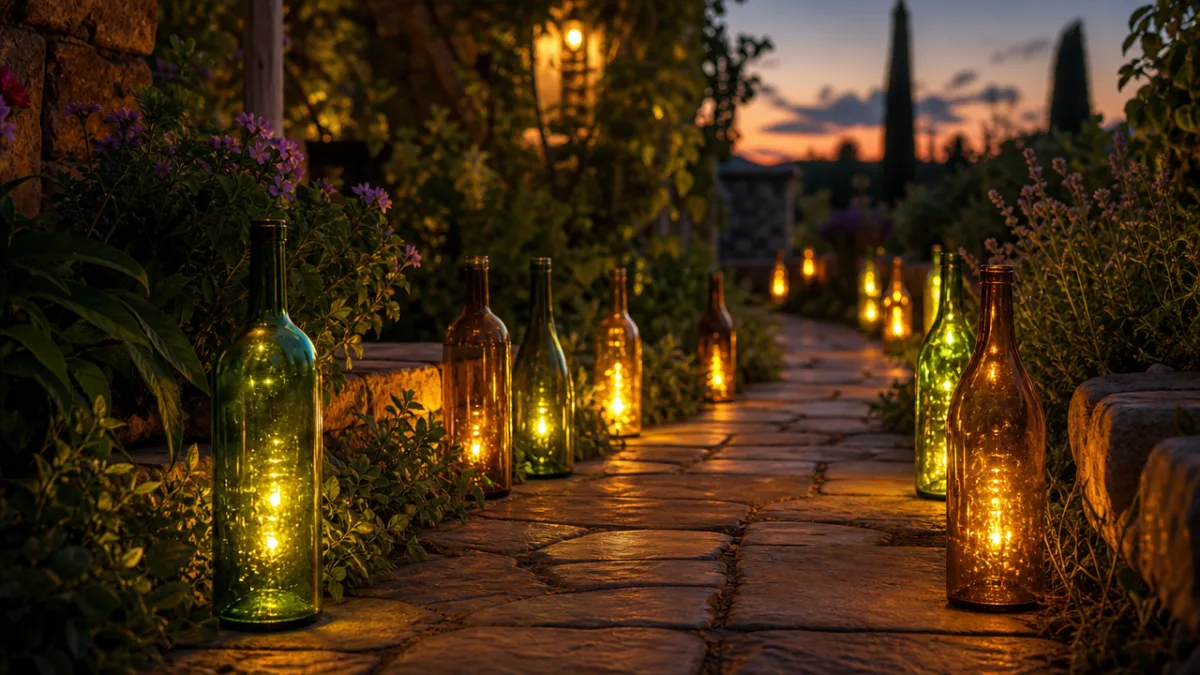
Good lighting can completely transform a garden after dark, and wine bottles are honestly extraordinary vessels for it. The glass diffuses and colors light in a way that standard lanterns or string lights just can’t replicate. Whether you’re working with tea lights, solar fairy lights, or oil lamp inserts made specifically for bottles, the result is always warm, ambient, and a little bit magical. A cluster of glowing wine bottles along a pathway or on a garden table creates the kind of atmosphere people remember.
Wine bottle torches are one of the most popular lighting projects, and they’re easier to make than you might think. You need a copper or stainless steel tiki torch wick insert, a bottle you like the look of, and some lamp oil or citronella fuel. Fill the bottle partway, thread the wick through the stopper that comes with the insert, let it soak, and light it. The bottle holds a lot more fuel than a standard tiki torch, so you’ll get longer burn times and fewer trips back to refill it during an evening.
Solar wine bottle lights have gotten really popular as the technology has improved and the cost has come down. You can find solar cork inserts online or at garden centers — they have a small solar cell on top and a strand of micro LEDs that coil down inside the bottle. Leave them in a sunny spot during the day, and they’ll glow softly for a few hours after dark. Cluster several together among river stones or tuck them into garden beds and you’ve got a low-maintenance lighting feature that costs absolutely nothing to run.
Water Features and Wind Chimes
Wine bottles can play a surprisingly elegant role in water features — everything from simple decorative fountains to drip irrigation accents. One popular project stacks bottles in a tiered arrangement where water pumped to the top cascades from one bottle to the next before collecting in a basin below. The sound of water trickling through glass is really something special, and watching it sheet over those smooth curves has a meditative quality that makes it a natural focal point for a seating area or a quiet corner of the garden.
To build a simple bottle fountain, you’ll need a small submersible water pump, some flexible tubing, a watertight basin or large pot, and a few bottles with their bases removed. Stack or mount the bottles, thread the tubing through them to carry water to the top, and set the whole thing in your basin. Fill it with water, plug in the pump, and adjust the flow until it behaves the way you want it to. Seal the connections with waterproof aquarium silicone to prevent leaks and keep everything looking tidy.
Wine bottle wind chimes are another lovely addition that brings both visual interest and gentle ambient sound to the garden. Score and cut the bottoms from several bottles of different sizes, smooth the cut edges carefully with sandpaper or a glass grinding tool, and hang them from a piece of driftwood or a metal ring using fishing line or thin wire. When a breeze moves through, the pieces tap each other with a clear, bell-like tone that varies depending on the thickness and size of each piece. Paint the bottles with glass paint before cutting if you want to add another layer of color and make them truly your own.
Decorative Garden Art and Sculptures
Beyond practical projects, wine bottles open up a lot of room for pure creative expression. Bottle trees are probably the most iconic example — a tradition with deep roots in African American folk art of the American South, where bottles were placed on trees and fence posts for both decoration and spiritual meaning. A modern bottle tree can be as simple as a metal pole with welded branches or a handful of rebar stakes driven into the ground, each one capped with a colorful bottle slipped over the top. When sunlight hits it, the colors seem to catch fire, and the gentle clinking sound the bottles make in a breeze adds a whole other dimension to the thing.
Mosaic work with broken wine bottle glass opens up a completely different creative direction. Carefully break and sort bottle fragments by color, then use them to create vibrant mosaic surfaces on garden pots, stepping stones, birdbaths, or outdoor tabletops. Use the same tile adhesive and grout you would for ceramic mosaic work, and seal the finished surface with an outdoor-rated sealer to protect it from frost and moisture. When you work with a planned color palette and design rather than a purely random arrangement, the results can be genuinely breathtaking.
Stacked bottle sculptures and towers are yet another approach worth trying. Thread bottles onto a central rod or rebar stake, alternating colors and sizes, and you’ll get a tall, slender sculpture that catches light from every angle and adds vertical interest to flat garden beds. Some gardeners mortar their stacks into permanent structures; others leave them unset so individual bottles can be swapped out or rearranged with the seasons. Either way, these installations invite conversation and show a genuinely inventive approach to garden design — one that feels both personal and a little playful.
Practical Garden Tools Made from Wine Bottles
It’s easy to get so caught up in the decorative possibilities that you forget how practically useful wine bottles can be in the garden. One of the simplest and most effective tricks is using them as slow-release watering devices for individual plants during hot summer months. Fill a clean bottle with water, invert it, and push the neck a few inches into the soil beside a plant. As the surrounding soil dries out, water seeps out gradually, keeping moisture levels consistent without any pumps, timers, or electricity. This works especially well for potted plants on a hot balcony or for vegetables when you’re away for a few days.
Wine bottles also make surprisingly effective cloches — small protective covers that shield young seedlings from frost, wind, and pests during their most vulnerable early weeks. Cut the bottom from a bottle, place the open top over a small plant, and you’ve created a miniature greenhouse that traps warmth and humidity while still allowing some air circulation if you leave the cork out. This is particularly useful for hardening off seedlings started indoors, letting them gradually adjust to outdoor conditions without the shock of full exposure all at once. Pop the cloche off on mild days and put it back on cool nights until the plant can handle things on its own.
Garden markers and labels made from wine bottle glass are both durable and genuinely attractive. Cut small ovals or rectangles, smooth the edges thoroughly, and use an oil-based paint marker or glass etching cream to write plant names. These won’t fade, warp, or become unreadable the way paper or wooden markers tend to after a season of rain and sun. Alternatively, use whole bottles as large-scale row markers at the end of garden beds, painting the crop name directly on the bottle in weatherproof paint. It’s practical, it looks great, and it adds a bit of personality to the kitchen garden.
Getting Started: Tips, Tools, and Safety
Before you dive into your first wine bottle garden project, it’s worth spending a few minutes thinking about tools and safety. Working with glass does require more care than wood or metal, but it’s completely manageable with the right approach. At minimum, have a quality glass cutter, a pair of heavy leather gloves, and safety glasses on hand before you attempt any cutting or breaking. For cleaner cuts, a glass scoring tool combined with the string-burn technique will give you much better results than improvised methods.
Collecting enough bottles for bigger projects can take a while, but there are ways to speed things up without working through your entire wine rack. Local restaurants and wine bars will often set aside their empties for anyone who asks — just check in regularly and offer to pick up on a schedule that works for them. Neighbors, coworkers, and community groups are other great sources, and plenty of areas have free sections on local buy-and-sell platforms where people are genuinely happy to see their empties go somewhere useful.
A few last things to keep in mind before you get started. Always clean your bottles thoroughly before use — warm soapy water handles most of it, and a little rubbing alcohol takes care of any stubborn label adhesive. If you’re leaving bottles outside through winter, make sure your design allows for drainage, since water that collects inside a sealed bottle and freezes can crack the glass. And don’t be afraid to experiment. Some of the most beautiful garden features come from unexpected combinations of techniques and materials that no instructions could have anticipated. That’s kind of the whole point — let creativity lead the way.








What do you think?
It is nice to know your opinion. Leave a comment.