










Nomocharis pardanthina: The Jewel of Alpine Meadows
Introduction to Nomocharis pardanthina
If you’ve never heard of Nomocharis pardanthina, you’re in for a treat — and probably a slight obsession. This rare flowering plant, a member of the lily family Liliaceae, is the kind of thing that stops botanists and wildflower lovers dead in their tracks. It grows on the high-altitude meadows and rocky slopes of southwestern China, Myanmar, and the eastern Himalayas, and it’s been turning heads in the plant world for well over a century. Those delicate fringed petals and intricate spotted markings? There’s simply nothing else quite like it in the lily family, which is exactly why alpine plant collectors around the world tend to become rather devoted to it.
The name itself is a bit of a poem. Nomocharis comes from the Greek “nomos” (meadow or pasture) and “charis” (grace or beauty) — which honestly couldn’t be more apt for a plant that decorates mountain grasslands with such effortless elegance. The species name pardanthina references Pardanthus, an old name for Iris domestica, nodding to the leopard-like spots splashed across the inner petals. Put it together and you’ve got something like “graceful meadow flower spotted like a wildcat,” which, when you see one in bloom, feels exactly right.
Botanist Francis Wall Oliver first described it scientifically in 1888 from specimens collected in Yunnan, China, and Western gardeners immediately wanted one. Plant hunters of the Victorian and Edwardian eras — George Forrest and Frank Kingdon-Ward among them — ventured into some pretty punishing mountain terrain to bring back bulbs and seeds for European gardens. Their efforts paid off, and though growing it remains a genuine challenge, dedicated enthusiasts have been treasuring this alpine gem ever since.
Natural Habitat and Geographic Distribution
Nomocharis pardanthina is not a plant that just grows anywhere and gets on with things. It has a very particular idea of where it wants to live: cool, moist conditions at elevations somewhere between 3,000 and 4,500 meters above sea level. Its home base is the mountainous terrain of Yunnan province in southwestern China, stretching into Sichuan, northern Myanmar, and the nearby Himalayan foothills. Within that range, it gravitates toward open alpine meadows, the edges of light woodland, and rocky slopes with soil that’s rich in organic matter, well-draining, and reliably cool even in midsummer.
The climate up there is cold winters, cool and wet summers, with monsoon rains doing the heavy lifting during the growing season. That rhythm — summer moisture followed by cold, dry dormancy — is absolutely central to how this plant lives. The soils tend to be slightly acidic to neutral, well-aerated, and built up over centuries of decaying meadow vegetation. If you’re wondering what grows alongside it in the wild, think primulas, meconopsis, gentians, and rhododendrons along the woodland edges. Good company, all around.
Its range sits squarely within one of the most staggering biodiversity hotspots on the planet — the mountains of southwest China and the Hengduan Mountains region, sometimes called the “plant hunters’ paradise.” The concentration of flowering plant species found here and nowhere else on Earth is genuinely mind-boggling, and the fact that Nomocharis pardanthina calls this place home says a lot about just how botanically extraordinary this corner of the world is. Protecting it matters, both for conservation science and for horticultural heritage.

Botanical Description and Flower Morphology
Nomocharis pardanthina is a bulbous perennial herb, growing anywhere from 30 to 90 centimeters tall depending on how mature the bulb is and what conditions it’s growing in. The stem is slender and upright, with lance-shaped to broadly oval leaves arranged alternately or in whorls along the upper part. The foliage is smooth and bright green — relatively narrow and light-looking, which gives the whole plant an airy, delicate feel that suits its flowers perfectly.
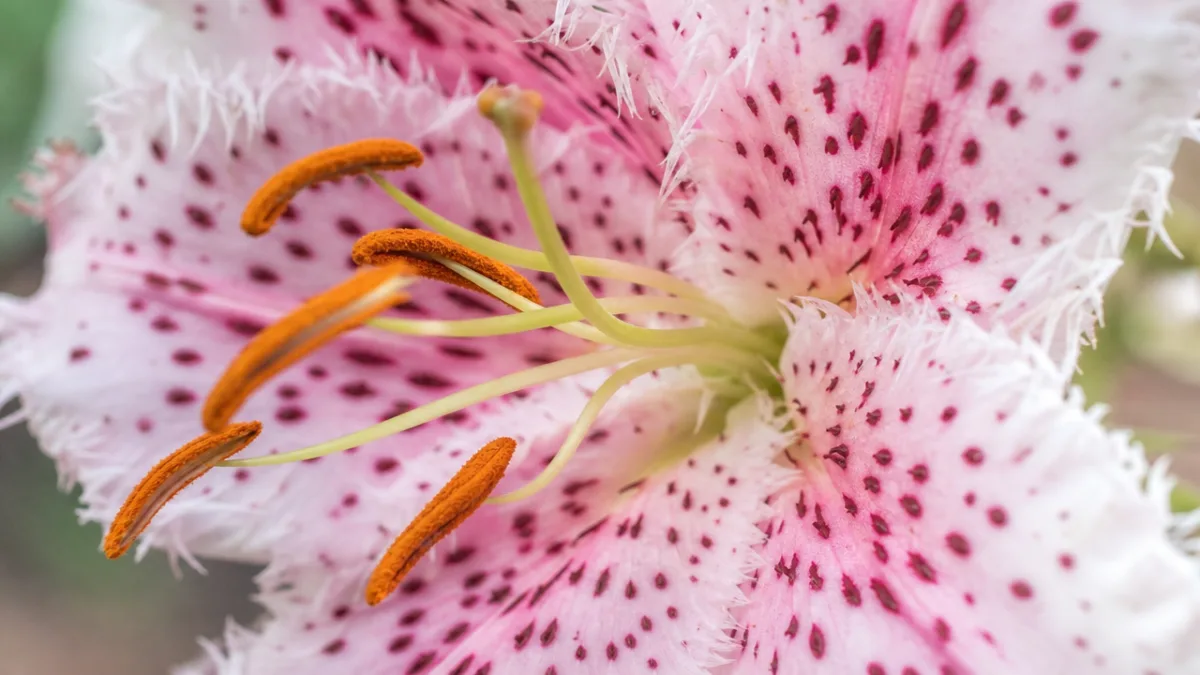
And then there are the flowers, which are frankly the whole point. They’re among the most intricately beautiful of any plant in the lily family, full stop. A single stem typically carries between one and six nodding or outward-facing blooms, each opening to six or nine centimeters across. The six perianth segments — three outer and three inner tepals — spread wide into a lovely open, saucer-shaped flower. What really sets Nomocharis apart, though, are the inner tepals: they’re distinctively fringed along the margins, giving the whole flower an almost lacy, ornate look that you won’t find in any other lily-related genus.
The coloring tends to vary a little from plant to plant, but you’re generally looking at a soft pink to pale rose base, heavily decorated with deep crimson or purple spots and blotches that get more intense as they approach the center. That innermost zone is often a deeper, richer color surrounding the nectary, which creates a dramatic focal point — and a very practical one, since it’s essentially signposting pollinators toward the reproductive structures. Six prominent stamens with large anthers and a three-lobed stigma complete the picture, adding even more visual detail to what is already a remarkably complex and gorgeous flower.
Pollination, Reproduction, and Seed Biology
Scientists don’t have the full picture yet on how Nomocharis pardanthina gets pollinated in the wild, but the evidence points to bumblebees and other large, sturdy native bees as the main visitors. It makes sense — those bees are built for the cool, often windy conditions of high-altitude meadows, and the wide-open, saucer-shaped flowers with their exposed anthers and accessible nectaries are basically designed for generalist pollinators. The spotted patterns on the inner tepals are thought to work as nectar guides, steering insects toward the center where the pollen and nectar rewards are waiting.
Once pollination succeeds, the plant produces an upright, three-valved seed capsule that ripens through late summer and into autumn. Inside are numerous flat, papery, winged seeds that get released on the wind when the capsule opens at maturity. Wind dispersal is a smart strategy for an alpine plant — open terrain and persistent breezes do a decent job of spreading seeds across the hillside. Whether those seeds actually establish depends on finding the right microsite, with the correct balance of moisture, temperature, and soil conditions.
Beyond seeds, Nomocharis pardanthina also reproduces vegetatively as the scaly bulb slowly increases and occasionally produces small offset bulblets around its base. It’s a gradual process that builds loose clumps over the years. Growers in cultivation use both approaches — sowing seed to raise new plants, and carefully separating bulb offsets to grow on individually. Vegetative propagation is especially useful for preserving particularly beautiful flower forms or interesting color variants, since the offspring will be genetically identical to the parent.
Cultivation: Challenges and Requirements
Let’s be upfront: growing Nomocharis pardanthina is genuinely hard. It’s widely considered one of the more demanding challenges in temperate horticulture, and for good reason — the conditions it needs in the wild are tough to recreate at lower altitudes. Cool summers, reliably moist but well-drained soil, and a proper cold winter dormancy are the non-negotiables, and for gardeners in most lowland temperate regions, that’s already a tall order. In places with hot, humid summers, the plant really struggles and rarely survives long without serious intervention to keep the root zone cool and the foliage dry during heat spells.
The ideal setup is pretty similar to what you’d aim for with other alpine or sub-alpine lilies and woodland bulbs. Partial shade is strongly preferred — somewhere sheltered from the hottest afternoon sun. The soil needs to be humus-rich and moisture-retentive without ever getting waterlogged, and moderately acidic, ideally with a pH of around 5.5 to 6.5. Where the native soil doesn’t cooperate, raised beds or peat-free ericaceous compost mixed with grit are the go-to solutions. A mulch of leaf mold helps keep the root temperature cool and consistent, nicely mimicking the natural buildup of organic debris on an alpine meadow floor.
The places where this plant actually thrives in an open garden are fairly specific — Scotland, parts of Scandinavia, the highlands of New Zealand, and the Pacific Northwest of North America all come close to the right conditions. Elsewhere, an unheated or minimally heated alpine house or cold greenhouse is a solid alternative, giving you precise control over moisture and protecting the foliage from rain-borne fungal diseases. Here’s a summary of what you’re aiming for:
- Cool summers with maximum temperatures ideally below 25°C for extended periods
- Well-drained but consistently moist, humus-rich, slightly acidic soil
- Partial shade, particularly protection from intense afternoon sun
- Cold but not severely freezing winter dormancy, with bulbs protected from prolonged waterlogging
- Good air circulation to reduce the risk of fungal diseases such as botrytis
- Planting depth of approximately two to three times the bulb’s diameter
Conservation Status and Threats in the Wild
Like a lot of highly specialized alpine plants with limited natural ranges, Nomocharis pardanthina is facing real pressure in the wild — enough to be genuinely concerning. Agricultural expansion, overgrazing by livestock, and the conversion of mountain meadows to other land uses are ongoing problems across much of its range in Yunnan and the surrounding regions. High-altitude meadows that once supported rich, diverse plant communities — including thriving Nomocharis populations — have in some areas been significantly degraded or reduced in recent decades.
Climate change is layering another serious threat on top of all that. As temperatures rise, the cool conditions these plants depend on are being pushed higher and higher up the mountain, forcing populations to shift upslope to track suitable habitat. For plants already living near the upper limits of where they can survive, that’s a problem with a very literal ceiling — at some point, there’s simply no higher ground to move to. Shifts in the timing and amount of monsoon rainfall add another layer of uncertainty, potentially disrupting the precise hydrological conditions that healthy Nomocharis populations rely on.
Wild bulb collection has also historically taken a toll on localized populations, though it’s less of an issue now than it once was. The appeal of Nomocharis pardanthina to gardeners did motivate some unsustainable harvesting of wild bulbs in the past, but that practice is now widely condemned and legally prohibited in many areas. On the brighter side, the species does occur within several protected areas across its range, and ex situ conservation through seed banking and cultivation by specialist nurseries and botanic gardens provides a meaningful safety net for its long-term survival.

Nomocharis in Horticulture and Botanical History
Getting Nomocharis pardanthina into Western gardens is one of the genuine success stories of the plant hunting era — that remarkable period roughly from the mid-nineteenth century through the early twentieth century when botanical explorers were systematically scouring remote corners of Asia for new plants. George Forrest stands out as one of the key figures here. He made seven major collecting expeditions to Yunnan between 1904 and 1932, funded largely by syndicates of wealthy Scottish gardeners, and his collections introduced several Nomocharis species to European cultivation for the first time.
The plant made quite an impression on Edwardian and interwar gardeners who focused on alpine and woodland plants, eventually earning an Award of Merit from the Royal Horticultural Society after being exhibited at shows in the early twentieth century. Its reputation as something beautiful but genuinely difficult was cemented during this period, and it featured regularly in horticultural writing of the time. Reginald Farrer, who actually encountered Nomocharis in the wild on his own plant-hunting expeditions, wrote about it with the kind of enthusiasm he was famous for. E.A. Bowles was another admirer.
Today, Nomocharis pardanthina holds a cherished but decidedly specialist place in horticulture. It’s grown and shown by members of alpine garden societies across the UK, continental Europe, North America, and Australasia, and when it appears at specialist shows, it reliably draws a crowd. A handful of specialist nurseries keep it in stock, and seed circulates among collectors through the distribution schemes of organizations like the Alpine Garden Society and the Scottish Rock Garden Club. That it’s still captivating gardeners more than a century after its introduction speaks volumes about how truly extraordinary its flowers are — and about the dedicated people who put in the effort to grow it.
Its closest relatives in the genus include Nomocharis aperta, Nomocharis farreri, and Nomocharis saluenensis, all sharing those characteristic fringed inner tepals and spotted markings that define the group. Deliberate and accidental hybridization in cultivation has produced garden hybrids with a pleasing range of colors and patterns. One ongoing taxonomic question worth mentioning: molecular studies have suggested that Nomocharis may actually be embedded within the genus Lilium rather than being a separate genus in its own right — which, if it holds up, would have fairly significant implications for how the whole group gets classified and named going forward.








What do you think?
It is nice to know your opinion. Leave a comment.