










6 Math Concepts Explained by Knitting and Crochet
Where Yarn Meets Numbers: An Unlikely Partnership
At first glance, a basket of colorful yarn and a pair of knitting needles might seem to have little in common with a mathematics textbook. Yet the truth is that knitting and crochet are among the most mathematically rich craft traditions in human history. Every stitch, every increase, every carefully counted row is an act of applied mathematics, often performed intuitively by crafters who may never have thought of themselves as mathematicians. The relationship between fiber arts and math is deep, elegant, and surprisingly illuminating for anyone who has ever struggled to understand abstract numerical concepts.
Mathematicians have long recognized this connection, and in recent decades, academics have begun using knitted and crocheted models to explain concepts that are notoriously difficult to visualize on a flat page or chalkboard. Cornell University mathematician Daina Taimina famously crocheted physical models of hyperbolic planes, solving a centuries-old problem of how to represent non-Euclidean geometry in a tangible, holdable form. Her work opened a door that researchers, educators, and curious crafters have been walking through ever since, discovering that yarn can teach us things that equations alone sometimes cannot.
Whether you are a seasoned crafter looking at your hobby with fresh eyes, or a math enthusiast curious about unexpected applications of numerical thinking, this exploration of six core mathematical concepts as revealed through knitting and crochet promises to be both enlightening and genuinely delightful. Grab your needles, cast on your imagination, and let us dive into a world where mathematics is soft, tactile, and endlessly creative.
Geometry in Every Stitch: Shapes, Angles, and Structure
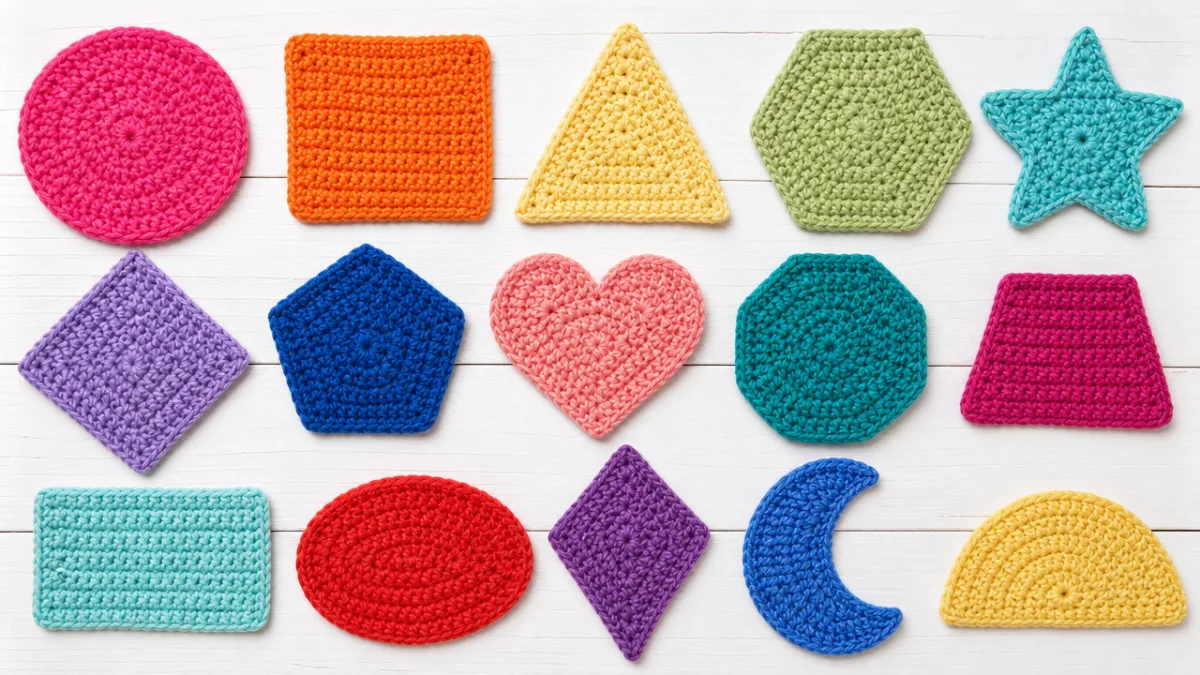
Geometry is perhaps the most immediately obvious branch of mathematics present in fiber arts. When a knitter works a flat square dishcloth or a crocheter constructs a granny square, they are working directly with geometric forms. The construction of circles in crochet is a particularly elegant geometric exercise: to create a flat circle, a crafter must increase the number of stitches in each round at a precise and consistent rate. Increase too slowly and the fabric will cup inward into a bowl; increase too quickly and it will ruffle and wave. The perfect flat circle requires exactly the right ratio of increases, a principle rooted in the geometry of circumference and area.
Beyond flat shapes, fiber arts venture boldly into three-dimensional geometry. Knitted hats, socks, and sweater sleeves require crafters to construct curved, tubular, and spherical surfaces using nothing but a length of continuous yarn and a set of needles. The construction of a sock heel, for example, involves a sophisticated geometric operation called short-row shaping, where rows of different lengths are stacked to create a curved cup that mirrors the shape of a human heel. This is geometry in action, not drawn on paper but built stitch by stitch in three-dimensional space.
Polygon construction is another area where crochet excels as a teaching tool. A flat hexagon is worked by making six equal increases per round, always in the same six positions, so that six distinct corners emerge naturally from the mathematics of the stitch count. Pentagons require five, octagons require eight, and so on. These principles underpin not only crochet design but also architecture, engineering, and the study of crystal structures. When a child crochets their first hexagon, they are, without knowing it, engaging with the same geometric logic that governs the structure of a honeycomb or the panels of a soccer ball.
Arithmetic and Counting: The Foundation of Every Pattern
Every knitting and crochet pattern is, at its core, an exercise in arithmetic. A crafter must constantly add, subtract, multiply, and divide as they work. Calculating how many stitches to cast on for a given width at a particular gauge requires multiplication and division. Figuring out how to space decreases evenly across a row of stitches to shape a sleeve cap or a neckline requires careful division and sometimes the handling of remainders. Even the simple act of counting stitches on a needle at the end of a row is an act of arithmetic that keeps the entire project on track.
Patterns themselves are written as condensed arithmetic instructions. A direction such as “decrease one stitch every four rows, six times, then every six rows, four times” is a compact arithmetic sequence that requires the knitter to plan ahead, tracking progress through a series of calculations. More complex patterns layer multiple arithmetic sequences simultaneously, asking the crafter to work shaping at the sides of a garment while also tracking pattern repeats across the width and length adjustments for size. Managing all of these concurrent calculations develops a genuine practical fluency with arithmetic that is difficult to acquire through abstract exercises alone.
Gauge swatching, a practice that experienced crafters treat as non-negotiable, is a miniature lesson in ratio and proportion. If a pattern calls for twenty stitches and twenty-eight rows per four inches, but your personal swatch measures twenty-two stitches and thirty rows per four inches, you must adjust the stitch counts throughout the entire pattern proportionally to achieve the correct finished size. This is straightforward ratio arithmetic, but it is also the kind of arithmetic that many people find confusing in a classroom yet execute correctly and confidently when their beloved sweater depends on getting it right. The stakes make the math real.
Fractions and Ratios: Scaling Patterns Up and Down
The world of pattern scaling brings fractions and ratios to the very front of the crafting experience. A designer who creates a pattern in one size must often scale it to fit a range of body types and measurements. This is not as simple as multiplying every number by a constant factor, because different parts of a garment scale at different rates. The body width scales with circumference, the sleeve length scales more or less linearly with arm length, and certain design elements like pockets and button bands may not scale at all. Navigating this complexity requires a confident, flexible understanding of fractions and ratios that many crafters develop entirely through practice.
Colorwork patterns illustrate the power of ratios in a visually stunning way. A Fair Isle or stranded colorwork pattern is defined by the ratio of colored stitches to background stitches in each row. Changing the ratio shifts the visual weight of the pattern, making motifs appear bolder or more delicate. When a crafter wants to adapt a colorwork chart to a different stitch count, they must maintain the essential ratios of the design while fitting the new numbers, which is precisely the kind of proportional reasoning that fractions are designed to express. The resulting fabric is a visible proof that the ratio has been correctly preserved or intentionally altered.
Yarn quantities also bring fractions into sharp practical focus. If a pattern calls for 800 yards of yarn and you have only a partial skein, calculating whether you have enough to complete a specific section requires working with fractions of total quantities. Crafters regularly calculate that they have used roughly three-fifths of their yarn and have completed only half the pattern, meaning they need to adjust their plans or acquire more yarn. These are real-world fraction problems with real-world consequences, and the motivation to get them right is considerably higher than any textbook exercise could provide.
Symmetry and Tessellation: Repeating Patterns in Fiber
Symmetry is one of mathematics’ most beautiful concepts, and it is absolutely central to the design of knitted and crocheted fabric. A pattern that is symmetrical around a central axis will lie flat and look balanced on the body, while a pattern that lacks the intended symmetry will twist, pull, or simply look wrong. Crafters develop a keen intuitive eye for symmetry precisely because asymmetry has such immediate and obvious consequences in their finished work. Understanding the difference between reflective symmetry, where one side is the mirror of the other, and rotational symmetry, where a design looks the same after being rotated, is a fundamental skill in both mathematics and textile design.
Tessellation, the tiling of a plane with repeating shapes that fit together without gaps or overlaps, is the mathematical concept behind virtually every repeating stitch pattern in knitting and crochet. A cable pattern, a lace repeat, a seed stitch texture — all of these are tessellations. The stitch repeat is the fundamental tile, and the fabric is created by repeating that tile across and down the textile. When a crafter talks about a pattern with a six-stitch repeat, they are describing a tessellation unit. Understanding this connection helps crafters modify patterns intelligently, knowing that a stitch count must be a multiple of the repeat unit, or else the tessellation will break and the fabric will not look as intended.
The mathematical study of wallpaper groups, which classifies all possible two-dimensional symmetry patterns, identifies exactly seventeen distinct types of repeating pattern symmetry. Remarkably, traditional textile traditions around the world have independently discovered and exploited most or all of these seventeen types over centuries of craft practice. A Scandinavian knitting tradition, a West African weaving tradition, and a Japanese crochet tradition may all independently produce fabrics embodying the same mathematical symmetry group, discovered through artistic intuition rather than formal mathematical analysis. This convergence speaks to the deep and universal nature of mathematical structure in human creative work.
Topology and Non-Euclidean Geometry: The Deeper Mathematics of Yarn
Topology is the branch of mathematics concerned with properties of shapes that remain unchanged under stretching, bending, and deformation, so long as the surface is not torn or glued. Knitted and crocheted fabric is an extraordinarily rich topological object. A tube of knitting, such as a sock or a sleeve, is topologically equivalent to a cylinder. A knitted sphere, such as a stuffed toy, is topologically equivalent to a ball. A piece of flat fabric with a hole in it, such as a crocheted donut-shaped basket, is topologically equivalent to a torus, the same shape as a mathematician’s beloved coffee cup. Crafters navigate topological transformations constantly when they close a sock toe or join a garment seam.
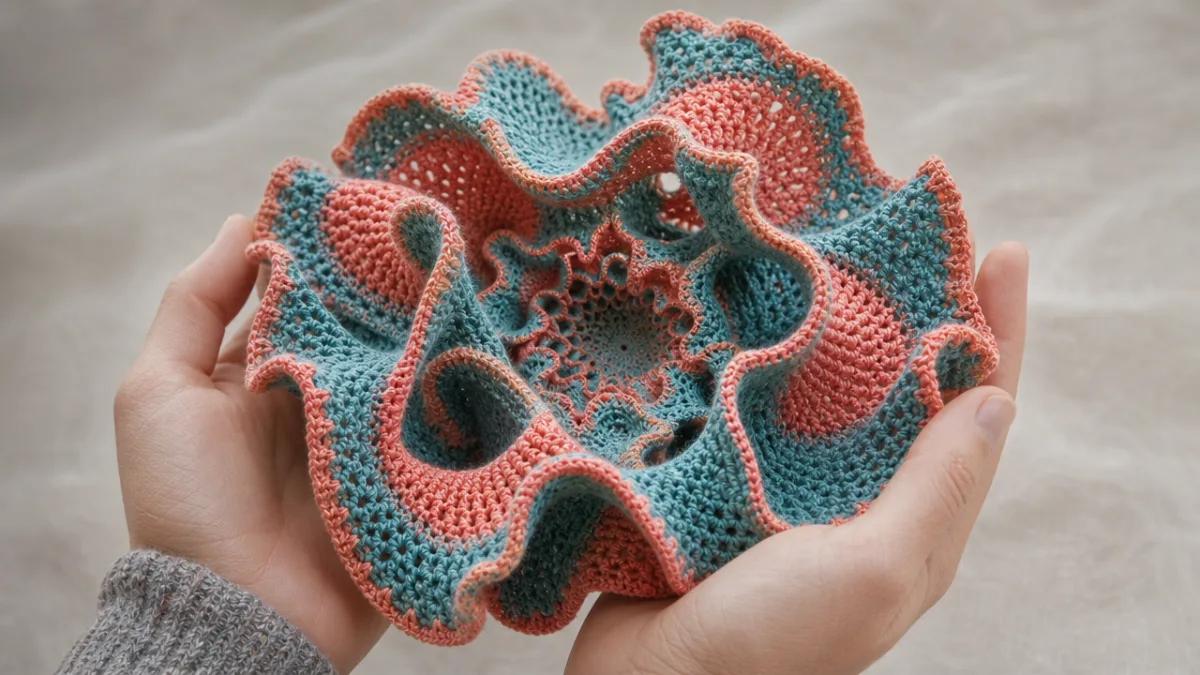
Hyperbolic geometry, the study of surfaces with constant negative curvature, was for a long time one of the hardest areas of mathematics to communicate to a non-specialist audience because no one could make a satisfying physical model of a hyperbolic plane. In Euclidean flat geometry, parallel lines never meet. In the positively curved geometry of a sphere, parallel lines eventually converge. In hyperbolic geometry, parallel lines diverge, and there is more space in every direction than flat intuition suggests. Daina Taimina’s crocheted hyperbolic planes solved this representation problem beautifully: by increasing stitches at an exponential rate as you work outward, you create a fabric that ruffles and frills in exactly the way a hyperbolic surface must, giving students a physical, touchable model of a previously abstract concept.
The implications of this discovery extended well beyond the classroom. Hyperbolic geometry describes the shape of certain coral reef structures, the form of sea slugs, the organization of lettuce leaves, and possibly the large-scale structure of the universe itself. By crocheting models of these surfaces, mathematicians and biologists have been able to collaborate in new ways, using fiber art as a shared language for discussing complex geometric structures. The Hyperbolic Crochet Coral Reef project, initiated by the Institute For Figuring, recruited hundreds of volunteer crafters to crochet a massive collaborative installation that modeled reef structures and communicated both mathematical and ecological ideas to museum visitors around the world.
Sequences and Series: The Mathematics of Pattern Progression
Mathematical sequences, which are ordered lists of numbers following a defined rule, appear throughout knitting and crochet in ways that are immediately practical and often beautiful. The most famous mathematical sequence, the Fibonacci sequence in which each number is the sum of the two preceding numbers (1, 1, 2, 3, 5, 8, 13, 21…), produces proportions that human eyes tend to find naturally pleasing. Many experienced textile designers use Fibonacci numbers to determine the widths of stripes in a colorwork project, the proportional spacing of cables across a panel, or the rate of increases in a shawl. The resulting fabric has a visual harmony that the designer may sense intuitively but that has a precise mathematical explanation.
Arithmetic sequences, in which each term increases or decreases by a constant amount, are the backbone of standard shaping instructions in most garment patterns. When a pattern instructs a knitter to decrease one stitch every other row twelve times, then every fourth row eight times, it is guiding them through two consecutive arithmetic sequences. The total rate of decrease slows as the shaping progresses, producing a smoothly curved edge rather than an abrupt straight line. Understanding that these instructions are describing sequences allows experienced crafters to modify them confidently, knowing that changing the interval between decreases changes the curvature of the resulting shape in a predictable and calculable way.
Geometric sequences, in which each term is multiplied by a constant factor, appear in the exponential increases required to produce hyperbolic surfaces, as noted above, but also in certain types of modular crochet construction. The number of modules required to cover a surface can follow a geometric progression as the design grows outward, and understanding this helps crafters plan material requirements accurately before beginning a large project. More broadly, sequences and series are the mathematical language of pattern itself, of things that change in regular and predictable ways. Because knitting and crochet are fundamentally about structured repetition and controlled change, they are naturally expressed in the language of sequences, making the craft an ideal intuition pump for one of mathematics’ most powerful and pervasive ideas.
Conclusion: Why Every Crafter Is Also a Mathematician
The six mathematical concepts explored in this article — geometry, arithmetic, fractions and ratios, symmetry and tessellation, topology and non-Euclidean geometry, and sequences and series — do not exhaust the mathematical content of knitting and crochet. They do not even come close. Crafters also engage with probability when planning projects from limited yarn quantities with uncertain dye lots, with graph theory when working out how to connect modular pieces, with statistics when interpreting gauge swatches as samples from a population of possible fabric behaviors. The mathematics of fiber arts is vast, layered, and genuinely profound.
What makes this connection so valuable is not merely that it is intellectually interesting, though it certainly is. The real power lies in what it suggests about how mathematical understanding is developed and communicated. Many people who struggle with mathematics in the abstract find it immediately accessible when it is embedded in a physical, purposeful, creative activity. The stakes are clear, the feedback is immediate, the results are tangible and beautiful, and the mistakes are correctable. This is the ideal learning environment, and fiber arts provide it naturally. Educators who bring yarn and needles into mathematics classrooms consistently report increased engagement, deeper conceptual understanding, and a meaningful shift in students’ beliefs about who is and is not capable of mathematical thinking.
If you knit or crochet, you are already a practicing mathematician, working every day with geometry, arithmetic, ratio, symmetry, topology, and sequences. The stitches you count, the shapes you construct, the patterns you follow and modify and invent — all of these are mathematical acts. Recognizing this does not diminish the artistry of what you make; if anything, it deepens the appreciation for a craft tradition that has always been, at its most essential level, a human conversation with the mathematical structure of the universe, conducted in wool and cotton and silk, one stitch at a time.








What do you think?
It is nice to know your opinion. Leave a comment.