










DIY Origami Paper Crafts: A Complete Guide to the Ancient Art of Paper Folding
The Rich History and Cultural Roots of Origami
Origami is so much more than a rainy-day hobby. It’s a centuries-old art form with real cultural weight, tracing its roots back to sixth-century Japan, when Buddhist monks first brought paper to the country. The word itself comes from the Japanese oru (to fold) and kami (paper), and folding quickly became woven into religious ceremonies, social customs, and everyday expressions of respect. Early origami models showed up in Shinto rituals and as decorative accents on gifts — a reflection of the idea that paper itself held a kind of spiritual worth.
Over time, what started as a sacred and aristocratic tradition gradually became something anyone could enjoy. During Japan’s Edo period (1603–1868), paper got cheaper and origami spread to everyday people. Instruction books called orikata were published to preserve folding patterns and pass them down through families. Then, in the twentieth century, masters like Akira Yoshizawa elevated it into a recognized fine art and developed a universal notation system — meaning anyone, anywhere in the world, could follow a folding diagram without speaking a word of Japanese.
These days, origami has gone truly global. Artists, mathematicians, engineers, and casual crafters all find something in paper folding — whether that’s a meditative quiet or a satisfying intellectual puzzle. It’s even made its way into the design of solar panels, medical stents, and space technology, which is a remarkable thing to think about when you’re sitting at your kitchen table with a square of paper. Knowing that history makes every fold feel like it means a little more.
Essential Materials and Tools for Getting Started
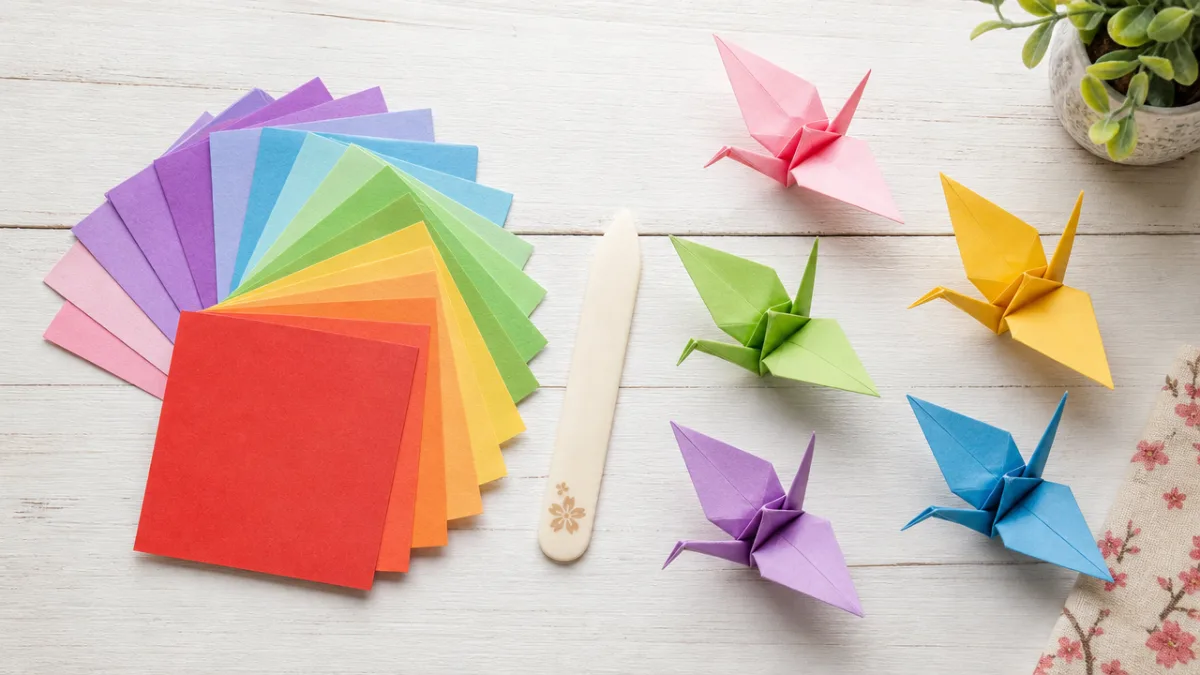
One of the best things about origami as a DIY craft is how little you actually need to get started. At its most bare-bones, all it takes is a single square sheet of paper — making it one of the most accessible and budget-friendly crafts out there. That said, the paper you choose really does matter. Standard printer paper is fine for a trial run, but it’s usually too thick and stiff for anything intricate, and fighting with the wrong paper is a quick way to get frustrated before you’ve even gotten going.
Traditional Japanese washi paper is the gold standard. Made from plant fibers like gampi, mitsumata, or mulberry, washi is thin but strong — it holds a crease beautifully and doesn’t tear easily. For most DIY projects, though, the colorful kami paper you’ll find at any craft store or online hits a sweet spot between quality and price. It comes in a huge range of colors, patterns, and sizes, from tiny 3-inch squares for miniature models to large 10-inch sheets that give you room to work on more complex designs.
A few simple tools can make a real difference, too. A bone folder — a small, smooth tool for pressing and scoring folds — helps you get those sharp, satisfying creases that are the hallmark of good origami. A ruler is handy for making sure your paper is actually square before you start, which matters more than you’d think when you’re aiming for a symmetrical model. Some folders keep tweezers nearby for coaxing tiny folds into place, and a clean, flat, well-lit workspace makes everything easier as models start getting more layered and complex.
- Kami paper: Colorful, lightweight, and widely available — ideal for beginners and intermediate folders
- Washi paper: Traditional Japanese paper offering superior strength and texture for display-quality pieces
- Bone folder: Creates sharp, clean creases and dramatically improves fold precision
- Tweezers: Essential for manipulating small or tightly layered sections in complex models
- Ruler and pencil: Useful for trimming paper into perfect squares before folding
Beginner-Friendly Origami Projects to Build Your Confidence
Every origami journey starts with the foundational models — the ones that teach you the core folds you’ll come back to over and over. The classic paper crane, or tsuru, is probably the most iconic origami model in the world and makes a great early goal, though it’s a step up from true beginner territory. Before tackling it, you’ll get a lot out of simpler forms like the traditional boat, the jumping frog, and the modular cube. Each one introduces key folds in a way that feels manageable and, importantly, satisfying.
The mountain fold and valley fold are the two building blocks that everything else in origami is built on. A valley fold brings the paper toward you, making a V-shaped crease; a mountain fold pushes it away, creating an inverted V. From just those two moves, every model — from a simple boat to a complex dragon — is constructed. Taking time to really practice these until they feel natural is one of the best things you can do early on. Getting consistent with your folding pressure and accurate when matching up edges and corners is the difference between results you’re proud of and results you want to throw across the room.
Once the basic folds feel solid, the paper crane is a wonderful first milestone. Its sweeping wings and graceful shape make it one of the most rewarding models to finish, and Japanese folklore says that folding a thousand cranes — called senbazuru — earns you a wish. Many people string them into garlands, use them as wedding decorations, or give them as heartfelt handmade gifts. The crane also introduces the inside reverse fold, the petal fold, and the squash fold, building up a vocabulary of techniques that will carry you through hundreds of future projects.
- Start with a perfectly square sheet of paper, color side down
- Fold diagonally both ways and horizontally both ways, creasing firmly each time
- Collapse into a preliminary base by bringing all four corners together
- Create a petal fold on both sides to form the bird base
- Shape the neck and tail, then gently pull the wings apart to open the body
Intermediate and Advanced Origami Techniques to Explore
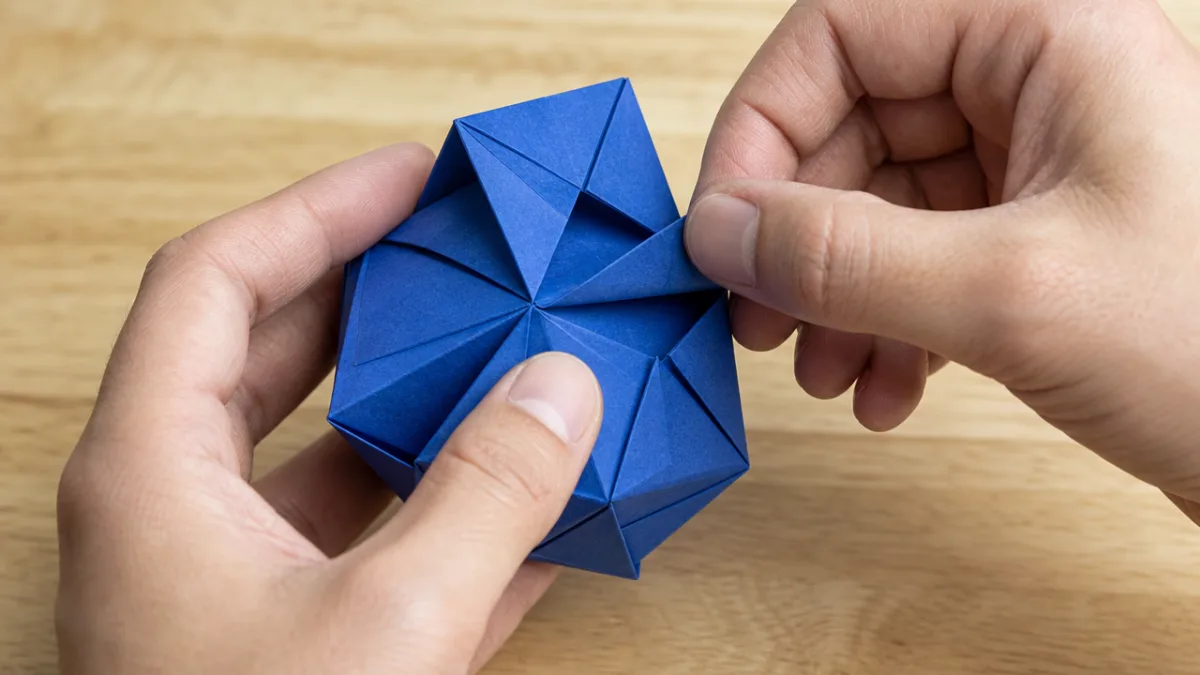
Once the basics feel comfortable, a whole new world opens up. Modular origami — also called unit origami — is a great bridge between beginner and advanced folding. You fold multiple identical units from separate sheets and then fit them together without any glue, relying entirely on interlocking flaps and pockets to hold the whole thing together. The results are often stunning three-dimensional geometric forms — simple cubes and stars on one end of the spectrum, elaborate polyhedra that look more like mathematical sculpture than paper craft on the other.
Wet folding is another technique that changes what’s possible entirely. Developed by Akira Yoshizawa, it involves slightly dampening the paper before folding, which lets you curve and sculpt it into organic, flowing shapes that dry hard and hold their form permanently. Animals made this way have a lifelike softness and dimension that flat-folded models just can’t achieve. It works best with thicker, unsized papers that can handle a little moisture without falling apart, and it rewards patience — you have to work slowly and let the paper dry in position before you let go.
Box pleating and tessellations are where things get really serious. Box pleating means covering the entire sheet in a dense grid of pre-creases before you start collapsing the design, which lets you create models with an almost unbelievable number of points and details from a single uncut square. Tessellations, meanwhile, are repeating geometric patterns that spread across the paper’s surface, producing incredible light-filtering effects when held up to a lamp. Both techniques have attracted genuine academic attention — researchers have borrowed their mathematical principles for engineering and design applications around the world.
Creative DIY Origami Projects for Home Décor and Gifting
One of the most fun things about origami is how naturally it crosses over into everyday life — for decorating, for gifting, for making your home feel a little more like you. Origami wall art has become genuinely popular in modern interiors, where clusters of geometric paper forms in coordinating colors create focal points that are both tactile and visually striking. Imagine a gallery wall made entirely of origami butterflies, foxes, and geometric diamonds in a curated palette — it’s the kind of thing that makes people stop and ask where you got it, and the answer is that you made it yourself.
Origami gift wrapping is also a lovely sustainable alternative to conventional paper and ribbon. Paper equivalents of the Japanese furoshiki fabric-folding technique let you wrap even oddly shaped gifts in a single elegant sheet. Origami boxes, envelopes, and gift bags made from decorative paper make the packaging part of the present, and they’re easy to size up or down for anything from a ring to a book. Swapping out a commercial bow for a small origami crane or flower on top of a gift is one of those small touches that people genuinely remember.
Seasonal origami projects give you a reason to fold all year long, and they produce decorations that feel so much more personal than anything you’d pick up at a shop. Origami stars strung on twine make beautiful Christmas garlands; cherry blossoms folded from pink paper are perfect for spring tablescapes; geometric pumpkins in orange and black are surprisingly effective Halloween ornaments. Kids especially love seasonal origami, and making them together is one of those low-key activities that turns into a real memory. Since the materials cost almost nothing, you can experiment freely and fold as many variations as you like.
- Wall art arrangements: Mount finished models on canvas or frames for graphic, textural gallery walls
- Table centerpieces: Group origami flowers, birds, or geometric forms in clusters for event décor
- Garlands and mobiles: String cranes, stars, or butterflies for ceiling installations or window décor
- Gift toppers: Replace bows with small origami figures that become a secondary gift in themselves
- Place cards: Fold name cards into small tents or animal shapes for dinner party settings
The Mindful Benefits of Origami as a Daily Practice
Beyond everything it produces, origami is genuinely good for your brain — and researchers and therapists are increasingly paying attention to why. The repetitive, focused nature of folding engages both hemispheres simultaneously: your left brain handles the sequential, logical steps of following a diagram, while your right brain manages the spatial reasoning and visualization required to picture a three-dimensional form emerging from flat paper. That combination creates a kind of relaxed concentration that many people describe as deeply meditative — similar to the calm you get from mindfulness practice or gentle yoga.
Occupational therapists have used origami therapeutically for years, working with patients recovering from strokes, managing anxiety, or living with conditions like Parkinson’s or arthritis. The fine motor demands of precise folding help maintain and build hand dexterity, and following sequential steps supports memory and cognitive function. For older adults, regular practice has been linked to improved spatial reasoning and sustained mental sharpness. There’s also something genuinely meaningful about the fact that progress is always visible — a finished crane, a completed star — providing a reliable little hit of real accomplishment, especially during harder stretches of life.
For kids, the benefits go well beyond the craft table. Origami builds patience and perseverance, teaching children to slow down and follow instructions carefully instead of rushing to the end. It develops mathematical intuition too — kids who fold regularly tend to develop a natural feel for geometry, fractions, and symmetry that carries over into their schoolwork. Folding together, whether in a classroom or around the kitchen table, builds communication skills as people put into words what they’re seeing and doing with their hands. And at its heart, origami delivers a reminder that both children and adults need: that starting with something flat and simple, and working at it with a little patience and intention, you can make something genuinely beautiful and surprising.

Whether you’re looking for a new creative hobby, a more personal way to give gifts, a calming daily ritual, or something to do with kids that’s actually engaging, origami offers something genuinely rare: a craft that’s both ancient and completely current, simple to start and impossibly deep to explore. Every fold connects you to a tradition that spans centuries and continents. And every finished model is a small reminder that transformation — of paper, of patience, of perspective — is always within reach.








What do you think?
It is nice to know your opinion. Leave a comment.