










“`html
The Art of Scrapbooking: A Complete Guide to Preserving Your Most Precious Memories
What Is Scrapbooking and Why It Matters
Scrapbooking is one of those hobbies that’s hard to explain to someone who’s never tried it — but once you get it, you really get it. At its heart, it’s about combining photographs, mementos, decorative touches, and your own words to tell the story of your life, or the life of someone you love. It’s so much more than sticking pictures in an album. A scrapbook is a living, breathing creative work that captures not just what things looked like, but how they felt.
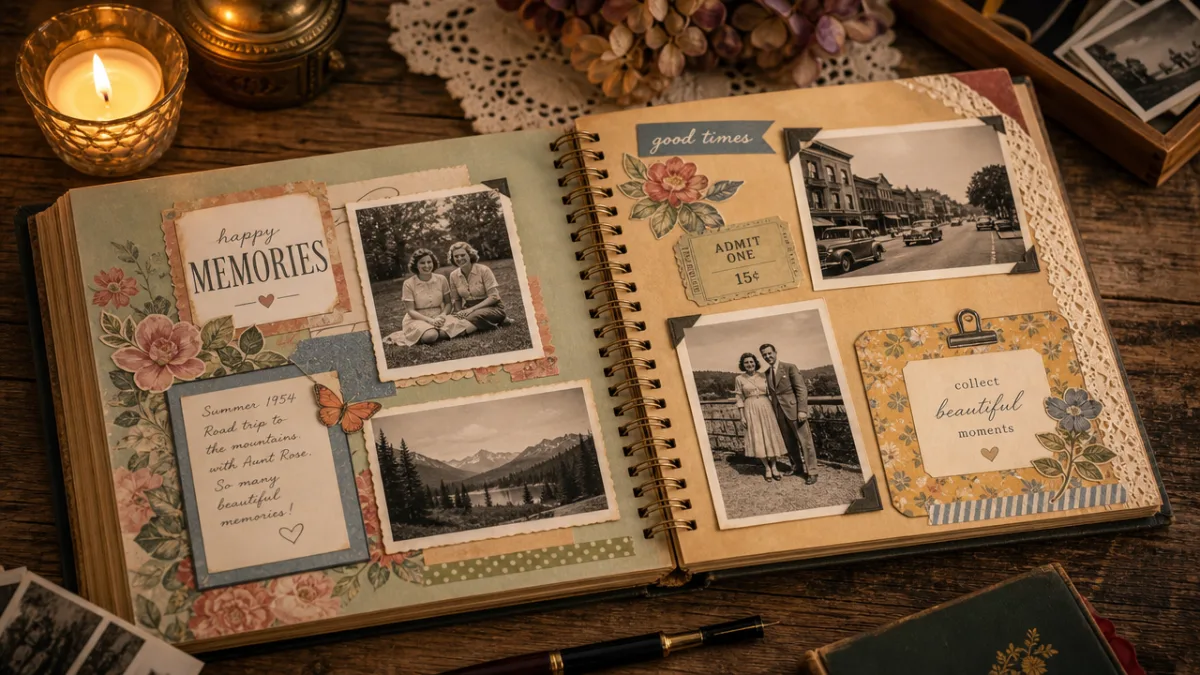
People have been doing versions of this for centuries. Victorian enthusiasts filled elaborate albums with calling cards, pressed flowers, ribbons, and newspaper clippings — part personal diary, part social record. Today’s scrapbooking carries that same spirit forward, blending old-fashioned craft traditions with modern materials, digital tools, and a whole world of embellishments and specialty papers made just for memory-keeping.
What makes scrapbooking genuinely matter is that it asks you to slow down. When you sit with your photos and your supplies, you’re making a conscious decision to honor the moments that shaped you. Research into the psychology of memory-keeping suggests that the act of curating and documenting your experiences actually deepens your emotional connection to them. And beyond your own experience, a well-made scrapbook becomes a gift — to your family, and to whoever comes after you who wants to know what your life was really like.
Essential Supplies Every Scrapbooker Needs
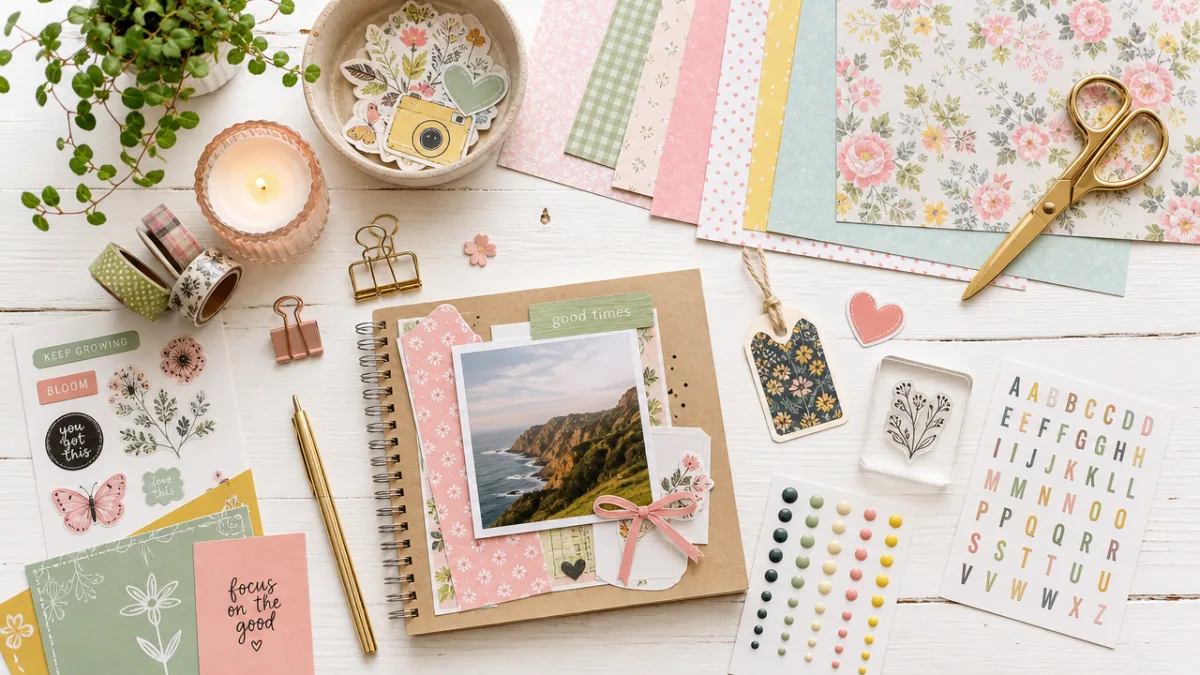
Getting started doesn’t have to mean spending a fortune or knowing exactly what you’re doing. But having a sense of the core supplies will make your first pages a lot less frustrating. The starting point is the album itself. Albums come in several formats — post-bound, three-ring binder, spiral, and strap-hinge — and each has its own pros and cons when it comes to flexibility, capacity, and how easy they are to work with. For most beginners, a post-bound album with 12×12 inch pages is a great first choice, since it fits the widest range of pre-cut papers and page protectors you’ll find at any craft store.
Cardstock and patterned paper are the workhorses of any layout. You’ll want to look for papers labeled acid-free and lignin-free — that’s what keeps them from yellowing, becoming brittle, or damaging your photos over time. Most well-known scrapbooking brands already meet archival standards, but it’s worth a quick label check. Cardstock gives your pages a solid, sturdy base, while patterned papers — and there are truly endless options — add color, texture, and a visual theme that ties everything together.
Beyond paper and albums, a well-stocked supply kit typically includes the following items that any dedicated scrapbooker will reach for again and again:
- Acid-free adhesives such as double-sided tape, adhesive dots, and photo-safe glue sticks
- A paper trimmer or guillotine cutter for clean, straight edges
- Scissors, including decorative-edge scissors for creative borders
- Stamps and ink pads for adding custom text and decorative motifs
- Die-cuts, stickers, and chipboard embellishments for dimensional accents
- Journaling pens in a variety of colors and tip sizes
- Bone folders and scoring tools for precise folds and creases
As you get more comfortable, you’ll naturally start adding more specialized tools — cutting machines like Cricut or Silhouette, embossing powders, watercolor supplies, specialty adhesives for heavier embellishments. But starting simple is genuinely the better path. Learning the fundamentals of composition, color, and photo placement with a modest toolkit will teach you far more than stocking up on every gadget in the store ever could.
Design Principles That Transform Good Pages into Great Ones
A few core design principles can take your pages from “pretty good” to genuinely beautiful — and once you understand them, you start seeing them everywhere. The most important is visual hierarchy, which is just a fancy way of saying your page should naturally guide a viewer’s eye from the most important thing to the least important. In practice, that usually means your main photo should be the largest and most prominent element, with everything else arranged to support it rather than compete with it.
Color theory matters more than people expect. A simple trick for beginners is to pull your color palette straight from the photos on a page — find a paper that echoes the warm red of fall leaves, or choose a neutral cardstock that lets a bright summer portrait really pop. Sticking to three to five colors tends to produce the most cohesive results. Playing with contrast — light elements on dark backgrounds, or the other way around — adds energy and keeps text and photos easy to read.
White space is something a lot of new scrapbookers wrestle with. There’s a real temptation to fill every inch of a page with stickers and embellishments and layers of paper, but restraint almost always looks more polished. Leaving deliberate open space around your focal photo actually draws more attention to it and gives the whole layout room to breathe. Some of the most stunning scrapbook pages out there are ones where the designer had the confidence to leave a big chunk of beautiful cardstock completely empty and just let the photos and journaling do the work.
Layering is another technique worth getting comfortable with early on. Building up papers of different patterns and textures beneath your photos creates a sense of depth that a single flat background just can’t match. Tearing paper edges, running an ink pad along the borders of elements to distress them, tucking small embellishments under the corners of photos — these are all classic layering moves that give finished pages that warm, handmade quality that’s hard to replicate any other way.
Choosing Themes and Telling Stories Through Your Pages
Every good scrapbook page tells a story, and having a clear theme or narrative focus is what separates a layout that feels meaningful from one that just feels like a bunch of photos on a page. Thematic albums — built entirely around one vacation, a child’s first year, a wedding, a family reunion — are popular for a reason. They give you a natural framework to work within and make it much easier to develop a consistent visual style that carries across many pages. The result is something that feels cohesive and satisfying both to make and to look back on.
Journaling — the written part of a scrapbook page — is where a lot of newer scrapbookers freeze up, which is a shame, because it’s arguably the most important piece of the whole thing. Decades from now, the people who flip through your album won’t just want to see faces in photos. They’ll want to know what was happening, how you were feeling, what the weather was like, what someone said that made everyone crack up. Even a few sentences of honest, specific writing transforms a pretty layout into something that actually functions as family history. Write in your own voice. Use names, dates, and places. Don’t shy away from real emotion.
Some of the most popular themes for dedicated scrapbook albums include:
- Baby and childhood milestones — first steps, first words, birthdays, school years
- Travel and adventure — vacation memories, road trips, international journeys
- Seasonal and holiday celebrations — Christmas, Thanksgiving, Halloween traditions
- Relationships and friendship — couples, best friends, family portraits
- Personal growth and achievements — graduations, career milestones, fitness journeys
- Everyday life — morning routines, backyard play, Sunday dinners
Don’t sleep on everyday life as a scrapbooking subject. The big moments — weddings, vacations, milestone birthdays — tend to be well photographed and well remembered anyway. It’s the ordinary Tuesday afternoons that disappear from memory almost completely, and those are the ones that make the most unexpectedly moving pages. Future generations will treasure a real glimpse into what a regular day in your house looked and felt like far more than another perfectly posed holiday portrait.
Digital Scrapbooking: Where Technology Meets Tradition
Digital scrapbooking has gone from a niche corner of the hobby to a full-blown global community, and it’s easy to see why. Using tools that range from Adobe Photoshop and Photoshop Elements to more beginner-friendly platforms like Canva, MyMemories Suite, or PicMonkey, digital scrapbookers design their layouts entirely on a computer or tablet. Those finished pages can be printed and bound into physical albums, shared on social media, turned into digital slideshows, or published as gorgeous photo books through services like Shutterfly, Mixbook, or Artifact Uprising.
The advantages are real. The most obvious one is that you don’t need a single bin of supplies or a dedicated craft space — everything lives on your hard drive. Digital kits, which typically include digital papers, element packs, and fonts, are also usually much cheaper than physical supplies, and you can find and download them instantly from places like Etsy, Creative Market, or the Oscraps community. Mistakes vanish with a single undo. Layers can be rearranged in seconds. And you can reuse any digital element across as many pages as you want without ever running out.
That said, plenty of scrapbookers who start digitally eventually feel pulled back toward physical supplies, because there’s something about working with actual paper and photos and little embellishments in your hands that a screen just can’t replicate. The good news is you don’t have to pick a side. Hybrid scrapbooking — mixing digital design with physical crafting — has become a popular middle path. A hybrid scrapper might print a background they designed on their computer, layer real embellishments on top, and then scan or photograph the finished page to share online. It really is the best of both worlds.
Building a Sustainable Scrapbooking Practice
One of the most common frustrations in scrapbooking — at every skill level — is the ever-widening gap between the photos you’ve taken and the pages you’ve actually finished. The community has a name for this backlog: the “photo pile.” It can feel genuinely overwhelming, and that creeping sense of being perpetually behind is one of the main reasons people drift away from the hobby. The antidote is building a practice that feels sustainable and enjoyable, not one that feels like a guilt trip.
Organization is the first step. Whether you sort your photos by date, by theme, by person, or by event matters less than just having some kind of system. A lot of scrapbookers find it helpful to keep a dedicated folder on their computer for photos that haven’t been processed yet, tag images right after downloading them from their phones, and block out a regular time — maybe one afternoon a month — for choosing, editing, and printing the photos they want to use. Treating that prep time as part of the creative process, rather than a chore to power through before the real work starts, makes a huge difference.
Setting realistic goals matters just as much. Instead of telling yourself you need to finish an entire album before you can feel good about your progress, try focusing on one page at a time, or a small set of two or three layouts. Celebrating those smaller completions keeps your motivation up and gives you a real, tangible sense of accomplishment. Many experienced scrapbookers keep an inspiration album — filled with layouts they love, whether their own past work or pages they’ve collected from communities like Pinterest — to turn to whenever the creative well runs dry.
The scrapbooking community itself is one of the hobby’s best-kept secrets and one of the most reliable sources of ongoing motivation. Online communities on Instagram, in Facebook groups, and on dedicated forums offer constant inspiration, warm and generous feedback, and a genuine sense of belonging. Challenges and prompts — weekly sketches, monthly color palettes, “scrap lifts” where you recreate a layout you love using your own photos — are fantastic for pushing through creative blocks and quietly building your skills. And if you ever get the chance to attend a local crop, where scrapbookers gather to work together in person, go. It’s a completely different energy than working alone at your kitchen table, and it tends to be incredibly energizing.
At the end of the day, the most sustainable scrapbooking practice is one that actually brings you joy. Give yourself permission to race through some pages and to pour everything into others. Give yourself permission to leave certain memories unscrapbooked, and to feel okay about that. The goal was never to document everything — it was to savor and honor the things that matter most. When you approach it with that kind of generosity toward yourself, every page you finish becomes something more than a record of the past. It becomes a small, handmade act of love.
“`








What do you think?
It is nice to know your opinion. Leave a comment.