










The T-Shirt Surplus: A Growing Environmental Crisis
Every year, the global fashion industry produces an estimated 2 billion t-shirts, making them the single most manufactured garment on the planet. The numbers are staggering: Americans alone discard roughly 11 million tons of textile waste annually, and a significant portion of that mountain of fabric is made up of cotton tees that have lost their novelty, faded past wearability, or simply fallen out of fashion. For decades, the dominant solution has been to donate, donate, donate — but the uncomfortable truth is that secondhand markets are overwhelmed, and a large percentage of donated clothing ends up in landfills or shipped to developing nations where it disrupts local textile economies.
The environmental cost of a single cotton t-shirt is harder to ignore than ever. Producing just one requires approximately 2,700 liters of water — roughly what one person drinks over the course of two and a half years. Add to that the pesticide use in conventional cotton farming, the dyes and finishing chemicals used in manufacturing, and the carbon footprint of global shipping, and you begin to understand why fashion consistently ranks among the world’s most polluting industries. The t-shirt, that humble wardrobe staple, carries a surprisingly heavy environmental burden from the moment the cotton seed is planted.
This is the crisis that a growing movement of artists, designers, and craftspeople are choosing to confront head-on — not with despair, but with scissors, dye, thread, and imagination. Rather than accepting the cycle of fast fashion consumption and disposal as inevitable, these creatives are rewriting the story of the discarded t-shirt. They are transforming castoff garments into art pieces, functional home goods, wearable fashion statements, and community projects that challenge us to see what we have thrown away in an entirely new light. The upcycling movement is not just a trend; it is a serious cultural and environmental response to a problem that has been building for decades.
What Upcycling Really Means — And Why It Matters More Than Recycling
Most people are familiar with recycling, the process of breaking down materials into raw components that can be reused in manufacturing. Upcycling is something fundamentally different and, in many ways, more powerful. Upcycling means taking an existing object and transforming it into something of equal or greater value without stripping it down to raw materials first. For textiles, this distinction matters enormously. Recycling a t-shirt typically means shredding it into fiber that can be respun into low-grade insulation or stuffing. Upcycling a t-shirt means turning it into a quilt, a tote bag, a wall hanging, or a completely new garment that someone will cherish and keep for years.
The energy savings alone make upcycling a compelling alternative. When you upcycle a garment, you preserve all the energy, water, and labor that went into producing the original fabric. You bypass the energy-intensive processes of fiber extraction, spinning, weaving, and finishing that would be required to create a new piece of textile from scratch. Studies suggest that extending the life of a garment by just nine months can reduce its carbon, water, and waste footprint by roughly 20 to 30 percent. Multiply that across millions of t-shirts and the cumulative environmental benefit becomes genuinely significant.
Beyond the environmental mathematics, upcycling carries a philosophical dimension that resonates deeply with a generation of consumers who have grown skeptical of disposable culture. There is something meaningful about the act of repair and transformation — acknowledging that the object in front of you has a history worth honoring, that the resources embedded in it deserve respect. Artists working in upcycled textiles often describe their practice in these terms: not just making something new, but having a conversation with the material about what it wants to become. This approach to creativity stands in direct opposition to the planned obsolescence that drives the fast fashion industry.
The Artists Turning Old T-Shirts Into Treasures
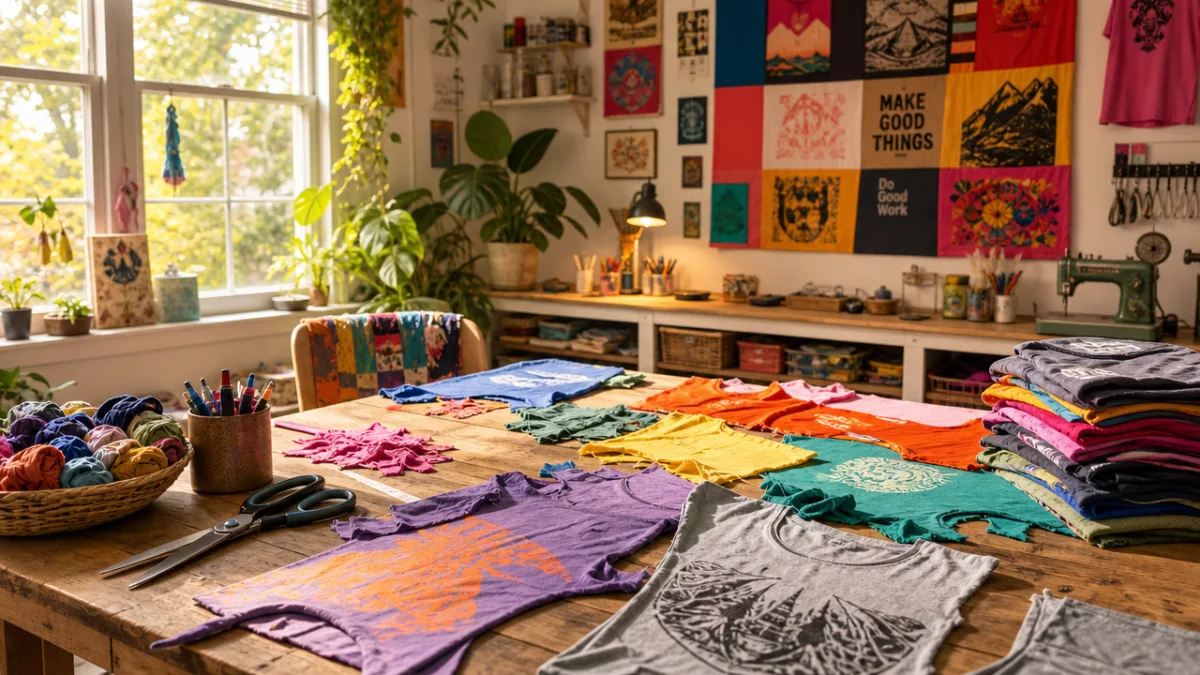
Across the world, a diverse community of artists has built entire creative practices around the transformative potential of the discarded t-shirt. Some work with graphic tees, preserving beloved band logos and vintage print designs by incorporating them as focal points in quilts or patchwork garments. Others are drawn to the structural properties of jersey knit fabric — its stretch, its softness, its resistance to fraying — and use these qualities to create woven baskets, braided rugs, and intricate macramé wall hangings that would be impossible to achieve with woven fabric. The range of work emerging from this community is genuinely surprising in its sophistication and beauty.
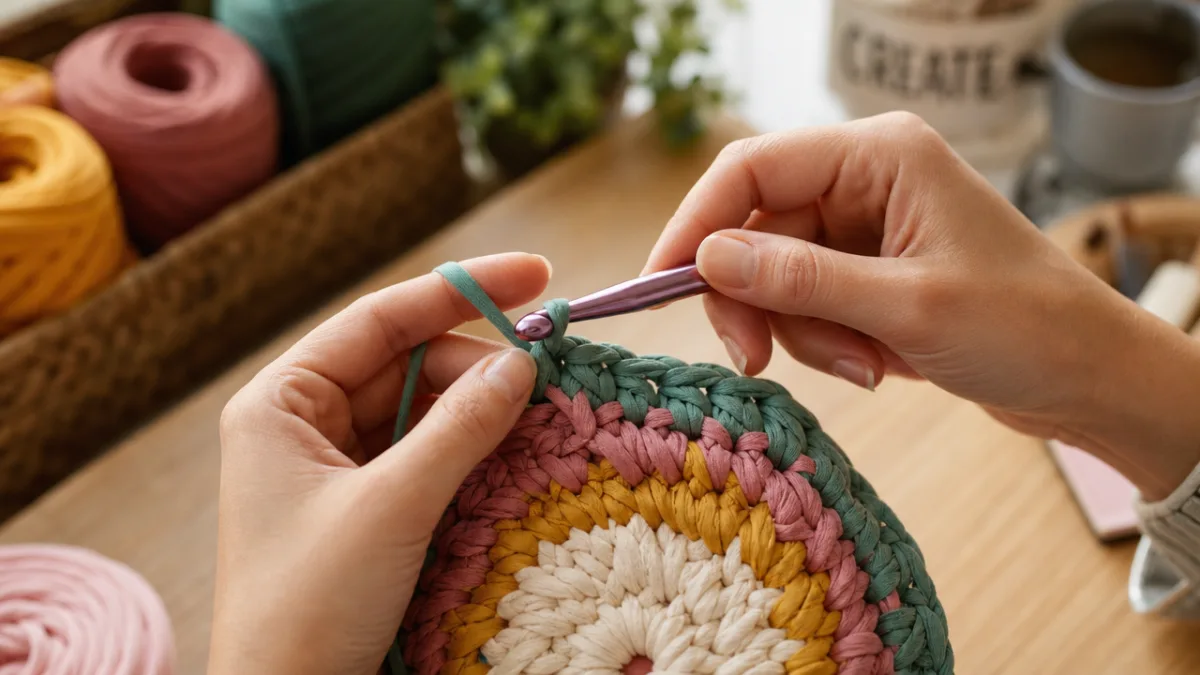
One particularly influential approach involves what textile artists call “t-shirt yarn” or “tarn.” By cutting an old cotton tee into a continuous spiral strip, a craftsperson can produce a surprisingly long length of stretchy, chunky yarn that is ideal for knitting, crocheting, or weaving. The resulting material has a soft, rope-like quality and produces finished pieces — bags, baskets, pot holders, floor mats — with a distinctive textural character that commercially produced yarns simply cannot replicate. Tarn has become a gateway craft for thousands of people who have discovered that transforming a drawer full of unwanted shirts into a beautiful rug is far more satisfying than dropping them in a donation bin and hoping for the best.
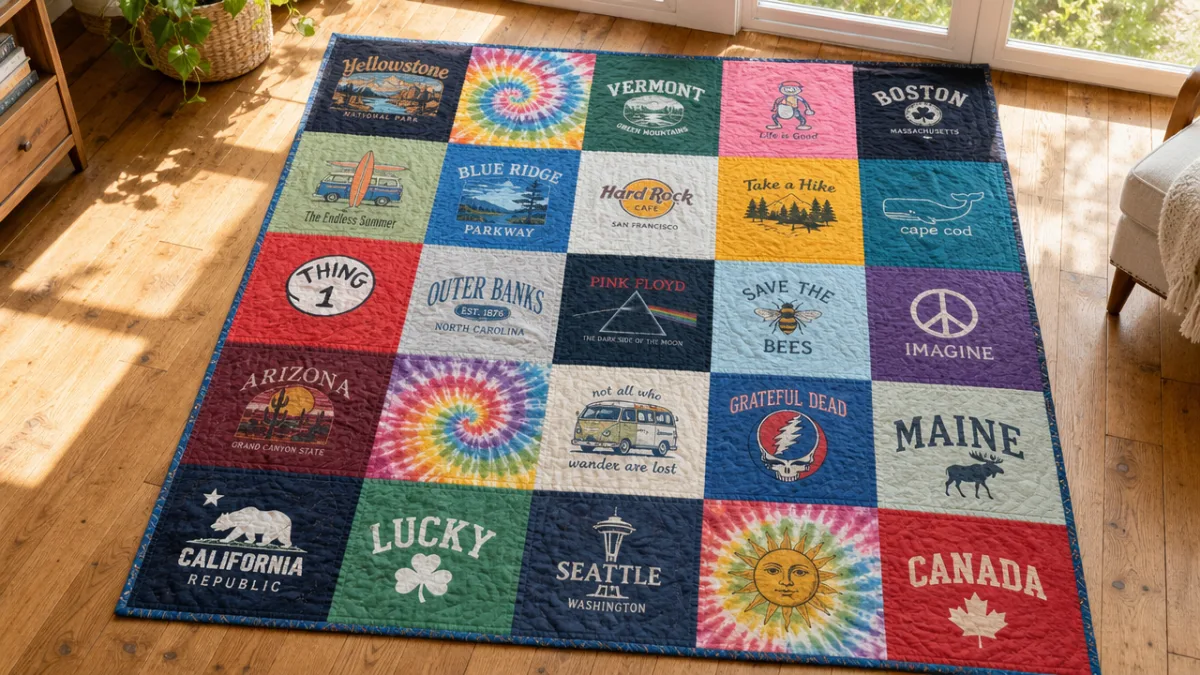
Other artists work at a more conceptual level, treating the t-shirt not just as raw material but as a cultural artifact loaded with meaning. Graphic tees carry stories — the concerts attended, the causes supported, the teams cheered, the vacations taken. Artists like New York-based designer Emily Fischer have built collections around the idea of “memory quilts,” working with clients to turn personal collections of meaningful shirts into heirloom textiles that preserve those stories in a new form. The finished pieces function simultaneously as art objects, family archives, and practical bedcovers. They are among the most emotionally resonant objects in contemporary craft, precisely because every square of fabric carries a piece of lived experience.
Techniques and Tools: How to Begin Your Own Upcycling Practice
The beauty of t-shirt upcycling is that it requires remarkably little in the way of equipment or prior experience. Unlike many craft practices, you do not need a sewing machine to get started, though one certainly expands your possibilities. Some of the most impressive and functional upcycled projects rely on nothing more than a sharp pair of fabric scissors, a ruler, and a willingness to experiment. The forgiving nature of jersey knit fabric — which does not fray when cut — means that beginners can dive in without the intimidation of fraying edges and precise seam allowances that often accompanies sewing with woven textiles.
Here are some foundational techniques that artists and educators recommend for those just beginning their upcycling journey:
- T-shirt yarn (tarn): Cut the body of a t-shirt into horizontal strips about one inch wide, stopping just before the side seam. Then cut diagonally at the seam to create one continuous strip. Stretch the strip to activate the fabric’s natural curl, and you have a versatile yarn ready for knitting, crocheting, or weaving into bags, baskets, and rugs.
- No-sew tote bags: Turn a t-shirt upside down, cut off the sleeves, and cut a deeper neckline to create handles. Then fringe the bottom hem and tie the fringe strips together in pairs to close the base. The result is a functional, durable shopping bag requiring zero stitching.
- Patchwork and quilting: Cut t-shirts into squares, rectangles, or more complex shapes to assemble patchwork panels. A thin interfacing ironed to the back of each piece stabilizes the stretch and makes the fabric easier to sew together accurately.
- Braided rugs: Cut three long strips of tarn from different colored shirts, braid them together, and coil the braid into a flat spiral, stitching or lacing the coils together as you go. Even a modest pile of old tees can produce a striking, durable floor rug in an afternoon.
- Dyeing and overdyeing: Plain or faded t-shirts can be given a new lease on life with natural dyes derived from avocado pits, onion skins, turmeric, or indigo. Resist-dyeing techniques like shibori folding and clamping create complex, beautiful patterns without any special equipment.
Beyond these entry-level techniques, more experienced practitioners explore screen printing on reclaimed fabric, embroidery and visible mending as decorative arts, and complex zero-waste pattern cutting that treats the existing seams and edges of an old garment as design constraints rather than obstacles. Workshops teaching these skills have proliferated in recent years in craft studios, community centers, and maker spaces, reflecting genuine public appetite for hands-on engagement with sustainability. Many participants report that the workshops are as much about community and conversation as they are about the finished object — a reminder that making things together has social and psychological value that goes well beyond the material output.
Community Projects and Collective Impact
While individual upcycling practice is valuable, some of the most inspiring work in this space is happening at the community level, where collective action amplifies both the environmental impact and the social benefits of textile transformation. Organizations in cities across North America, Europe, and Australia have built programming around the idea that discarded t-shirts can be a catalyst for community connection. In these initiatives, neighborhoods organize shirt drives, shared workshops, and collaborative making sessions that turn what would have been waste into neighborhood resources — donated to shelters, sold to fund local programs, or displayed as public art.
One notable model is the community quilt project, in which participants contribute a square made from their own donated t-shirts to a larger collaborative piece. These quilts often go on public display before being donated to a community organization, and the process of making them creates a shared narrative about the neighborhood or group that participated. The finished quilt becomes a kind of portrait of a community, woven from the everyday objects of people’s lives. Projects like these have been used in schools, senior centers, housing projects, and refugee communities as tools for building social cohesion and creative confidence simultaneously.
Digital platforms have played an important role in scaling this movement beyond local communities. Instagram, TikTok, and Pinterest have become powerful incubators for upcycling ideas, with creators sharing tutorials, finished projects, and before-and-after transformations that inspire millions of followers. The comment sections of popular upcycling accounts are notably generous spaces, where experienced makers freely share tips and beginners ask questions without self-consciousness. This culture of open knowledge-sharing is itself a kind of rebuke to the proprietary, trend-driven logic of the fashion industry — a reminder that creativity and resourcefulness, not consumption, are the real engines of personal style.
The Bigger Picture: Fashion Industry Response and the Road Ahead
The upcycling movement has not gone unnoticed by the broader fashion industry, which has watched with a mixture of genuine interest and calculated opportunism. Some brands have launched “take-back” programs that collect worn garments for repurposing, though critics note that many of these initiatives process only a tiny fraction of what a brand produces and function more as marketing than genuine sustainability strategy. A smaller number of independent designers have built their entire business models around upcycled and deadstock materials, creating collections that are genuinely circular in their approach to materials. The work of designers like Marine Serre and Christopher Raeburn has demonstrated that upcycled fashion can be commercially viable, aesthetically compelling, and critically respected — dismantling the assumption that sustainability requires compromise on quality or design.
Policy is also beginning to catch up with the urgency of the problem. The European Union has introduced extended producer responsibility legislation that will require fashion brands to fund the collection and sorting of textile waste. France has banned the destruction of unsold goods, including clothing. Several countries are actively developing standards and certification frameworks for recycled and upcycled content in fashion products. These regulatory developments create new economic incentives for the kinds of practices that upcycling artists have been pursuing out of creative conviction for years — suggesting that what began as a grassroots artistic movement may eventually reshape the economics of the entire industry.
What the artists at the heart of this movement understand, and what the industry is only beginning to absorb, is that the t-shirt problem is ultimately a design problem. We have built a system that is extraordinarily efficient at producing cheap garments and extraordinarily inefficient at dealing with them at the end of their useful life. The upcyclers are not just making beautiful objects; they are demonstrating, one cut t-shirt at a time, that another kind of relationship with material goods is possible — one grounded in attention, care, and creativity rather than volume, novelty, and disposal. Their work is a provocation and an invitation, asking all of us to look at the overstuffed drawer of old t-shirts and see not waste, but raw material for something extraordinary.








What do you think?
It is nice to know your opinion. Leave a comment.