










Jewelry Display Stands: Trees with Nest — The Complete Guide to Showcasing Your Collection
Introduction to Jewelry Display Trees with Nest
If you’ve ever wished your jewelry could look as beautiful sitting on your dresser as it does when you’re wearing it, tree-with-nest jewelry display stands might be exactly what you’ve been missing. These little pieces manage to be both genuinely useful and genuinely lovely — holding rings, necklaces, bracelets, and earrings in a way that feels more like a tiny sculpture than a storage solution. Whether you’re setting one up in a boutique or on your bedroom vanity, they turn the everyday act of putting your jewelry away into something that actually feels intentional.
Getting them as a set of two is where things really start to click. A matching pair lets you split your collection in a way that actually makes sense — maybe one tree handles necklaces and longer chains while the other holds rings in the bird’s nest base and smaller earrings on the branches. That kind of simple system saves real time in the morning, keeps chains from turning into a knotted mess, and means you can actually see everything you own without digging through a box.
There’s also something quietly meaningful about the design itself. Trees have always carried a sense of growth and rootedness, and a nest suggests that whatever’s inside it is worth cradling carefully. Together, they send a small but clear message: your jewelry isn’t just being stored, it’s being kept. That’s part of why these stands have found their way into home décor conversations as much as jewelry storage ones — they say something about how you feel about the things you love.
Design Features and Aesthetic Appeal
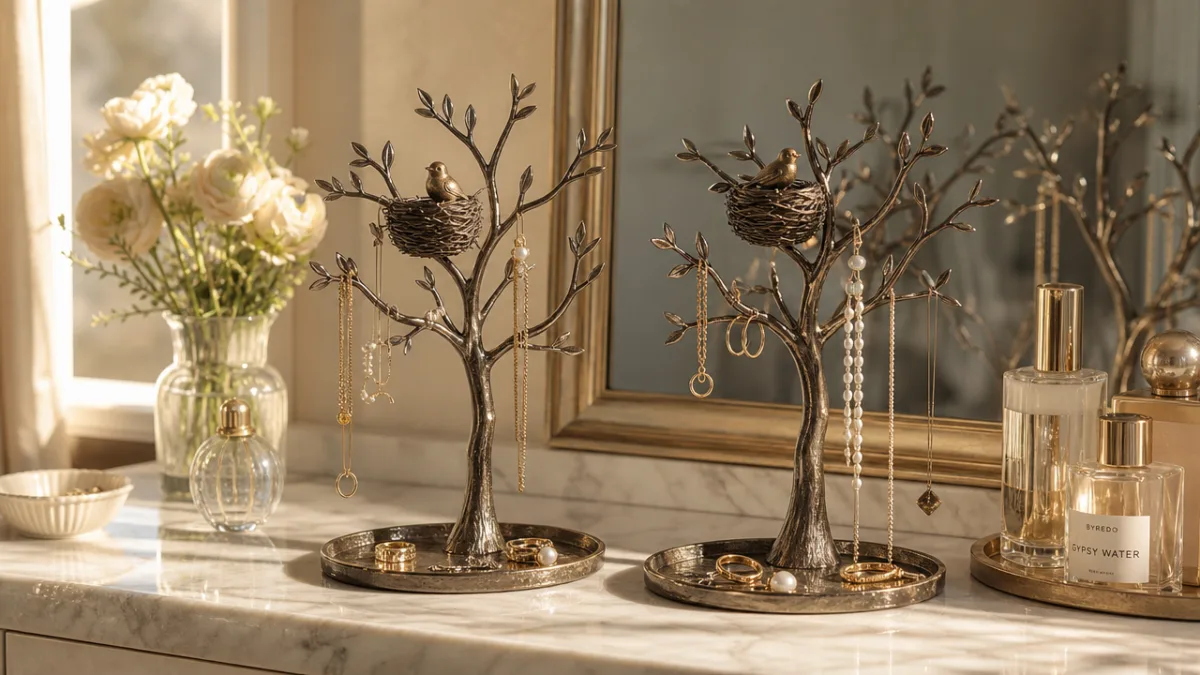
The silhouette of a tree jewelry stand is instantly recognizable — a slender trunk that reaches upward and fans out into branches at various heights and angles, somewhere between a bare winter tree and a small bonsai. That variation in height and angle isn’t just for looks; it’s what lets multiple pieces hang without crowding each other or tangling together. The result feels organic rather than engineered, which is exactly the point. A well-made display tree looks like it grew that way.
The nest is the part that really earns its place. Sitting at the base of the trunk or tucked where the main branches meet, it’s shaped like a real bird’s nest — usually wire or resin twisted to look like woven twigs — and it forms a shallow little bowl that’s perfect for rings, small studs, or tiny pendants. These are exactly the pieces most likely to roll off a flat surface and disappear under the dresser, and the nest handles them beautifully. It holds them safely without hiding them away, so everything stays visible and within reach.
Material-wise, there’s a lot of flexibility depending on the look you’re going for. Metal finishes are the most common — gold, silver, rose gold, bronze, matte black — and each one brings a different feeling to a space. Some stands lean into a more naturalistic look with resin or painted wood details, while others keep it clean and architectural with bare metal lines. When you buy them as a matching set, both stands share the same finish and scale, which matters more than you might think — it’s the difference between a display that looks curated and one that just looks like two random things sitting next to each other.
Practical Organization Benefits
Ask anyone who’s made the switch to a tree-style display stand, and tangling usually comes up first. Necklaces are the main culprit — store a few of them loosely together and they will absolutely find each other in the night. Hanging each chain on its own branch lets gravity do the work, keeping everything separate and elongated so you can just grab what you want and go. That one change alone is enough to make mornings noticeably less frustrating, and the time savings really do add up.
The nest handles the other classic jewelry problem: tiny pieces that disappear. Rings, small earrings, delicate pendants — they’re all perfectly sized to roll off a surface or slip behind something. The nest gives them a contained, textured spot to live that keeps them right where you left them, visible and easy to grab, without needing to be locked away or fastened down.
Having two stands opens up a lot of options for how you organize things. A few approaches that work well:
- Keep gold-toned pieces on one tree and silver-toned on the other, so you’re never hunting for a match when you’re getting dressed.
- Use one for everyday jewelry and the other for pieces you save for special occasions, giving each its own dedicated space.
- In a shared space like a couple’s dresser, one tree per person is a simple solution that keeps things from getting mixed together.
- Sort by type — necklaces and pendants on one tree, bracelets and chains on the other, with rings and earrings in their respective nests.
- Rotate seasonally, keeping what you’re actually wearing right now on display and tucking the rest away until you need it again.
There’s also a quieter benefit that’s easy to overlook. Research in environmental psychology has found that visual order in personal spaces tends to lower background stress and create a greater sense of calm. When your jewelry is out in the open and arranged nicely rather than stuffed in a drawer, getting ready shifts from a hunt into something that actually feels good. It’s a small thing, but starting the day with a moment of order rather than frustration has a way of sticking with you.
Styling Your Jewelry Tree in Different Spaces
One of the nicer things about tree jewelry stands is how well they adapt to different settings. On a bedroom vanity, a matching pair creates a natural focal point — especially alongside a mirror, a small vase of dried flowers, or a candle. The branching shapes add softness and visual interest to what’s often a flat, functional surface. In a room with neutral tones — whites, creams, warm wood — a gold or bronze set adds warmth without feeling cluttered or overdone.
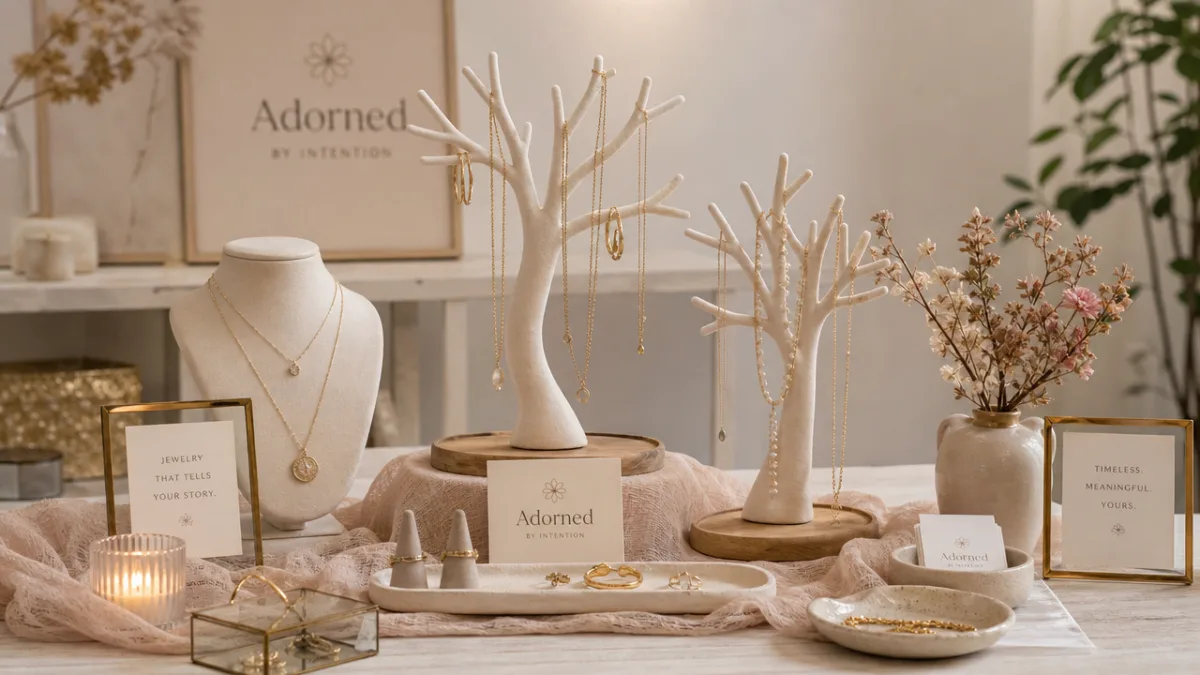
In a retail boutique or market stall, they’re genuinely hard to beat as display tools. Unlike flat trays that require customers to pick each piece up individually, a tree stand lets everything be seen at once, in three dimensions, from a distance. The sculptural quality naturally draws the eye and invites people to take a closer look. Two matching trees side by side create a little scene that reads as carefully considered and artisan-quality from across a room — which is exactly the kind of silent branding that works without saying a word.
For a dedicated dressing room or open shelving setup, jewelry trees fit right in among perfume bottles, sunglasses, and small plants. The key is thinking of the shelf as a styled arrangement rather than just a storage spot. Vary the heights of surrounding objects, keep a consistent color palette, and leave some breathing room around each tree so the jewelry on it has room to be the thing you actually look at. Done right, this approach turns a storage decision into something that looks like it belongs in a magazine.
Choosing the Right Jewelry Tree Set for Your Needs
The first thing to think about is how much jewelry you actually need to display. Smaller, finer trees with delicate wire branches are beautiful, but they work best for minimal collections or people who prefer a lighter, more airy look. If you have a lot of pieces — longer statement necklaces, multiple layered chains, heavier bracelets — you’ll want something with more branches and a sturdier build. Buying a set of two immediately doubles your capacity, which is one of the most practical arguments for the paired format.
Finish is the other big decision, and it’s worth thinking through carefully since these stands will likely sit on a surface for years. Warm finishes like brushed gold or antique brass feel at home in earthy, vintage, or maximalist spaces — terracotta, warm wood, cream linen. Matte black or gunmetal reads as modern and minimal. Bright silver or chrome fits well in contemporary, Scandinavian, or art deco settings. Getting this right isn’t overthinking it; it’s just making sure something you’ll look at every day actually works in the space where it lives.
If you’re buying for a retail setting, construction quality deserves a closer look than it might for personal use. Things to check:
- Bases that are weighted well enough to stay upright even when several pieces are hanging on them.
- Branch tips that are smooth and rounded — sharp tips snag chains and can scratch stones.
- A nest that’s firmly attached and made from materials that won’t scratch or discolor metal over time.
- A finish that holds up to fingerprints and handling, especially on silver or chrome options.
- Both stands in the set matching closely in weight, scale, and proportion — not just in color.
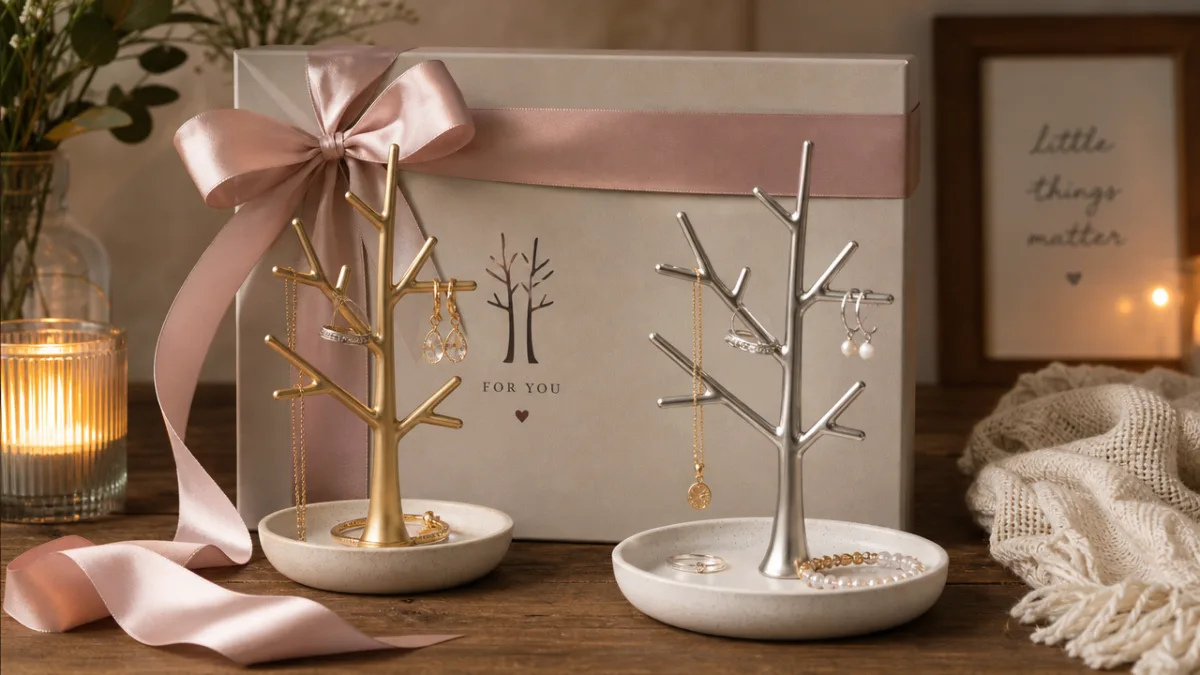
It’s also worth mentioning that a set like this makes a genuinely good gift. Birthdays, graduations, bridal showers, Mother’s Day, housewarmings — tree-with-nest stands work for most of them. The two-stand format is especially generous because it’s immediately useful rather than barely enough. And if you drape a piece of the recipient’s jewelry on one of the branches before you hand it over, you’ve turned a practical gift into something that feels personal and considered. That combination tends to land really well.
Care, Maintenance, and Longevity
Keeping a metal jewelry tree looking good doesn’t take much effort. A soft, dry microfiber cloth handles routine dust easily. If you end up with fingerprints or smudges — and you will, because polished metal is unforgiving that way — a slightly damp cloth followed right away by a dry one will take care of it without leaving moisture behind to cause tarnishing. Just skip anything abrasive or spray-based, since those can strip protective coatings and dull the surface in ways that aren’t really fixable.
Placement matters more than people tend to realize. Bathrooms might seem convenient, but the humidity isn’t great for metal finishes or for certain stones over time. Direct sunlight is similarly worth avoiding — UV exposure can fade some finishes and, with prolonged exposure, affect certain gemstones as well. A bedroom or dressing room away from windows, or a retail display under diffused artificial lighting, is genuinely the better long-term choice, not just for the stands but for the jewelry on them.
One habit that’s worth building: take especially heavy pieces off the tree when you know you won’t be wearing them for a while. Tree stands are built to hold jewelry, but very heavy necklaces or dense chain bracelets hanging on fine branch wire for weeks or months can create cumulative stress over time. Rotating what’s on display also has a nice side effect — you tend to rediscover pieces you’d forgotten about and actually start wearing them again. Which is a good reminder that jewelry is meant to be worn, not just beautifully stored.
A quality pair of tree-with-nest display stands, looked after well, can easily last for years and keep earning their place on your surface the whole time. They belong to that satisfying category of things that are useful, beautiful, and meaningful all at once — and that combination makes the small bit of upkeep feel less like a chore and more like taking care of something worth keeping. For anyone who cares about their jewelry or just about the spaces they spend time in, that’s a pretty good return on a simple purchase.








What do you think?
It is nice to know your opinion. Leave a comment.