










Fælles Broderi: The Art of Communal Embroidery and Its Place in Danish Craft Culture
The Tradition of Communal Needlework in Scandinavia
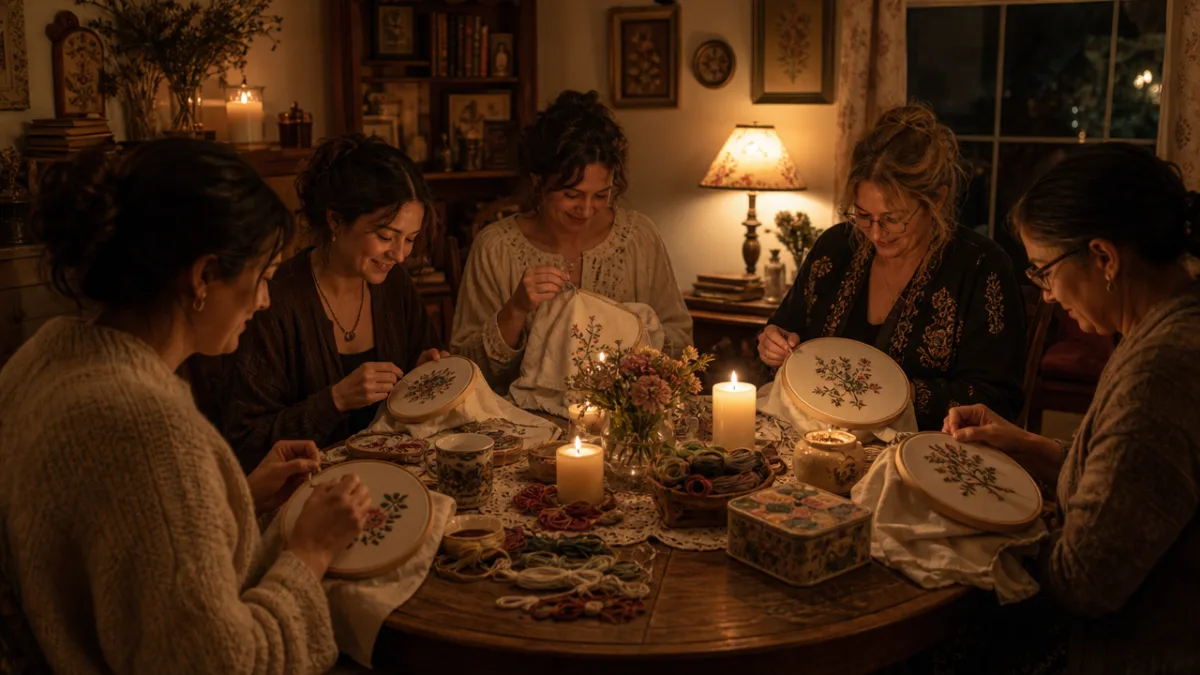
Across Scandinavian history, gathering together to stitch, sew, and embroider has always meant something more than just getting work done. In Denmark, fælles broderi — which translates simply as “communal embroidery” — is a tradition where people come together around a shared piece of fabric, each person adding their own thread to something collectively beautiful. These get-togethers were never really about the finished piece. They were about sitting close to people you care about, trading stories, and the quiet satisfaction of making something that matters — together.
These needlework circles go back centuries, and they popped up in farmhouses and merchant homes, church halls and parlors, all across rural and urban Denmark. People would show up with their hoops and thread and spend hours in comfortable silence or easy conversation. The tradition was naturally tied to the rhythms of farm life — those long winter evenings were practically made for stitching by candlelight — and the things they made often ended up right there in the homes where they were created. Tablecloths, bed linens, altar cloths, everyday garments: all of it carried the fingerprints of collective effort.
What makes the Danish version of communal embroidery feel particularly special is how closely it’s tied to hygge — that famously untranslatable quality of coziness and togetherness that sits at the heart of Danish life. Broderi circles were, and still are, a way of making hygge with your hands. The needles moving through cloth, the soft hum of voices, swapping patterns and tips with someone across the table — it all adds up to a sense of belonging that modern life can make surprisingly hard to find. And the tradition hasn’t faded. If anything, it’s coming back stronger than ever.
Karen Marie and the Modern Revival of Collective Craft
If you spend any time in Denmark’s contemporary craft scene, the name Karen Marie tends to come up. She’s become a quietly influential force in the revival of fælles broderi — someone who takes the history seriously but holds it lightly enough to welcome anyone in. Through her workshops, her online presence, and her thoughtfully designed patterns, she’s built a space where beginners and seasoned embroiderers can both feel at home, and where the simple pleasure of making something with your hands alongside other people is the whole point.
At the core of Karen Marie’s approach is a real commitment to accessibility. A lot of craft traditions can feel a bit intimidating from the outside — wrapped up in expertise, with an unspoken pressure to do things perfectly. She actively pushes back against that. She gets that the real value of communal embroidery isn’t in executing a flawless stitch; it’s in all the smaller moments along the way — picking a color, the slight nervousness of starting a new section, the little thrill of watching a motif actually come together under your fingers. Her workshops are designed to hold space for exactly those moments, and to treat them as meaningful rather than just incidental.
Her influence has rippled out across Denmark’s growing craft community, where a new generation of embroiderers has picked up the needle with real enthusiasm. Social media has helped considerably, giving people in small towns or more remote areas a way to connect with her aesthetic and philosophy even when an in-person workshop isn’t an option. Through that digital extension of the communal spirit, fælles broderi has found its way into some unexpected corners — proof that the desire to make things and share them with others doesn’t really care much about geography.
Patterns, Motifs, and the Visual Language of Danish Embroidery
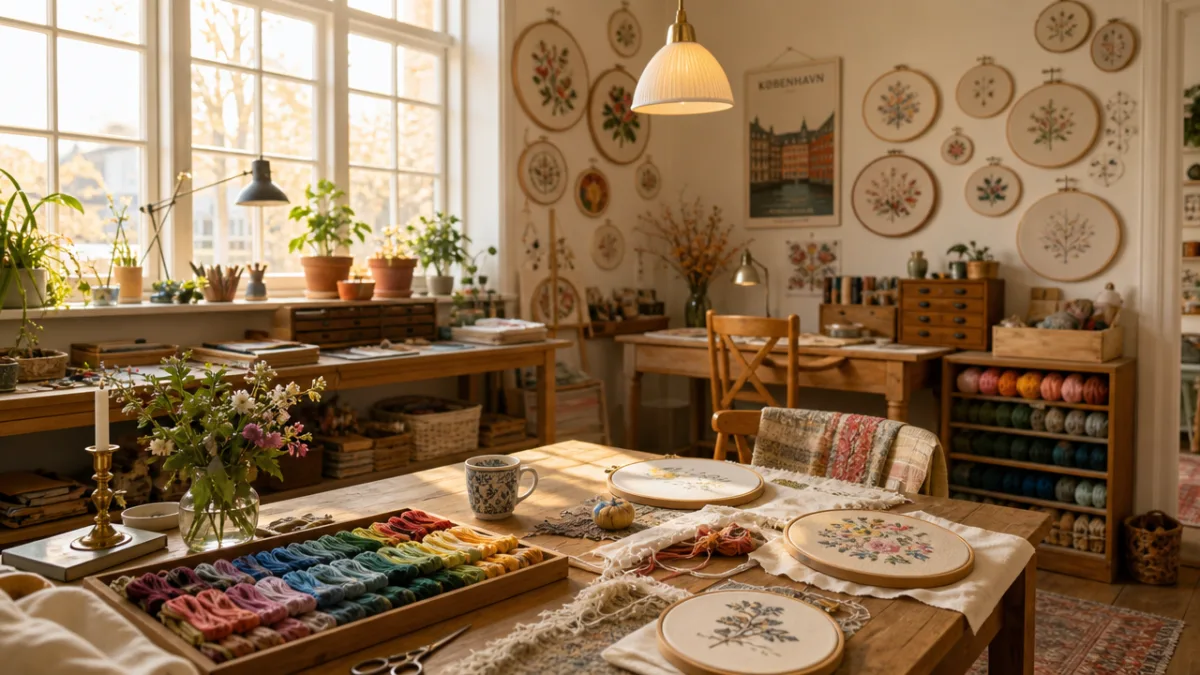
Danish embroidery has always had a recognizable look — a visual language drawn from the natural world, from folk tradition, and from a kind of refined graphic simplicity that feels very distinctly Danish. Flowers are probably the most enduring motif you’ll encounter: roses, tulips, forget-me-nots, and all manner of stylized blooms that split the difference between botanical accuracy and decorative flair. Birds show up often too, especially swallows and robins — symbols of home and of seasons turning. Geometric borders, hearts, and interlocking patterns fill out a design vocabulary that manages to feel both ancient and surprisingly fresh at the same time.
One thing that sets Danish broderi apart from what you’d find in Sweden or Norway is the color palette and the sense of compositional restraint. Swedish folk embroidery tends to lean into bold, saturated color; the Danish tradition tends more toward softer, muted tones — dusty roses, warm creams, gentle blues, earthy greens. That quietness isn’t austerity, though. It’s more of an aesthetic preference for harmony and balance, for designs that sit comfortably in the understated elegance of a Danish home. Karen Marie’s own patterns work within those conventions while bringing enough freshness to keep them feeling very much alive.
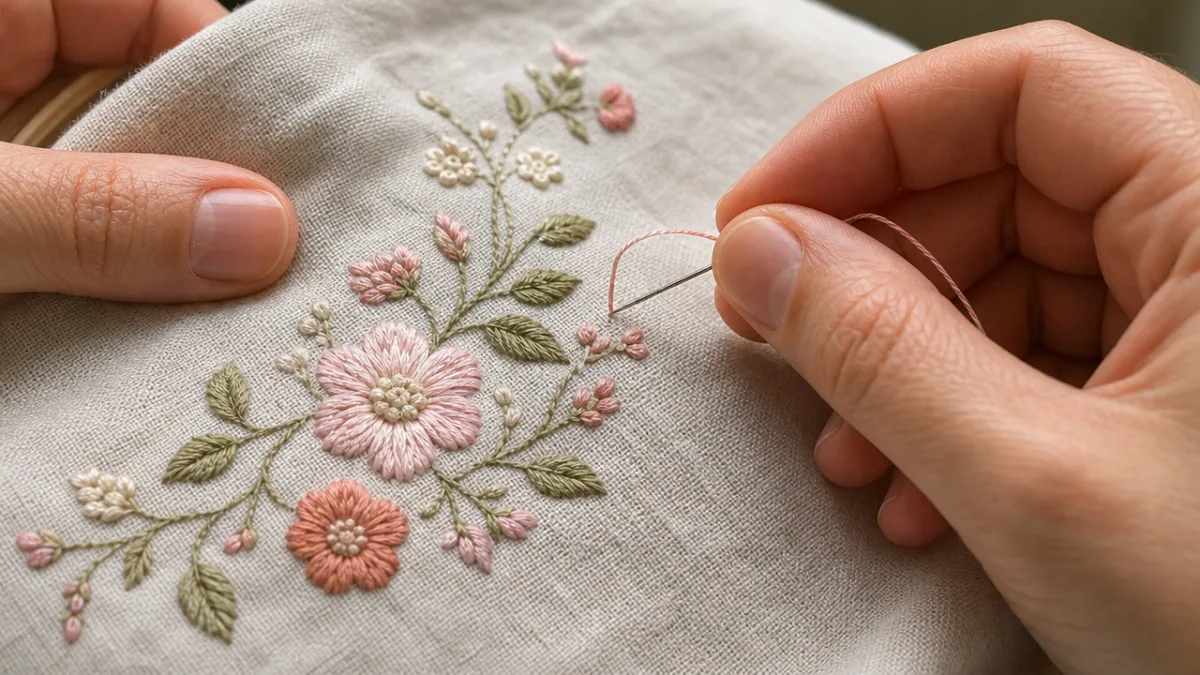
The techniques themselves cover a lot of ground, and part of what makes a fælles broderi gathering so enjoyable is the natural exchange of knowledge about different methods. Cross-stitch, satin stitch, stem stitch, French knots, and the delicate pulled-thread work known as hvidsyning all have their place in the Danish needlework tradition. In a communal setting, more experienced people naturally share what they know with newer participants, creating an informal kind of apprenticeship that has kept craft knowledge moving from one generation to the next. The stitches themselves become their own sort of language — a way of talking across time.
The Social and Psychological Benefits of Communal Making
Researchers and mental health practitioners have been paying closer attention to the benefits of embroidery — and communal craft more broadly — in recent years, and what they’re finding is genuinely interesting. The repetitive, rhythmic nature of stitching seems to promote a kind of meditative state: cortisol levels drop, and people settle into a calm, focused alertness that’s similar to what you’d get from a mindfulness practice. For anyone who finds traditional meditation frustrating or just not for them, the gentle concentration required by embroidery can be a surprisingly natural way in.
Put that individual experience inside a communal setting, and the benefits seem to stack. We know that social connection is one of the most powerful things going for human wellbeing, and yet so much of modern life is quietly structured in ways that make genuine community harder to find. A broderi circle offers something genuinely rare: a context where simply being together is the whole agenda, with no particular goal beyond the shared making. Conversation flows naturally from the work — patterns become metaphors, colors pull up memories, and the slow build of stitches mirrors the slow build of trust between people.
There’s also something that’s hard to fully explain about making a real, physical, beautiful object with your own hands. At a time when so much of what we experience exists as nothing more than light on a screen, the tangibility of embroidery carries a particular kind of emotional weight. Holding a finished piece — running your fingers over the raised texture of French knots, seeing the care locked into every stitch — produces a sense of accomplishment that feels genuinely different from any digital reward. Karen Marie’s gatherings understand this instinctively, and they give participants real room to sit with that feeling.
- Reduction in stress and anxiety through rhythmic, repetitive hand motion and focused attention
- Strengthened social bonds through shared creative practice and informal conversation
- Increased sense of personal accomplishment and creative confidence in participants
- Preservation and transmission of traditional craft knowledge across generations
- Cultivation of patience, fine motor skill, and aesthetic sensibility over time
Materials, Tools, and Getting Started with Fælles Broderi
One of the things that makes embroidery such an appealing craft to pick up is how little you actually need to get started. Unlike woodworking, weaving, or ceramics, needlework doesn’t ask much of you in terms of equipment or space. A decent embroidery hoop, a few needles, some evenweave fabric or linen, and a range of embroidery floss will genuinely get you going. That low barrier to entry is a big part of why the communal model works so well — you can walk into your first session and actually start making something, without needing to spend weeks acquiring tools or learning technique before the real work begins.
Thread is probably the first place where embroidery starts to reveal how deep it actually goes. The difference between stranded cotton, silk, wool, and linen thread isn’t just a technical matter — each one produces a completely different surface, different luminosity, a different quality of texture under your fingers. In Karen Marie’s workshops, exploring thread and fabric combinations is treated as a creative practice in its own right, not just a preliminary step you get through before the interesting part. Participants are encouraged to touch things, compare them, and start developing their own preferences — to understand that choosing a thread is already an artistic decision, already the beginning of finding your own voice.
Fabric matters just as much. Traditional Danish broderi was typically worked on linen or cotton evenweave, where the regular grid of the weave guides counted work like cross-stitch. But contemporary embroiderers have expanded well beyond that, working on silk organza, recycled clothing, hand-dyed fabric, and even unconventional surfaces like paper or leather. This openness to experimentation is part of how the craft has stayed vital — it honors the tradition without being trapped by it. For anyone drawn to fælles broderi, that spirit of exploration is part of the invitation itself.
- Begin with a small embroidery hoop in a size comfortable to hold, typically between 15 and 20 centimeters in diameter
- Choose a medium-weight linen or cotton fabric with a visible but not overly coarse weave for your first project
- Select a basic starter palette of six to eight colors in stranded cotton embroidery floss
- Practice the fundamental stitches — backstitch, running stitch, satin stitch, and French knots — before starting a full pattern
- Join a local embroidery group or online community to share your progress and gather inspiration from others
- Allow yourself the freedom to make mistakes, understanding that imperfection is part of the beauty of handmade work
Fælles Broderi as Cultural Heritage and Living Practice
Talking about embroidery purely in terms of personal wellbeing or aesthetic pleasure misses something important about what it actually carries. In Denmark, as in many parts of the world, textile crafts are one of the most intimate forms of cultural transmission there is — a thread, quite literally, connecting the present to the past. The patterns held in museum collections, the techniques passed from grandmother to grandchild, the regional styles that tell you something about where a piece comes from: all of that is a form of living heritage that only survives as long as people keep practicing it.
So when younger generations in Denmark are drawn back to fælles broderi, that’s not simply a lifestyle trend or a push back against the relentless pace of digital life — though it’s honestly a bit of both. It’s also an act of cultural preservation, a deliberate choice to stay connected to a form of knowledge that could otherwise slip away. When a twenty-five-year-old sits down in a workshop and learns a pulled-thread technique from someone three times her age, something genuinely irreplaceable passes between them. Karen Marie’s work sits inside that broader story, and she clearly understands the weight of it.
Museums, cultural institutions, and craft organizations across Denmark have been increasingly willing to support living needlework traditions — not just as historical curiosities, but as vital contemporary practices. Exhibitions that bring together historical pieces and new work have helped shift how people think about embroidery, moving it out of the “domestic hobby” category and into recognition as a sophisticated art form with a rich and layered history. That shift in perception has, in turn, given more practitioners permission to take their own work seriously — to see themselves as part of a long continuum rather than just people with a nice hobby.
Looking ahead, fælles broderi in Denmark seems to be in genuinely good shape. Community centers, libraries, and craft studios around the country now host regular embroidery gatherings. Online communities have created connections that stretch across Scandinavia and out into Germany, the Netherlands, the UK, and further. Pattern designers like Karen Marie keep producing work that balances the traditional and the new, giving fresh generations a point of entry that feels both rooted and very much alive. The needle moves through the fabric, the thread pulls tight, and something beautiful starts to take shape — as it has in Denmark, and across the world, for as long as people have needed beauty and community in roughly equal measure.








What do you think?
It is nice to know your opinion. Leave a comment.