










Smart Home Project Ideas: Transform Your Living Space with Intelligent Technology
Introduction to Smart Home Technology
Smart homes have come a long way in a short amount of time. What used to feel like something out of a sci-fi movie is now completely within reach for regular homeowners — regardless of budget or tech savviness. Today’s smart home tech spans a huge range of interconnected devices, sensors, and systems that work together to automate, monitor, and improve almost every corner of your home. Whether you’re trying to cut down on energy bills, beef up your home security, or just make everyday life a little easier, there’s genuinely something in the smart home world for you.
The good news is you don’t have to dive in all at once. Most people start with just one thing — a smart speaker, a programmable thermostat, maybe a set of smart bulbs — and build from there as their comfort and budget grow. That’s honestly the best approach. The major platforms like Amazon Alexa, Google Home, and Apple HomeKit are all designed to play nicely with hundreds of third-party devices, so you have tons of flexibility in how you piece things together over time.
Before you buy anything, though, it’s worth taking a few minutes to think about what you actually want to improve. Do you constantly leave lights on when you leave a room? Does the thought of an empty house while you’re traveling make you nervous? Are your utility bills driving you crazy? Knowing your specific pain points helps you spend your money where it’ll actually make a difference — instead of ending up with a bunch of gadgets that just add more complexity to your life.
Smart Lighting Projects for Every Room
If you’re only going to start one smart home project, lighting is probably your best bet. It’s one of the most affordable entry points, delivers instant results, and honestly just makes your home feel different in all the right ways. Smart bulbs, strips, and switches from brands like Philips Hue, LIFX, and Govee let you dial in millions of colors, set automated schedules, and control everything by voice or app. A basic starter kit can be up and running in under an hour.
One of the more surprising benefits of smart lighting is what it can do for your health. Circadian rhythm lighting — where your bulbs shift from warm amber tones in the morning to crisp, cool-white light during the day, then gradually dim back to warm tones in the evening — mimics the natural arc of sunlight. Research backs this up: syncing your indoor lighting with your body’s natural rhythms can improve sleep, sharpen daytime focus, and even lift your mood. It sounds a bit niche, but once you try it, it’s hard to go back.
Motion-activated lighting is another project that pays for itself quickly. Toss some motion sensors in your hallways, bathroom, closet, or garage, and you’ll never walk into a dark room again — and never leave a light burning in an empty one either. If you want something even smarter, radar-based presence sensors can detect a person sitting quietly in a chair and keep the lights on accordingly, rather than plunging you into darkness mid-chapter. Swap in smart switches to keep manual control intact, and your whole home can run on autopilot when you want it to.
Home Security and Surveillance Systems
A solid smart security setup is one of those projects that genuinely earns its keep. Done right, it gives you a real-time picture of what’s happening in and around your home, acts as a deterrent, and lets you sleep easier whether you’re home or halfway across the world. Most DIY setups are built around some combination of smart door locks, video doorbells, outdoor cameras, window and door sensors, and a central hub or monitoring service. Brands like Ring, Arlo, SimpliSafe, and Eufy all take a modular approach, so you can tailor coverage to your home’s actual layout rather than buying a one-size-fits-all package.
Video doorbells have exploded in popularity, and it’s easy to see why. A good one — like the Ring Video Doorbell Pro or Google Nest Doorbell — streams live HD video of your front door, pings your phone the second someone approaches or rings the bell, and lets you have a two-way conversation with whoever’s there, even if you’re at the office. That alone is enough to deter package theft and let you remotely let in a trusted visitor. Newer models add AI features like facial recognition, vehicle detection, and package alerts, so you’re getting smarter notifications rather than a flood of false alarms every time a car drives by.
Don’t overlook what’s happening inside the house either. Smart locks on your exterior doors let you hand out digital access codes to family, a dog walker, or a housecleaner — and revoke them just as easily, no key-copying required. You can restrict codes to certain hours, get a full entry log, and get instant alerts whenever a door is unlocked. Pair that with a smart garage door controller that notifies you if you’ve left the door open and lets you close it remotely, and you’ve got a pretty airtight perimeter going.
Energy Management and Climate Control
If you want your smart home to actually save you money, energy management is where to focus. Heating, cooling, and electricity eat up a big chunk of most household budgets, and the right devices can make a real dent in those costs. The smart thermostat is the obvious starting point — the Ecobee SmartThermostat and Google Nest Learning Thermostat are both excellent. They learn your schedule and preferences over time, adjust themselves when you’re away, and generally do a much better job of balancing comfort and efficiency than a traditional thermostat ever could.
Smart plugs are cheap and surprisingly useful. Plug one between any regular appliance and the wall, and suddenly you can see exactly how much power it’s drawing, set a schedule for it, or turn it off remotely. This is great for tracking down “phantom loads” — devices that sip electricity even when you think they’re off — which can add up to around 10% of your total electricity bill. Smart power strips take this a step further for your TV setup or home office, letting you cut power to a whole cluster of devices at once.
For homeowners with solar panels or anyone curious about going deeper on energy, platforms like Tesla Powerwall, Enphase, and the Sense Energy Monitor give you a real-time, granular view of everything your home is producing and consuming. More importantly, they can automatically shift energy-hungry tasks — running the dishwasher, charging an EV, running the dryer — to times when your panels are producing the most power or when electricity rates are lowest. Over time, that kind of intelligent scheduling can lead to seriously lower bills and a meaningfully smaller carbon footprint.
Smart Kitchen and Appliance Automation
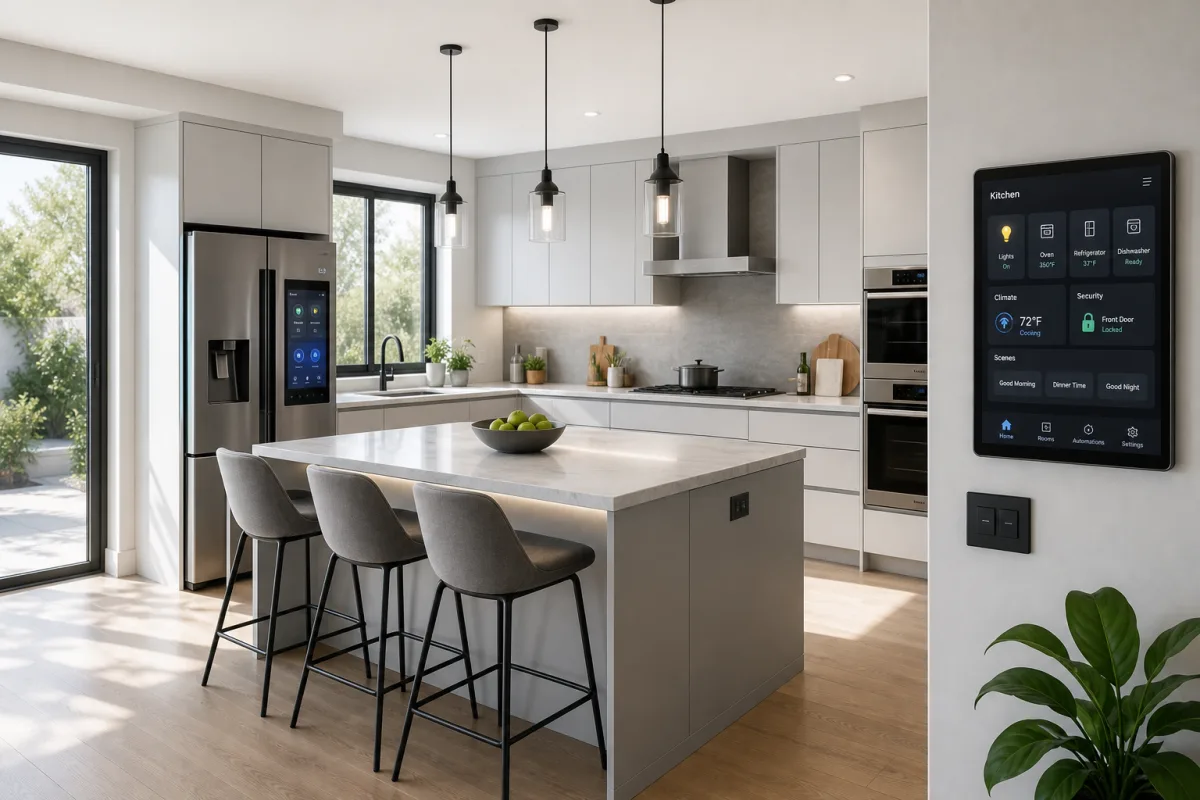
The kitchen might be the most fun room to outfit with smart tech right now. Samsung and LG make refrigerators with interior cameras so you can check what you need from the grocery store without opening the door — which sounds gimmicky until you realize how often you’ve stood in a store aisle trying to remember if you’re out of butter. Built-in touchscreens can display recipes, family calendars, and weather, while voice assistant integration means you can add to your shopping list or set a timer without touching anything.
Smart ovens and cooktops are genuinely impressive these days. Ovens from June, Breville, and GE Profile can actually identify food you put inside them using built-in cameras and AI, then suggest the right temperature and cook time. You can preheat remotely so the oven is ready the minute you get home, and get a notification on your phone when dinner’s done. Induction cooktops with smart temperature controls offer a level of precision that gas and electric burners can’t match — if you’ve ever tried to temper chocolate or hold a precise simmer, you’ll appreciate that immediately.
Smaller connected kitchen gadgets round things out nicely. Smart scales linked to recipe apps can walk you through ingredient measurements step by step, advancing automatically when you hit the right weight. A connected coffee maker can sync with your alarm so a fresh cup is brewing the moment you stumble out of bed. Even smart faucets with touchless or voice activation have gotten surprisingly affordable, and they’re handy when your hands are covered in raw chicken.
Whole-Home Automation and Integration Strategies
Individual smart devices are great, but the real magic happens when everything starts working together. Whole-home automation is built around “scenes” or “routines” — sequences of actions that fire off together from a single trigger. A “Good Morning” routine, for example, might raise your bedroom blinds, start brewing your coffee, bump the thermostat up to your daytime setting, and kick on your morning playlist, all the moment your alarm goes off. That’s the kind of thing that makes a smart home feel genuinely smart rather than just a collection of remote-controlled gadgets.
Picking the right hub or platform is a big decision, because it shapes everything you buy afterward. Amazon Alexa, Google Home, and Apple HomeKit all have their own strengths and weaknesses around device compatibility, privacy, and how sophisticated their automations can get. The good news is that a newer standard called Matter — built collaboratively by the major tech companies — is designed to break down the compatibility walls between ecosystems. As more devices adopt Matter, you’ll have a lot more freedom to mix and match without getting locked into one brand’s universe.
If you want to go really deep, platforms like Control4, Savant, or the open-source Home Assistant offer a whole different level of capability. Home Assistant in particular has built a passionate community around it, thanks to its ability to connect almost any device from any manufacturer, handle complex automation logic, and run entirely locally — meaning your automations still work even if your internet goes down, and your data isn’t sitting on someone else’s cloud server. It takes more technical confidence to set up than an out-of-the-box consumer hub, but the level of control you get in return is hard to beat.

Future-Proofing Your Smart Home Investment
Smart home tech moves fast, and it’s easy to spend money on something that becomes obsolete or unsupported a few years down the road. The best defense is to favor devices built on open standards rather than proprietary ones. Matter is a great example — devices certified for Matter should stay compatible with major platforms no matter how the landscape shifts. It’s also worth leaning toward devices that can process things locally rather than depending entirely on a manufacturer’s cloud servers. When a company pulls the plug on support for older hardware (and it happens more often than you’d think), locally-processed devices at least still work.
Your home network is the foundation everything else sits on, and it’s worth investing in a good one before you start loading it up with smart devices. A Wi-Fi network that barely keeps up with a few laptops and phones will buckle under the weight of dozens of connected devices. A mesh Wi-Fi system from Eero, Orbi, or Google Nest WiFi Pro spreads strong, consistent coverage across your whole home — including the garage, basement, and backyard — so nothing loses connection at an awkward moment. Look for systems that support Wi-Fi 6 or Wi-Fi 6E, which are specifically designed to handle lots of devices at once without slowing down.
Last thing: think of your smart home as an ongoing project, not a one-time setup. Keep notes on your devices, firmware versions, network settings, and automations so that when something needs fixing or upgrading, you’re not starting from scratch trying to remember how you built it. Jump into the online communities — forums, subreddits, YouTube channels — where other smart home enthusiasts share what’s working, what isn’t, and creative ideas you’d never think of on your own. The best smart home setups tend to be the ones built slowly and thoughtfully by people who actually took the time to understand what they were building. Start small, stay curious, and it’ll get better every year.








What do you think?
It is nice to know your opinion. Leave a comment.