










How to Eliminate Security Camera Blind Spots: The Complete Placement Guide
Understanding Security Camera Blind Spots and Why They Matter
Security camera blind spots are the areas within or around your property that fall outside the field of view of your installed cameras. These gaps in coverage can be surprisingly large, even in systems that appear comprehensive at first glance. Every camera has a fixed angle of view, a maximum effective range, and physical limitations that make complete coverage impossible without careful, strategic planning. Understanding these limitations is the first step toward building a truly effective home or business security system.
The consequences of blind spots can be severe. Burglars and intruders are often experienced at identifying gaps in camera coverage, and they will exploit any area that offers concealment or unmonitored access to your property. A single blind spot near a side door, a basement window, or a poorly lit corner of your yard can render an otherwise expensive security system practically useless. Research consistently shows that properties with visible, comprehensive camera coverage are far less likely to be targeted by opportunistic criminals than those with obvious gaps.
Beyond theft and intrusion, blind spots also create liability issues for business owners and gaps in accountability for homeowners. If an incident occurs in a zone that your cameras do not cover, you will have no footage to review, no evidence to present to law enforcement, and no way to reconstruct what happened. Understanding the geometry and limitations of your specific cameras, combined with a methodical approach to placement, is the only reliable way to minimize these dangerous gaps and protect your property comprehensively.
Mapping Your Property to Identify Coverage Gaps
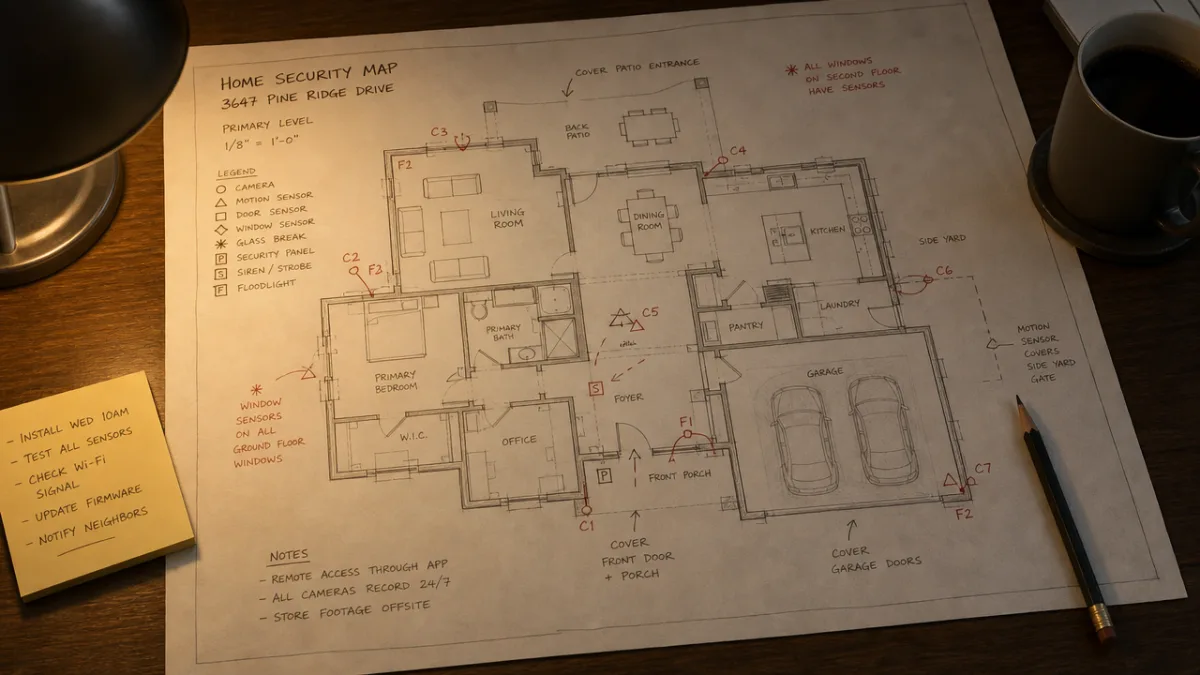
Before you purchase or reposition a single camera, you need a detailed map of your property. Start with a simple top-down sketch or a blueprint if one is available. Mark every entrance and exit point, including doors, windows, garage openings, gates, and any other points of access. Note any outbuildings, vehicles, landscaping features, fences, and structures that could block sightlines or create natural hiding places. This visual reference becomes the foundation of your entire camera placement strategy and will save you significant time and money in the long run.
Once your map is drawn, walk the perimeter of your property and physically stand at each potential camera mounting location you are considering. Look outward from that point and identify what you can and cannot see from eye level. Pay special attention to areas that are obscured by trees, hedges, walls, pillars, or outdoor furniture. Mark these obstructions on your map. Then walk the boundary of your property as an intruder might, noting where you could approach without being seen from your proposed camera positions. This exercise is surprisingly revealing and often exposes vulnerabilities that are invisible from inside the property.
After completing your walk-through, overlay the approximate field of view of each planned camera onto your map using a protractor or an online camera placement tool. Most standard security cameras offer between 90 and 130 degrees of horizontal field of view, while wide-angle and fisheye lenses can extend that range significantly. Draw arcs representing each camera’s coverage area and look for the spaces between them. These uncovered spaces are your blind spots. Color them in on your map so they stand out clearly. Your goal is to either reposition cameras to cover these zones or add additional cameras until every critical area appears within at least one camera’s arc of coverage.
Optimal Camera Placement Strategies for Maximum Coverage
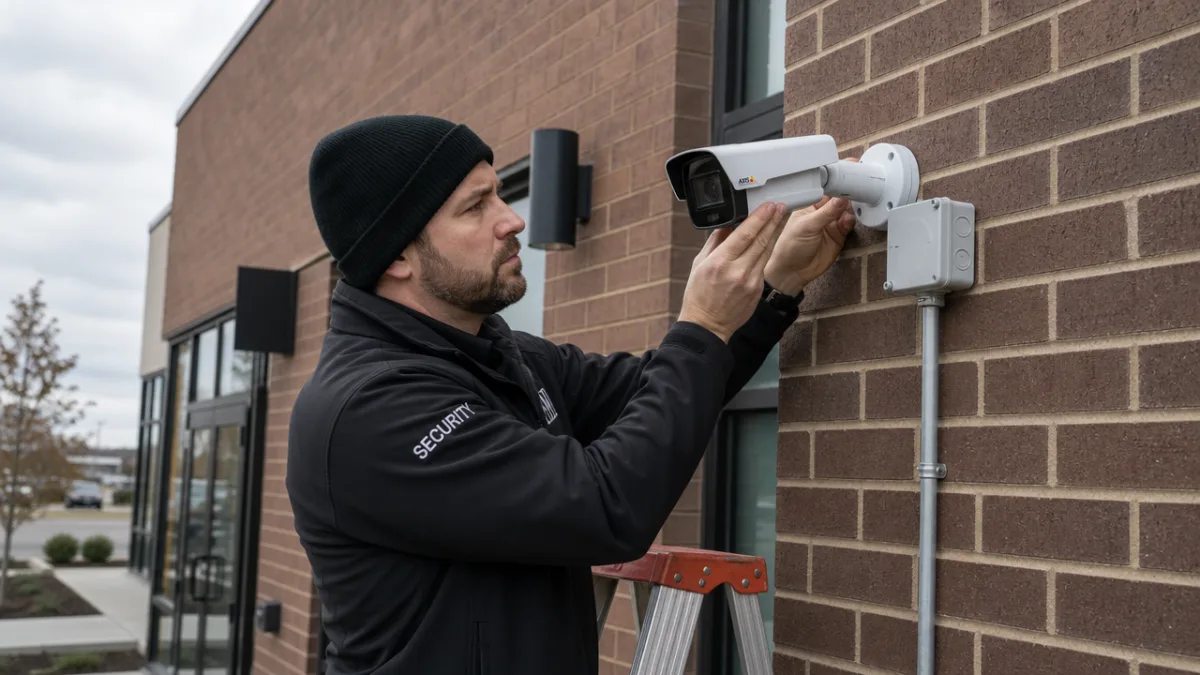
Mounting height is one of the most important and frequently misunderstood factors in eliminating blind spots. Cameras mounted too low can be easily blocked by parked vehicles, overgrown bushes, or even a person standing in front of them. Cameras mounted too high lose facial detail and may struggle to capture identifying features of individuals on the ground. The generally recommended mounting height for outdoor security cameras is between eight and ten feet above the ground. At this height, a camera is out of easy reach while still capturing faces, clothing details, and license plates at a usable resolution.
Corner placement is one of the most effective strategies for maximizing coverage with fewer cameras. Mounting a camera at the corner of a building allows a single unit to monitor two sides simultaneously, dramatically extending coverage per device. Wide-angle cameras positioned at corners can sometimes cover an entire side of a smaller structure plus a portion of the adjacent wall. When combined with the appropriate field of view, corner cameras reduce the total number of devices you need while minimizing the overlap and dead zones that result from placing cameras in the middle of flat walls where they cover only a narrow corridor directly ahead.
Layered coverage is another powerful principle used by professional security installers. Rather than relying on a single camera to cover a large area, a layered approach uses multiple cameras at different distances and angles to create overlapping zones of coverage. An outer perimeter camera might monitor the driveway and front gate, while a secondary camera covers the front door and porch at closer range, and a third watches the interior entryway. Any individual attempting to approach the property must pass through multiple camera zones, making it far less likely that any single point of failure will result in lost footage. This redundancy is the hallmark of a genuinely robust security system.
Common Blind Spot Locations and How to Address Them
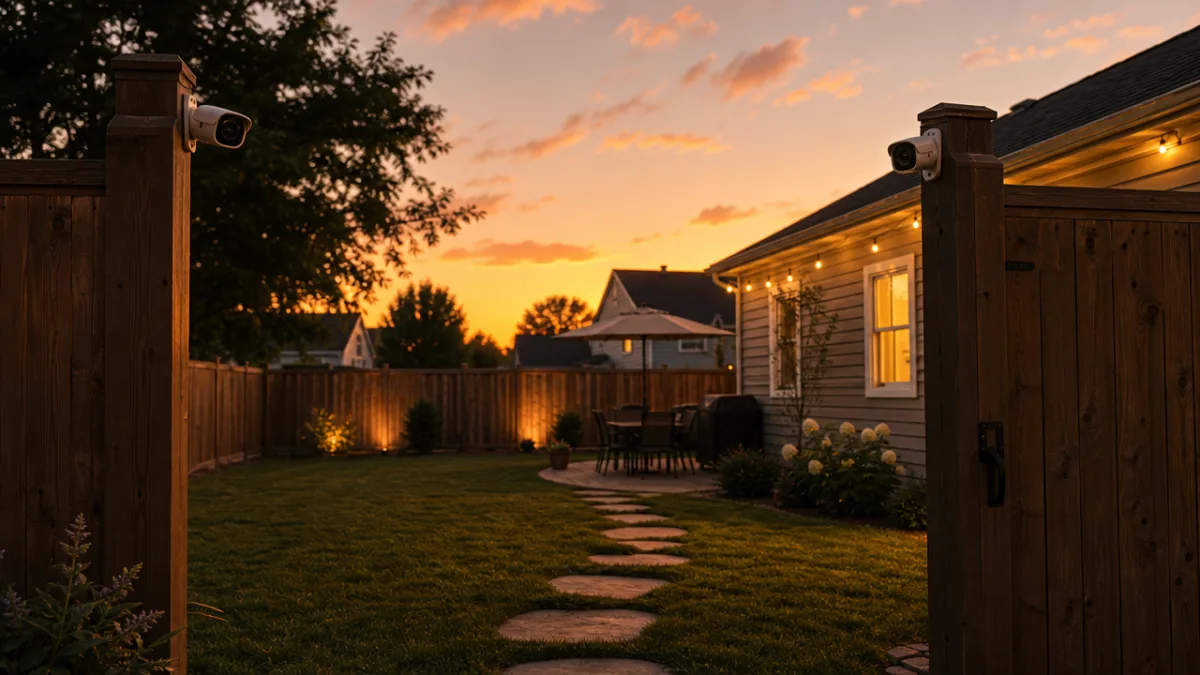
The most frequently overlooked blind spots in residential security systems tend to cluster around predictable areas. Side yards and narrow passages between buildings are among the most commonly missed zones because they are easy to forget during initial planning and awkward to cover without dedicated cameras. These narrow corridors are, however, frequently used by intruders as access routes precisely because homeowners tend to neglect them. A single camera mounted at the entrance to each side passage, angled inward, can close this gap effectively without requiring full-length coverage of the entire passage.
Garage areas represent another major blind spot category. Many homeowners install cameras that cover the front driveway but fail to monitor the garage door itself, the interior of an attached garage, or the alleyway behind the property. Garage break-ins are among the most common forms of residential burglary, and attackers know that garages often provide quiet, hidden access to the main house. A camera mounted above the garage door facing outward, combined with one covering the interior near the door to the home, significantly reduces this vulnerability. For detached garages, a separate camera covering both the structure and the path connecting it to the house is strongly advisable.
Landscaping and seasonal changes create dynamic blind spots that many property owners fail to account for. A camera that provides clear coverage in winter may be completely blocked by a mature tree’s foliage in summer. Hedges grow, shrubs spread, and climbing plants can gradually obscure a lens over time. Regularly walking your property and checking each camera’s live feed against your coverage map is essential for catching these creeping blind spots before they become serious vulnerabilities. Trimming vegetation near camera lines of sight twice a year and adjusting camera angles seasonally are simple maintenance habits that pay significant security dividends.
The following are the most critical blind spot locations to address on any residential or commercial property:
- Side yard passages and narrow alleys between buildings or fences that offer concealed access routes to the rear of the property
- Areas directly below mounted cameras, which fall outside the camera’s downward angle and can be exploited by someone standing close to the wall
- Garage interiors and the connection point between the garage and the main structure, especially in attached garages
- Rear yards and back fences, which are often left unmonitored despite being common points of entry
- Basement windows and ground-level access points that are hidden by shrubs or low structures
- Stairwells and interior hallways in multi-story homes or commercial buildings that connect levels without passing a monitored entrance
Choosing the Right Camera Types to Minimize Blind Spots
Not all security cameras are created equal, and matching the right camera type to each location is essential for eliminating blind spots efficiently. Fixed cameras offer the most stable, reliable coverage for specific, well-defined zones and are the workhorses of most residential systems. Pan-tilt-zoom cameras, commonly called PTZ cameras, can rotate horizontally and vertically and zoom into distant subjects, making them valuable for large open areas like parking lots, expansive backyards, or commercial premises where a single camera needs to actively monitor a wide zone. However, PTZ cameras have a limitation: when they are pointed in one direction, the area behind them is unmonitored, so they should always be paired with fixed cameras in critical locations.
Wide-angle and fisheye cameras are particularly effective for eliminating blind spots in confined spaces like hallways, interior rooms, and corners of small yards. A single fisheye camera mounted in the center of a room’s ceiling can capture a 360-degree view of the entire space, leaving virtually no blind spots within that environment. For outdoor use, wide-angle cameras mounted at building corners can provide sweeping coverage with a single device. The trade-off is resolution: the wider the field of view, the lower the pixel density per square foot of coverage, which can make facial recognition and fine detail harder to extract from footage. Balancing field of view with resolution based on the distance at which you need to identify subjects is an important consideration in camera selection.
Infrared and low-light cameras address a different kind of blind spot: the temporal one created by darkness. A camera that provides excellent daytime coverage but fails at night effectively leaves your property blind during the hours when many intrusions occur. Modern infrared cameras use built-in IR illuminators to provide clear black-and-white footage in complete darkness, typically up to a range of 30 to 100 feet depending on the model. Color night vision cameras use larger sensors and advanced processing to produce color footage in very low light conditions, which can be more useful for identifying clothing colors and vehicle colors. Ensuring that every camera in your system performs adequately after dark is as important as any daytime placement consideration.
Lighting, Angles, and Technical Adjustments That Affect Coverage
Camera placement is not purely a physical problem; it is also a technical and optical one. The angle at which a camera is tilted affects not only what it can see but also how usable the resulting footage is. A camera pointed too steeply downward may capture the tops of heads rather than faces, making identification difficult. A camera tilted too far toward the horizon may have a large portion of its field of view occupied by the sky, wasting resolution on empty space. The ideal tilt angle for most outdoor cameras positions the center of the frame at roughly the chest height of an average adult standing at the most important point of coverage within the camera’s range.
Lighting conditions interact with camera performance in ways that create invisible blind spots. Strong backlighting, such as a bright sun or powerful outdoor light positioned behind the area you are monitoring, can wash out a camera’s image and render subjects as dark silhouettes with no identifiable features. This is a common problem with cameras monitoring driveways or gates that face west in the late afternoon. Using cameras with wide dynamic range technology, also called WDR, helps manage these high-contrast lighting situations by processing bright and dark areas of the image separately. Supplemental lighting positioned to illuminate the subject rather than shine into the camera lens can also dramatically improve footage quality and eliminate light-based blind spots.
Regular testing and review of your system is the final and most important technical practice for maintaining complete coverage. At least twice a year, review the live feed and recorded footage from every camera in your system. Test each camera at different times of day and in different weather conditions, including rain, fog, and bright sunlight. Walk through the zones each camera is supposed to cover and confirm that you appear clearly in the footage. Check for new obstructions, lens fogging, camera drift from mounting hardware vibration, and any other factors that may have degraded coverage since your last review. A security system that is never tested is a system that may have developed significant blind spots without your knowledge, offering a false sense of protection that is arguably more dangerous than no system at all.
Advanced Techniques and Technology for Complete Property Coverage
For properties with persistent or unusually complex blind spot challenges, several advanced technologies can provide solutions that standard fixed cameras cannot. Video analytics software, now available even in consumer-grade systems, can track moving objects across overlapping camera zones and stitch together continuous movement paths even when a subject passes briefly through an uncovered area. This does not eliminate the physical blind spot but compensates for it analytically, helping you reconstruct events even when full visual continuity is unavailable. Some advanced systems can send real-time alerts when a tracked subject disappears from coverage for more than a few seconds, flagging the event for immediate review.
Wireless and battery-powered cameras have expanded placement options significantly in recent years, making it possible to mount cameras in locations where running power cables was previously impractical or impossible. Remote outbuildings, fence posts, gates far from the main structure, and temporary monitoring positions in areas undergoing renovation can all now be covered without extensive electrical work. Solar-powered cameras take this further, eliminating battery replacement as a maintenance concern for cameras in outdoor locations with adequate sunlight. These flexible deployment options mean that geographic or structural constraints no longer need to result in permanent blind spots.
Integrating your camera system with motion-activated lighting is one of the most cost-effective strategies for both deterring intrusion and improving camera performance in blind spot-prone areas. Motion-activated lights illuminate potential blind spot zones the moment activity is detected, flooding previously dark areas with light and simultaneously alerting you to possible intrusion. When paired with cameras that have color night vision capabilities, this combination produces high-quality, identifiable footage of any activity in areas that would otherwise be poorly covered after dark. The combined deterrent effect of sudden bright illumination and visible camera coverage is also a powerful behavioral deterrent that causes many potential intruders to abandon their approach before an incident can occur.
Finally, consulting with a licensed security professional is a worthwhile investment for any property where comprehensive coverage is a serious priority. Professional security assessors bring experience from hundreds of installations and can quickly identify blind spots that homeowners and business owners consistently overlook. They are familiar with the specific challenges of different property types, local crime patterns, and the technical capabilities and limitations of current camera systems. Even a single consultation can save significant money by preventing costly camera repositioning after installation and ensuring that your system is designed from the start to provide the complete, reliable coverage that genuine security requires.








What do you think?
It is nice to know your opinion. Leave a comment.