










DIY Modern Home Office Makeover: Transform Your Workspace Without Breaking the Bank
Working from home has shifted from a temporary convenience to a permanent reality for millions of people around the world. Whether you’re a freelancer, a remote employee, or an entrepreneur building something from the ground up, the space where you work directly influences how well you work. A cluttered, uninspiring corner of your bedroom or a folding table shoved against a wall simply won’t do when you’re spending eight or more hours a day in that environment. A thoughtfully designed home office can improve your focus, elevate your mood, and even signal to your brain that it’s time to get into a productive headspace.
The good news is that transforming your home office doesn’t require a professional interior designer or a massive renovation budget. With the right planning, a few smart purchases, and some weekend DIY energy, you can create a modern, functional, and genuinely beautiful workspace that rivals anything you’d find in a trendy co-working space. This guide walks you through every phase of a complete home office makeover, from decluttering and layout planning all the way to the finishing decorative touches that make a space feel truly yours.
Modern home office design blends clean lines, purposeful storage, and personal expression in a way that feels both professional and livable. The aesthetic is less about sterile minimalism and more about intentional simplicity — keeping what serves you, removing what doesn’t, and choosing materials and colors that energize rather than drain. Throughout this article, you’ll find practical advice you can act on immediately, along with inspiration to help you see what’s possible even in the smallest or most awkward of spaces.
Step One: Assess, Declutter, and Plan Your Layout
Before you buy a single piece of furniture or paint a single wall, you need to take a hard, honest look at what you’re working with. Walk into your office space — or the area you intend to convert into one — and observe it as a stranger would. Note where natural light enters, identify any awkward architectural features like slanted ceilings or odd corners, and measure the dimensions of the room carefully. Having accurate measurements in hand is non-negotiable; it’s the foundation of every good design decision you’ll make from this point forward.
Decluttering is where the transformation actually begins, even though it’s the least glamorous part of the process. Go through every item currently in the space and ask yourself whether it actively supports your work or simply occupies square footage out of habit. Old cables you no longer recognize, stacks of paper from projects completed years ago, duplicate office supplies — all of this needs to go. A good rule of thumb is to separate everything into three categories: keep, donate or sell, and discard. Be ruthless. Every item you remove from the room is one less thing competing for your attention when you sit down to work.
Once the space is cleared, you can begin planning your layout on paper or using a free online tool like RoomSketcher or IKEA’s planning software. Think carefully about traffic flow, the position of electrical outlets, and how you naturally move through the space during your workday. The desk should ideally face toward the room rather than a blank wall if possible, and you should consider placing it perpendicular to a window rather than directly in front of one to minimize screen glare. Sketch out two or three layout options before committing to any single arrangement, because what looks logical in your head sometimes reveals unexpected problems when drawn to scale.
Step Two: Choose a Color Palette That Works for You
Color psychology is a real and well-documented field, and the hues you choose for your workspace can have a measurable impact on your daily performance and mood. Blues and greens are widely associated with calm focus and sustained concentration, making them popular choices for offices where deep analytical work happens. Warmer tones like terracotta, ochre, and warm whites create an inviting, energized atmosphere that works beautifully for creative professionals. If you’re drawn to neutral palettes, don’t default to cold grey — instead look at warm greiges, soft creams, and natural linen tones that feel sophisticated without feeling sterile.
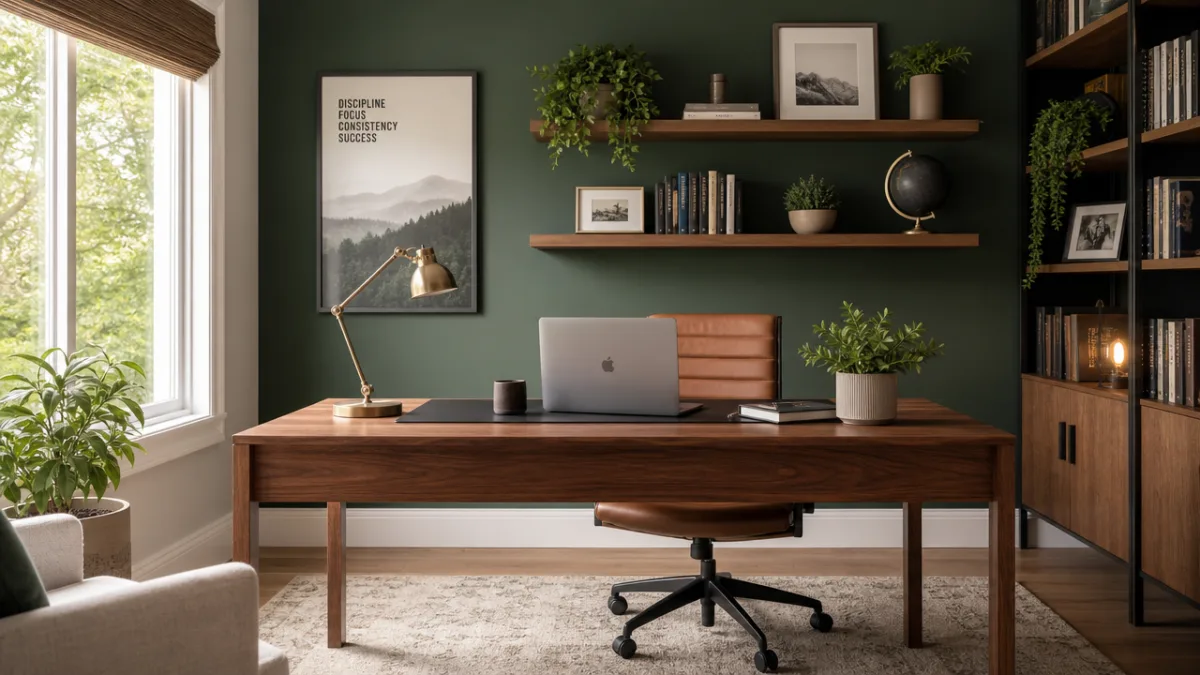
In a modern home office makeover, an accent wall is one of the highest-impact, lowest-cost changes you can make. Painting a single wall in a bold, intentional color — deep forest green, slate blue, matte black, or even a rich terracotta — instantly anchors the room and gives it a designed, purposeful look that four identical white walls simply cannot achieve. If you’re renting and can’t paint, removable peel-and-stick wallpaper has evolved dramatically in quality and range, offering everything from subtle textures to bold geometric patterns that can be removed cleanly when you move out.
When selecting your palette, pull from a maximum of three to four colors and make sure they work cohesively across all the elements in the room — walls, furniture, accessories, and textiles. A useful trick is to gather physical swatches from a paint store and hold them against your existing furniture and flooring in the actual light conditions of your office at different times of day. Colors can look dramatically different under warm afternoon sun versus cool morning light or artificial evening lighting. Taking this extra step before committing to a purchase saves you from the frustration of a color that looked perfect on a screen but feels completely wrong on the wall.
Step Three: Invest in the Right Desk and Chair
Your desk and chair are the two most important investments you’ll make in your home office, and they deserve the most careful consideration of any items in the space. The desk needs to be appropriately sized for the room — not so large that it dominates every square foot of available floor space, and not so small that you’re constantly juggling your laptop, notebook, and coffee cup in a frustrating game of surface Tetris. For modern aesthetics, look for desks with clean lines, minimal ornamentation, and materials like solid wood, engineered wood with real-wood veneers, or powder-coated steel frames paired with natural surfaces.
Standing desks have become increasingly popular and for good reason — alternating between sitting and standing throughout the workday reduces the physical strain associated with long sedentary hours and can genuinely improve both energy and focus. Motorized sit-stand desks are the most convenient option, allowing you to change heights with the touch of a button, but they represent a significant investment. A more budget-friendly alternative is a fixed standing desk used in combination with a drafting stool, or a desk converter that sits on top of your existing surface and raises your monitor and keyboard to standing height when needed.
When it comes to the chair, ergonomics should be your absolute first priority, ahead of aesthetics or price. A chair that looks sleek but fails to support your lower back, encourage proper posture, or adjust to your body’s dimensions will cause physical discomfort that makes it nearly impossible to sustain focus over long sessions. Look for chairs with adjustable seat height, lumbar support, armrest height and depth, and ideally tilt tension control. Many ergonomic chairs in the mid-range price point — from brands like Branch, Autonomous, or Flexispot — offer genuine quality without requiring you to spend the price of a used car on a Herman Miller or Steelcase model.
Step Four: Master Storage and Cable Management
One of the defining characteristics of a modern, professional-looking home office is the absence of visual chaos — and nothing creates visual chaos more reliably than poor storage and unruly cables. Before you can achieve the clean, intentional look that defines modern workspace design, you need a storage system that gives every single item in your office a designated home. This doesn’t necessarily mean buying expensive built-in cabinetry; it means being thoughtful about what you store, where you store it, and how you access it throughout the day.
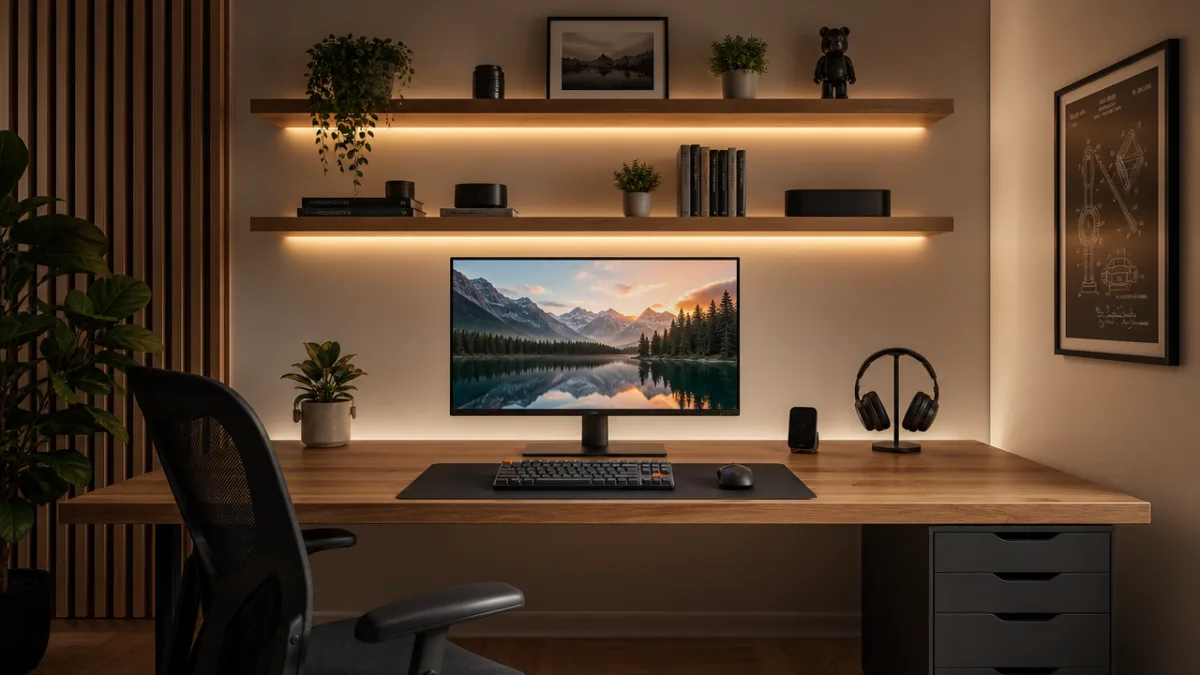
Floating shelves are one of the best DIY-friendly storage solutions available because they add vertical storage without consuming valuable floor space, and they can be styled in a way that’s genuinely decorative as well as functional. A set of three or four floating shelves above or beside your desk can hold reference books, small planters, decorative objects, and everyday supplies in a way that looks curated rather than cluttered. The key to keeping shelves from looking messy is the rule of odd numbers — group items in threes or fives, vary heights and textures, and leave deliberate breathing room between groups rather than packing every inch.
Cable management deserves its own dedicated effort and is one of the most transformative changes you can make to your office for very little money. Start by using velcro cable ties to bundle cables that run together, then route them along the underside of your desk using adhesive cable clips or a cable management tray. A power strip mounted directly to the underside of your desk keeps the cluster of plugs out of sight while keeping your devices fully accessible. For the cables that still need to travel from desk to wall outlet, a cable raceway — a plastic channel that mounts flush against the baseboard — conceals them completely and gives the room a polished, professional finish.
- Use a cable management tray mounted under your desk to hide power strips and cable clusters from direct sight lines.
- Label both ends of every cable using small adhesive tags so you never have to trace a cable from end to end again.
- Consider a wireless charging pad on your desk surface to eliminate at least one or two cables for everyday devices entirely.
- Route monitor cables through a desk grommet if your desk has one, or add an aftermarket grommet kit to achieve the same clean result.
- Use matching cable ties in a neutral color — black or white — rather than mismatched zip ties, which add visual noise even when cables are bundled.
Step Five: Optimize Lighting for Focus and Video Calls
Lighting is one of the most underestimated elements of home office design, yet it has an outsized effect on both your wellbeing and how you appear to colleagues and clients during video calls. Working under harsh overhead fluorescent lighting or, at the opposite extreme, in a dim space lit only by a single desk lamp creates eye strain, fatigue, and a general sense of bleakness that erodes motivation over the course of a long day. A well-lit home office uses layered lighting — combining ambient, task, and accent light sources — to create an environment that’s bright enough to work comfortably without being harsh or flat.
Natural light should be maximized wherever possible, because it’s genuinely the best light source available for sustained focus and mood regulation. If your office has a window, keep it unobstructed and use light-filtering rather than blackout curtains so that diffused daylight can enter even when you want some privacy. Position your monitor so that the window is to your side rather than directly behind or in front of you — a window behind your screen creates a backlit situation that strains your eyes, while a window behind you will cause glare on your monitor and a washed-out appearance on video calls.
For task lighting, a quality LED desk lamp with adjustable color temperature is an excellent investment. Being able to shift from a warmer light (around 2700–3000K) during morning hours to a cooler, more energizing light (around 4000–5000K) during peak focus periods mirrors the natural progression of daylight and helps maintain your circadian rhythm even when you’re indoors all day. For video calls specifically, a ring light or a dedicated LED panel placed slightly above and in front of your face creates the flattering, even illumination that makes you look alert and professional — a worthwhile upgrade that colleagues will notice immediately, even if they can’t articulate exactly why.
Step Six: Add Personality with Decor and Greenery
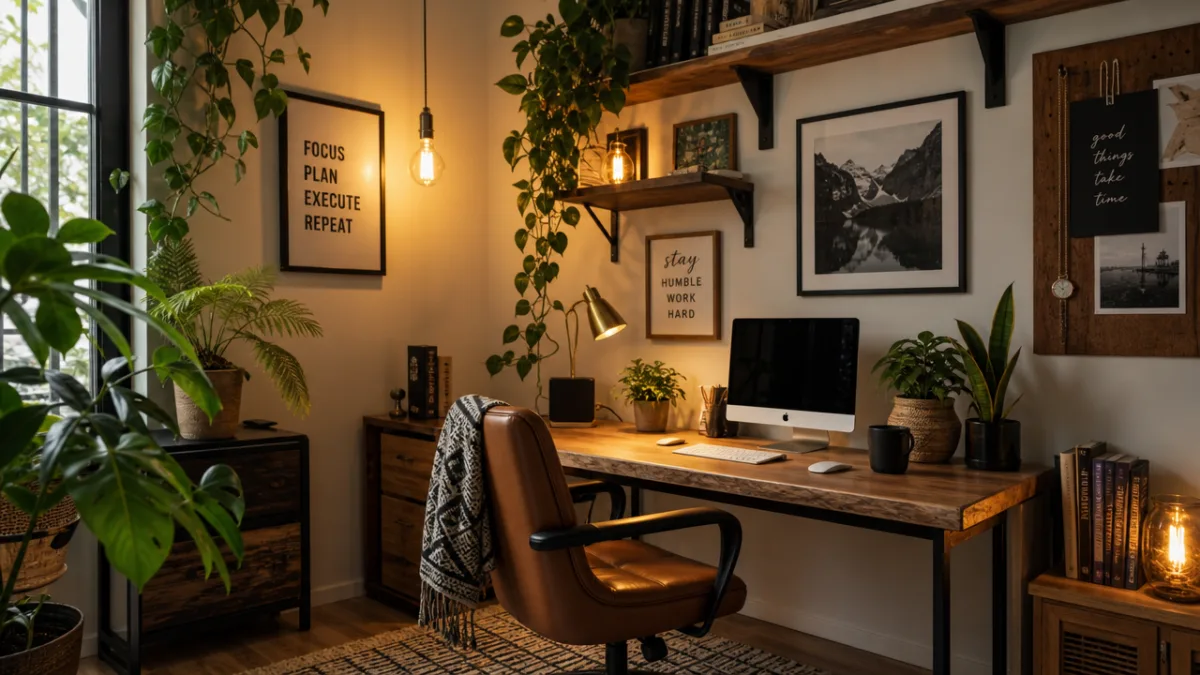
A modern home office should feel like a space that belongs to you — not a generic showroom or a corporate cubicle. Once the functional elements are in place, the final layer of the makeover involves adding the personal touches that make the environment genuinely inspiring to spend time in. This is where your own aesthetic preferences get to take center stage, whether that means a gallery wall of framed prints and photographs, a collection of sculptural objects sourced from travels and markets, or a curated shelf of books whose spines happen to coordinate beautifully with your color palette.
Plants deserve a special mention because they offer benefits that go well beyond the visual. Research consistently shows that having living plants in a workspace can reduce stress, improve air quality, and increase feelings of wellbeing — all of which translate directly into better work. The good news is that you don’t need to be an experienced plant parent to maintain an office-appropriate collection. Low-maintenance varieties like pothos, snake plants, ZZ plants, and peace lilies thrive in indoor conditions with minimal fuss, and their trailing or architectural forms add genuine visual interest to shelves, desktops, and corners that might otherwise feel empty.
When it comes to wall art, the modern approach favors intention over quantity. Rather than filling every available inch of wall space, choose a small number of pieces that you genuinely love and give them room to breathe. A single large-format print in a simple frame can be more impactful than a dozen smaller pieces arranged in a grid. Black and white photography, abstract art, typographic prints, and architectural drawings all work beautifully in modern office environments and are available at a wide range of price points — including high-quality downloadable prints you can have printed locally for a fraction of the cost of framed originals.
- Start with one or two plants and build your collection gradually as you learn what thrives in your specific light conditions.
- Use a consistent frame finish — all black, all natural wood, or all white — to unify a gallery wall even when the art inside varies widely in style.
- Add a textured throw or cushion to your chair to soften the space and make it feel more personal and inviting during long work sessions.
- Incorporate one or two items of sentimental value — a meaningful object, a piece of art made by someone you love — to remind yourself why the work you do matters.
- Rotate decorative items seasonally to keep the space feeling fresh and intentional rather than static and forgotten.
Bringing It All Together: The Modern Home Office You Deserve
A complete home office makeover is less about any single dramatic purchase or gesture and more about the cumulative effect of many intentional decisions made in sequence. When you start with a clear-eyed assessment of the space, build a foundation of good ergonomics and smart layout, layer in thoughtful color and lighting choices, conquer the chaos of cables and clutter, and finish with personal touches that make the environment feel alive and uniquely yours — the result is a workspace that genuinely supports the best version of your working self.
The DIY nature of this kind of makeover is one of its greatest strengths. Because you’re making decisions yourself, sourcing materials, and doing the physical work, you develop an intimate relationship with the space that’s simply impossible to replicate when you hire someone else to do it all for you. You know exactly why every element is there, you understand how it all connects, and you feel a genuine sense of pride and ownership every time you sit down at your desk. That psychological relationship with your workspace is more valuable than any expensive piece of furniture you could simply buy and have delivered.
Finally, remember that a great home office is never truly finished. As your work evolves, as your needs shift, and as your tastes develop, your workspace should evolve with you. Build in flexibility wherever possible — furniture that can be rearranged, storage that can be repurposed, lighting that can be adjusted — so that the space continues to serve you as your career and creative life grow. The best workspace isn’t the most expensive one or the most photographed one; it’s the one that makes you genuinely excited to sit down and do your best work, day after day.








What do you think?
It is nice to know your opinion. Leave a comment.