










Design the Home Theatre Setup of Your Dreams
Why a Home Theatre is Worth Every Penny
There is something undeniably magical about watching your favorite film in a space designed entirely around the cinematic experience. A dedicated home theatre transforms ordinary movie nights into immersive events, pulling you away from the distractions of everyday life and placing you directly inside the story unfolding on screen. When every visual and audio element is optimized specifically for your enjoyment, the difference is not subtle — it is transformative in the most profound way.
Beyond the sheer pleasure of the experience, a well-designed home theatre adds significant value to your property. Real estate agents consistently report that purpose-built entertainment rooms rank among the most sought-after features in luxury home listings. Buyers are willing to pay a premium for a space that is already thoughtfully conceived and professionally executed, meaning your investment in a quality setup can pay dividends long after you have enjoyed countless evenings in your private cinema.
The practical benefits extend further than resale value. Consider how much money a family spends annually on cinema tickets, concessions, parking, and babysitters for a single evening out. A home theatre recoups those ongoing costs remarkably quickly while offering an experience that no commercial cinema can match — your own seating preferences, your own food choices, your own volume levels, and the freedom to pause the film whenever life demands your attention. It is convenience and luxury combined into a single, deeply personal space.
Planning Your Space: Dimensions, Layout, and Acoustics
The foundation of any great home theatre is a thorough understanding of the space you are working with. Room dimensions dictate nearly every subsequent decision, from the size of the screen you can accommodate to the type of speaker system that will perform optimally. Ideally, a dedicated home theatre should be at least four metres wide and six metres long, though compelling setups have been achieved in smaller rooms through clever design choices and careful calibration of equipment. The shape of the room matters too, as square rooms create problematic standing waves that muddy bass frequencies.
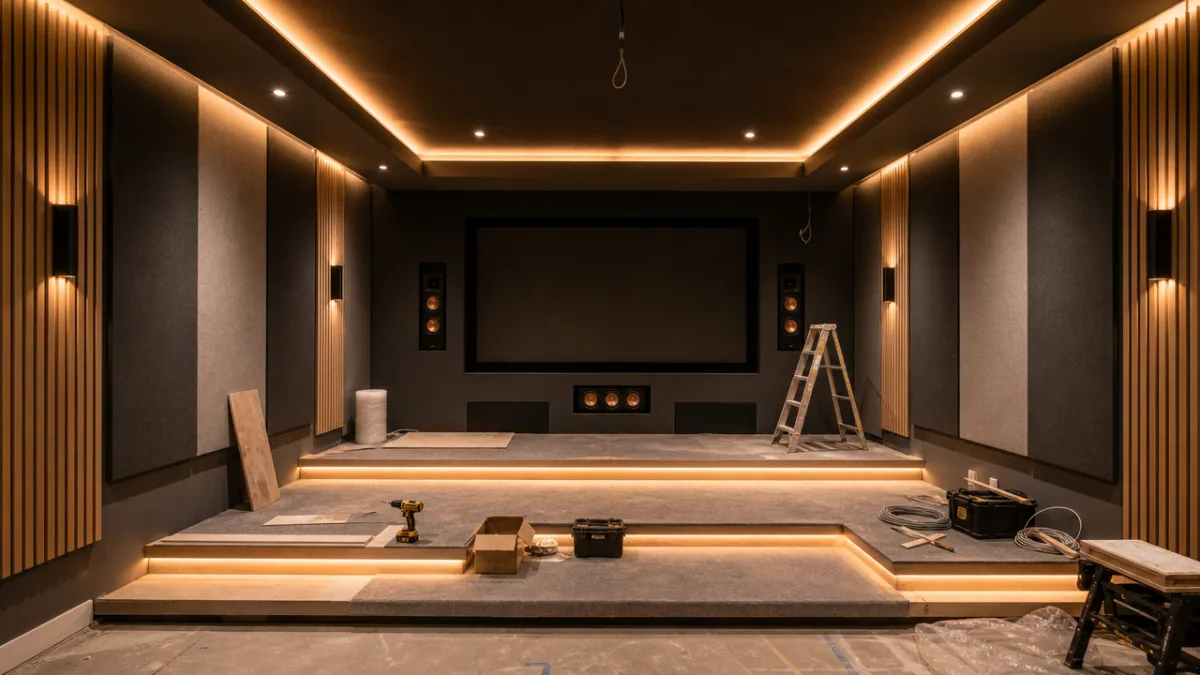
Acoustic treatment is one of the most overlooked aspects of home theatre design, yet it is arguably the most consequential. Hard, parallel walls create flutter echoes and harsh reflections that degrade sound quality regardless of how expensive your speaker system might be. Installing acoustic panels, bass traps in the corners, and diffusers on the rear wall can dramatically improve the clarity and depth of your audio experience. These elements need not look industrial or ugly — modern acoustic panels come in virtually every color and fabric, and can be custom-framed to blend seamlessly with or even enhance your room’s aesthetic.
Lighting design in the planning phase is equally critical and often underestimated. The ideal home theatre uses layered lighting with full dimming capability across every zone. Recessed ceiling lights on dimmers provide ambient illumination when the room serves non-cinematic purposes. Dedicated aisle lighting at floor level adds safety without breaking immersion during screenings. Bias lighting behind the screen reduces eye strain during long viewing sessions and actually improves perceived contrast, making your image appear richer and more dynamic without any changes to the projector or display settings themselves.
Choosing the Right Screen and Projection Technology
The centrepiece of your home theatre is undoubtedly the display, and the choice between a large flat-panel television and a projector-and-screen combination is one of the most consequential decisions you will make. Modern OLED and QLED televisions in sizes up to 97 inches deliver breathtaking picture quality with perfect blacks, extraordinary brightness, and exceptional color accuracy that is difficult to rival. For rooms with significant ambient light that cannot be fully controlled, a premium large-format television may actually outperform a projector setup in terms of day-to-day usability and perceived image quality.
Projectors, however, offer something that even the largest television cannot: the ability to produce an image that genuinely feels cinematic in scale. A quality 4K laser projector throwing an image onto a 120-inch or larger screen creates a field of view that envelops the viewer’s peripheral vision in a way that profoundly deepens immersion. Laser projectors have overtaken traditional lamp-based models in recent years, offering lifespans exceeding 20,000 hours, dramatically improved brightness, and near-instantaneous start-up times. Paired with a high-gain acoustically transparent screen, a laser projector setup can rival the visual quality of a commercial cinema at a fraction of the operational cost.
Screen material selection deserves its own careful consideration. Fixed-frame screens offer the flattest, most uniform surface and are ideal for dedicated rooms where the screen will remain permanently in place. Motorized retractable screens suit multipurpose rooms where the space doubles as a living area. Acoustically transparent screens — woven with tiny perforations invisible to the viewer — allow you to position speakers directly behind the screen surface, achieving perfect audio-visual alignment in precisely the way professional cinema engineers intended. When budget allows, this configuration represents the gold standard for home cinema sound staging.
Building Your Surround Sound System
Audio quality is, in the considered opinion of most dedicated home cinema enthusiasts, even more important than video quality to overall immersion. The human brain is remarkably forgiving of visual imperfections but acutely sensitive to audio anomalies, distortions, and imbalances. A mediocre image paired with exceptional sound will feel more cinematic than a stunning image accompanied by flat, compressed audio. This understanding should inform your budget allocation — spending at least as much on audio as on your display system is a principle that consistently produces the most satisfying results.
A proper home theatre audio system begins with a capable AV receiver or processor at its heart. Look for support for the latest immersive audio formats, including Dolby Atmos and DTS:X, which add height channels to the traditional surround sound format for a genuinely three-dimensional soundfield. The recommended speaker configurations for these formats include:
- A 5.1 system featuring front left, center, front right, surround left, and surround right speakers plus a subwoofer — the minimum for convincing surround sound
- A 7.1 configuration adding rear surround channels for enhanced lateral movement and greater envelopment in large rooms
- A 7.1.4 Atmos setup incorporating four ceiling-mounted or upward-firing height speakers that bring overhead audio objects to life with remarkable precision
- A 9.1.4 or larger configuration for very large rooms where additional side and rear channels eliminate any dead zones in the surround field
Subwoofer selection and placement require particular attention because low-frequency reproduction is the element most responsible for the visceral, physical dimension of cinema sound. A single high-quality subwoofer placed in a room corner typically produces the most even bass response, though dual subwoofers positioned symmetrically will smooth out frequency response across a wider seating area. Sealed subwoofer enclosures offer tighter, more accurate bass ideal for music, while ported designs deliver greater extension and impact at extreme low frequencies — precisely the qualities that make film explosions and thunderstorms feel genuinely threatening and real.

Seating, Comfort, and Interior Design
The finest audiovisual technology in the world cannot compensate for uncomfortable seating during a three-hour epic. Home theatre seating has evolved into a sophisticated design category of its own, with dedicated manufacturers producing recliners, loveseats, and sectional configurations purpose-built for the demands of extended viewing sessions. Key features to evaluate include lumbar support quality, headrest adjustability, armrest width and height, the smoothness and travel of the reclining mechanism, and the availability of powered versus manual recline — powered recline is noticeably quieter and avoids the mechanical thump of manual systems that can disrupt a scene.
Tiered or raised flooring for rear seating rows is both a practical and aesthetic upgrade that elevates your home theatre from a nice room to a genuinely professional environment. Even a modest platform rise of 25 to 30 centimetres for a second row ensures that viewers seated in the back have unobstructed sightlines over the heads of those in front. When planning a tiered layout, ensure that the platform is structurally integrated with the room’s framing rather than simply stacked on top of the existing subfloor, as this produces a much more solid feel underfoot and eliminates any resonance from the platform acting as a secondary sound-radiating surface.
Interior design choices should serve the acoustic and visual goals of the space while reflecting your personal aesthetic sensibility. Dark wall colors — deep charcoal, navy, burgundy, or matte black — minimize light reflection from the screen and create the sense of enclosure that helps the brain focus on the visual presentation. Thick, heavy drapes eliminate light leakage around doorways and windows. Carpet or rugged area rugs are preferable to hard flooring because they absorb sound rather than reflecting it. Decorative elements such as movie posters in illuminated frames, custom-fabricated column speakers, and coffered ceilings with integrated lighting all contribute to an atmosphere that signals to every visitor that this space was conceived with genuine passion and expertise.
Smart Technology Integration and Future-Proofing Your Setup
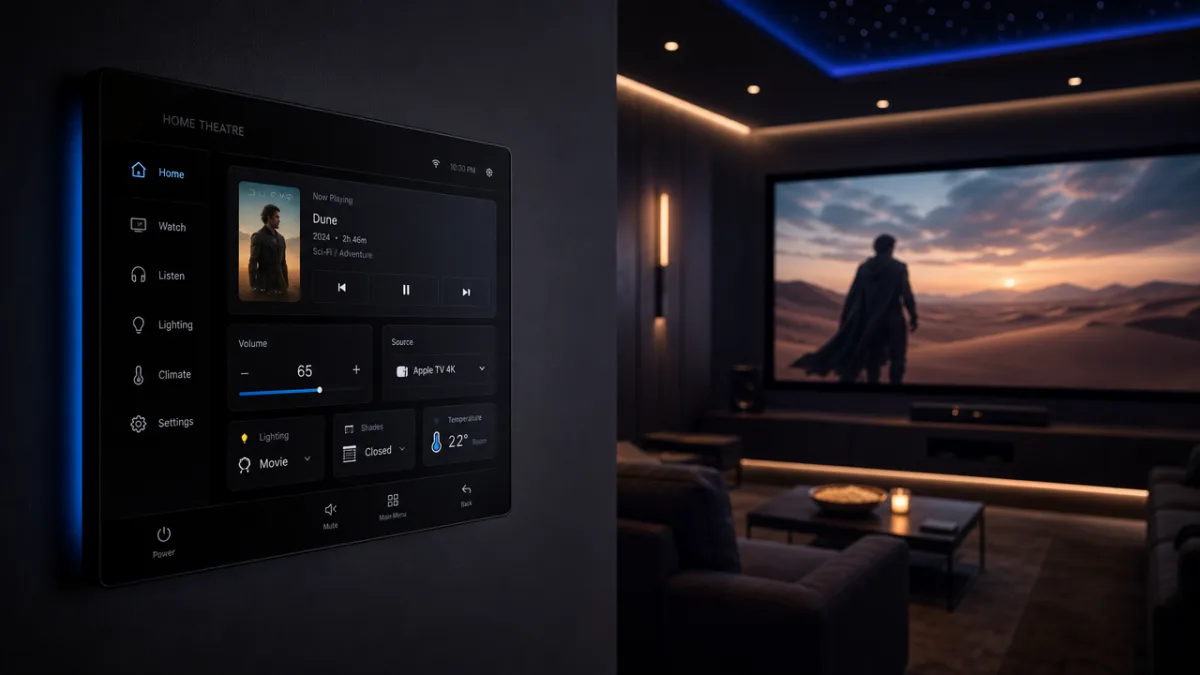
A modern home theatre is as much a technology ecosystem as it is a room, and thoughtful integration of smart home systems can elevate the experience from great to genuinely extraordinary. A well-configured control system — whether a dedicated platform or a well-programmed universal remote — should be capable of executing a single “Watch Movie” command that simultaneously dims all lights to your preferred levels, lowers the motorized screen, powers on the projector and AV receiver, switches inputs to your media server, and prepares your seating to your chosen recline position. This kind of seamless, one-touch automation transforms routine into ritual.
Future-proofing your infrastructure during the build phase costs relatively little in materials but can save enormous expense and disruption later. Install conduit runs through walls and under floors during construction so that cable upgrades can be pulled through without demolition. Run more HDMI and speaker cable than you currently need, terminating unused runs in accessible junction boxes. Ensure your electrical panel has dedicated circuits for high-current amplifiers and projectors to avoid ground noise and power fluctuation artifacts. Consider a whole-home uninterruptible power supply or at minimum a quality power conditioner, both to protect your expensive equipment from electrical transients and to ensure clean, stable power that allows your audio system to perform at its genuine best.
Streaming and media playback technology changes rapidly, and your infrastructure should accommodate that evolution. A dedicated media server or network-attached storage device loaded with a high-quality media player application allows you to maintain a personal library of 4K HDR content in lossless format that exceeds the quality of any streaming service currently available. A high-speed wired network connection to your media player is strongly preferable to Wi-Fi for large file playback, eliminating buffering and ensuring that bandwidth-intensive formats such as Dolby Vision and lossless Dolby TrueHD audio stream without interruption. Building your home theatre around a robust, wired network backbone ensures the room remains fully capable of handling whatever new formats and resolutions the next decade of cinema technology delivers.
Budgeting, Priorities, and Working with Professionals
Home theatre projects span an extraordinary range of budgets, from modest conversions of an existing spare room costing a few thousand dollars to custom-built underground cinemas with price tags in the hundreds of thousands. The good news is that the principles governing great home theatre design remain constant regardless of budget: control the room acoustics, manage light carefully, invest proportionally in audio, and choose components with strong long-term performance records over brand prestige. A thoughtfully chosen mid-range system in a properly treated room will consistently outperform a high-end system installed without acoustic consideration.
When allocating your budget across the major categories, consider the following priority framework that experienced home theatre designers consistently recommend:
- Room construction and acoustic treatment first — this is the investment that multiplies the performance of everything else
- Speaker system and subwoofer, including the AV receiver or processor — audio is the emotional engine of cinema
- Seating — comfort determines how long and how often you actually use and enjoy the space
- Screen and projection or display system — spectacular images need a proper foundation to shine
- Source components, streaming infrastructure, and smart home control systems — refine these over time as technology evolves
Working with a certified home theatre designer or custom installation professional is an investment that pays for itself many times over, particularly for first-time builds. Professional designers bring not only product knowledge but also practical experience with the countless small decisions — cable routing, equipment rack placement, acoustic panel positioning, sight line calculation — that collectively determine whether a completed room feels genuinely professional or merely expensive. Many certified integrators offer design consultations for a reasonable flat fee that can be applied toward a full installation, making it financially sensible to at least obtain a professional assessment of your room’s potential before committing to any purchases. Your dream home theatre is absolutely within reach — it simply rewards careful planning, informed priorities, and a willingness to invest first in the fundamentals that make every frame of every film an experience worth savoring.








What do you think?
It is nice to know your opinion. Leave a comment.