










100 Products That Will Make Your Home Smarter
The Smart Home Revolution: Why Now Is the Perfect Time to Upgrade
The concept of a smart home has evolved dramatically over the past decade, shifting from a futuristic fantasy reserved for tech billionaires into an accessible reality for everyday homeowners. What once required expensive custom installations and complex wiring can now be accomplished with a few taps on a smartphone app. The convergence of affordable hardware, reliable wireless protocols, and intuitive software platforms has created a golden era for home automation enthusiasts and casual adopters alike.
Consumer spending on smart home devices has surged year over year, and the reasons are compelling. Modern smart home products don’t just add novelty — they deliver measurable improvements in energy efficiency, security, convenience, and even mental well-being. Imagine waking up to lights that gradually brighten to simulate sunrise, a thermostat that already knows your morning temperature preference, and a coffee maker that started brewing the moment your alarm went off. These aren’t distant dreams; they’re products sitting on shelves right now at accessible price points.
Perhaps most importantly, today’s smart home ecosystem is more interoperable than ever before. The Matter standard, developed collaboratively by Apple, Google, Amazon, and Samsung, has dramatically reduced compatibility headaches that once plagued early adopters. Devices from different manufacturers can now communicate seamlessly, giving homeowners the freedom to mix and match the best products across categories without being locked into a single brand’s ecosystem. This openness has accelerated innovation and driven prices downward across the entire category.
Smart Lighting: Transforming Every Room With Intelligent Illumination
Lighting is widely considered the best entry point into home automation, and for good reason. Smart bulbs are affordable, easy to install, and deliver an immediately noticeable impact on both ambiance and energy consumption. Brands like Philips Hue, LIFX, and Sengled offer bulbs that connect directly to your Wi-Fi network or a dedicated hub, giving you granular control over brightness, color temperature, and even millions of colors for accent lighting. A single bulb replacement can introduce you to scenes, schedules, and voice control overnight.
Beyond individual bulbs, smart lighting systems now encompass light strips, recessed lighting panels, outdoor fixtures, and even smart switches that allow you to retrofit existing dumb bulbs with intelligent controls. Light strips tucked behind televisions, under kitchen cabinets, or along staircase railings can transform the visual character of a space dramatically. Outdoor smart lighting with motion detection and scheduled sunset-to-sunrise operation simultaneously improves curb appeal and security, deterring potential intruders while welcoming family members home.
The health benefits of smart lighting deserve particular attention. Circadian rhythm lighting — systems that automatically adjust color temperature throughout the day from cool, energizing blues in the morning to warm, sleep-promoting ambers in the evening — has been shown to improve sleep quality and daytime alertness. Products like the Philips Hue Gradient Lightstrip and the Nanoleaf Lines can create dynamic lighting environments that respond to the time of day, your activity, or even the music playing in your home, making intelligent illumination a genuine wellness investment.
- Smart bulbs with color temperature control for circadian rhythm support
- Motion-activated outdoor fixtures with integrated cameras
- LED light strips for accent and bias lighting applications
- Smart switches and dimmers compatible with existing wiring
- Modular light panels for creative wall installations

Smart Security: Protecting Your Home Inside and Out
Home security represents one of the most compelling use cases for smart technology, offering homeowners unprecedented visibility into and control over their property’s safety. Today’s smart security ecosystem includes video doorbells, indoor and outdoor cameras, smart locks, motion sensors, glass break detectors, and professional monitoring services — all integrated into a single app on your phone. The peace of mind that comes from being able to check in on your home from anywhere in the world, at any moment, is something previous generations of security systems simply couldn’t offer.
Video doorbells have become the flagship product of the smart security category, and it’s easy to understand why. Devices from Ring, Google Nest, and Arlo provide crisp high-definition video, two-way audio, package detection, and AI-powered person recognition. Many models now include color night vision and wide-angle lenses that eliminate blind spots entirely. Beyond deterrence, the footage these devices capture has proven invaluable in helping law enforcement identify porch pirates, vandals, and other criminals, with many neighborhood communities sharing footage through platforms like Amazon’s Neighbors app.
Smart locks represent another transformative leap in home security and convenience. Products like the August Smart Lock Pro, Schlage Encode, and Yale Assure allow you to grant keyless access to family members, housekeepers, dog walkers, and guests via temporary PIN codes or digital keys sent directly to their smartphones. You can monitor every entry and exit with a timestamped log, lock and unlock your door remotely, and receive instant notifications if a door is left unlocked. For families with children who frequently arrive home before parents, smart locks eliminate the anxiety of lost keys entirely.
- Install a video doorbell at your primary entrance as a first step
- Add a smart lock to eliminate physical key vulnerabilities
- Place indoor cameras in common areas and points of entry
- Deploy outdoor cameras covering driveways and backyards
- Connect everything to a central security hub with professional monitoring
Smart Climate Control: Comfort, Efficiency, and Savings Automated
Heating and cooling typically account for nearly half of a home’s total energy consumption, making smart climate control one of the most financially impactful areas of home automation. Smart thermostats like the Google Nest Learning Thermostat, Ecobee SmartThermostat Premium, and Honeywell Home T9 learn your schedule and preferences over time, automatically adjusting temperatures to optimize both comfort and efficiency. Independent studies have shown that smart thermostat users save an average of 10 to 23 percent on heating and cooling bills annually — savings that often pay for the device within a single year.
What separates modern smart thermostats from their programmable predecessors is adaptive intelligence. The Ecobee’s SmartSensor technology places small wireless sensors in individual rooms, detecting occupancy and temperature variations throughout the house and adjusting airflow accordingly. If the living room is consistently warmer than the bedroom due to afternoon sun exposure, the system compensates automatically without any manual input. Geofencing features use your smartphone’s location to begin warming or cooling your home as you approach, ensuring perfect comfort the moment you walk through the door.
Smart climate control extends beyond thermostats into a broader ecosystem of devices. Smart ceiling fans with automated scheduling and wind-down modes work in coordination with your thermostat to reduce runtime. Smart air purifiers with real-time air quality monitoring adjust their filtration intensity based on detected pollutants, allergens, and particulate matter. Smart humidifiers and dehumidifiers maintain optimal humidity levels automatically, protecting both your health and your home’s structure. When these devices communicate with each other and with your central thermostat, they create a holistic indoor climate system that’s far more effective than any individual appliance operating alone.
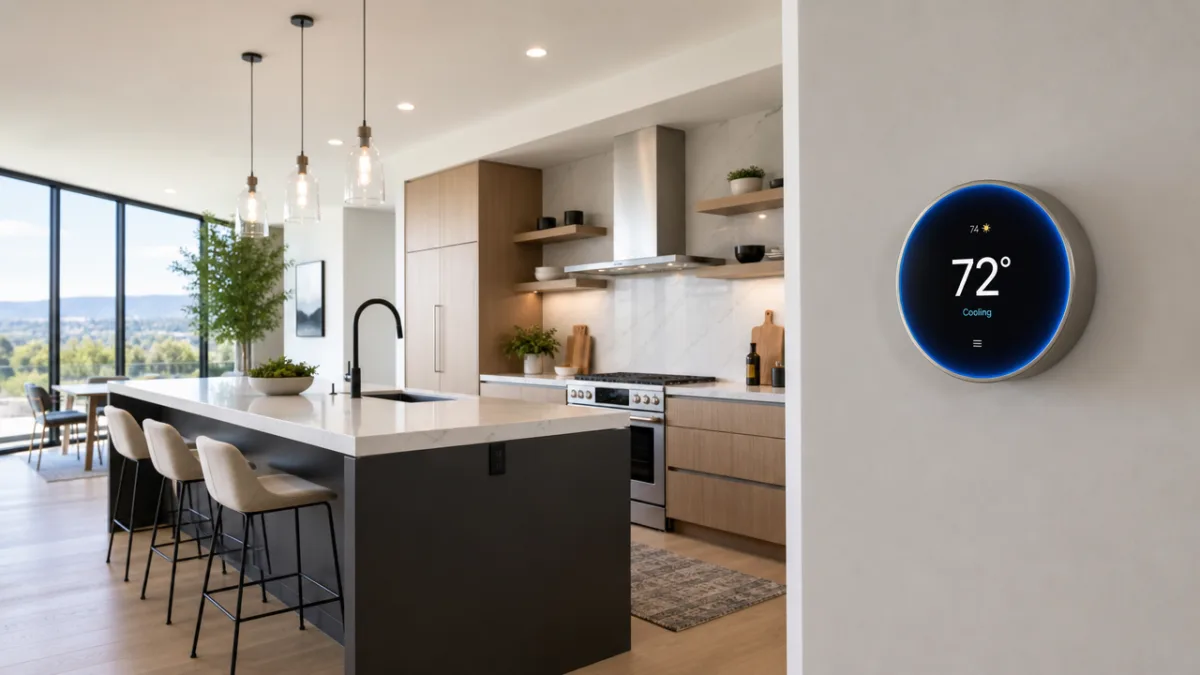
Smart Kitchen Appliances: Reinventing How You Cook, Store, and Entertain
The kitchen has become a hotbed of smart appliance innovation, with manufacturers introducing connected versions of nearly every appliance category imaginable. Smart refrigerators from Samsung and LG now feature internal cameras that let you check your food inventory from the grocery store, touchscreen displays for recipe browsing and family messaging, and AI-powered food management systems that track expiration dates and suggest meals based on available ingredients. While premium models carry premium price tags, the technology is gradually filtering down into more accessible product tiers as the category matures.
Countertop smart appliances have democratized access to kitchen automation without requiring a full renovation. The Instant Pot with Wi-Fi connectivity allows you to monitor and control cooking remotely, starting a slow-cook cycle before you leave work so dinner is ready the moment you arrive home. The June Oven uses AI and a built-in camera to identify food items automatically and cook them using precisely optimized programs developed by professional chefs. Smart coffee makers like those from Hamilton Beach and Breville can be scheduled, adjusted, and monitored from bed, ensuring your morning brew is perfectly timed and precisely calibrated every single day.
Smart kitchen technology also extends to less glamorous but equally practical applications. Smart faucets with voice activation and preset water temperature and volume controls reduce waste and improve convenience during meal prep. Smart dishwashers with leak detection and remote cycle monitoring alert you to potential water damage before it becomes catastrophic. Under-sink water filtration systems with connected filter life monitoring ensure you never unknowingly drink unfiltered water due to a forgotten replacement schedule. Taken together, these products transform the kitchen from a space of manual labor into one of streamlined, intelligent efficiency.
- Smart refrigerators with internal cameras and inventory tracking
- Wi-Fi connected Instant Pots and multicookers for remote meal management
- AI-powered countertop ovens with automatic food identification
- Smart coffee makers with precision scheduling and remote control
- Connected dishwashers with leak detection and cycle monitoring
- Voice-activated faucets with preset temperature and volume programs
Smart Entertainment and Connectivity: Building the Brains of Your Smart Home
No smart home is truly smart without a robust entertainment and connectivity infrastructure at its core. Smart speakers and displays from Amazon, Google, and Apple serve as the conversational interface through which most people interact with their entire smart home ecosystem. The Amazon Echo, Google Nest Hub, and Apple HomePod mini allow voice-controlled management of lights, locks, thermostats, security systems, and entertainment — functioning as always-on home assistants that can answer questions, play music, manage calendars, set reminders, and control virtually any connected device in your home simultaneously.
Whole-home Wi-Fi mesh systems represent perhaps the most foundational smart home investment you can make, as every other connected device depends on reliable, fast wireless coverage throughout the property. Systems from Eero, Google Nest Wi-Fi Pro, and Orbi use multiple access points distributed throughout the home to eliminate dead zones and ensure consistent bandwidth in every room. Many of these systems include built-in smart home hubs, automatic security updates, parental controls, and network management features that allow you to see every connected device and allocate bandwidth intelligently based on priority.
Smart televisions have evolved from passive display panels into central hubs for home entertainment and, increasingly, home automation. Platforms like Google TV, Roku TV, and Amazon Fire TV provide unified interfaces for streaming services alongside smart home dashboards, allowing you to monitor security cameras, check who’s at the door, or adjust your thermostat without leaving the couch. Multi-room audio systems from Sonos, Denon HEOS, and Amazon Echo allow synchronized or independent music playback in every room of the house, controlled by voice or app, creating an immersive audio environment that adapts to any occasion.

Getting Started: Building Your Smart Home Strategy Step by Step
The most common mistake new smart home adopters make is trying to do everything at once. The sheer breadth of available products can be overwhelming, and purchasing devices without a coherent strategy often results in incompatible systems, redundant functionality, and considerable buyer’s remorse. Instead, experienced smart home enthusiasts universally recommend beginning with a single ecosystem — whether that’s Amazon Alexa, Google Home, or Apple HomeKit — and ensuring every subsequent purchase is compatible with that platform before committing to a purchase. This ecosystem-first approach saves money, reduces frustration, and creates a more cohesive user experience over time.
Prioritization matters enormously when building a smart home on a budget. Security and climate control offer the highest return on investment in terms of both safety impact and financial savings, making them logical starting points for most homeowners. Smart lighting comes next for its combination of accessibility, visual impact, and entry-level affordability. Kitchen appliances and entertainment systems, while compelling, typically involve larger investments and longer decision timelines, making them more appropriate for the second or third phase of a multi-year smart home build. Mapping out a phased roadmap before spending a dollar prevents impulsive purchases that don’t align with your long-term vision.
Installation and network considerations are often underestimated by first-time smart home buyers. A quality mesh Wi-Fi system capable of supporting dozens of simultaneous connected devices is not optional infrastructure — it is the essential foundation upon which everything else depends. Running a separate IoT network for your smart devices, isolating them from computers and phones containing sensitive personal data, is a security best practice that network-savvy homeowners are increasingly adopting. Finally, keeping firmware and app software updated across all devices ensures you benefit from the latest security patches and feature enhancements, protecting both your investment and your privacy for years to come.
- Choose a primary smart home ecosystem and commit to it consistently
- Upgrade your home’s Wi-Fi infrastructure before adding smart devices
- Start with security and climate control for maximum practical impact
- Add smart lighting room by room as budget allows
- Expand into kitchen, entertainment, and specialty devices in later phases
- Review and update all device firmware and app software regularly
- Consider professional installation for complex integrations and hardwired devices
The smart home journey is ultimately a personal one, shaped by your household’s unique routines, priorities, and living space. Whether you start with a single smart bulb or a comprehensive security system, each product you add teaches you something new about how technology can enhance daily life in ways both practical and delightful. The 100 products available to you today represent only the beginning of what’s possible — as artificial intelligence, edge computing, and sensor technology continue to advance, the gap between a smart home and a genuinely intelligent home will continue to close in ways that will surprise and inspire even the most seasoned tech enthusiasts.








What do you think?
It is nice to know your opinion. Leave a comment.