










Small Garden Decor Ideas: Transform Your Tiny Outdoor Space into a Beautiful Retreat
The Art of Making Small Gardens Feel Larger
Here’s a misconception worth clearing up right away: a small garden doesn’t mean a limited one. In fact, working with a compact outdoor space often pushes you toward a level of creativity that bigger gardens never really demand. When every plant, pot, and decorative touch has to earn its spot, you end up with something far more intentional and visually interesting than you might expect. Done well, a tiny garden can feel surprisingly spacious — and deeply, unmistakably yours.
A lot of making a small garden feel bigger comes down to understanding how the eye moves through a space. Vertical elements — trellises, tall planters, climbing plants — pull the gaze upward and create a sense of height that more than makes up for what you’re missing on the ground. Mirrors mounted on walls or fences are another clever trick borrowed straight from interior design: position one well and you can effectively double the perceived depth of your garden. Light-colored surfaces and anything with a bit of reflectivity help too, bouncing natural light around so the whole space feels airier and more open.
Layering is another technique that makes a huge difference. Instead of keeping everything at the same level, think in tiers: raised beds, hanging baskets, wall-mounted planters, and ground-level containers all working together. This multi-dimensional approach adds richness and complexity without eating up a single extra square foot. When each level brings something different — a new texture, a change in color, a different plant entirely — the result feels lush and abundant in a way that has nothing to do with how big the garden actually is.
Container Gardening: Versatility in Every Pot
If there’s one approach that suits small gardens better than almost anything else, it’s container gardening. Pots, troughs, window boxes, hanging baskets — they let you grow an impressive variety of plants without committing to permanent beds. You can rearrange things with the seasons, swap out anything that’s past its best, and try out new color combinations whenever the mood strikes. Containers also make it possible to garden on hard surfaces like patios, balconies, and paved courtyards where you simply can’t dig a traditional bed.
Choosing the right containers matters just as much as choosing the right plants. Terra cotta has that warm, classic look and lets roots breathe, which makes it great for herbs and Mediterranean plants. Glazed ceramic pots come in so many colors that they can become a decorative feature in their own right, even when the plant inside isn’t at its showiest. Fiberglass and resin are worth considering if weight is an issue — they can look remarkably like stone or lead without putting stress on a balcony or elevated space. And don’t overlook the charm of recycled finds: old colanders, wooden crates, vintage buckets — they bring real character and a relaxed, sustainable feel to the whole garden.
When it comes to arranging containers, odd numbers just work. A cluster of three pots in different heights and sizes, planted with species that complement each other, becomes a living sculpture that anchors a corner beautifully. A useful formula for mixed plantings is thriller, filler, and spiller: one tall, dramatic centerpiece, mounding plants to fill in around it, and something trailing that spills over the edge. It sounds almost too simple, but it reliably produces something that looks considered and interesting from every angle — like a complete little garden in a single pot.
- Terra cotta pots for herbs, succulents, and drought-tolerant plants
- Glazed ceramic containers for bold color statements and focal points
- Hanging baskets for trailing plants like lobelia, petunias, and ivy
- Window boxes for continuous color along fences and railings
- Upcycled containers for a unique, sustainable, and budget-friendly look
Vertical Gardening: Growing Up When You Can’t Grow Out
Vertical gardening has genuinely changed how small-space gardeners think about what’s possible. Training plants upward on structures, or using wall-mounted systems, dramatically increases what you can grow without giving up a single inch of ground. Walls, fences, even the sides of buildings all become growing surfaces — bare brick or timber transformed into something green and alive. It’s practical, yes, but it’s also one of the most decorative things you can do for a small garden. A well-planted vertical surface creates a feeling of enclosure and intimacy that makes even the tiniest space feel like somewhere special.
Trellises and obelisks are the classics, and they suit a wide range of plants and styles. A wooden trellis painted in a color that contrasts with your fence becomes a design statement before a single plant has started climbing it. Add clematis, roses, jasmine, or honeysuckle and you’re getting seasonal flowers and often fragrance on top of everything else. Obelisks in containers are particularly useful because you can move them around — shift them to wherever you need a focal point at any given time of year.
Modular wall planting systems have become much more accessible in recent years, which has made vertical gardening genuinely easy to get into. They typically work with interlocking pockets or panels that you fill with soil and plant up however you like. Succulents, ferns, herbs, and compact flowering plants all thrive in them, and when they’re fully established the results can be genuinely breathtaking. There are practical bonuses too — a living wall improves air quality, helps regulate temperature near the surface, and can even reduce noise, which is a real bonus in a city garden. It’s one of those additions that earns its place several times over.
Lighting and Atmosphere: Extending the Magic Beyond Daylight
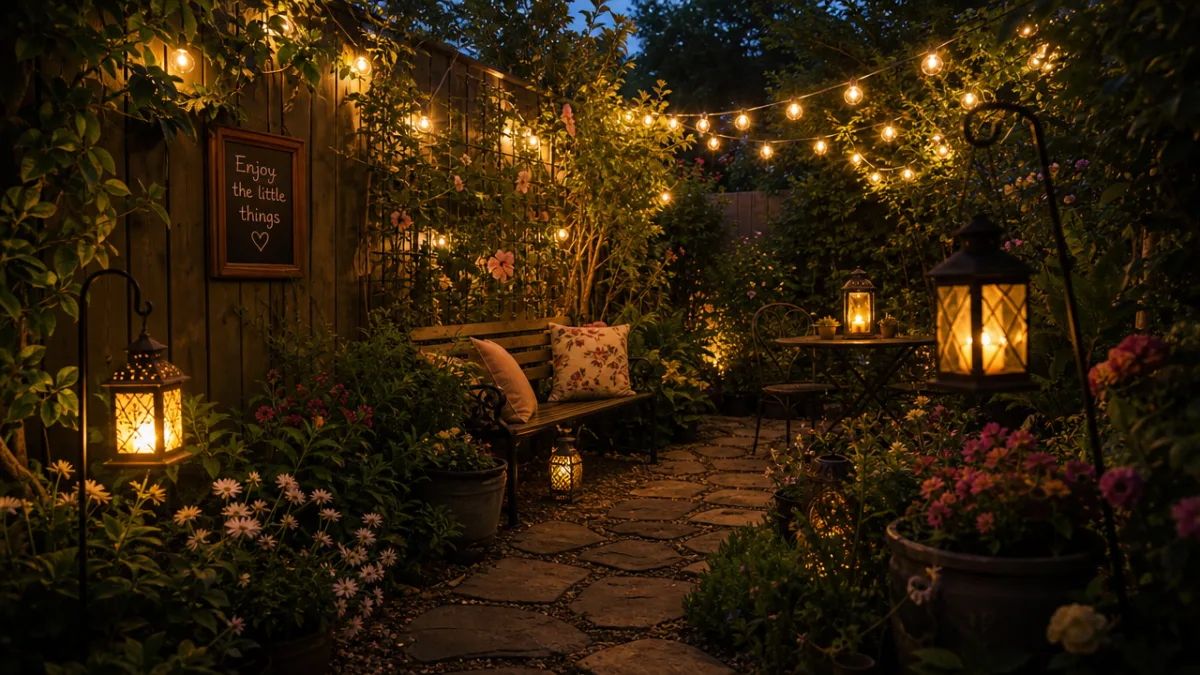
Garden lighting is one of the most transformative things you can add to an outdoor space, and it’s consistently underestimated. Good lighting doesn’t just let you use the garden after dark — it completely changes the mood, creating warm pools of light and interesting shadows that show the garden in a way you simply don’t see during the day. Solar-powered options have come a long way and are now genuinely reliable, with no wiring required and essentially no running costs. String lights, stake lights, lanterns, uplighters — each does something different, and layering them together is where the real magic happens.
String lights are probably the most universally loved garden lighting option, and it’s not hard to see why. Draped over a pergola, woven through the branches of a small tree, or strung along a fence, they instantly make everything feel warmer and a bit more celebratory. Warm white LED strings have largely replaced older incandescent bulbs and give off a soft, flattering glow that’s kind to both plants and people. If you want something with more personality, Edison-style bulbs with visible filaments add a vintage, slightly industrial charm that works particularly well with rustic or eclectic garden styles.
Uplighting plants or structural features adds a dramatic layer to the garden after dark, drawing attention to textures and forms that tend to go unnoticed during the day. A single spotlight at the base of a sculptural shrub or an interesting wall can create a striking effect with very little effort or cost. Candles and lanterns bring something else entirely — a flickering, organic quality of light that no electric source can quite replicate. Group some lanterns on a table or line them along a path and the atmosphere becomes immediately intimate and romantic, perfect for evenings outside. If fire risk is a concern, battery-powered LED candles look remarkably convincing and are a much more practical choice for outdoor settings.
Furniture and Seating: Creating a Functional Outdoor Room
Even the smallest garden benefits enormously from having somewhere to sit. A seat transforms a garden from something you look at to somewhere you actually spend time — even if that’s just a quiet coffee in the morning or a glass of wine at the end of the day. The trick in a tight space is finding furniture that’s comfortable and useful without overwhelming everything around it. Folding chairs and tables that pack away when you don’t need them are always a smart option, and anything that pulls double duty — a storage bench, say, or an ottoman that hides garden accessories inside — is worth its weight in gold.
Scale really is everything when you’re choosing garden furniture for a small space. Pieces that are too large will make the garden feel cramped and cluttered, and suddenly the planting you’ve worked so hard on gets lost. The classic bistro set — a small round table and two chairs — has been a staple of European café culture forever, and for good reason: it’s perfectly proportioned for a balcony or a pocket-sized patio. A slim bench tucked against a wall or fence can also do a lot of work, using peripheral space efficiently while keeping the center of the garden open and breathable.
When it comes to materials, you want something that balances good looks with practicality. Teak and other hardwoods age beautifully, developing a silver-grey patina that many people end up preferring to the original warm tone. Powder-coated steel and wrought iron are durable and come in styles ranging from sleek and contemporary to very ornate. Synthetic rattan and wicker have a relaxed, natural feel that suits cottage-style planting especially well. Adding outdoor cushions in weather-resistant fabric is one of the easiest ways to bring in color and pattern — and because cushions are so easy to swap out, you can completely refresh the look of your seating area from one season to the next without spending much at all.
- Choose furniture scaled appropriately to your space to avoid a crowded feel
- Consider folding or stackable pieces for maximum flexibility
- Use weather-resistant cushions and textiles to add color and comfort
- Place seating in a position that takes advantage of the best views within the garden
- Add a small side table or stool for practical functionality beside seating areas
Decorative Accents and Personal Touches
The decorative accents in your small garden are what give it a genuine personality — what make it yours rather than anyone else’s. Garden ornaments, sculptures, and meaningful objects have been part of outdoor spaces since ancient times, and that hasn’t changed because it works. In a small garden, the important word is restraint. A few well-chosen pieces make a much stronger statement than a crowd of unrelated ornaments competing for attention. A single interesting sculpture, a beautiful piece of driftwood, or a carefully arranged group of stones can carry a whole corner of the garden on its own.
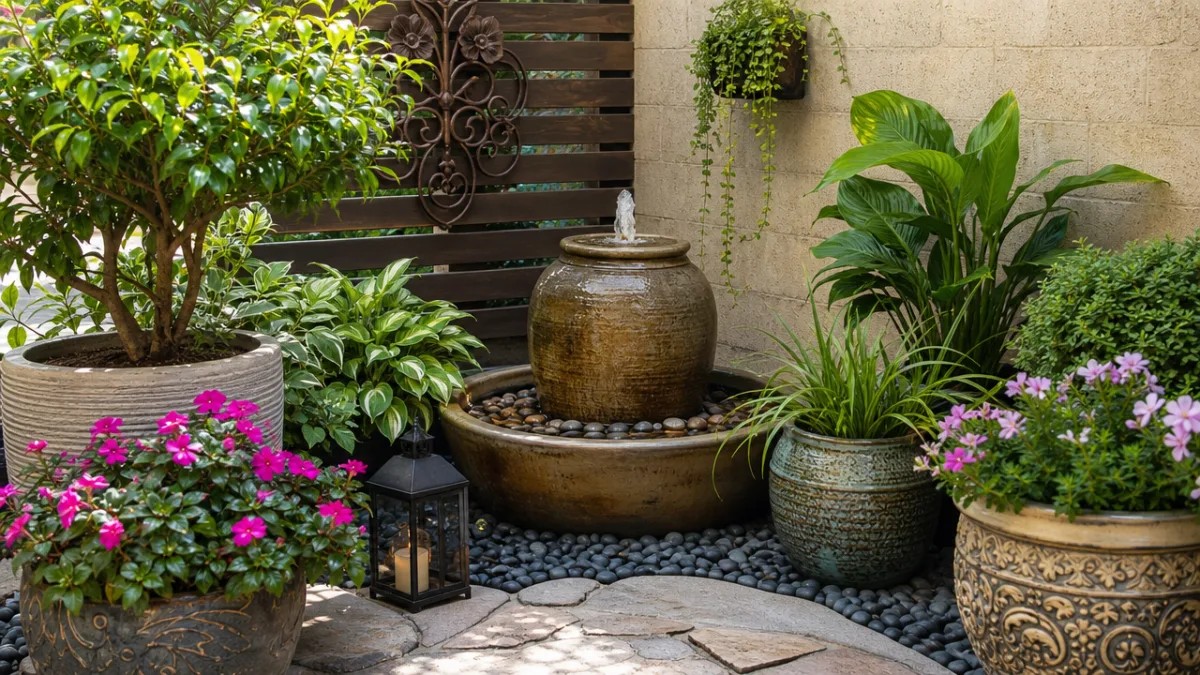
Water features bring something to a garden that plants and lighting simply can’t replicate on their own. The sound of moving water is almost universally calming, and in an urban garden it does something practical too — it softens the noise of traffic or neighbors and makes the space feel genuinely removed from the city around it. Self-contained fountain bowls and bubbling millstones are ideal for small gardens because they need no external water supply and can go wherever you have a power outlet or a solar panel. Even something as simple as a birdbath adds movement and sound when birds come to drink, and it does real good for local wildlife at the same time.
Bringing some color coordination to your decorative scheme makes a surprising difference in how pulled-together a small garden feels. Picking two or three complementary colors for your containers, furniture, and ornaments gives everything a sense of intention that lifts the whole space. This doesn’t mean everything needs to match — it just means the colors should feel like they’re having a conversation rather than arguing with each other. A palette of soft blues and greys with touches of terracotta, for instance, creates a relaxed Mediterranean mood that works in sun or shade and manages to feel both easy and quietly sophisticated at the same time.
Seasonal Planting and Year-Round Interest
Getting a small garden to look good all year round is one of the most satisfying challenges in gardening. Without wide borders where different areas can take turns doing the heavy lifting, you have to think more carefully about succession planting and choosing species that deliver across multiple seasons. Plants that flower in spring and summer, produce interesting seed heads or berries in autumn, and hold their structure or keep their foliage through winter are genuinely invaluable in a small space. Ornamental grasses are a perfect example — they bring movement and texture from late spring right through to winter and ask for very little in return.
Spring bulbs are one of the simplest and most rewarding ways to bring the garden back to life after winter. Tulips, daffodils, crocuses, and hyacinths can be packed into containers at remarkable density using the lasagne planting method, where you layer different bulbs at different depths in the same pot. When they finish flowering, simply move the pots somewhere out of the way while the foliage dies back, and bring fresh summer containers in to take center stage. This relay approach means there’s always something worth looking at in the garden, no matter the time of year.
Evergreen plants are what give a well-planned small garden its backbone. They provide structure, a degree of privacy, and visual interest even in the depths of winter when everything deciduous has shut down for the season. Box, bay, pittosporum, and euonymus can all be clipped into neat, architectural forms that take up minimal space. Dwarf conifers offer a wonderful variety of color and texture in very compact sizes — from the silver-blue of a dwarf blue spruce to the warm gold of a miniature cypress. Weave these structural evergreens together with seasonal color and a few well-chosen ornamental details, and your small garden will have something to offer in every single month of the year, always with something a little new to discover.








What do you think?
It is nice to know your opinion. Leave a comment.