










Top 23 Clever Garden Storage Ideas to Organize Your Outdoor Space
Why Outdoor Storage Matters More Than You Think
A well-organized garden is not just visually appealing — it is fundamentally more functional, safer, and easier to maintain over time. When tools, pots, hoses, and seasonal accessories are scattered across a yard without a clear system, small tasks like planting a new flower bed or watering the vegetable patch can turn into frustrating scavenger hunts. Clutter outdoors also creates hazards: a misplaced rake or a tangled garden hose can lead to trips and falls that are entirely preventable with a little forethought and the right storage solutions in place.
Beyond safety and function, thoughtful garden storage dramatically extends the lifespan of your equipment and supplies. Garden tools left exposed to rain, frost, and intense summer sun deteriorate far more quickly than those stored in a dry, sheltered environment. A quality spade or pair of pruning shears can last decades when cared for properly, but the same tools left leaning against a fence through a wet winter may rust and weaken within just a couple of seasons. Investing in even modest storage structures pays dividends in reduced replacement costs over the years.
There is also the matter of aesthetics. A garden should be a place of calm and beauty, a retreat from the noise and disorder of everyday life. Jumbled equipment piled in corners or stacked haphazardly beside the shed works against that goal entirely. The good news is that modern garden storage solutions are designed with both practicality and style in mind, meaning you do not have to choose between a tidy space and an attractive one. The ideas collected here prove that organization and good design go hand in hand in any outdoor setting.
Vertical Storage Solutions That Transform Fence Lines and Walls
One of the most underutilized spaces in any garden is the vertical plane — the surface area offered by fences, exterior walls, and outbuildings. Most gardeners think instinctively in terms of floor space, but the moment you begin thinking upward, an entirely new dimension of storage potential opens up. Pegboards mounted to a shed wall, for instance, allow an entire collection of hand tools to hang neatly within reach, each peg customizable to accommodate different handle widths and tool weights. This approach keeps the floor clear and makes taking stock of your inventory effortless at a glance.
Wall-mounted planter and storage combos are another brilliant vertical option that merges organization with decoration. Repurposed wooden pallets fixed to a fence can hold small potted herbs, seed packets in labeled jars, and lightweight hand tools all at once. The rustic texture of weathered timber complements most garden styles, from cottage gardens to contemporary outdoor rooms, and the entire structure can be assembled in an afternoon with minimal tools. You end up with a feature that is genuinely attractive while solving several storage challenges simultaneously.
For larger items such as long-handled rakes, brooms, and spades, a wall-mounted rack fitted with individual hooks or spring-loaded clips keeps everything upright, visible, and easily retrievable without bending or rummaging. These racks are available in galvanized steel, powder-coated iron, and treated timber, giving you flexibility to match the material to your existing garden aesthetic. Consider positioning them just inside the entrance of a shed or under a covered porch area so that the tools remain accessible even during light rain, adding a practical layer of convenience to the system.

Clever Storage Benches and Dual-Purpose Furniture
Garden furniture that doubles as storage is one of the smartest investments any outdoor enthusiast can make. A storage bench placed near the back door or at the edge of a patio creates the perfect transitional zone between the home and the garden. Cushions for outdoor seating, small hand tools, gardening gloves, sunscreen, and seed packets can all disappear inside a well-constructed bench, keeping the surface of the patio clean and ready to use at a moment’s notice. Many designs feature weatherproof interiors lined with treated wood or plastic to protect contents from moisture.
Ottoman-style garden storage units serve a similar dual function on a smaller scale and are particularly useful on decks and compact balconies where space is at a premium. These cube-shaped pieces are light enough to reposition easily, large enough to hold a meaningful quantity of accessories, and sturdy enough to support a seated adult when the lid is closed. They are available in a range of materials including resin wicker, powder-coated aluminum, and treated hardwood, so finding one that complements your existing outdoor furniture is straightforward regardless of your aesthetic preferences.
Built-in seating with integrated storage represents the most permanent and polished version of this concept. If you are planning a deck renovation or installing new raised garden beds, incorporating bench seating with lift-up or slide-out storage compartments beneath adds lasting value to the space. A run of built-in bench seating along one side of a deck, for example, can comfortably seat six guests while concealing an entire season’s worth of bulbs, fertilizers, irrigation supplies, and children’s outdoor toys. The result is a space that feels generous and uncluttered regardless of how much equipment you own.
Shed Organization Systems That Maximize Every Inch
A garden shed is only as useful as the organization system inside it. Many sheds begin life as well-intentioned storage spaces but gradually devolve into dark, crowded rooms where things are piled on top of other things and nothing can be found efficiently. The transformation from chaos to clarity usually begins with a systematic approach to zones: dedicating specific areas of the shed to tools, chemicals, seeds, pots, and seasonal equipment respectively. Once zones are established, the right combination of shelving, hooks, and containers can make even a modest shed feel spacious and navigable.
Adjustable metal shelving units are a shed organizer’s best friend. Unlike fixed wooden shelves, adjustable systems allow you to reconfigure heights as your collection of equipment evolves through the seasons. Tall items like fertilizer bags and stacked seedling trays can occupy one side, while smaller items such as seed packets, plant labels, twine, and hand tools fill labeled bins on narrower shelves at eye level. Clear plastic bins are particularly effective here because they allow you to see the contents without opening every container, cutting down search time dramatically when you are in the middle of a task.
Ceiling and overhead storage is a game-changer in sheds with sufficient headroom. Suspended pulley systems can lift bicycles, folding tables, or rolled-up garden hoses to the ceiling, freeing the floor entirely for foot traffic and large equipment. Overhead loft platforms constructed from treated timber can store bulky seasonal items — Christmas lights, inflatable paddling pools, extra pots — that are only needed a few times a year. Taking advantage of the full height of your shed essentially doubles its usable storage capacity without adding a single square foot to the building’s footprint.
- Label every shelf and bin clearly so all household members can participate in maintaining the system.
- Install a magnetic strip near the workbench to hold small metal tools like scissors, knives, and wire cutters securely.
- Use stackable crates for seasonal items and clearly mark which season each crate belongs to.
- Hang a whiteboard or corkboard inside the shed door to track planting schedules and stock levels for seeds and fertilizers.
- Apply a non-slip mat to the floor to prevent accidents and protect the foundation from moisture damage over time.
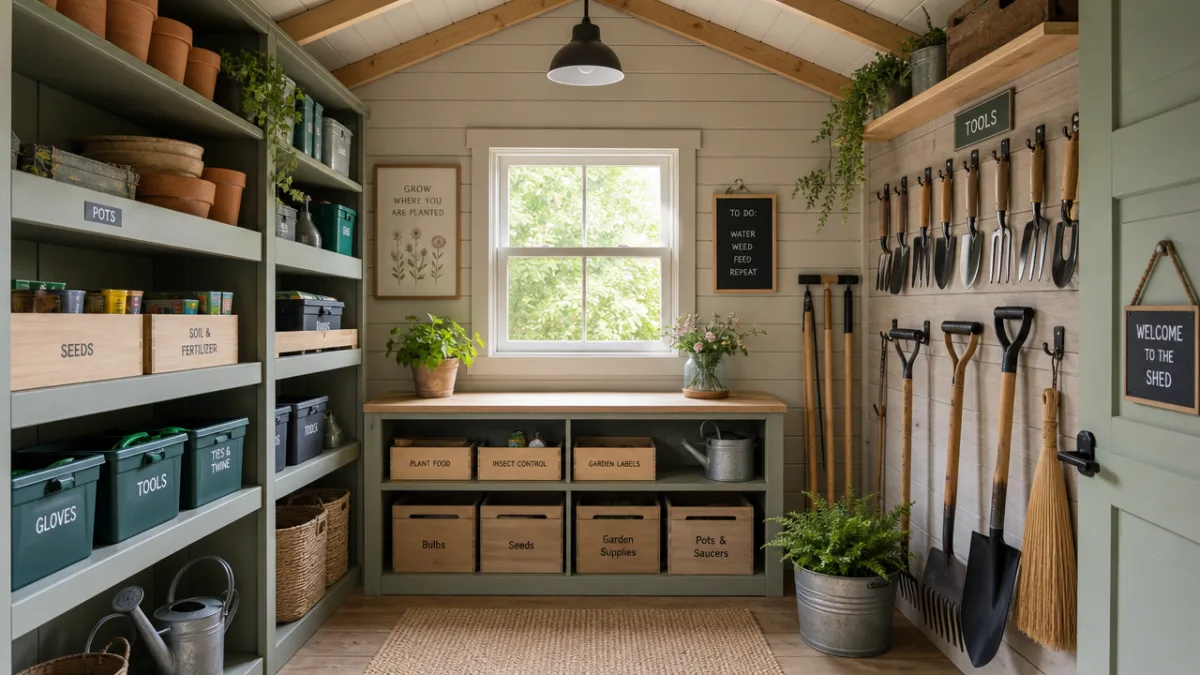
Potting Station Ideas That Combine Storage and Workspace
A dedicated potting station brings together storage and function in one purpose-built area, transforming the often messy business of repotting plants and preparing seed trays into an organized, enjoyable ritual. At its most basic, a potting bench is a raised work surface at a comfortable standing height with built-in shelves below for bags of compost, containers of perlite or grit, and stacks of empty pots. At its most elaborate, it is a full outdoor workstation with a sink, mounted tool hooks, a built-in bin for soil waste, and overhead shelving for all the accessories a keen gardener could need.
DIY potting stations made from reclaimed materials are enormously popular because they marry function, sustainability, and character in equal measure. An old wooden dresser stripped down and treated with exterior paint or oil makes a beautiful potting bench, with the drawers providing ideal storage for seed packets, plant markers, and hand tools, and the open shelving beneath offering space for pots in multiple sizes. A section of zinc roofing sheet fixed to the top surface creates a durable, easy-clean workspace that resists staining from compost and water. These bespoke creations cost a fraction of purpose-built units while adding a personal, characterful touch to the garden.
Even without a dedicated potting bench, a portable potting caddy or tote can bring surprising order to potting activities. These open-topped carriers, available in canvas, plastic, or galvanized metal, hold a selection of the tools and materials needed for a specific task and can be carried directly to wherever the work is happening. When the session is finished, the caddy is replenished and returned to its storage spot, ready for next time. This approach is particularly effective for gardeners with multiple growing areas spread across a large plot, reducing the number of trips back to the shed for forgotten supplies.
Hose and Irrigation Storage That Keeps Lines Tangle-Free
Few things in a garden cause as much frustration as a tangled, kinked, or tripping-hazard hose draped across a path or left coiled in a heap on the patio. Proper hose storage is one of the simplest improvements a gardener can make to their outdoor space, and the options available today range from basic to genuinely beautiful. Wall-mounted hose reels in powder-coated steel or cast iron are both practical and decorative, allowing a hose to be wound neatly after each use and unwound smoothly at the start of the next watering session without the inevitable wrestling match that accompanies a loosely coiled hose on the ground.
Decorative hose pots are a particularly elegant solution for gardens where aesthetics are a priority. These large ceramic or resin containers are designed to accept a standard garden hose coiled inside, with a neat opening at the side for the hose to thread through to the tap connection. From a distance, they look like an attractive garden urn or planter, and many models are genuinely beautiful objects in their own right. They keep the hose hidden from view, protected from UV degradation, and ready to use whenever needed, all while contributing to the visual appeal of the garden rather than detracting from it.
For more extensive irrigation setups involving soaker hoses, drip lines, and timer units, a dedicated storage cabinet or weatherproof box near the water source keeps all components organized and protected from frost. Labeling each hose component and coiling lines individually prevents the tangle of different tube sizes becoming indistinguishable from each other. A simple pegboard inside the cabinet door can hold spare connectors, nozzle attachments, and a small pair of scissors for cutting tubing, creating a self-contained irrigation management station that makes the start and end of each growing season far less laborious.
- Mount a hose reel at a convenient height near the primary outdoor tap for daily ease of use.
- Store drip irrigation components in labeled zip-lock bags inside a waterproof box to prevent loss of small fittings.
- Rinse and fully drain hoses before winter storage to prevent mold growth and ice damage inside the tubing.
- Keep a spare set of connectors and washers in the storage area to avoid interrupted watering sessions.
- Run a short leader hose from the tap to the reel location so the reel itself can be positioned optimally rather than directly at the wall tap.

Seasonal and Bulky Item Storage Solutions
Every garden accumulates items that are essential for part of the year and simply in the way for the rest of it. Lawn furniture cushions, patio umbrellas, children’s outdoor toys, and holiday lighting all fall into this category of seasonal storage challenges. Waterproof deck boxes made from high-density polyethylene are among the most practical solutions for outdoor seasonal storage because they are lightweight, frost-resistant, UV-stabilized, and require no maintenance beyond an occasional rinse. Positioned on a patio or deck, a large deck box can hold an entire season’s worth of cushions and accessories in one accessible location.
For larger seasonal items like garden furniture itself, investing in quality breathable furniture covers is essential, but so is having a designated area in the shed, garage, or under a carport where covered furniture can sit without blocking pathways. Stacking garden chairs on a rolling trolley before covering them allows easy movement and frees floor space for other storage uses. Similarly, folding or disassembling tables before storing them is worth the effort, as flat-packed furniture takes up dramatically less space than assembled pieces and reduces the risk of structural damage from being stacked or leaned awkwardly against a wall.
Raised storage platforms built over unused corner spaces in a garden can accommodate truly bulky seasonal items that have nowhere else logical to go. A simple treated timber platform raised on posts creates covered, dry storage underneath for items like spare bags of bark chipping, sand for play areas, or stacks of paving slabs for future projects. The platform itself can serve as an elevated deck area, a place for container planting, or even a small wildlife habitat if planted with low-growing sedum. This kind of multi-layered thinking, where a single structure serves several purposes simultaneously, is the hallmark of truly effective garden design.
Creative Repurposing and Upcycling for Unique Storage Solutions
Some of the most inventive and characterful garden storage ideas come not from garden centers or hardware shops but from a willingness to look at old objects with fresh eyes. A vintage wooden ladder propped against a fence or shed wall instantly becomes a display and storage structure for hanging small tools, potted herbs in terracotta pots, and coils of twine. An old metal wheelbarrow past its working days can be planted up as a planter while simultaneously serving as a container for a collection of pots, trowels, and seed packets. These repurposed pieces bring personality to a garden in a way that factory-produced storage units rarely achieve.
Reclaimed timber crates and old wooden wine boxes are endlessly versatile in the garden context. Stacked and fixed together, they create modular shelving that can be assembled in any configuration to suit the available space. Mounted horizontally on a fence, a single crate becomes a display shelf for succulents or a storage niche for folded gardening gloves and a bottle of hand cream. Lined with hessian and filled with potting mix, the same crate becomes a planter. This adaptability means that a collection of matching crates represents a genuine long-term investment in a flexible storage and display system.
Old metal tins, colanders, and kitchen utensils find new purpose as quirky garden storage and display containers. A row of tin cans painted in coordinating colors and mounted on a fence board stores small seeds packets, pencils for labeling, and plant markers. A vintage colander hung on a wall drains well and makes an unusual wall planter that doubles as a conversation piece. These small-scale creative solutions cost almost nothing and inject warmth, humor, and individuality into the garden in a way that no mass-produced product can replicate. The best-organized outdoor spaces are invariably those where practical thinking meets genuine creative joy.








What do you think?
It is nice to know your opinion. Leave a comment.