










An Eagle Scout Steps Up: Leadership, Service, and the Making of Tomorrow’s Heroes
The Eagle Scout Legacy: More Than a Badge
If you’ve ever met an Eagle Scout, you probably sensed there was something different about them — a quiet confidence, a sense of purpose. That’s not an accident. The Eagle Scout rank is one of the most meaningful things a young person can earn in this country, and it’s been that way for over a hundred years. It’s not just about collecting merit badges or knowing how to set up a tent. It’s about spending years becoming the kind of person your community can actually count on. And here’s the thing — fewer than four percent of all Scouts who start the program ever make it to Eagle. That alone tells you something.
Look at the history of Eagle Scouts and the list of names is genuinely remarkable. Neil Armstrong walked on the moon. Gerald Ford guided the country through one of its most turbulent constitutional moments. And beyond the famous names, there are thousands of people you’ve never heard of — engineers, teachers, firefighters, neighbors — who’ve quietly made life better for the people around them. That’s the real legacy of the program, and it shows up in communities big and small all across the country.
What makes the whole journey so formative is that it’s genuinely hard, and it takes a long time. A Scout typically spends years working toward Eagle, pushing through physical challenges, taking on leadership roles, earning merit badges on everything from first aid to environmental science, and finally designing and leading a major community service project from scratch. That last piece is huge. The Eagle project alone demands skills a lot of adults struggle with — managing a budget, coordinating volunteers, speaking in front of groups, and seeing something complicated all the way through from idea to finished product. It’s the real deal.
When the Community Calls: Recognizing a Need
Every Eagle Scout project starts the same way — with a teenager deciding to pay attention. Before anything else, the Scout has to spot a real need in their community and commit to actually doing something about it. That might sound simple, but think about it for a second. We’re talking about a young person choosing, on their own, to look outward instead of inward, to give up their free time for something that helps other people. That’s a genuinely mature thing to do, and it’s not a decision most teenagers make naturally. The Scouts who get to Eagle are the ones who’ve been practicing that outward-looking mindset for years.
Finding the right project usually means a lot of conversations — with local nonprofit leaders, government officials, church or community center staff, and everyday people who know where the gaps are. A Scout might spend weeks visiting sites, asking questions, and talking things through with their Scout leaders before they land on the right fit. That whole process, honestly, is an education in itself. You learn how communities actually work, how organizations make decisions, and how one person’s initiative can connect with a bigger mission to get something real done.
Once they’ve landed on a project, the Scout has to write up a detailed proposal — scope, timeline, budget, materials, volunteers needed, the whole thing. That proposal goes through multiple rounds of review before it’s approved. It can be frustrating for an eager teenager to wait on all that, but the process exists for good reason: it keeps projects grounded in reality and makes sure they’re actually going to serve the people they’re meant to serve, not just look impressive on paper.
Planning and Preparation: The Work Before the Work
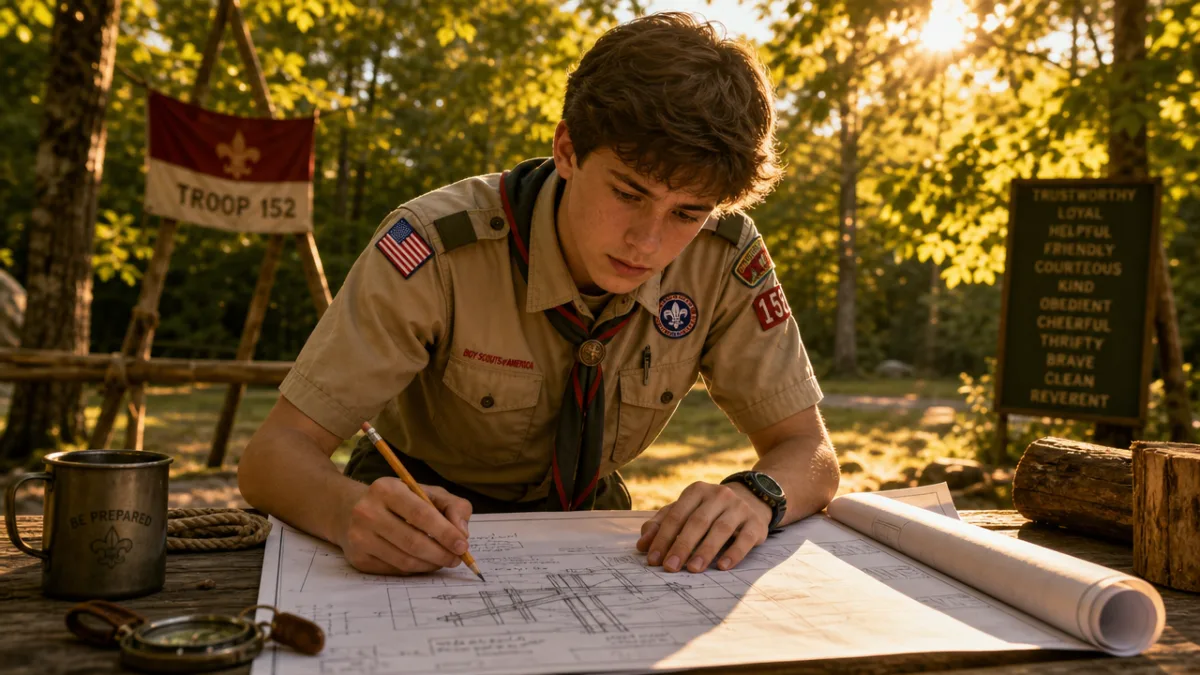
Here’s something people don’t always realize: the months before the actual project workday are often more demanding than the workday itself. During that stretch, the Scout is essentially functioning as a project manager — handling every logistical detail while still keeping up with school, Scout meetings, and everything else going on in their life. That’s completely intentional. The Boy Scouts of America wants these candidates to feel firsthand what it’s like to juggle real priorities without letting any of them slip. It’s one of those lessons that just doesn’t stick the same way in a classroom.
Fundraising tends to be one of the harder parts of this phase. Eagle projects can’t be fundraising activities themselves, but they often need materials or equipment that cost real money. So the Scout has to go out and make the ask — approaching local businesses, community organizations, and individual donors for cash contributions or donated supplies. That experience teaches you things pretty quickly: how to make a compelling pitch, how to track money responsibly, and how to build genuine relationships with people who care about your community’s success.
Recruiting and organizing volunteers is another serious challenge. The Scout can’t just text a few friends and call it good — they need to make sure every volunteer knows their role, has the right tools, understands the safety protocols, and actually shows up ready to work. Done well, it’s essentially running a small nonprofit for a day. And a lot of the organizations and employers who later interact with Eagle Scouts are genuinely impressed by that experience, because it’s real, not theoretical.
Execution Day: Leadership in Action
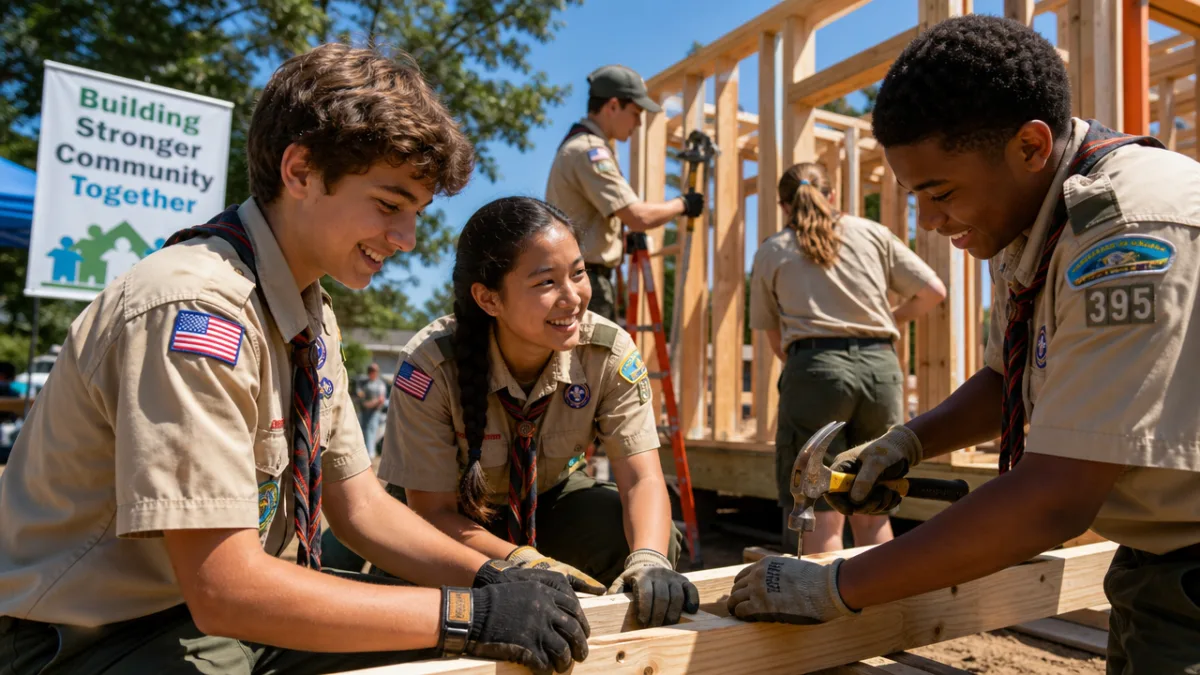
When project day finally arrives, it’s go time — and there’s nobody coming to rescue the Scout if things go sideways. They’re responsible for the entire operation: every volunteer on the site, every donated dollar, and the quality of whatever ends up getting built or installed or organized. That’s a lot to carry, and it’s meant to be. There’s no substitute teacher stepping in, no parent quietly handling the hard parts behind the scenes. The Scout has to make real calls in real time, and that’s where the growth really happens.
Leading a project like this demands a lot at once. The Scout has to match tasks to the right volunteers, give clear direction without hovering, keep people’s energy up through the inevitable midday slump, handle the small conflicts or miscommunications that come up in any group, and adapt when things don’t go according to plan — because they never do, not completely. Someone doesn’t show. A measurement is off. The weather shifts. The Scout who navigates all of that and still brings the project home walks away with a kind of confidence you honestly can’t get any other way.
Adult mentors, Scout leaders, and the project beneficiary are all watching how the Scout leads that day, and what they’re looking for isn’t perfection. They want to see growth. Does the Scout ask smart questions? Do they take feedback without getting defensive? Can they own a mistake and move on? Do they put the project’s success above their own ego? That’s what the Eagle Scout program is actually trying to build, and execution day is where it all shows up.
The Eagle Board of Review: Accountability and Reflection
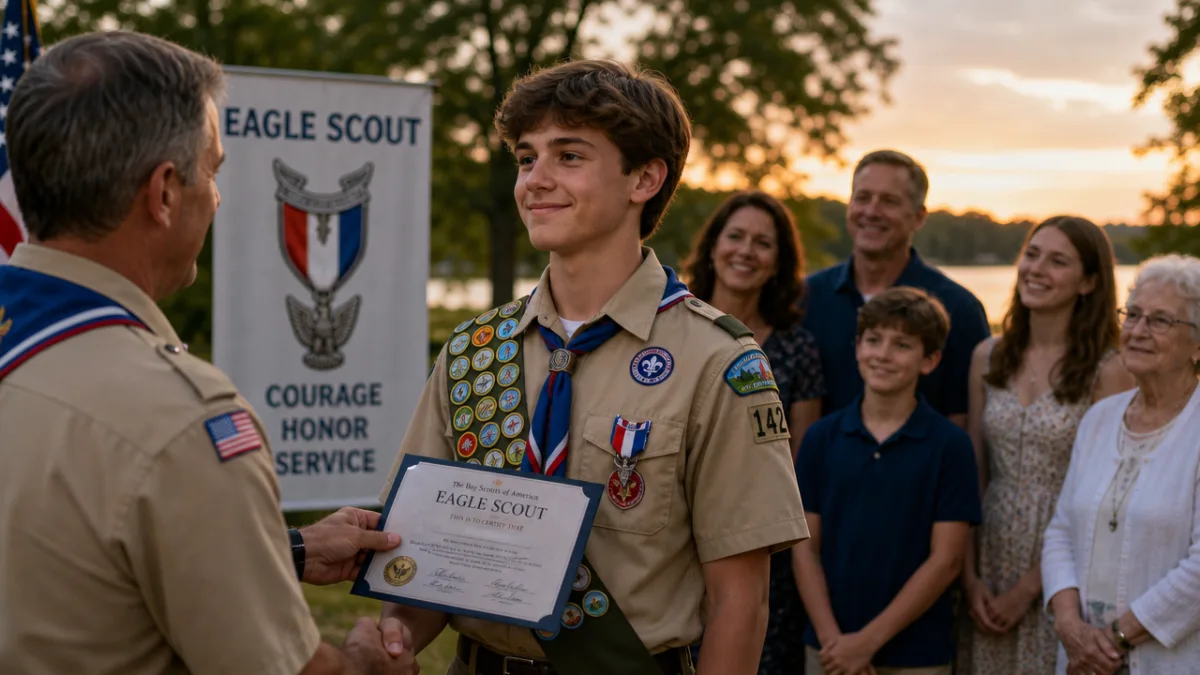
The Eagle Board of Review is the last big hurdle before the rank is officially conferred, and it’s a meaningful one. A panel of adult community members — people who aren’t involved with the Scout’s unit — sits down with the candidate for a serious, substantive conversation about their character, their growth as a leader, their community involvement, and how they plan to carry Scout values forward into adulthood. This isn’t a formality or a rubber stamp. Scouts who have genuinely earned the rank tend to describe it as one of the most significant conversations of their lives.
The Board doesn’t just ask about the Eagle project. They want to hear about the whole journey — the merit badges, the leadership roles, the service hours, the tough moments, the things that didn’t go as planned and what the Scout learned from them. In that sense, it asks the Scout to do something genuinely hard: to tell a coherent story about their own growth, to see themselves as someone who has actually developed over time rather than just accumulated achievements. That kind of self-awareness is one of the most valuable things the whole process produces.
The Board also looks ahead. How do you plan to keep serving after you age out of Scouting? What does the Scout Oath actually mean to you, in your real life? Those forward-looking questions turn the review into something more than a final exam — they make it a real rite of passage, a moment where a young person articulates, maybe for the first time with real seriousness, who they want to be and how they’re going to get there.
The Eagle Scout’s Lasting Impact on Community and Character
The impact of an Eagle Scout project doesn’t end when the volunteers pack up and go home. The park bench, the cleared trail, the organized food bank storage room, the sensory playground — those things stick around. Years from now, people who have no idea who built them will still be using them. That’s one of the quieter gifts of the Eagle Scout program: it leaves something behind that keeps giving long after the Scout has moved on to college or a career or a family of their own.
Beyond the physical improvements, Eagle projects have a way of sparking something bigger. Nonprofits that partner with Eagle Scouts often say the experience renews their optimism about the next generation. Businesses that donate materials sometimes turn that into an ongoing relationship with the Scout unit. Volunteers who show up for one project day find they’ve caught the service bug and go looking for more opportunities. One Scout’s project can quietly set a whole network of community caring in motion.
As for the Eagle Scouts themselves, the research is pretty clear: they’re more likely to graduate college, to hold leadership roles in their careers and communities, and to report higher levels of civic engagement and personal satisfaction than their peers. And it’s not just that high achievers tend to finish Eagle — the program itself, with its particular combination of outdoor challenge, service, peer leadership, and character development, actively shapes the kind of person who thrives in adult life. The badge is the symbol; what it represents is a whole lot more.
Stepping Up: Why This Generation of Eagle Scouts Matters More Than Ever
We live in a time when civic life feels increasingly fragmented, when trust in shared institutions is at a low, and when it’s genuinely easier than ever to check out and scroll instead of showing up. Against that backdrop, a young person who chooses the Eagle Scout path is doing something quietly countercultural. They’re saying: I want to be part of something bigger than myself, and I’m willing to put in the work to get there. That choice isn’t easier now than it was a generation ago — if anything, it’s harder, with more distractions and more pressure pulling in other directions. Which is exactly why it means so much.
The skills Eagle Scouts develop aren’t extras — they’re the core of what healthy communities and functioning institutions actually need. The ability to bring diverse groups of people together around a shared goal. To communicate clearly across generational and cultural differences. To manage a complex project on a limited budget. To stay calm and make good decisions under pressure. To hold to your values even when no one’s watching. These aren’t nice-to-haves. They’re the building blocks of a working democracy, practiced in real time by real young people.
Every Eagle project completed, every rank earned, every Scout who chooses service over convenience is a small but genuine sign of hope. These young people push back against the cynical narrative that the next generation is lost — because they’re out there, in neighborhoods all over the country, doing the work and proving otherwise. When an Eagle Scout steps up, they lift more than the immediate beneficiaries of their project. They remind the rest of us what’s possible when a young person decides to take their community seriously.
- Leadership: Eagle Scouts have led real teams in real situations — not just in theory, but across years of patrol leadership, mentoring younger Scouts, and managing their own complex projects from start to finish.
- Service: Between required service hours and the Eagle project itself, every Scout who reaches this rank has left a tangible, lasting mark on their community — something you can actually point to and say, “they built that.”
- Character: The Scout Oath and Law aren’t just words to memorize. They’re a framework that Eagle Scouts have been living out, day after day, in decisions big and small, for years.
- Resilience: The program pushes Scouts physically and mentally, on purpose. That accumulated experience of pushing through hard things is exactly the kind of grit that carries people through adult challenges too.
- Citizenship: Eagle Scouts don’t see themselves as bystanders in their communities. They understand that being part of a community means contributing to it — and they’ve been doing just that for a long time already.








What do you think?
It is nice to know your opinion. Leave a comment.