










Supporting Players: The Unsung Heroes of the Garden
The Philosophy of the Supporting Cast
Every great garden tells a story — and like any good story, it needs more than just the flashy main characters. Sure, showstopping roses, towering dahlias, and flamboyant peonies grab all the attention. But it’s the quieter, more understated plants that give a garden its real soul, its structure, and the kind of appeal that holds up season after season. These are the supporting players: the companions, fillers, and foils that make the stars shine even brighter, while quietly keeping things interesting when the headliners have finished their moment in the sun.
Fine Gardening has long championed this way of thinking, and for good reason: sophisticated planting design isn’t really about collecting as many jaw-dropping specimens as you can find. It’s about orchestrating a living composition that works as a whole. A bed packed wall-to-wall with prima donnas tends to feel chaotic, visually exhausting, and oddly unsatisfying. The eye needs somewhere to rest — neutral passages to travel through, subtle moments of texture and form that let the bolder plants read clearly against them.
Getting comfortable with supporting players means shifting your mindset a little. Instead of the plant collector’s urge to track down the rarest, most striking thing in the catalog, you start developing a designer’s eye — one that asks how each element serves the whole picture. It means learning to genuinely love the workhorses: those reliable, graceful, often underestimated plants whose real value only becomes clear when you see them in relationship to everything around them.
What Makes a Great Supporting Plant
Not every plant is cut out for a supporting role, so it helps to know what to look for. The best companions tend to share a few key qualities that make them genuinely indispensable. They’re usually long-seasoned — offering attractive foliage, good form, or both across a wide stretch of months, rather than producing one brief, dazzling flush of bloom and then disappearing. That sustained presence gives the garden a reliable backbone that holds steady while the more dramatic plants cycle through their peaks and valleys.
Color and texture are the two biggest tools a supporting plant brings to the table. Plants with fine, ferny foliage — think fennel or asparagus fern — create a soft, airy backdrop that makes bold-leafed neighbors look even more sculptural and imposing. On the flip side, broad, smooth leaves like those of hostas or bergenia anchor lighter, more delicate plants and give the planting a sense of weight and solidity. It’s that push and pull between contrasting textures that gives a border its visual depth, drawing the eye in rather than just letting it skim across the surface.
Color repetition is another hallmark of the best supporting plants. A well-chosen companion will often echo a secondary color in the star plant’s flower, or pick up a hue from an earlier-blooming neighbor, creating subtle visual threads that pull the whole composition together. Purple-leafed plants like Salvia officinalis ‘Purpurascens’ or Heuchera ‘Palace Purple’ are classic examples: their foliage picks up the cool tones in blue and pink flowers while also playing nicely with the warm reds and oranges of nearby hot-colored companions.
Foliage First: The Foundation of the Planting
If flowers are the garden’s big celebrations, foliage is its everyday conversation — the constant, ongoing dialogue of form, texture, and color that defines a garden’s character far more durably than any bloom ever could. The best supporting players are almost always outstanding foliage plants first, with any flowers they produce functioning as a welcome bonus rather than their main event. This is one of those distinctions that tends to separate seasoned gardeners from beginners: the ability to choose plants primarily for their leaves, and treat the flowers as a secondary consideration.
The range of foliage available to gardeners today is genuinely staggering — every conceivable size, shape, texture, and color, from the near-black of Ophiopogon planiscapus ‘Nigrescens’ to the silver-white of Artemisia ‘Powis Castle’. Learning to read foliage the way a painter reads a color palette is one of the most rewarding skills you can develop. Think about how the strap-like leaves of ornamental grasses introduce a vertical energy into a planting, how the rounded, scalloped leaves of lady’s mantle (Alchemilla mollis) create a soft, mounding presence at the front of a border, or how the bold architectural leaves of cannas or rodgersias can command attention without producing a single flower.
Some of the most indispensable foliage plants have been grown in gardens for centuries, simply because they do their job so reliably and so well. Hostas are among the most versatile and hardworking of all shade-garden companions — their enormous range of leaf size, color, and texture, from tiny heart-shaped miniature varieties to the enormous blue-green paddles of ‘Elegans’, makes them adaptable to an almost limitless range of situations. Ferns are similarly invaluable, their fronds offering a delicacy and architectural quality that makes them a perfect foil for the bolder forms of woodland perennials like epimediums and hellebores.
The Role of Texture and Form
Texture in the garden operates on multiple scales at once, and understanding this layered quality is key to using supporting players well. At the big-picture level, the overall form of a plant — whether it’s upright, spreading, mounding, or weeping — contributes to the garden’s rhythm and structure. Zoom in closer, and the surface quality of individual leaves — smooth or rough, glossy or matte, hairy or waxy — creates a sensory richness that reveals itself most fully to someone who takes the time to explore the planting up close.
Thoughtful gardeners use plants with contrasting forms to create the kind of visual tension that makes a composition feel dynamic rather than flat. A tall, upright grass like Calamagrostis x acutiflora ‘Karl Foerster’ placed behind a low, spreading mound of catmint (Nepeta) sets up a simple but effective contrast between vertical and horizontal energy. Add a third element — maybe the rounded, airy flower clusters of Phlox paniculata or the bold architectural spikes of Veronicastrum virginicum — and you’ve introduced complexity without tipping into confusion. The trick is varying the forms while keeping the whole thing coherent.
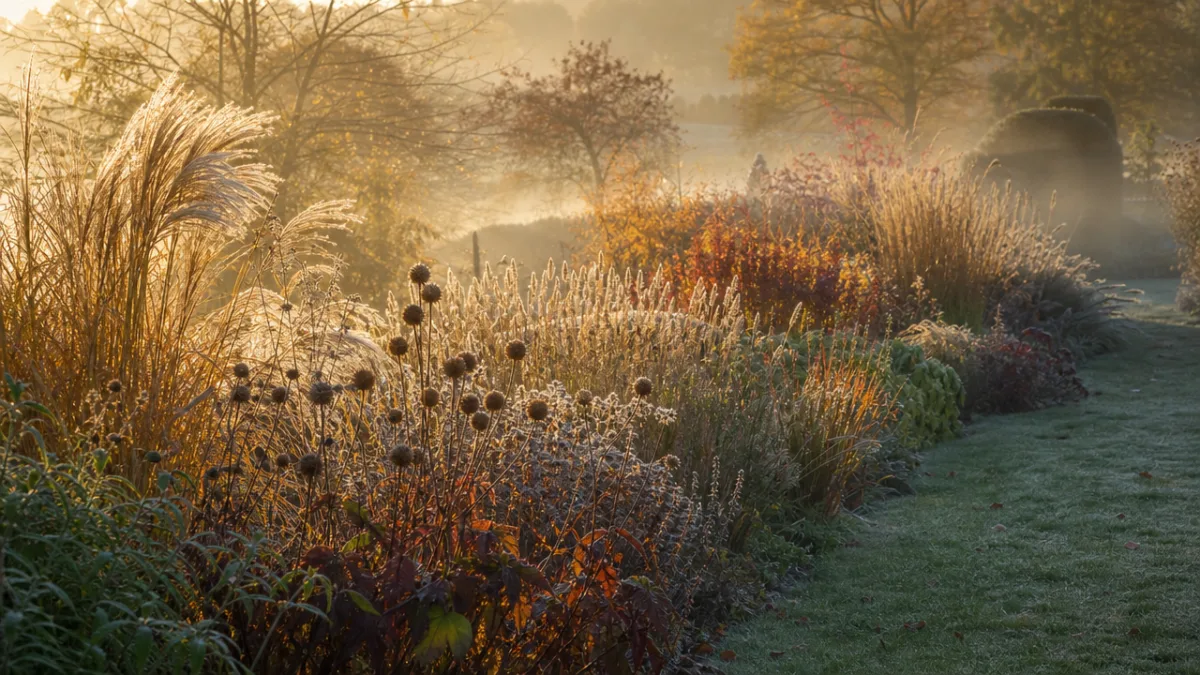
Form also matters enormously in the winter garden, when foliage has largely retreated and the structural bones of a planting are laid bare. Plants chosen for strong architectural form keep earning their keep through the coldest months: ornamental grasses hold their frosted silhouettes beautifully, evergreen mounds of Epimedium or Carex provide reassuring patches of color and structure, and the persistent seed heads of rudbeckias, echinaceas, and teasels add sculptural interest while feeding overwintering birds at the same time.
- Ornamental grasses: Provide movement, vertical interest, and winter structure while serving as neutral companions for bolder bloomers throughout the growing season.
- Epimediums: Versatile, drought-tolerant ground covers that offer delicate spring flowers, attractive summer foliage, and semi-evergreen winter presence in difficult spots.
- Alchemilla mollis (Lady’s mantle): A classic edging plant whose pleated, water-repelling leaves and frothy yellow-green flowers complement almost any color scheme.
- Stachys byzantina (Lamb’s ears): The soft, silver-felted leaves provide a cooling, luminous effect that brightens shaded corners and harmonizes with pastel flower colors.
- Heucheras and Heucherellas: Available in an extraordinary range of foliage colors from deep burgundy to lime green, offering year-round interest in sun or shade.

Color, Repetition, and Visual Rhythm
One of the most powerful moves in planting design is the deliberate repetition of color — and supporting plants are the main way this gets done. Rather than massing all plants of a single color in one spot, a skilled designer scatters them through the planting at intervals, creating a visual rhythm that pulls the eye through the composition in a satisfying, unhurried way. In practice this might mean repeating a purple-leafed heuchera at regular intervals along a border, or threading the silver foliage of artemisia through the planting to tie together otherwise disparate color groups.
Color temperature matters just as much as color itself when it comes to deciding where supporting plants go. Cool colors — blues, purples, silvers, and blue-greens — tend to recede visually, making a space feel larger and more serene. Warm colors — yellows, oranges, reds, and bronzes — do the opposite, advancing visually and bringing energy and a sense of intimacy. Supporting plants can be used to nudge these effects in either direction: a planting of hot-colored flowers can be cooled down and made more sophisticated with the addition of silver or blue-green foliage companions, while a pale, cool-toned border gains warmth and definition from bronze or copper-leafed supporting plants.
Repetition works through form and texture too, not just color. Returning to the same textural note — the fine, needle-like foliage of a grass, or the bold roundness of a large-leafed plant — at intervals throughout a planting creates a visual beat that gives the whole composition its rhythm and coherence. This is the principle behind the celebrated borders of great garden designers from Gertrude Jekyll to Piet Oudolf: not a random assembly of beautiful plants, but a carefully orchestrated sequence of recurring motifs that gives a planting its distinctive character and unity.
Choosing Supporting Players for Every Season
A garden that peaks brilliantly in midsummer but goes quiet in spring, autumn, or winter hasn’t quite reached its potential. The real mark of a well-designed planting is its ability to sustain beauty and interest across all four seasons — and this is where the choice of supporting players becomes especially important. Most headline perennials have a fairly narrow window of peak performance, so the best supporting plants are the ones that extend their contribution across multiple seasons, making sure the garden always has something to offer no matter the time of year.
Spring is all about emergence, and the supporting players that shine then tend to be those with attractive emerging foliage as much as those with early flowers. The unfurling fronds of ferns, the emerging leaves of hostas in every shade from chartreuse to blue-grey, the rosettes of hellebores and epimediums — all of these provide interest during the weeks when the garden is still waking up. Bulbs, which function as some of the most reliable supporting players of all, are also doing their thing at this point, pushing color up through the soil before most herbaceous perennials have even broken the surface.
Autumn brings its own cast of supporting players into the spotlight. Ornamental grasses hit their full glory as the days shorten and cool, their flower and seed heads catching the low autumn light in a way that rivals anything from high summer. Japanese anemones keep the bloom season going well into autumn in most climates, while asters and sedums deliver the final flourish of color before the garden settles into its winter mode. The foliage of many supporting plants also gets better in autumn — Geranium macrorrhizum turns shades of red and orange, and Epimedium foliage deepens to rich burgundy and bronze.
- Spring: Rely on emerging bulbs, hellebores, pulmonarias, and the unfolding foliage of ferns and hostas to carry the garden through its earliest weeks.
- Early summer: Allow the foliage of grasses, geraniums, and alchemilla to establish the border’s framework as the first perennials begin to bloom.
- Midsummer: Use the sustained foliage of heucheras, artemisias, and ornamental grasses to provide continuity between waves of bloom.
- Late summer and autumn: Lean on grasses, sedums, asters, and Japanese anemones to extend the season and bridge the transition into winter.
- Winter: Value the architectural presence of evergreen carex, epimediums, hellebore rosettes, and the sculptural seed heads of previous season’s perennials.
Practical Guidance for Incorporating Supporting Players
Putting these principles into practice takes both knowledge and a willingness to experiment — no amount of theory can fully substitute for watching plants actually grow and interact in your specific garden over a few seasons. That said, there are some practical approaches that will help you make better use of supporting players right from the start. One of the most useful is to plan the supporting cast before you select the stars, which flips the usual instinct on its head. Instead of starting with the most exciting plants and then trying to fill in around them, you establish a framework of foliage and structure first. The result is a garden with a more reliable foundation — one that can handle changes in the headline acts without losing its sense of coherence.
Scale is another consideration that’s easy to overlook but makes a real difference. A large border calls for supporting plants of proportionate size. Small-leafed, fine-textured plants that look charming in a compact garden can read as fussy and insignificant in a large, open border where they simply get swallowed up by their surroundings. The reverse is equally true: bold, large-leafed plants that read beautifully from a distance can feel overwhelming and oppressive in a small, intimate garden where you’re always in close proximity to them. Getting the scale right is a foundational principle of good design, and it’s one that rewards careful thought.
Finally, resist the urge to treat your supporting plant choices as permanent decisions carved in stone. One of the genuine pleasures of gardening is the ongoing cycle of observation, reflection, and adjustment that lets a planting evolve and improve over time. A supporting plant that seemed perfectly suited to its spot may, after a season or two, turn out to be too vigorous, too retiring, or just not quite right in terms of color or texture. Being able to recognize those mismatches, remove plants without regret, and try something new is what separates a thoughtful, evolving garden from a static collection — and it’s that spirit of continuous refinement that ultimately produces the most beautiful and satisfying results.








What do you think?
It is nice to know your opinion. Leave a comment.