










Purple Trailing Ice Plant: A Complete Guide to Lampranthus spectabilis
Introduction to Lampranthus spectabilis
The Purple Trailing Ice Plant, known botanically as Lampranthus spectabilis, is one of nature’s most breathtaking groundcover plants. Native to the coastal and interior regions of South Africa, this remarkable succulent has captivated gardeners across the world with its vivid, jewel-toned flowers and its extraordinary resilience in challenging growing conditions. Whether cascading over a sunny hillside, spilling from a terrace planter, or carpeting a dry garden bed, this plant delivers an unmatched visual spectacle that few ornamentals can rival.
Belonging to the family Aizoaceae — commonly known as the fig-marigold family or ice plant family — Lampranthus spectabilis shares its botanical lineage with a wide array of succulent flowering plants native predominantly to southern Africa. The genus name Lampranthus derives from the Greek words lampros, meaning brilliant or shining, and anthos, meaning flower. The species epithet spectabilis is Latin for spectacular or worth seeing, a name that any gardener who has witnessed the plant in full bloom would wholeheartedly agree is perfectly chosen. Together, the name essentially translates to “spectacular shining flower,” and it more than lives up to that billing.
What makes this plant particularly fascinating from a botanical standpoint is its classification within the large and diverse Aizoaceae family, which contains over 2,000 species. Many members of this family share the characteristic of producing flowers with numerous narrow, glistening petals that shimmer and catch the light in ways that suggest the surface of ice or water — a trait that inspired the common group name “ice plant.” In Lampranthus spectabilis, this shimmering quality is amplified by the intense magenta-purple coloration of the petals, creating a display that can seem almost luminescent in bright sunlight.
Physical Characteristics and Botanical Description
Lampranthus spectabilis is a low-growing, sprawling perennial succulent that typically reaches a height of only 15 to 30 centimeters while spreading outward up to 60 centimeters or more, making it an ideal groundcover choice. The plant forms dense, trailing mats of fleshy, cylindrical stems covered in tightly packed, equally fleshy leaves. These leaves are three-angled in cross-section, often described as trigonous, and typically measure between 3 and 5 centimeters in length. They are a soft, glaucous grey-green color, sometimes tinged with hints of red or purple, particularly when the plant is grown in full sun or subjected to slight drought stress.
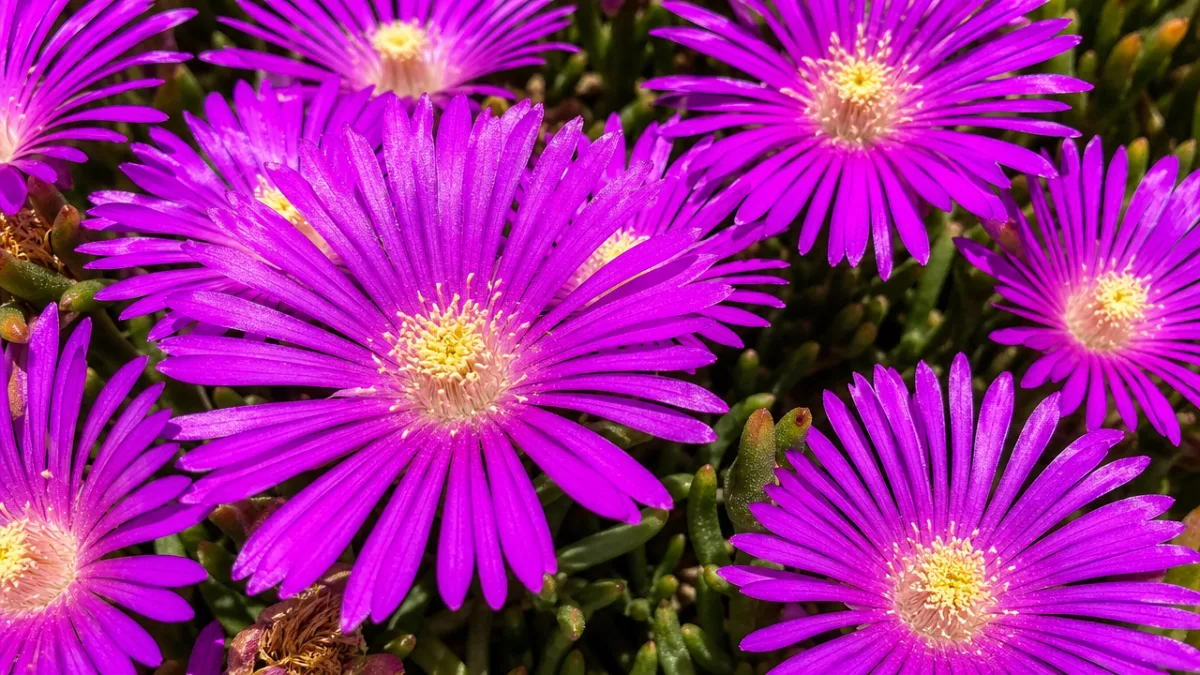
The flowers are the undeniable stars of this plant, and they are truly spectacular by any measure. Each bloom measures approximately 5 to 8 centimeters in diameter and is composed of dozens of slender, strap-shaped petals radiating outward from a central cluster of golden-yellow stamens. The petals are typically a deep, saturated magenta-purple, though colors can range across cultivars and growing conditions from rosy lilac to near-crimson purple. Like most members of the Aizoaceae family, the flowers open fully only in direct sunlight and tend to close during cloudy weather and at night — a behavior called nyctinasty — which can be both charming and occasionally frustrating for gardeners hoping to enjoy the blooms on overcast days.
The plant’s stems are semi-woody at the base and become increasingly succulent and pliable toward the tips. They root readily where they make contact with moist soil, allowing the plant to spread naturally and colonize large areas over time. The fruit that follows flowering is a dry, dehiscent capsule typical of the Aizoaceae family, containing small seeds that are dispersed by wind and rain. While seed propagation is possible, most gardeners propagate Lampranthus spectabilis vegetatively through stem cuttings, which root with remarkable ease and speed.
Natural Habitat and Geographic Origins
Lampranthus spectabilis originates from the Western Cape and Eastern Cape provinces of South Africa, a region characterized by a Mediterranean-type climate featuring hot, dry summers and mild, wet winters. This climatic pattern is crucial to understanding the plant’s preferences and requirements in cultivation. In its native habitat, the plant typically grows on rocky slopes, sandy coastal flats, and disturbed ground where competition from other vegetation is reduced and drainage is excellent. It often forms large, sprawling colonies that erupt into sheets of color during the flowering season.
The broader region of the Western Cape is one of the world’s recognized biodiversity hotspots, known as the Cape Floristic Region. This area is home to an extraordinary concentration of plant species found nowhere else on Earth — approximately 9,000 plant species, nearly 70 percent of which are endemic to the region. Lampranthus spectabilis is part of this remarkable flora, having evolved alongside other specialized succulents, fynbos plants, and hardy shrubs in conditions that would stress or kill most garden plants. Understanding this origin helps explain the plant’s legendary tolerance of heat, drought, and poor soils.
Beyond its South African homeland, Lampranthus spectabilis has been introduced and naturalized in many parts of the world with similar Mediterranean climates. It is commonly found growing along roadsides and coastal bluffs in California, in gardens and wild spaces throughout the Mediterranean basin, and in parts of Australia and New Zealand. In some regions, particularly coastal California and parts of Australia, related ice plant species have become invasive, outcompeting native vegetation on dunes and bluffs. While Lampranthus spectabilis is generally considered less aggressively invasive than some relatives, gardeners in fire-prone or ecologically sensitive areas should be mindful of its potential to spread beyond intended boundaries.
Cultivation and Growing Requirements
Growing Lampranthus spectabilis successfully is a rewarding and largely uncomplicated endeavor, provided that a few key requirements are met. Above all else, this plant demands full sun and excellent drainage. It thrives in USDA hardiness zones 9 through 11, tolerating light frost but dying back in prolonged freezing conditions. In climates with colder winters, it is often grown as an annual or brought indoors during the coldest months. Gardeners in frost-free or near frost-free climates can enjoy it as a reliable perennial that returns year after year with increasing vigor and spread.
Soil requirements are refreshingly undemanding. Lampranthus spectabilis performs best in sandy, gravelly, or rocky soils with very good to excellent drainage. It tolerates poor, nutrient-depleted soils with equanimity and actually performs worse in rich, fertile soils, which tend to promote lush, soft, disease-prone growth at the expense of flowers. If planting in heavier clay soil, amending generously with coarse sand and gravel is strongly recommended. Raised beds and rock gardens are ideal settings, as is planting on slopes where natural drainage is enhanced by gravity. Container cultivation is also highly successful, provided that pots have adequate drainage holes and a gritty, fast-draining potting mix is used.
Watering requirements reflect the plant’s succulent nature and drought-adapted origins. Once established, Lampranthus spectabilis requires very little supplemental irrigation and in many Mediterranean or dry climates can survive entirely on natural rainfall. During establishment — typically the first growing season — regular watering helps the plant develop a strong root system, but overwatering at any stage is the most common cause of failure, leading to root rot and stem collapse. A useful general rule is to water deeply but infrequently, allowing the soil to dry out completely between waterings. Fertilization needs are similarly minimal; a light application of a balanced, low-nitrogen fertilizer in early spring is generally sufficient for a full year’s growth and flowering.
- Sunlight: Full sun, minimum 6 hours of direct sunlight daily for best flowering performance
- Soil: Sandy, gravelly, or rocky; excellent drainage is non-negotiable; low to moderate fertility
- Water: Low to very low; drought-tolerant once established; avoid overwatering
- Temperature: Thrives in heat; tolerates light frost; hardy in USDA zones 9–11
- Fertilizer: Minimal; light application of balanced fertilizer in spring if desired
- Spacing: Plant 30–45 cm apart to allow spreading; fills in quickly under good conditions
Propagation and Maintenance
One of the many appealing qualities of Lampranthus spectabilis is how effortlessly it can be propagated. Stem cuttings are the preferred and most reliable method. Simply snip a healthy stem tip measuring 8 to 12 centimeters in length, remove the lower leaves to expose a few centimeters of bare stem, and allow the cutting to dry and callus for 24 to 48 hours before planting. This callusing step is important for succulents, as it reduces the risk of rot at the cut surface. The calloused cutting can then be inserted into dry or barely moist sandy compost, where it will typically develop roots within two to three weeks under warm, bright conditions.
Maintenance requirements are minimal, which is a significant part of the plant’s enduring appeal. Annual or biennial pruning after the main flowering season helps keep plants compact, encourages fresh new growth, and prevents the base from becoming overly woody and bare — a natural tendency in older plants. Hard pruning by up to one-third of the plant’s total volume is generally well tolerated and stimulates vigorous regrowth. Deadheading spent flowers can prolong the overall bloom period slightly, though in practice most gardeners find that the sheer volume of flowers makes systematic deadheading impractical. Removing dead or damaged stems at any time of year is always beneficial for plant health and appearance.
Pests and diseases are relatively uncommon concerns with Lampranthus spectabilis, largely because its succulent tissues and specific soil preferences make it inhospitable to many common garden pathogens. The most significant threat by far is root rot caused by poorly draining soil and excessive moisture — conditions that encourage fungal pathogens and can kill a plant surprisingly quickly. Aphids and mealybugs occasionally colonize soft new growth, particularly on plants grown in sheltered positions or indoors. These are easily managed with a strong spray of water, insecticidal soap, or a light application of neem oil. Snails and slugs may also feed on the fleshy leaves in damp conditions, and appropriate slug control measures can be employed if damage is significant.
Landscape Uses and Garden Design Applications
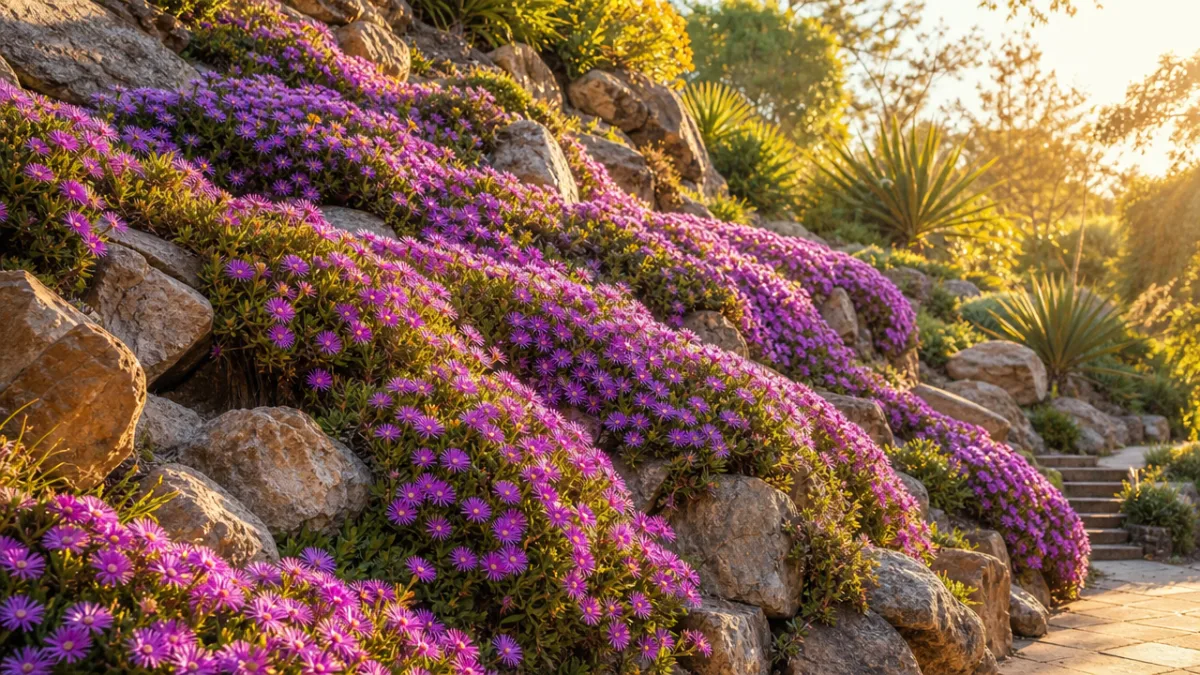
Lampranthus spectabilis is extraordinarily versatile in the landscape, serving equally well in formal garden settings, naturalistic plantings, and utilitarian applications such as erosion control and slope stabilization. Its trailing, mat-forming habit makes it a natural and highly effective choice for covering large areas of otherwise challenging terrain — steep banks, rocky outcrops, roadside embankments, and dry hillsides where few other ornamentals will thrive without intensive irrigation and soil amendment. In these difficult settings, the plant not only provides reliable coverage and color but also helps bind the soil and reduce erosion with its spreading root system.
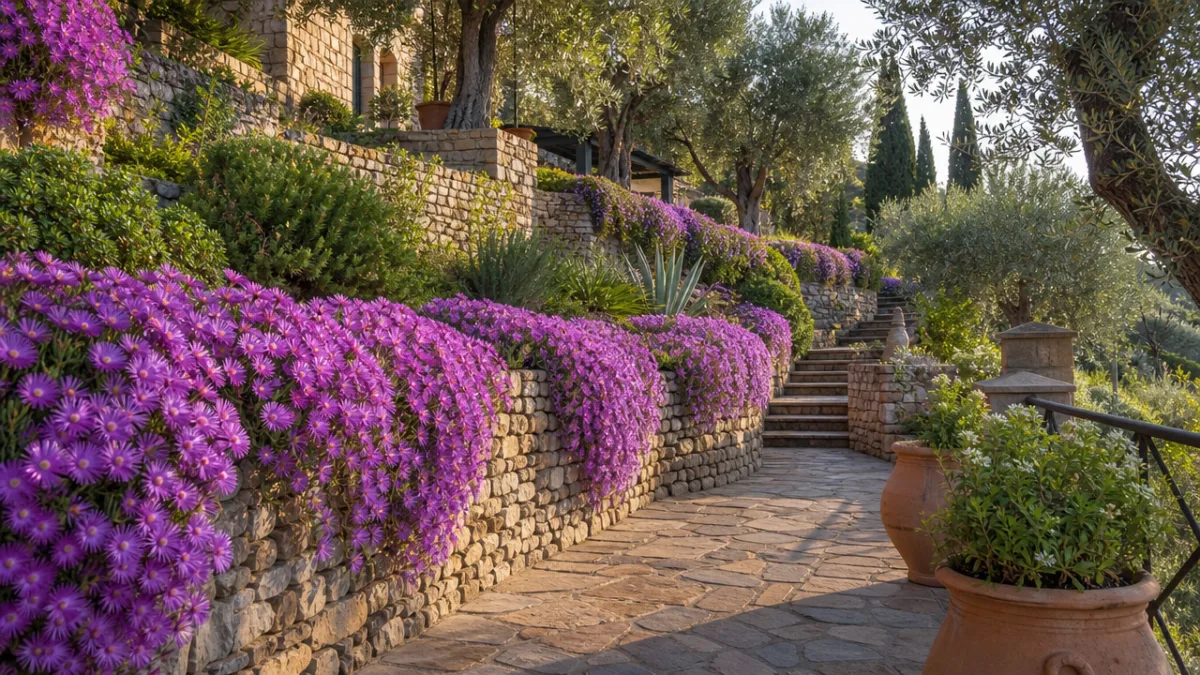
In designed garden settings, the plant excels as a border edging, a cascading element in raised beds and retaining walls, or as a living mulch beneath open-canopied trees and shrubs. Its low profile and spreading habit allow it to knit together well with other Mediterranean-climate and drought-tolerant plants such as lavender, rosemary, ornamental grasses, agaves, and aloes. The vivid purple of its flowers provides powerful color contrast against silver-leafed plants and warm-toned terracotta paving or stonework, making it a favorite of designers working in sun-baked, architectural garden styles. It is equally striking cascading over the edge of a large container or stone urn, where its trailing stems can reach impressive lengths.
The flowering season is one of the plant’s greatest landscape assets. In mild climates with minimal frost, Lampranthus spectabilis typically blooms most profusely in spring, with peak flowering occurring between March and May in the Northern Hemisphere. A secondary, lighter flowering often occurs in autumn. During peak bloom, an established planting can cover itself so thoroughly in flowers that the foliage becomes nearly invisible beneath a solid carpet of shimmering purple — a spectacle that invariably draws attention and admiration. This intense but finite flowering season makes thoughtful planting combinations important; pairing the ice plant with other species that provide color and interest during its non-flowering periods ensures continuous garden appeal throughout the year.
- Slope and bank stabilization: Dense root system and spreading habit make it excellent for erosion control on dry, sunny slopes
- Rock gardens: Thrives in the sharp drainage and reflected heat of rocky settings; beautifully complements stone surfaces
- Container planting: Stunning in large pots and urns where trailing stems can cascade freely
- Coastal gardens: Excellent salt tolerance makes it ideal for seaside gardens and dune stabilization
- Xeriscape and drought-tolerant gardens: A flagship plant for water-wise garden design in warm climates
- Groundcover beneath trees: Works well under open-canopied trees where lawn grass struggles in dry shade
Ecological Significance and Pollinator Value
Beyond its undeniable ornamental merits, Lampranthus spectabilis offers meaningful ecological value, particularly in gardens designed with pollinators in mind. The large, open flowers with their prominent central boss of stamens are highly accessible to a wide range of pollinating insects. Bees of many species — both honeybees and numerous native and solitary bee species — are frequent and enthusiastic visitors to the blooms, attracted by the abundant pollen and nectar. In gardens where supporting pollinator populations is a priority, dense plantings of this ice plant during its spring flowering season can provide a significant and reliable foraging resource at a time when many other garden plants have not yet reached peak bloom.
Butterflies are also strongly attracted to the flowers, and a large planting of Lampranthus spectabilis in full bloom can become a remarkable living butterfly garden during warm, sunny spring days. The open, flat flower form is perfectly suited to butterflies, which require a stable landing platform to access nectar, unlike tubular flowers that favor bees and hummingbirds. In regions where the plant has naturalized, it has effectively extended its pollinator support role beyond private gardens into the broader landscape, providing resources in road verges, coastal areas, and disturbed land where other nectar sources may be limited.
It is worth noting the ecological nuance surrounding non-native plants like Lampranthus spectabilis in their adopted regions. While the plant provides genuine pollinator benefits, it is important for gardeners in ecologically sensitive areas — particularly coastal California and parts of Australia where related ice plants have become problematic — to consider the potential for spread beyond the garden boundary. Responsible gardening practice involves monitoring for unwanted spread, not planting near intact native vegetation communities, and removing any seedlings that appear in areas where they are not wanted. With thoughtful management, the plant can provide its considerable ornamental and ecological benefits without contributing to native habitat displacement.
Cultural History and Global Spread
The journey of Lampranthus spectabilis from its South African homeland to gardens around the world is a story that mirrors the broader history of plant exploration and horticultural exchange that accelerated dramatically during the eighteenth and nineteenth centuries. European botanical collectors, particularly those working along the Cape of Good Hope trade route, were among the first to bring South African succulents to European botanical gardens and private collections. The extraordinary flowering displays of Lampranthus species and their relatives made them immediate sensations in European horticulture, and they were soon being cultivated in glasshouses and conservatories across Britain, France, and the Netherlands.
As European emigration spread to other parts of the world with favorable climates, so too did beloved garden plants. Lampranthus spectabilis and its relatives were carried to California, Australia, New Zealand, and across the Mediterranean basin, where mild winters and dry summers provided conditions close enough to the plant’s native Cape climate for it to thrive. In many of these regions, the plant became so well established and widely grown that it came to feel like a native or traditional part of the local garden palette, even though it arrived relatively recently in historical terms. Today, it is among the most widely recognized groundcover plants in California’s horticultural identity.
The plant has also played a role in the broader cultural shift toward water-wise and drought-tolerant gardening that has gathered significant momentum over the past several decades. As water scarcity has become an increasingly pressing concern in many parts of the world, and as traditional lawn-and-bedding-plant garden aesthetics have given way to more sustainable, ecologically sensitive approaches, plants like Lampranthus spectabilis have moved from the margins to the mainstream of horticultural practice. Its combination of spectacular beauty, genuine drought tolerance, low maintenance requirements, and ecological utility positions it as an ideal plant for the gardens of the present and future — a species perfectly adapted not just to the conditions of its native South African landscape, but to the challenges and values of contemporary gardening worldwide.








What do you think?
It is nice to know your opinion. Leave a comment.