










Modern Ikebana Sculpture – Floral Concept: The Art of Living Architecture
The Ancient Roots of Ikebana and Its Modern Evolution
Ikebana, the Japanese art of flower arrangement, traces its origins back more than six centuries to the Muromachi period, when Buddhist monks began placing offerings of flowers on altars with deliberate, contemplative care. Unlike Western floral design, which tends to prioritize abundance and symmetry, ikebana emerged from a philosophy of restraint, silence, and mindful attention to the relationship between plant material, space, and the human observer. Over generations, this practice evolved into a codified art form with dozens of recognized schools, each carrying its own aesthetic principles and philosophical underpinnings.
The transition from traditional ikebana to what contemporary practitioners call “modern ikebana sculpture” represents one of the most exciting developments in decorative and fine art today. Artists working in this space draw deeply from classical schools such as Ikenobo, Ohara, and Sogetsu, yet they deliberately push beyond inherited forms to create three-dimensional floral works that occupy space the way a bronze or ceramic sculpture would. The results are arresting — organic constructions that challenge the viewer to reconsider what flowers, branches, and natural materials can express when liberated from the vase and the centerpiece.
What distinguishes modern ikebana sculpture from mere flower arranging is its insistence on conceptual intent. Every stem placed, every void left open, every asymmetric angle chosen communicates something specific about impermanence, tension, growth, or stillness. The contemporary practitioner approaches their materials the way a sculptor approaches clay — with an awareness that each decision shapes meaning, and that the negative space between elements carries as much visual weight as the elements themselves. This intellectual seriousness has elevated the form from domestic decoration into gallery and museum contexts worldwide.
Core Principles That Define the Modern Ikebana Aesthetic
To appreciate modern ikebana sculpture, it is essential to understand the foundational principles inherited from classical practice and then observe how contemporary artists extend or subvert them. The classical tradition identifies three primary lines in any arrangement, traditionally representing heaven, humanity, and earth. These three structural axes create a dynamic tension within the composition, preventing it from collapsing into mere prettiness. In modern interpretations, artists may multiply these axes, invert their hierarchies, or replace organic stems with industrial materials to create dissonance that speaks to contemporary anxieties about nature and technology.
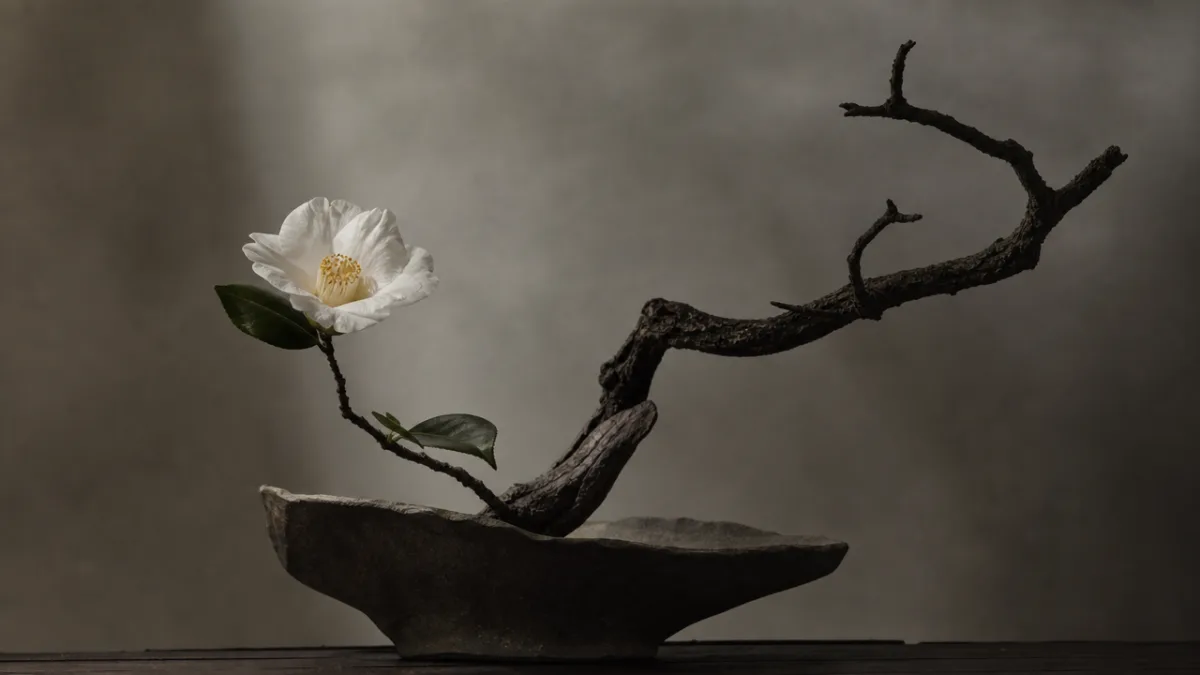
The concept of ma — negative space — is perhaps the most philosophically loaded principle in ikebana and the one most transformed by modern sculptural practice. In traditional arrangements, ma describes the deliberate emptiness between branches and blooms, the breathing room that allows each element to be seen fully and completely. In modern ikebana sculpture, ma expands dramatically. Artists may use a single dried branch and one flower head to occupy an entire room corner, trusting that the vast empty air surrounding these elements amplifies rather than diminishes their presence. This confidence in emptiness is profoundly counter-cultural in an age of visual noise and constant stimulation.
Color relationships in modern ikebana sculpture tend toward the unexpected and the austere. Where conventional floral arrangement celebrates chromatic harmony, the modern ikebana sculptor is just as likely to select materials for their textural contrast, structural silhouette, or symbolic resonance as for their color. A blackened, charred branch paired with a single white peony creates a dialogue about life and death that no cheerful bouquet could approach. Monochromatic schemes using only bleached or dried materials create works of such concentrated quiet that viewers often report a meditative response when standing before them.
Materials and Tools of the Modern Ikebana Sculptor
The palette of materials available to the modern ikebana sculptor has expanded far beyond the seasonal flowers and branches that traditional practice employed. While many contemporary practitioners still work primarily with fresh botanical materials — cherry blossoms, lotus pods, pine branches, orchids, grasses, and mosses — others incorporate dried, preserved, bleached, or artificially treated plant matter to achieve effects that transcend seasonal availability and extend the lifespan of their work. Some artists introduce entirely non-botanical elements: wire, stone, glass, ceramic, rusted metal, or woven cord that interacts with organic material in ways that generate conceptual friction.
The physical tools of ikebana sculpture are deceptively simple yet require years of practice to master. The kenzan, or needle-point frog, is a dense metal base studded with sharp upright pins onto which stems are impaled at precise angles. Learning to use the kenzan fluently — to achieve the exact angle and stability one envisions without damaging the stem — is a foundational skill that takes considerable time to develop. Modern practitioners may also use custom fabricated armatures, clear acrylic bases, suspended frameworks of wire or bamboo, or even ceiling-mounted structures to support works that defy gravity in ways a traditional arrangement never could.
Among the most important tools is what might be called the artist’s eye for seasonal and textural dialogue. Selecting materials is not simply shopping; it is a form of listening. The modern ikebana sculptor often visits flower markets, forests, coastlines, and even construction sites in search of materials whose current condition — whether fresh and vibrant, decay-softened, storm-bent, or bleached by sun — speaks to the concept they are developing. This gathering practice is itself considered part of the artistic process, an engagement with the natural world that keeps the work grounded in lived reality rather than aesthetic theory alone.
- Kenzan (needle-point frog): The classic anchoring tool, available in round, rectangular, and custom shapes, used to hold stems at precise angles without visible support.
- Hasami (ikebana scissors): A specialized cutting tool designed to make clean angled cuts that allow stems to drink water efficiently while seated in the arrangement.
- Custom armatures: Wire, bamboo, or welded metal frameworks that allow large-scale sculptural works to extend beyond the boundaries of any conventional vessel.
- Preservation compounds: Glycerin solutions, silica gel, and botanical lacquers used to preserve fresh materials and extend the lifespan of completed sculptures.
- Vessels and bases: From handmade ceramic to industrial concrete, the container or base is considered an active participant in the composition, not merely a functional holder.
The vessel itself deserves special attention as a material consideration. In modern ikebana sculpture, the container is never neutral. A rough-hewn ceramic bowl with an irregular rim makes different philosophical claims than a sleek stainless steel cylinder or a found object repurposed from industrial use. Many contemporary ikebana artists collaborate with ceramicists, glassblowers, or metalworkers to create vessels that are themselves works of art, so that the final sculpture exists as a dialogue between the maker of the container and the arranger of the botanicals — a creative collaboration encoded in a single unified object.
Philosophical Dimensions: Wabi-Sabi, Impermanence, and the Contemporary Mind
To engage seriously with modern ikebana sculpture is to engage with one of Japan’s most profound aesthetic philosophies: wabi-sabi, the acceptance and even celebration of impermanence, incompleteness, and imperfection. Wabi-sabi insists that beauty is not found in the polished, the permanent, or the perfect, but in the weathered, the transient, and the flawed. A single flower that has just begun to open, positioned against a branch whose bark has been stripped by weather, embodies wabi-sabi in a way that a perfectly composed bouquet of hothouse roses never could. Modern ikebana sculpture is one of the few Western-accessible art forms that makes wabi-sabi not merely an intellectual concept but a visceral visual and physical experience.
The concept of mono no aware — often translated as “the pathos of things” or a gentle sadness at the transience of beautiful things — runs through ikebana as surely as water runs through the stems of its flowers. Traditional ikebana arrangements were designed to be observed, meditated upon, and then allowed to die. The wilting of flowers was not a failure but the culmination of the work’s meaning. Modern ikebana sculptors working with fresh materials embrace this lifecycle completely, some even creating time-lapse documentation of their sculptures’ gradual transformation as blooms open, fade, and drop, understanding the complete arc of the work as its fullest expression. This temporal dimension separates ikebana sculpture from every other sculptural medium: it is an art that insists on its own mortality.
For contemporary audiences in post-industrial societies, modern ikebana sculpture carries particular resonance as a counter-practice to the relentless acceleration of digital life. There is something profoundly deliberate about the making of an ikebana sculpture — the slow selection of materials, the meditative act of cutting and placing, the attention required to find the angle at which a single branch comes alive. Practitioners and viewers alike report that time seems to behave differently in proximity to these works, slowing and deepening in ways that resemble the experience of formal meditation. As mindfulness practices have moved from fringe to mainstream, modern ikebana sculpture has found a new and receptive audience that experiences it as both art and contemplative practice.
Creating Your Own Modern Ikebana Sculpture: A Conceptual Framework
Approaching the creation of your first modern ikebana sculpture requires a shift in mindset before a single stem is cut. The temptation for newcomers is to think in terms of what will look beautiful, which is not entirely wrong but is insufficient as a guiding principle. The more useful question is: what relationship do I want to express? This might be a relationship between two different types of plant material — the soft and the hard, the living and the preserved, the local and the exotic. It might be a relationship between the botanical elements and the space they inhabit. It might even be a relationship between the work and the person who will stand before it, asking what emotion or state of mind you wish to evoke in your viewer.
Once a conceptual framework is established, the selection of materials becomes not a shopping trip but an act of translation — finding in the natural world the physical equivalents of the ideas and feelings you wish to express. If your concept centers on resilience, you might seek materials that have survived adversity: storm-bent branches, flowers that bloom in arid conditions, mosses that persist through drought. If your concept is about abundance restrained, you might gather an extravagant quantity of a single material — fifty identical stems of a single grass variety — and then use structural discipline to give that abundance formal rigor. The concept guides every subsequent decision, from material selection through final placement.
The process of assembling the sculpture itself is best approached in a state of focused calm. Many practitioners begin by laying all materials on a clean surface and spending several minutes simply looking at them, allowing the materials to suggest their own relationships rather than forcing a predetermined design. This receptive phase is followed by a more active period of trial and arrangement, during which the sculptor works quickly and intuitively, trusting their trained eye to recognize when an element is correctly placed. Standing back frequently — moving away from the work to see it from a distance — is essential, because ikebana sculpture is a spatial practice, and proximity distorts judgment.
- Establish your concept: Define the relationship, emotion, or idea you wish to express before selecting any materials. Write it down in a single sentence if helpful.
- Gather mindfully: Select materials whose physical qualities — texture, color, weight, condition — translate your concept into visual terms. Gather more than you think you need.
- Choose your vessel: Select a container or base whose material, scale, and character actively participates in the composition rather than simply supporting it.
- Establish the primary line: Place your most structurally dominant element first — typically the tallest or most directionally strong piece — and build the composition outward from this anchor.
- Introduce dialogue: Add secondary and tertiary elements that respond to, contrast with, or extend the energy of the primary line, always preserving deliberate negative space.
- Refine and subtract: Remove anything that does not earn its place. In modern ikebana sculpture, restraint is almost always more powerful than addition.
Modern Ikebana Sculpture in Interior and Exhibition Spaces
The integration of modern ikebana sculpture into contemporary interior design represents one of the most compelling intersections of functional living space and fine art practice today. Unlike conventional art objects, which hang on walls or sit inertly on pedestals, ikebana sculpture engages dynamically with its environment — responding to changes in light throughout the day, gradually transforming as botanical materials progress through their natural cycles, and releasing subtle fragrance that makes it the only art form that engages the olfactory sense as part of its intended experience. Interior designers working in high-end residential and hospitality contexts have recognized these qualities and increasingly commission ikebana artists to create site-specific works for lobbies, entrance halls, dining environments, and contemplative spaces.
The placement of an ikebana sculpture within a room requires the same spatial sensitivity that governs the arrangement itself. Works of this character typically benefit from a single clean wall behind them, allowing the sculptural silhouette to read clearly without visual competition. Lighting deserves particular attention: directional light from above or at a low angle creates dramatic shadows that effectively double the visual impact of the work, while the botanical materials themselves — especially translucent petals and thin dried grasses — become luminous when backlit. Natural daylight, which shifts in quality and direction through the day, creates a relationship between the static sculpture and the living world outside that gives the work an almost cinematic quality over time.
In gallery and exhibition contexts, modern ikebana sculpture presents curators with both unique challenges and extraordinary opportunities. The temporal dimension of works made with fresh botanical materials demands careful coordination of exhibition timing, with some artists choosing to create their works in situ on the opening day of a show so that visitors encounter them at peak freshness. Others deliberately design works intended to be experienced across multiple visits as they transform, presenting the exhibition as a durational experience rather than a static encounter. The most ambitious practitioners have created site-specific installations of extraordinary scale — filling entire gallery rooms with architectural arrangements of branches, stones, and water — that transform the viewer’s experience of space itself into the primary artistic medium.
As modern ikebana sculpture continues to gain international recognition, educational opportunities for serious students have expanded significantly beyond the traditional Japanese school system. Contemporary workshops are offered in major cities worldwide, often led by practitioners who blend classical training with fine art or design backgrounds. Online platforms have made it possible to observe master artists at work across geographic boundaries, and the growing community of practitioners sharing work through visual social media has created a rich discourse around the form that accelerates its development. For those drawn to a creative practice that is simultaneously rooted in ancient wisdom and urgently contemporary in its concerns, modern ikebana sculpture offers a path that is as rewarding in the making as it is in the contemplating.








What do you think?
It is nice to know your opinion. Leave a comment.