










Dwarf Texas Sage: The Ultimate Guide to Growing Leucophyllum frutescens ‘Compacta’
Introduction to Dwarf Texas Sage
Dwarf Texas Sage, known botanically as Leucophyllum frutescens ‘Compacta’, is one of the most rewarding ornamental shrubs you can add to a water-wise landscape. This compact cultivar of the beloved Texas Sage brings all the charm of its full-sized counterpart into a tidy, manageable form that fits beautifully into smaller gardens, container plantings, and border designs. With its distinctive silvery-gray foliage and stunning seasonal blooms, it has earned a devoted following among gardeners throughout the American Southwest and beyond.
The plant’s common names tell a story of regional affection: Texas Sage, Texas Ranger, Cenizo, Purple Sage, and Barometer Bush are all names used to describe this iconic shrub native to the Chihuahuan Desert and surrounding regions. The nickname “Barometer Bush” is particularly evocative — locals have long observed that the plant bursts into bloom in response to high humidity, cloud cover, or imminent rain, making it a beloved natural weather predictor in the arid landscapes it calls home. This intuitive responsiveness to environmental conditions is just one of the qualities that makes it so fascinating to grow.
The ‘Compacta’ cultivar specifically was developed to address one of the few drawbacks of the species: its tendency to grow quite large and somewhat unruly without regular maintenance. Standing between five and nine inches tall at the young plant stage and eventually maturing to a rounded form roughly two to four feet in height and spread, Dwarf Texas Sage fits neatly into spaces where the standard species would overwhelm. Whether you are planting a xeriscape garden, a pollinator border, or simply looking for a low-maintenance evergreen shrub with spectacular seasonal color, this plant deserves serious consideration.
Botanical Profile and Physical Characteristics
Leucophyllum frutescens belongs to the Scrophulariaceae family, though some modern taxonomic classifications place it within Plantaginaceae. The genus Leucophyllum encompasses about a dozen species, all native to the Chihuahuan Desert ecosystem spanning parts of Texas, New Mexico, and northern Mexico. The species name frutescens means “becoming shrubby,” a fitting descriptor for this densely branching perennial shrub that develops a woody framework over time. ‘Compacta’ is one of several named cultivars, selected specifically for its reduced mature size and refined, globe-shaped growth habit.
The foliage of Dwarf Texas Sage is one of its most striking features even when the plant is not in bloom. Small, oval leaves are densely covered with fine silvery hairs, called trichomes, which give the entire plant a soft, luminous appearance in the garden. This woolly coating is not merely decorative — it serves as an essential adaptation to intense desert heat and sunlight, reflecting solar radiation and reducing moisture loss through the leaf surface. The result is a plant that practically glows in a sunny border, catching the light in a way that few other shrubs can match.
When in bloom, Dwarf Texas Sage transforms dramatically. Tubular flowers in shades ranging from soft lavender to vivid purple-magenta emerge in profuse clusters along the branches, almost completely obscuring the foliage beneath. Each individual flower is small but intricate, with five petals and a subtly spotted throat that is particularly attractive to native bees, butterflies, and hummingbirds. Bloom periods can occur multiple times throughout the warm season, with the most spectacular flowering displays typically triggered by summer monsoon rains or periods of increased atmospheric moisture. A mature plant in full bloom is genuinely breathtaking.

Climate, Hardiness, and Ideal Growing Conditions
Dwarf Texas Sage is rated hardy in USDA Zones 7 through 11, making it an excellent choice for gardeners across a broad swath of the southern and western United States. It thrives particularly well in Zones 8 through 10, where summers are hot and long and winters are mild. In Zone 7, it can survive cold snaps but may experience some dieback of younger wood during hard freezes; in most cases it will resprout vigorously from its woody base once temperatures warm in spring. Gardeners in marginal zones should plant it in a south-facing location sheltered from cold north winds to maximize winter survival.
Heat and sunshine are this plant’s true friends. Leucophyllum frutescens ‘Compacta’ demands full sun — a minimum of six to eight hours of direct sunlight per day — and performs best in the hottest, brightest spots in the garden where other plants might struggle. In partially shaded conditions, the plant becomes leggy, loses its characteristic dense form, produces significantly fewer flowers, and becomes more susceptible to fungal problems. If you are dealing with a challenging hot, dry, south-facing slope or a sun-baked corner that seems to defeat everything you plant there, Dwarf Texas Sage may be exactly the solution you have been searching for.
Humidity is actually the primary bloom trigger for this remarkable plant. Rather than flowering strictly in response to day length or temperature as most shrubs do, Texas Sage monitors atmospheric moisture and responds by producing flowers when humidity rises above certain thresholds. This is why it blooms so reliably just before or just after desert rainstorms. In humid climates, however, this adaptation works against the plant: consistently high humidity encourages excessive vegetative growth and can promote fungal diseases, particularly root rot, which is why Texas Sage is generally not recommended for the humid Southeast despite technically being within its cold-hardiness range.
Soil Requirements and Drainage
If there is one non-negotiable requirement for successfully growing Leucophyllum frutescens ‘Compacta’, it is excellent drainage. This plant evolved in rocky, calcareous desert soils that drain rapidly and remain dry between precipitation events. In poorly drained or clay-heavy soils, the roots are vulnerable to fungal pathogens that cause root rot, and even a brief period of waterlogged conditions can be fatal to an otherwise established plant. Before planting, it is worth investing time and effort into improving your soil’s drainage characteristics, as this single factor will determine your success more than any other.
In terms of soil composition, Dwarf Texas Sage actually prefers low-fertility, lean soils rather than rich, amended beds. Adding large amounts of compost or fertilizer to the planting area encourages rapid, lush vegetative growth at the expense of flowers and makes the plant less drought-tolerant over time. Sandy loam, decomposed granite, or gravelly soils with a neutral to slightly alkaline pH in the range of 6.5 to 8.0 are ideal. If your native soil is heavy clay, consider constructing a raised bed with a free-draining mix, or planting on a slope where water naturally moves away from the root zone rather than pooling around it.
When planting your young Dwarf Texas Sage plants — which typically arrive in the five-to-nine-inch size range — it is helpful to amend the planting hole with a modest amount of coarse horticultural grit or decomposed granite to ensure the immediate root zone drains freely. Avoid the temptation to dig an oversized hole and fill it with enriched potting mix, as this can actually create a “pot within a pot” effect where the looser soil holds more moisture than the surrounding ground and concentrates water around the roots. Instead, dig a hole only slightly larger than the root ball and backfill primarily with native soil.
- Preferred soil pH: 6.5 to 8.0 (neutral to alkaline)
- Ideal soil texture: Sandy loam, gravelly, or decomposed granite-based mixes
- Drainage requirement: Excellent; avoid clay soils or any situation with standing water
- Soil fertility: Low to moderate; avoid heavy fertilization
- Raised beds: Highly recommended in areas with heavy clay or poorly draining soils

Watering, Fertilizing, and General Care
Once established — typically after one to two growing seasons — Dwarf Texas Sage is one of the most drought-tolerant shrubs available to home gardeners. During the establishment period, young plants benefit from regular watering every one to two weeks, allowing the soil to dry out completely between sessions. Deep, infrequent watering encourages the roots to grow downward in search of moisture, developing the deep root system that will sustain the plant through future droughts. Shallow, frequent watering produces a shallow root system that is poorly adapted to dry conditions and more vulnerable to temperature fluctuations near the soil surface.
Once established, most gardeners in appropriate climates can rely almost entirely on natural rainfall to sustain their Dwarf Texas Sage. In extended droughts lasting several weeks without precipitation, a single deep watering every two to three weeks will keep the plant healthy and blooming. In fact, overwatering is one of the most common mistakes made with this species — the symptoms of overwatering (yellowing leaves, wilting, poor bloom production) are often misinterpreted as signs of drought, leading gardeners to water even more and inadvertently worsen the problem. When in doubt, err on the side of underwatering rather than overwatering.
Fertilization requirements for Leucophyllum frutescens ‘Compacta’ are minimal. In most garden situations, no supplemental fertilizer is needed at all; the plant obtains sufficient nutrients from the soil and performs best when not pushed to produce excessive vegetative growth. If plants appear pale, stunted, or show signs of nutrient deficiency, a single light application of a balanced, slow-release fertilizer in early spring is sufficient. Avoid high-nitrogen formulations, which stimulate lush leafy growth at the expense of flowers and can shorten the plant’s lifespan by making it less adapted to its natural dry-season dormancy cycle.
Pruning, Shaping, and Landscape Uses
One of the great advantages of the ‘Compacta’ cultivar is its naturally tidy, rounded growth habit, which requires significantly less pruning than the standard species to maintain an attractive appearance. Under normal circumstances, a light shearing once or twice per year is all that is needed to keep the plant looking neat and encourage dense branching. The best time to prune is in late winter or early spring before new growth emerges, and optionally again after the main summer bloom flush has faded. Avoid heavy pruning in fall, as this stimulates new tender growth that may be damaged by early frosts in colder zones.
In terms of landscape applications, Dwarf Texas Sage is extraordinarily versatile. It excels as a low border shrub or edging plant along pathways and driveways, where its compact form and vibrant seasonal blooms create an eye-catching display without overwhelming the space. It works beautifully as a mass planting on slopes and embankments, where its spreading root system helps control erosion while requiring virtually no supplemental irrigation. Planted in groups of three or more, it creates a dramatic silver-and-purple tapestry effect that is particularly stunning when multiple plants bloom simultaneously in response to a summer storm.
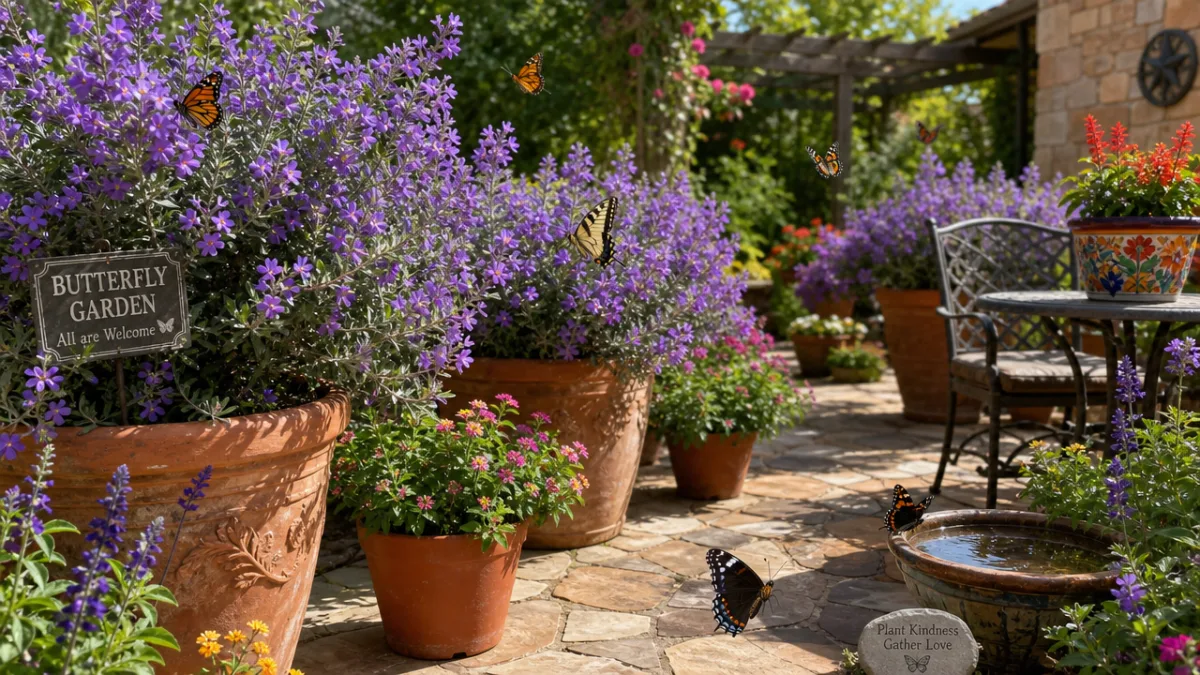
Container gardening is another excellent application for this cultivar. Its naturally compact size, drought tolerance, and preference for lean, well-draining soil make it ideally suited to large terracotta or ceramic pots filled with a fast-draining cactus and succulent mix. Container-grown plants can be moved to a sheltered location during cold snaps, extending the plant’s range into cooler climates. On patios and in courtyards, the silver foliage provides year-round interest and the flowers attract butterflies and bees in great numbers, turning an ordinary outdoor space into a lively pollinator garden.
- Low border planting along walkways and driveways for seasonal color and texture
- Mass planting on slopes and embankments for erosion control and visual impact
- Container gardening on patios, balconies, and courtyards in warm climates
- Xeriscape and water-wise garden design as a focal or anchor shrub
- Pollinator and butterfly garden plantings to attract native bees and hummingbirds
- Rock garden and desert-themed landscape compositions
Companion Plants and Ecosystem Benefits
Dwarf Texas Sage pairs beautifully with a wide range of drought-tolerant companion plants that share its preference for full sun, lean soil, and minimal water. Classic Southwestern companions include desert marigold (Baileya multiradiata), blackfoot daisy (Melampodium leucanthum), and autumn sage (Salvia greggii), all of which complement the silver-and-purple color scheme of Texas Sage while requiring similar minimal care. Ornamental grasses such as blue grama (Bouteloua gracilis) and sideoats grama (Bouteloua curtipendula) provide graceful textural contrast, their fine-textured seed heads catching the breeze alongside the woolly silver foliage of the sage.
From an ecological perspective, Leucophyllum frutescens ‘Compacta’ is an exceptionally valuable addition to any garden designed with native wildlife in mind. Its flowers are rich in nectar and pollen and are visited by an impressive variety of native bee species, including bumblebees, digger bees, and sweat bees, as well as migrating monarch butterflies and painted ladies. Hummingbirds are also frequent visitors, particularly during fall migration when the tubular flowers provide a critical energy source. By planting even a small grouping of these shrubs, gardeners make a meaningful contribution to the health of local pollinator populations.
Beyond its direct benefits to pollinators, Dwarf Texas Sage contributes to garden ecosystems in subtler but equally important ways. Its dense, twiggy branching provides nesting habitat and shelter for small songbirds and beneficial insects. Its drought tolerance and deep root system help stabilize soil and reduce surface runoff during the intense summer thunderstorms common in its native range. And its ability to thrive without irrigation, fertilizer, or pesticide applications means that gardeners who choose it are reducing their environmental footprint in a tangible and meaningful way — a consideration that matters more with each passing year as water resources become increasingly precious across the American West.
Planting Your New Dwarf Texas Sage: Step-by-Step Guide
When your young Dwarf Texas Sage plants arrive in the five-to-nine-inch size range, they are ready for transplanting into the garden or into containers. Begin by selecting a planting site that receives at least six to eight hours of full, direct sunlight daily. Inspect the plants carefully upon arrival, checking that the foliage is firm and silvery-green without signs of yellowing or wilting, and that the roots are white to tan in color without any evidence of rot or discoloration. Allow the plants to acclimate for a day in a bright, sheltered outdoor location before planting if they have been in transit for an extended period.
Prepare the planting site by loosening the soil to a depth of at least twelve inches and working in a generous amount of coarse grit, crushed granite, or perlite to improve drainage. In heavy clay soils, this amendment step is absolutely critical; without it, even a drought-tolerant plant like Texas Sage will struggle. Dig a planting hole approximately twice the width of the root ball but only as deep, so that the crown of the plant sits at or very slightly above the surrounding soil level. Setting the crown slightly proud of the soil surface promotes drainage away from the stem base and reduces the risk of crown rot.
After planting, water deeply to settle the soil around the roots and eliminate air pockets. Apply a two-to-three-inch layer of gravel mulch or decomposed granite around the base of the plant, keeping it pulled back slightly from the stem to prevent moisture accumulation at the crown. Avoid organic mulches such as wood chips or bark in close contact with the stem, as these retain moisture and can promote fungal problems in this desert-adapted species. Water again weekly for the first month, then gradually reduce frequency over the following growing season as the plant establishes its root system and begins to demonstrate its true drought-tolerant character.
- Choose a site with full sun and excellent drainage before purchasing
- Amend heavy soils thoroughly with coarse grit or decomposed granite
- Plant at or slightly above soil grade to promote drainage from the crown
- Water weekly for the first month, then taper off over the following season
- Mulch with gravel rather than organic material to maintain dry crown conditions
- Expect full establishment and mature blooming performance by the second growing season
With just a modest investment of time in preparation and planting, Leucophyllum frutescens ‘Compacta’ will reward you for years — even decades — with its stunning silver foliage, spectacular purple blooms, and virtually zero demand for ongoing maintenance. It is one of the rare plants that genuinely gets better with less attention, becoming more drought-tolerant, more floriferous, and more structurally beautiful as it matures. For anyone building a resilient, water-wise, wildlife-friendly landscape, a pack of two young Dwarf Texas Sage plants is one of the most impactful investments you can make.








What do you think?
It is nice to know your opinion. Leave a comment.