










26 Flowering Vines for Shade: The Best Shade-Loving Climbers for Your Garden
Introduction: Transforming Shady Spaces with Climbing Flowers
Many gardeners assume that shade means sacrifice — that the darker corners of their yards are destined to remain bare, uninspiring stretches of mulch or struggling ground cover. But the truth is far more exciting. A remarkable world of flowering vines exists specifically adapted to thrive in low-light conditions, and these climbers can turn even the most shadowy fence line, north-facing wall, or tree canopy into a breathtaking vertical garden bursting with color and fragrance.
Shade-loving climbing vines serve a dual purpose that few other plants can match. On one hand, they provide aesthetic value — cascading blooms, rich foliage textures, and seasons of visual interest. On the other hand, they function as practical solutions to common garden challenges: covering unsightly structures, adding privacy to patios, reducing heat absorption on walls, and creating habitat for beneficial insects and birds. When you choose the right vine for your shaded space, you’re investing in a plant that works hard and rewards generously.
This guide explores 26 of the best flowering vines for shaded environments, organized by growth habit, bloom season, and special features. Whether you’re working with deep shade under a dense tree canopy, partial shade along a north-facing fence, or dappled light filtering through an overhead pergola, there is a climbing vine on this list perfectly suited to your conditions. Understanding the specific needs of each plant will help you make confident choices that result in lush, flourishing vertical gardens for years to come.
Understanding Shade: Matching Vines to Light Levels
Before selecting any shade-loving vine, it’s essential to accurately assess the light conditions in your planting area. Gardeners often overestimate how much shade their spaces receive, or fail to distinguish between different types of shade. Full shade typically means fewer than two hours of direct sunlight per day, often found on the north side of buildings or beneath dense evergreens. Partial shade, sometimes called dappled shade, means two to four hours of direct sun, usually during the cooler morning hours. Most of the vines on our list thrive in partial shade, though several are truly tolerant of deep full-shade conditions.
Soil quality and moisture levels interact directly with light availability to determine whether a vine will merely survive or truly flourish. Shaded areas near buildings or beneath large trees often have dry, compacted soil because rain cannot penetrate effectively and tree roots compete aggressively for nutrients and water. Before planting any climbing vine in these locations, it’s wise to amend the soil generously with compost, improve drainage where necessary, and establish a consistent watering routine, particularly during the first growing season when root systems are becoming established.
The direction your planting wall or structure faces has a major influence on the type of shade it receives throughout the day. North-facing walls receive the least direct sun and tend to stay cool and moist — ideal for truly shade-tolerant species like climbing hydrangeas and some honeysuckles. East-facing walls enjoy gentle morning sun followed by afternoon shade, which suits a wider range of “shade-tolerant” vines that prefer some daily light. West-facing walls receive intense afternoon sun that can stress shade-preferring plants even if mornings are cool. Keeping these directional nuances in mind as you shop for vines will spare you costly mistakes and frustrating replanting projects.
Top Flowering Vines for Full and Deep Shade
Climbing hydrangea (Hydrangea anomala subsp. petiolaris) is arguably the gold standard of shade-tolerant flowering vines. This slow-growing but ultimately magnificent climber attaches itself to walls and structures using self-clinging rootlets, requiring no additional support once established. In late spring to early summer, it produces enormous lacecap flower heads in creamy white that can measure six to ten inches across, creating a spectacular floral display that seems almost impossible for a plant growing in such challenging conditions. Once mature, climbing hydrangea is remarkably drought-tolerant and requires virtually no maintenance beyond occasional shaping.
Hardy kiwi (Actinidia kolomikta) surprises many gardeners who know it primarily as a fruit producer. In shaded gardens, the foliage alone is worth growing — large heart-shaped leaves emerge green in spring and develop striking pink and white variegation as the season progresses, creating an almost painted appearance. Small, fragrant white flowers appear in late spring, and female plants produce edible grape-sized fruits in autumn. This vigorous grower can cover a large shaded trellis or fence within a few seasons, and its multi-season interest makes it one of the most versatile choices for challenging locations.
Several species of native honeysuckle deserve special attention for deep shade performance. Trumpet honeysuckle (Lonicera sempervirens) and its cultivars tolerate significant shade while still producing their characteristic tubular red and orange blooms beloved by hummingbirds. Unlike the invasive Japanese honeysuckle, native species are well-behaved and integrate beautifully into wildlife-friendly plantings. For deeper shade, Lonicera flava (yellow honeysuckle) is particularly forgiving, producing fragrant clusters of golden-yellow flowers even in conditions where other vines would refuse to bloom at all. These vines establish quickly and reward patience with dense, wildlife-rich coverage.
Additional Full-Shade Performers
- Creeping fig (Ficus pumila): A tenacious self-clinging vine with small, heart-shaped leaves that tiles itself against walls in overlapping layers. Though rarely noticed for flowers, its dense evergreen coverage and extreme shade tolerance make it invaluable for problem walls in warmer climates (USDA zones 8–11).
- Virginia creeper (Parthenocissus quinquefolia): Technically a foliage vine with inconspicuous flowers, but its blazing autumn color and small blue-black berries attract birds and create seasonal drama even in dense shade. Native to North America and extremely tough.
- Cross vine (Bignonia capreolata): A semi-evergreen climber producing stunning orange-red tubular flowers in spring. More shade-tolerant than many gardeners realize, particularly in the South where it’s native.
Partial Shade Champions: Color and Fragrance for Dappled Light
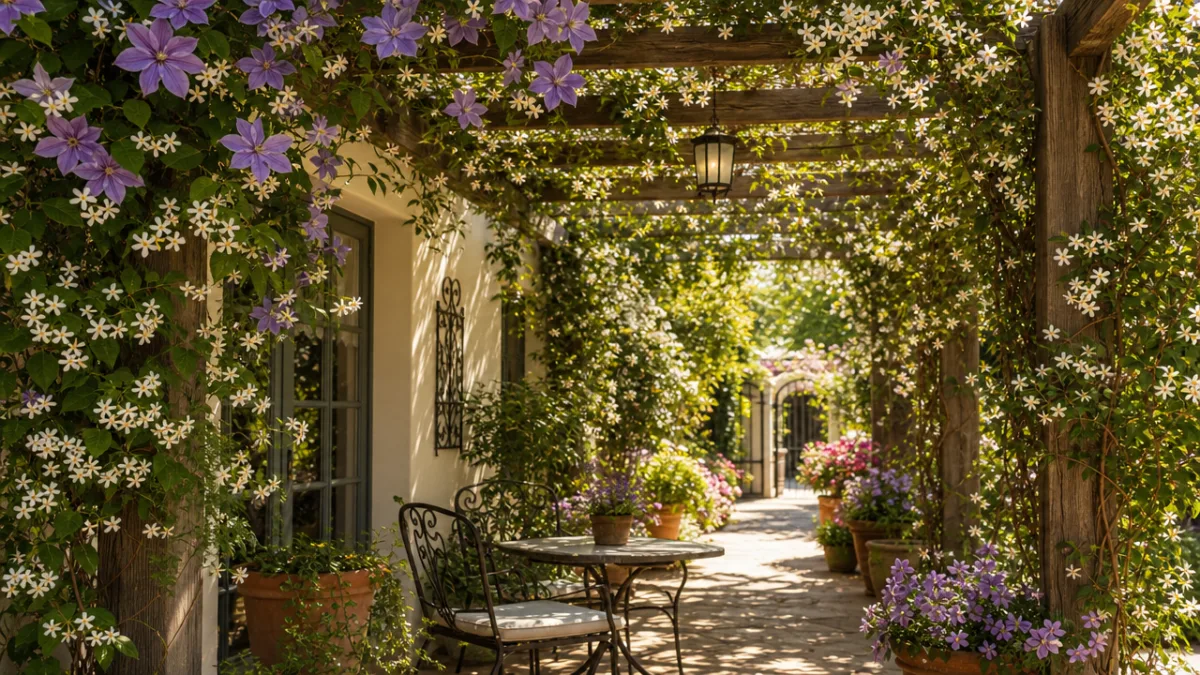
Clematis is one of the most beloved vine genera in the world, and while most gardeners associate it with full sun, a surprising number of species and cultivars perform beautifully in partial shade. The classic rule — “feet in the shade, head in the sun” — applies to many large-flowered hybrid clematis, but certain species take shade much further. Clematis montana, the mountain clematis, blooms with abandon in dappled light, smothering itself in small white or pink four-petaled flowers with a vanilla fragrance in late spring. Clematis viticella and its hybrids are similarly accommodating, producing masses of nodding bell-shaped flowers in purple, red, and pink well into summer even when light is limited.
Wisteria often appears on sun-loving plant lists, but several species — particularly American wisteria (Wisteria frutescens) and Kentucky wisteria (Wisteria macrostachya) — tolerate and even appreciate the cooler conditions provided by partial shade, especially in southern climates where intense sun can scorch foliage and shorten bloom periods. These North American native wisterias are also far less invasive than their Asian counterparts, with a more manageable growth habit that makes them appropriate for trellises and pergolas without the risk of structural damage. Their cascading flower clusters in lavender, purple, and white are deeply fragrant and genuinely spectacular in spring.
Jasmine varieties offer some of the most intoxicating fragrances in the garden world, and several tolerate partial shade conditions admirably. Star jasmine (Trachelospermum jasminoides) thrives in bright indirect light and produces masses of pinwheel-shaped white flowers with an almost overwhelming sweet scent throughout late spring and summer. In warmer climates, it remains evergreen and can serve as both a climber and a sprawling ground cover beneath trees. Jasminum officinale, common white jasmine, tolerates part shade surprisingly well and produces its beloved white flowers over an extended bloom period, particularly valuable in evening gardens where its fragrance intensifies at dusk.
More Partial Shade Stars
- Black-eyed Susan vine (Thunbergia alata): A fast-growing annual or tender perennial producing cheerful orange, yellow, or cream flowers with dark centers. Handles morning shade with afternoon indirect light beautifully, blooming continuously from late spring until frost.
- Coral honeysuckle (Lonicera sempervirens ‘Major Wheeler’): One of the best cultivars for hummingbird gardens in partial shade, with nearly year-round bloom in milder climates and reliable summer flowering everywhere else.
- Chocolate vine (Akebia quinata): An underused semi-evergreen climber with deeply attractive five-lobed leaves and small, chocolate-scented maroon flowers in spring. Thrives in challenging shaded spots and tolerates poor soil with grace.
- Dutchman’s pipe (Aristolochia macrophylla): Giant heart-shaped leaves and curious pipe-shaped flowers make this native vine a bold statement plant for shaded arbors. It’s the essential host plant for pipevine swallowtail butterflies.
Seasonal Interest: Choosing Vines for Year-Round Beauty
Planning a shade garden with vines means thinking carefully about which seasons matter most to you and layering plants so that something is always contributing color, texture, or fragrance. Early spring interest can be achieved with Clematis montana and climbing hydrangea, which both burst into bloom before many other plants have even leafed out. Summer gaps are filled beautifully by honeysuckles, thunbergia, and jasmines, which maintain flower production through the hottest months. Autumn brings the fiery foliage of Virginia creeper and hardy kiwi, while the structural seedheads of clematis provide winter silhouette and texture against bare walls and fences.
Evergreen vines deserve special consideration in shade gardens because they provide twelve months of visual coverage and structure. In warmer climates (zones 7 and above), star jasmine maintains its glossy dark green leaves through winter, creating an attractive backdrop for winter-blooming shrubs and spring bulbs planted at its base. Creeping fig offers similarly persistent evergreen coverage on sheltered walls. For cold climates, the semi-evergreen chocolate vine retains some foliage in milder winters while the cross vine remains surprisingly leafy even after hard frosts. Choosing at least one evergreen vine anchors the shade garden visually through the off-season when deciduous climbers have retreated to bare stems.
Fragrance adds an invisible but powerful dimension to shaded garden spaces, where the cooler, still air often concentrates scent in ways that windy sunny gardens cannot. An arbor or shaded seating area draped in jasmine or sweet autumn clematis (Clematis terniflora) becomes a sensory destination that draws people outdoors even on overcast days. Honeysuckle fragrance carries remarkable distances in evening air, making it an ideal choice for vines trained near outdoor dining areas or bedroom windows. Planning your vine selections with fragrance in mind — layering species that bloom successionally through the seasons — creates a shade garden experience that engages all the senses throughout the growing year.
Planting, Supporting, and Caring for Shade-Loving Vines
Successful establishment of flowering vines in shaded locations begins with thoughtful site preparation. The planting hole should be dug at least twice the width of the root ball and enriched with well-rotted compost or aged manure to improve both fertility and moisture retention. In areas with compacted soil, breaking up the sub-surface with a garden fork before amending will dramatically improve drainage and encourage deeper root development. Positioning the plant slightly away from a wall or fence — at least twelve inches — allows rain to reach the root zone naturally rather than running off the structure and leaving the plant dependent on supplemental irrigation.
Support structures must be matched thoughtfully to the climbing mechanism of each vine. Self-clinging vines like climbing hydrangea and Virginia creeper attach via adhesive rootlets or suction-cup holdfasts and need only a rough-textured surface such as brick, stone, or rough timber. Twining vines like honeysuckle and wisteria need thin supports they can wrap around — wire, string, or the thin branches of a trellis — and should not be trained on wide boards or thick posts they cannot encircle. Tendril climbers such as sweet peas grip narrow supports with threadlike tendrils. Understanding how each vine climbs prevents frustration and structural damage and ensures the plant can develop its natural architecture efficiently.
Pruning requirements vary widely among shade-loving vines, and getting timing right is critical to preserving the following season’s blooms. Vines that flower on old wood, including many clematis species and climbing hydrangeas, should be pruned immediately after flowering or not at all during the first several years of establishment. Vines that flower on new growth — including most large-flowered clematis hybrids and black-eyed Susan vine — can be cut back hard in late winter without sacrificing flowers. Honeysuckles benefit from selective thinning of old crowded stems every few years rather than dramatic pruning, which stimulates fresh flowering wood while maintaining the bulk of established coverage. Keeping a simple garden journal that notes when each vine blooms makes pruning decisions intuitive over time.

Feeding and Watering Shade Vines
Fertilizing climbing vines in shade requires a balanced approach that encourages flowering without pushing excessive leafy growth that a shaded plant cannot support photosynthetically. A slow-release balanced granular fertilizer applied once in early spring as growth begins is usually sufficient for established vines. Avoid high-nitrogen formulas that stimulate foliage at the expense of flowers, and resist the temptation to fertilize repeatedly through summer, which can produce lush growth susceptible to pest and disease pressure. Young vines in their first and second seasons benefit from a dilute liquid fertilizer every four to six weeks during the growing season to support rapid root establishment.
Watering deeply and infrequently — rather than shallowly and often — trains vine roots to explore deep soil layers where moisture is more consistently available. In shaded areas under tree canopies, supplemental irrigation is almost always necessary during dry spells because tree roots absorb surface moisture rapidly. A layer of organic mulch two to three inches deep applied around the base of climbing vines conserves moisture dramatically, moderates soil temperature, and suppresses competing weeds, all of which reduce stress on the plant during establishment. Refreshing this mulch layer annually also adds a slow trickle of nutrients to the soil as it decomposes over the growing season.
Common pest and disease issues affecting shade vines include powdery mildew — especially prevalent in still, humid shade environments — and vine weevil damage to roots. Improving air circulation around plantings by thinning overcrowded stems, choosing mildew-resistant cultivars where available, and avoiding overhead watering that leaves foliage wet overnight are the most effective preventive strategies. Many shade-tolerant vines are remarkably resilient once established, but monitoring plants regularly during the first two seasons allows gardeners to catch problems early when they are easiest to manage. A thriving shade vine, once past the establishment phase, typically requires little more than an annual tidy and the occasional deep watering during prolonged drought to maintain impressive performance for decades.
Design Ideas: Using Flowering Vines to Maximize Shaded Spaces
The most transformative use of shade-loving vines is vertical layering — training climbers upward to exploit the full height of fences, walls, and structures that would otherwise present a flat, monotonous surface. A twelve-foot fence becomes a living tapestry when draped with alternating climbing hydrangea, honeysuckle, and chocolate vine, each contributing different leaf textures, bloom times, and wildlife value. Training multiple compatible vines on the same support structure creates a layered effect that extends seasonal interest and increases planting density without requiring additional horizontal garden space — a particularly valuable strategy in small urban gardens where square footage is limited.
Shaded pergolas and arbors represent one of the most elegant applications for flowering vines, creating outdoor rooms that feel lush, private, and intimate even in the middle of a garden visible from neighboring properties. A pergola draped in wisteria or clematis becomes a destination rather than merely a passage — a place where the play of light through layered leaves and flowers creates an ever-changing atmosphere through the seasons. When designing a pergola planting, consider training a fragrant vine on the western and northern sides where evening visitors will encounter it at dusk, and a visually striking but less fragrant species on the sunnier approaches where daytime appreciation is more likely.
Ground-level combinations that pair shade vines with complementary shade perennials amplify the garden’s impact dramatically. At the base of climbing hydrangeas, hostas and ferns echo the large-leaved boldness of the vine while adding layered texture at foot level. Beneath honeysuckles, wild ginger and epimediums provide weed-suppressing coverage that keeps the area looking tended without high maintenance. When underplanting shade vines, always choose companions that tolerate the same light and moisture conditions, and be mindful of root competition from trees and shrubs nearby. The result of thoughtful combination planting is a shaded garden space that feels full, intentional, and alive — proof that shadow is not a limitation but an invitation to explore a uniquely beautiful range of plants built precisely for these conditions.








What do you think?
It is nice to know your opinion. Leave a comment.