










22 Unique Houseplants You Won’t Believe Exist: A Guide to the World’s Most Extraordinary Indoor Plants
Introduction: The Astonishing World of Unusual Houseplants
Most of us grew up with the familiar cast of houseplants — the steadfast pothos trailing from a shelf, the cheerful peace lily on a windowsill, or perhaps a cactus stubbornly thriving on neglect. But the plant kingdom is so extraordinarily vast and inventive that it has produced specimens that seem to belong more to science fiction than to your living room. These are plants that mimic stones, glow with unearthly colors, develop textures that defy expectation, and evolve survival strategies so clever they seem almost deliberate.
The growing popularity of rare and unusual houseplants has transformed what was once a niche obsession into a mainstream movement. Plant enthusiasts around the world are seeking out specimens that spark conversation, inspire wonder, and bring a genuine sense of discovery into their homes. Social media has played no small role in this shift, with photographs of extraordinary plants attracting millions of followers who are eager to learn, share, and collect. What was once only available through specialty botanical suppliers is increasingly accessible through online plant shops and dedicated growers.
This article introduces you to twenty-two of the most remarkable and unusual houseplants that genuinely exist and can, with varying degrees of effort, be grown indoors. Some are surprisingly easy to care for; others demand the patience and dedication of a seasoned collector. All of them share one quality: they will stop anyone who sees them in their tracks. Whether you are a beginner looking to move beyond the ordinary or an experienced grower searching for your next obsession, this guide has something to make your eyes wide with wonder.
Plants That Disguise Themselves: Masters of Natural Deception
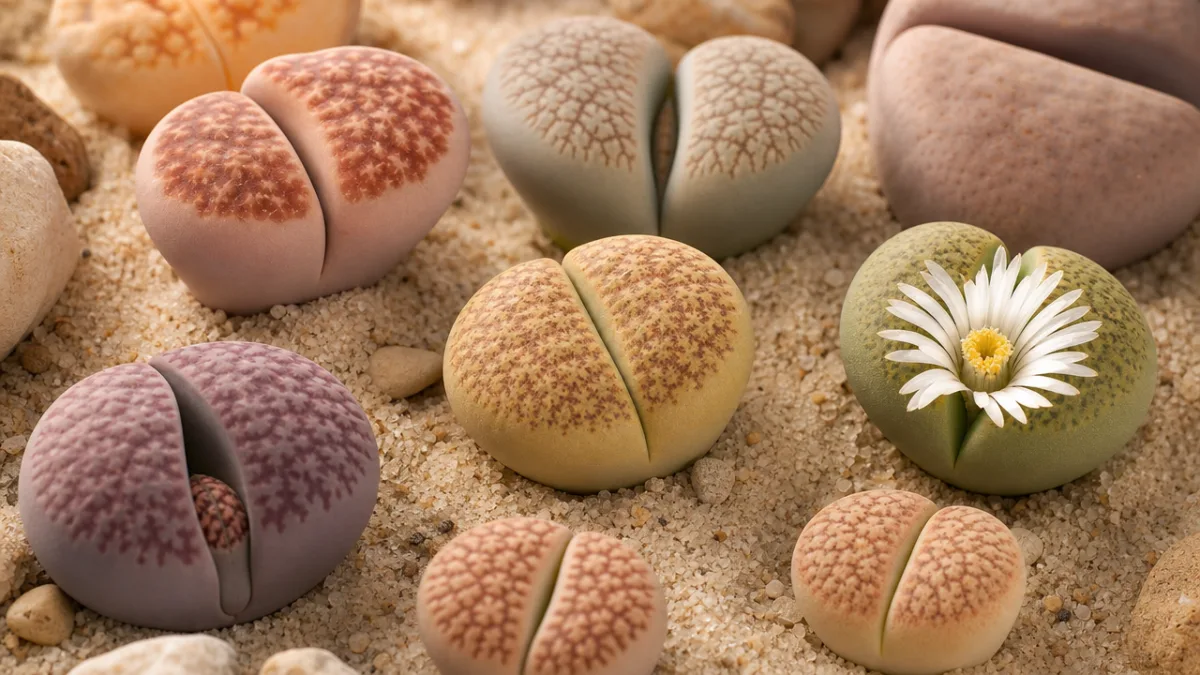
Nature’s most theatrical houseplants are those that have evolved to look like something else entirely. Lithops, commonly called living stones, are perhaps the most famous example. Native to the arid regions of southern Africa, these tiny succulents have developed an uncanny resemblance to the pebbles and rocks among which they grow. Each plant consists of two fleshy, patterned leaves pressed together, and their mottled surfaces mirror the colors and textures of their stony surroundings so precisely that predators — and gardeners — routinely overlook them entirely.
Equally astonishing is the Haworthia truncata, a plant whose leaves appear to have been sliced clean across the top as if by a surgeon’s blade. The flat, translucent windows at the tips of each leaf are a clever adaptation that allows light to filter into the plant even when it is partially buried in sand. Indoors, this creates the extraordinary effect of a plant that appears to be sinking into its own pot, with glassy panels catching the light in a way that seems almost architectural in its precision and intentionality.
The Monilaria obconica, nicknamed the bunny succulent, goes one step further in its theatrical display. During its growing season, it produces a pair of elongated green shoots that emerge from the base of the plant in a perfect V shape, mimicking the silhouette of rabbit ears with startling accuracy. This effect is temporary — the shoots eventually lengthen and lose their ear-like appearance — but for a brief and delightful window of time, this plant looks less like a member of the plant kingdom and more like a tiny, whimsical garden sculpture.
- Lithops — Living stones that blend seamlessly with rocky terrain, available in dozens of color variations
- Haworthia truncata — Features flat-topped, windowed leaves with a geometric, architectural quality
- Monilaria obconica — The famous bunny succulent with seasonal ear-shaped new growth
- Fenestraria rhopalophylla — Baby toes plant, with translucent tips that function as light-conducting windows
Plants With Extraordinary Colors and Patterns
If deceptive plants appeal to the intellect, then the strikingly colorful rarities of the houseplant world appeal directly to the senses. The Tradescantia zebrina, with its vivid stripes of silver, green, and deep purple, is one of the most visually arresting trailing plants available to home growers. Its leaves seem almost metallic under direct light, shimmering in a way that makes it look as though the plant has been hand-painted. It grows quickly and enthusiastically, spreading across shelves and cascading over pots with cheerful abandon.
More exotic still is the Calathea orbifolia, whose enormous round leaves carry sweeping stripes of pale silver-green over a deeper, richer green base. This Brazilian native belongs to a genus famous for its extraordinary foliage, but the orbifolia takes that reputation to new heights with leaves that can grow to nearly twelve inches across. The undersides of the leaves are equally beautiful, brushed in pale silver, and the entire plant has a restrained, sculptural quality that makes it look as though it belongs in a design studio rather than a garden center.
The Rex Begonia family represents perhaps the greatest concentration of wild and improbable color in the entire houseplant world. These plants have been cultivated and hybridized for over a century to produce leaves in combinations of crimson, silver, black, green, and pink that seem too vivid to be naturally occurring. Some varieties feature spiral patterns that emanate from the center of each leaf; others carry iridescent sheens that shift with the angle of the light. Growing a collection of Rex Begonias is less like keeping houseplants and more like curating a living art installation in your own home.
Carnivorous Plants: Nature’s Most Theatrical Hunters
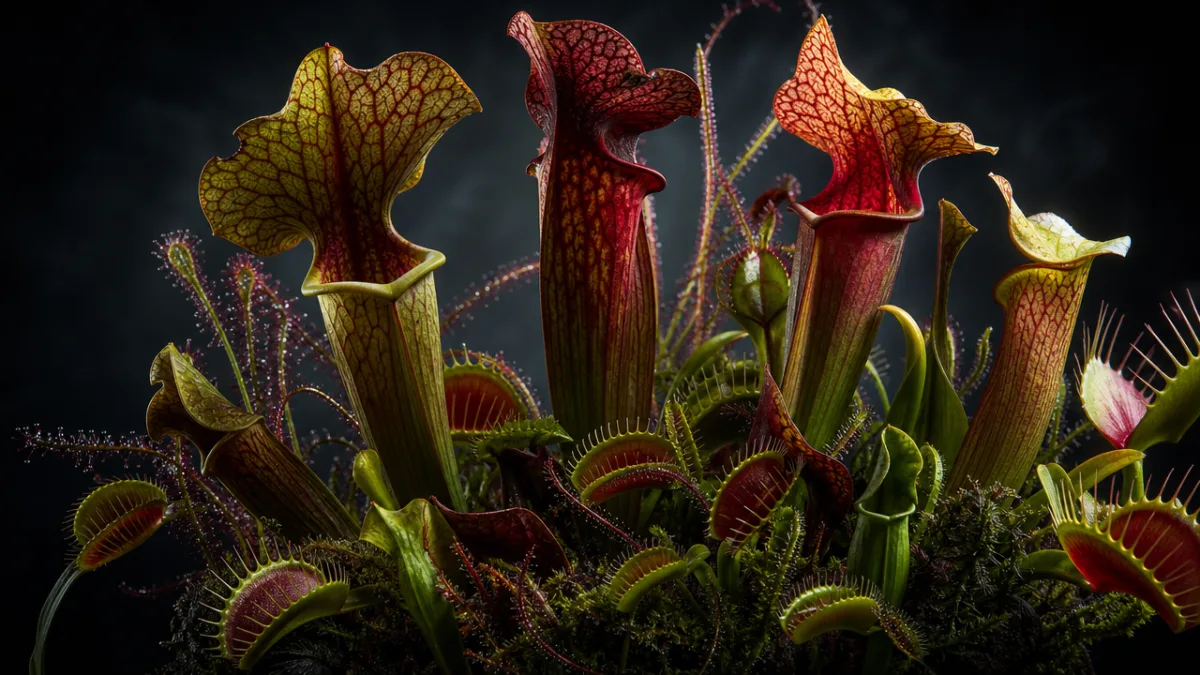
Few categories of houseplant inspire as much fascination — and, occasionally, slight unease — as the carnivorous plants. The Venus flytrap is the most famous, of course, its hinged, tooth-edged lobes snapping shut with remarkable speed when triggered by an unwary insect. But many people don’t realize that this extraordinary plant is native exclusively to a small region of North and South Carolina, making it one of the most geographically specific carnivorous plants in existence. It can be grown indoors with the right conditions: bright light, high humidity, distilled or rainwater, and nutrient-poor soil that mimics its boggy native habitat.
Nepenthes, the tropical pitcher plants, are arguably even more dramatic. These climbing or trailing plants produce modified leaves that form into deep, liquid-filled pitchers, sometimes with elaborate lids and waxy, colorful interiors that lure insects to their doom. Some Nepenthes species produce pitchers large enough to trap small vertebrates, though for indoor cultivation the smaller and more manageable varieties are more practical. Nepenthes alata, Nepenthes ventricosa, and their many hybrids have become increasingly popular as houseplants precisely because they combine extraordinary visual impact with a surprisingly robust constitution.
The Sundews — members of the Drosera genus — offer yet another approach to carnivory, one that is both beautiful and quietly horrifying on closer inspection. Their leaves are covered in fine, glistening tentacles tipped with sticky mucilage that sparkles like dew drops in the sunlight. Insects that land in search of moisture find themselves trapped and slowly enveloped as the tentacles curl inward. Despite this predatory lifestyle, many Sundew species are genuinely lovely plants, with delicate flowers and a jewel-like quality to their leaves that makes them unexpectedly ornamental choices for a bright windowsill.
- Venus flytrap (Dionaea muscipula) — The iconic snap-trap carnivore, best grown in a terrarium or on a humid windowsill
- Nepenthes species and hybrids — Tropical pitcher plants with dramatic, hanging pitchers in vivid colors
- Drosera (Sundews) — Glistening, tentacled leaves that trap insects with sticky mucilage
- Sarracenia (North American Pitcher Plants) — Elegant tubular pitchers in yellow, red, and green combinations
- Pinguicula (Butterworts) — Flat rosettes of sticky leaves that are surprisingly elegant and easy to grow
Air Plants and Epiphytes: Living Without Soil
Among the most conceptually surprising plants available to home growers are those that require no soil whatsoever to survive and thrive. Tillandsia, the air plants, are perhaps the most widely available of these soilless wonders. Belonging to the bromeliad family, they absorb water and nutrients through specialized scales on their leaves called trichomes, pulling moisture directly from the air and from the occasional rainfall or misting. This extraordinary adaptation has allowed them to colonize an astonishing range of environments, from humid cloud forests to parched desert rock faces, across much of Central and South America.
What makes Tillandsia so compelling as houseplants is the creative freedom their rootless nature provides. They can be mounted on driftwood, suspended from wire, nestled into shells or stones, displayed in glass globes, or simply arranged on a shelf like small living sculptures. With over 600 recognized species, the variety available to collectors is staggering, ranging from the tiny, silvery Tillandsia ionantha to the dramatic, sky-blue-flowering Tillandsia cyanea, with dozens of fascinating forms in between. Their periodic bloom cycles produce flowers of remarkable color and elegance that add an additional dimension of beauty to an already extraordinary plant group.
The Staghorn Fern, Platycerium bifurcatum, takes the epiphyte concept in a more dramatic architectural direction. In nature, it grows anchored to tree trunks and branches, producing two distinct types of fronds: flat, shield-shaped basal fronds that clasp the host surface, and magnificent forked fertile fronds that extend outward with a shape that strongly suggests the antlers of a large deer. Mounted on a wooden board and hung on a wall, a mature Staghorn Fern becomes a genuinely spectacular living artwork, demanding attention and admiration in equal measure while requiring only occasional watering and bright, indirect light.
The Rarest and Most Extraordinary: Plants That Push Every Boundary
At the furthest edge of the unusual houseplant world sit a handful of specimens so extraordinary that even experienced collectors encounter them with genuine surprise. The Corpse Flower, Amorphophallus titanum, is famous above all else for producing one of the largest unbranched flower structures in the plant kingdom — and for doing so with an overwhelming odor of rotting flesh designed to attract carrion beetles as pollinators. While its flowering form is clearly too massive and too pungent for home growing, it can be cultivated as a foliage plant between its infrequent blooms, producing a single enormous, tree-like leaf that can reach heights of several feet from its massive underground corm.
The Hoya kerrii, sold in its juvenile single-leaf form as a Valentine’s Day novelty, becomes something altogether more remarkable when allowed to mature into a full vine. Its waxy, heart-shaped leaves are arranged along winding stems that can extend for several feet, producing clusters of small, exquisitely fragrant star-shaped flowers — sometimes called porcelain flowers for the extraordinary smoothness and lustre of their petals. A mature, flowering Hoya is one of the most beautiful sights in the houseplant world, and the genus contains over 500 species, offering collectors a lifetime of discovery.
The Monstera obliqua has become something of a holy grail for serious plant collectors, with prices for authenticated specimens reaching into the hundreds or even thousands of dollars. Unlike the more familiar Monstera deliciosa with its distinctive split leaves, the obliqua takes fenestration — the development of holes in leaves — to an almost unbelievable extreme. Mature leaves may be more hole than leaf, with the green tissue reduced to a delicate web or lacework while the empty spaces between constitute the majority of the leaf’s area. It grows slowly, requires high humidity and careful attention, and remains one of the most sought-after and genuinely astonishing plants a collector can own.
The world of extraordinary houseplants is, ultimately, a reminder of how inventive and surprising the natural world continues to be. From stones that are secretly plants to ferns that live on walls like antlered sculptures, from pitchers that drown insects to leaves that are more air than matter, these twenty-two plants represent the very outer edges of what we might expect from the organisms sharing our homes. Collecting and growing them is not merely a hobby — it is a continuing education in the ingenuity, beauty, and stubborn vitality of life on earth. Whatever your level of experience, there is a plant on this list waiting to astonish you.








What do you think?
It is nice to know your opinion. Leave a comment.